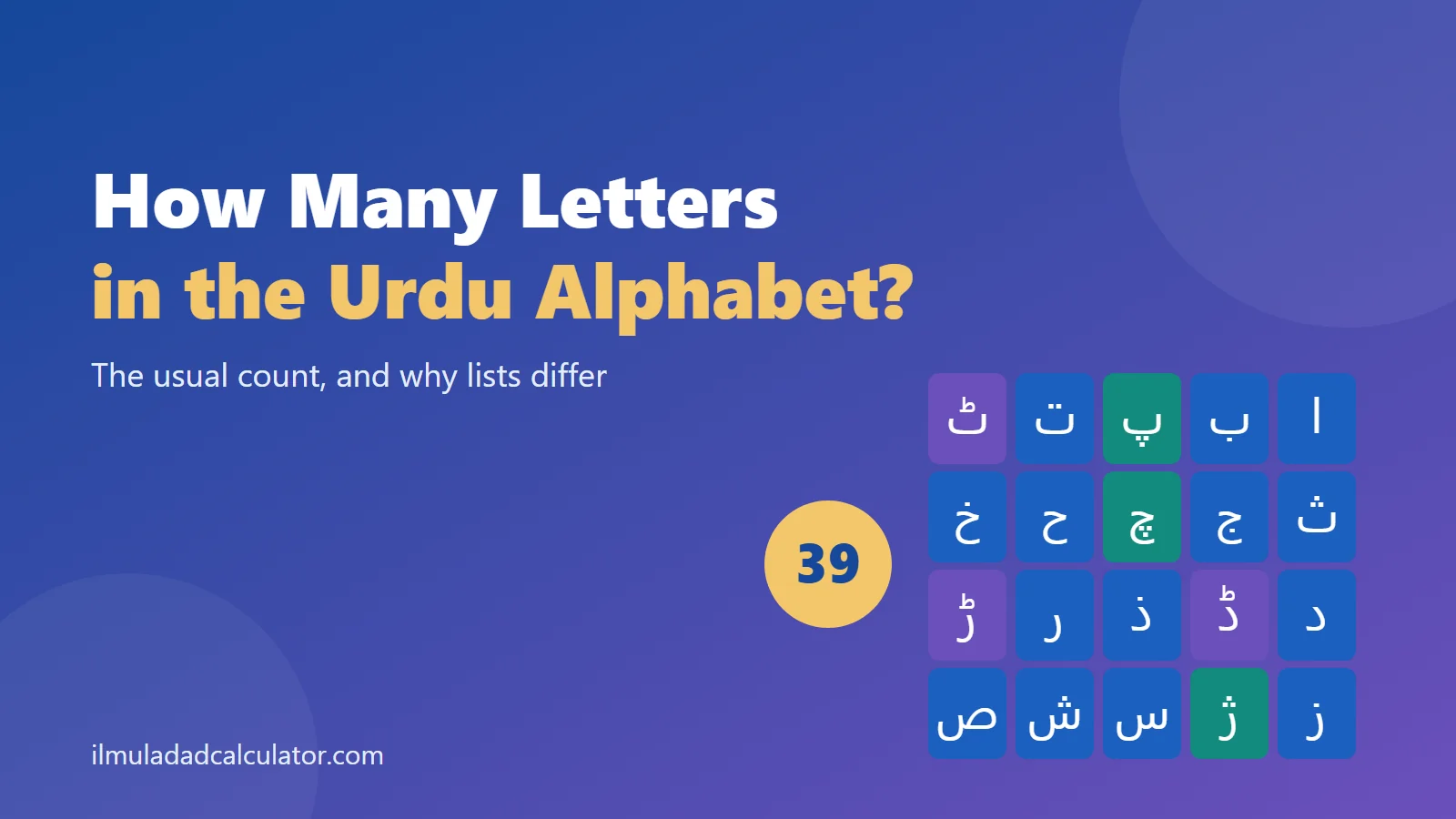
The Urdu alphabet is usually counted as 39 letters. Some lists give 37, 38 or 40, because sources disagree about a few signs. These are hamza (ء), do-chashmi he (ھ), nun ghunna (ں) and, rarely, ta marbuta.
How Many Letters Does the Urdu Alphabet Have?
The most common answer is 39. That count includes 28 letters from Arabic, four added in Persian and six added for Urdu sounds. The hamza sign makes 39.
The exact number is still debated among writers and teachers. Nobody disagrees about which letters Urdu uses. The question is which signs deserve their own place in the list.
What Are the 39 Letters of the Urdu Alphabet?
The table lists each letter in alphabet order with its Urdu name. It also gives the Roman name Pakistani learners usually use, and the letter’s Abjad value.
| # | Letter | Urdu name | Roman name | Abjad value |
|---|---|---|---|---|
| 1 | ا | الف | alif | 1 |
| 2 | ب | بے | be | 2 |
| 3 | پ | پے | pe | 2 |
| 4 | ت | تے | te | 400 |
| 5 | ٹ | ٹے | tte | 400 |
| 6 | ث | ثے | se | 500 |
| 7 | ج | جیم | jim | 3 |
| 8 | چ | چے | che | 3 |
| 9 | ح | بڑی حے | bari he | 8 |
| 10 | خ | خے | khe | 600 |
| 11 | د | دال | dal | 4 |
| 12 | ڈ | ڈال | ddal | 4 |
| 13 | ذ | ذال | zal | 700 |
| 14 | ر | رے | re | 200 |
| 15 | ڑ | ڑے | rre | 200 |
| 16 | ز | زے | ze | 7 |
| 17 | ژ | ژے | zhe | 7 |
| 18 | س | سین | sin | 60 |
| 19 | ش | شین | shin | 300 |
| 20 | ص | صاد | suad | 90 |
| 21 | ض | ضاد | zuad | 800 |
| 22 | ط | طوئے | toe | 9 |
| 23 | ظ | ظوئے | zoe | 900 |
| 24 | ع | عین | ain | 70 |
| 25 | غ | غین | ghain | 1000 |
| 26 | ف | فے | fe | 80 |
| 27 | ق | قاف | qaf | 100 |
| 28 | ک | کاف | kaf | 20 |
| 29 | گ | گاف | gaf | 20 |
| 30 | ل | لام | lam | 30 |
| 31 | م | میم | mim | 40 |
| 32 | ن | نون | nun | 50 |
| 33 | ں | نون غنہ | nun ghunna | 50 |
| 34 | و | واؤ | wao | 6 |
| 35 | ہ | چھوٹی ہے | chhoti he | 5 |
| 36 | ھ | دو چشمی ہے | do-chashmi he | 5 |
| 37 | ء | ہمزہ | hamza | 0 or 1 |
| 38 | ی | چھوٹی یے | chhoti ye | 10 |
| 39 | ے | بڑی یے | bari ye | 10 |
About the values: letters that Arabic lacks take the value of the Arabic letter they are built from. So پ counts as ب (2) and ٹ counts as ت (400).
Why Do Urdu Letter Counts Differ?
Four signs sit on the border between a full letter and a form of a letter. Each list makes its own choice about them.
- Nun ghunna (ں) marks a nasal sound at the end of a word. Some lists treat it as a form of nun, not a separate letter.
- Do-chashmi he (ھ) mostly appears inside aspirated pairs such as بھ. Some lists treat it as a form of he.
- Hamza (ء) is a sign for a catch in the voice. Some lists leave it out because it often sits on another letter.
- Ta marbuta (ة) appears only in a few Arabic loanwords. A few lists add it as a 40th letter.
So 37, 38, 39 and 40 are all honest counts. They describe the same writing system with different rules for what counts as a letter.
Where Did Urdu’s Extra Letters Come From?
The Urdu script grew from the Persian script, which grew from the Arabic script. Each step added letters for sounds the older language lacked.
Letters Added in Persian
Persian added پ (p), چ (ch), ژ (zh) and گ (g). Urdu kept all four, since these sounds are common in Urdu words.
Letters Added for Urdu
Urdu needed letters for its retroflex sounds, made with the tongue curled back. It marked ٹ, ڈ and ڑ with a small sign over ت, د and ر.
Early writers used four dots for this sign. Over time the mark took the shape of a small ط, which is how it looks today.
Urdu also added nun ghunna (ں), do-chashmi he (ھ) and bari ye (ے). They give Urdu its nasal vowels, its aspirated sounds and its long e ending.
Are Aspirated Sounds Like بھ and کھ Separate Letters?
No. Sounds such as بھ (bh), پھ (ph), تھ (th), کھ (kh) and گھ (gh) are written as pairs. Each pair joins a letter with do-chashmi he.
Many primers teach these pairs as a separate list after the alphabet. They are not counted among the 39 letters, because each is built from two letters already in the list.
In Ilm-ul-Adad, each pair counts as its two letters. So بھ gives 7 in this site’s convention: ba (2) plus he (5).
How Do Urdu Letters Differ From Arabic Letters?
Some letters look different in Urdu but count the same. Urdu writes ک for Arabic ك, ی for ي, and ہ for ه.
Urdu is also usually written in the flowing Nastaliq style, while Arabic is more often printed in Naskh. The letters are the same; only the style of writing changes.
Learning letters by family is a quick way to start. Once you know a shape, the dots and small marks tell the letters apart.
Which Urdu Letters Do Not Join the Next Letter?
Most Urdu letters join the letter that follows them. Nine letters never join forward, which is why words often have small gaps inside them.
ا د ڈ ذ ر ڑ ز ژ و
After one of these letters, the next letter starts a new connected group. In اردو, every letter is a non-joiner, so the four letters stand apart.
Tip: the gaps are part of the spelling. They do not mean a new word has started.
Is the Alphabet Order the Same as the Abjad Order?
No. Urdu learners study the letters in alphabet order, starting ا ب پ ت. This order groups letters with similar shapes, which makes reading easier.
Ilm-ul-Adad uses a much older order, the abjad order, which starts ا ب ج د. That order fixes the values from 1 to 1000.
The two orders begin the same way but soon part. The abjad hawwaz hutti memory words make the abjad order easy to recall.
How Can You Type Urdu Letters?
Phones and computers include Urdu keyboards. On Android and iPhone, add Urdu in the keyboard settings. The letters then appear in alphabet order or in a phonetic layout.
Windows and macOS also offer Urdu layouts in their language settings. A phonetic layout places each letter on the English key with the closest sound, so پ sits on p.
The calculators on this site also have an on-screen keypad with the Urdu letters. You can tap them without installing anything.
How Are Urdu Letters Used in Ilm-ul-Adad?
Every Urdu letter has a value, so Urdu names and words can be counted just like Arabic ones. Here is the word Pakistan, written in Urdu:
پ 2 + ا 1 + ک 20 + س 60 + ت 400 + ا 1 + ن 50 = 534
The word Urdu (اردو) itself gives 211. The full list of values is on the Arabic letter values page, and the Ilm-ul-Adad calculator accepts Urdu text directly.
خلاصہ
اردو حروفِ تہجی عام طور پر انتالیس حروف پر مشتمل مانے جاتے ہیں۔ بعض فہرستوں میں نون غنہ، دو چشمی ہے یا ہمزہ کو الگ حرف نہیں گنا جاتا، اس لیے سینتیس یا اڑتیس کی گنتی بھی ملتی ہے۔ بھ اور کھ جیسی آوازیں دو حروف سے مل کر بنتی ہیں، اس لیے انہیں الگ حروف میں شمار نہیں کیا جاتا۔
Sources and Further Reading
- Urdu alphabet, Wikipedia. The debated count, the added letters, retroflex marks and do-chashmi he.
- Abjad values come from this site’s tested engine. See the methodology.
Frequently Asked Questions
How many letters does the Arabic alphabet have?
Arabic has 28 letters. Urdu keeps all 28 and adds its own letters on top.
Is bari ye (ے) a separate letter?
Yes. Bari ye is counted as its own letter in Urdu, used mainly at the end of words.
Is Roman Urdu a separate alphabet?
No. Roman Urdu is Urdu written with English letters. It has no fixed spelling rules.
Why is ث called se and not tha in Urdu?
Urdu pronounces ث like an s. Its name follows that sound, so it is called se.
Do Urdu and Persian have the same number of letters?
No. Urdu adds letters that Persian does not have, such as ٹ, ڈ and ڑ.