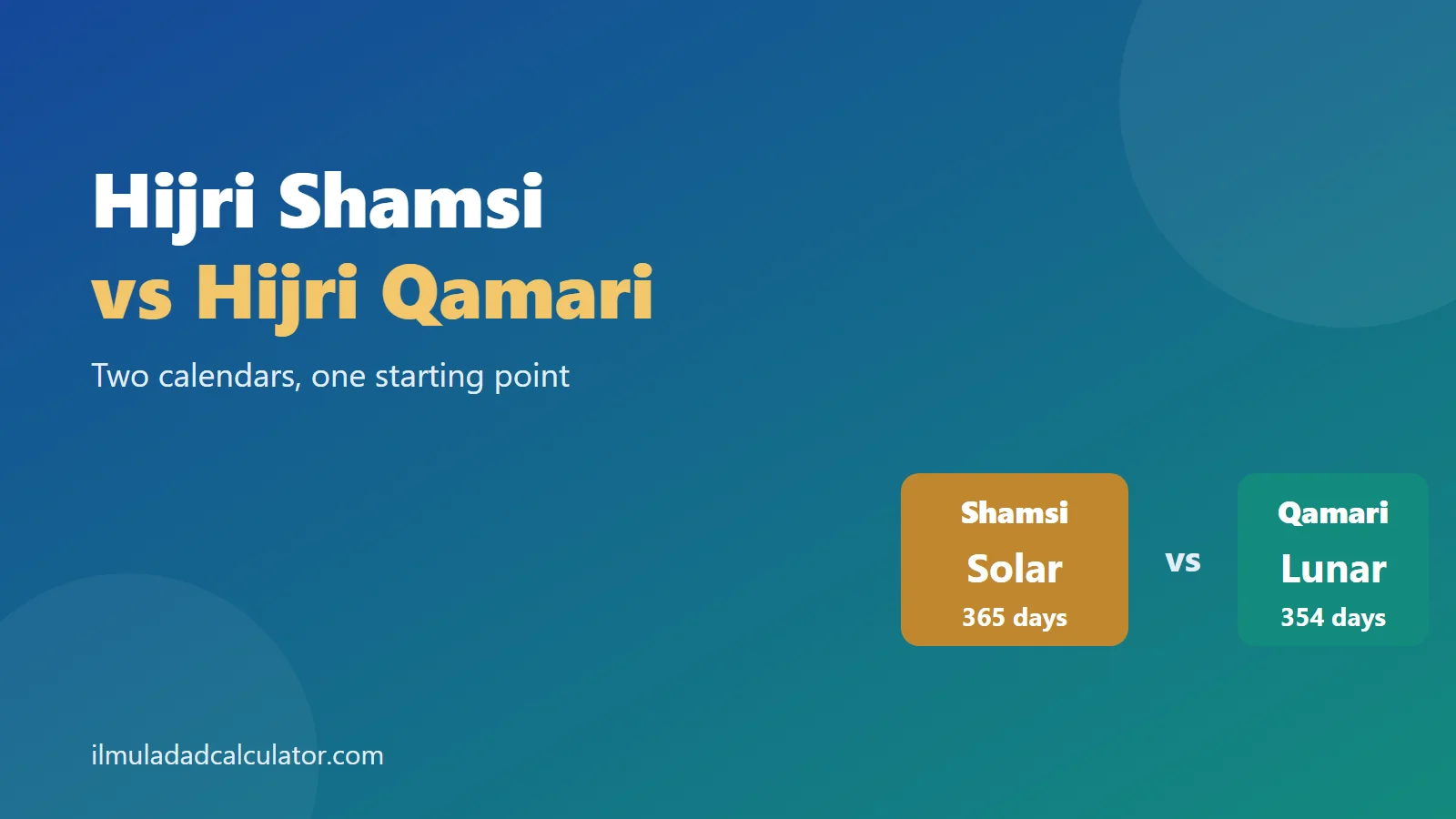
Hijri Qamari is the lunar Hijri calendar, with months that follow the moon. Hijri Shamsi is the solar Hijri calendar, with years that follow the sun. Both count from the same event, yet they give different years and different dates.
What Do Hijri Shamsi and Hijri Qamari Mean?
The two words describe the kind of year. Shamsi means solar, from the sun. Qamari means lunar, from the moon.
Both calendars count years from 622 CE, the year of the Hijra. That shared starting point is why both carry the name Hijri. After that they follow different clocks.
The Two Calendars at a Glance
- Hijri Qamari (lunar Hijri): twelve lunar months, 354 or 355 days a year. It is also called the Islamic calendar and is abbreviated AH.
- Hijri Shamsi (solar Hijri): twelve solar months, 365 or 366 days a year. It is the official calendar of Iran and the main one in Afghanistan, and it is abbreviated SH.
The solar Hijri calendar is also called the Persian calendar, the Iranian calendar and the Jalali calendar. Our calendar systems page covers the variants of the lunar count.
Why Are the Year Numbers Different?
A lunar year is about 11 days shorter than a solar year. The solar Hijri year averages 365.24 days, while the lunar one averages 354.37 days.
Divide one by the other and you get 365.24 ÷ 354.37 = 1.0307. So the lunar count grows about 3.07 percent faster than the solar count.
Worked Example: Year 1405
Multiply 1405 by 1.0307 to get 1448.1. That is about 1448, and the gap is 1448 – 1405 = 43 years.
The gap is not fixed. It grows by one year roughly every 33 years, because 354.37 × 33 is close to 365.24 × 32.
| Solar Hijri year (SH) | Starts about | Lunar Hijri year (AH) | Difference |
|---|---|---|---|
| 1300 | 21 March 1921 | 1339 AH | 39 |
| 1350 | 21 March 1971 | 1391 AH | 41 |
| 1400 | 21 March 2021 | 1442 AH | 42 |
| 1405 | 21 March 2026 | 1447 AH | 42 |
The difference is 42 on 21 March 2026 and becomes 43 once the new lunar year begins in June.
How Do the Months Differ?
Solar Hijri months have fixed lengths. The first six have 31 days and the next five have 30.
The last month, Esfand, has 29 days, or 30 in a leap year.
Lunar months follow the moon, which takes about 29.53 days to complete a cycle. Each month therefore has 29 or 30 days, and the year has 354 or 355.
Month Names
- Solar months in Iran use Persian names, from Farvardin to Esfand. Afghanistan uses Arabic names of the zodiac signs, such as Hamal and Sawr.
- Lunar months use the Arabic names, from Muharram to Dhu al-Hijja. See the Hijri months page.
The same word can appear in both lists only by accident. The names do not match, so a month name tells you which calendar a date belongs to.
When Does Each Year Begin?
The solar year begins at Nowruz, 1 Farvardin, near the spring equinox. The rule is that 1 Farvardin is the day whose start is nearest the equinox, measured for Tehran.
On the Gregorian calendar that is usually 21 March, and sometimes 20 or 22 March. The lunar year begins on 1 Muharram, which moves about 11 days earlier each Gregorian year.
Both counts start from the Hijra year. The lunar epoch is 1 Muharram 1 AH, Friday 16 July 622 in the Julian calendar. The solar epoch is 1 Farvardin 1 SH, 19 March 622 in the Julian calendar.
That is 119 days earlier. Written in the Gregorian calendar, the solar epoch is 22 March 622.
How Is Each Calendar Used Today?
Iran adopted the present solar calendar by law on 31 March 1925. Afghanistan adopted a solar Hijri calendar in 1922, with zodiac month names, according to Wikipedia.
Iran also uses the lunar Hijri calendar for religious observances. Printed Iranian calendars show the solar date beside the lunar and Gregorian ones.
Elsewhere, the lunar Hijri calendar is usually the one people mean by the Hijri calendar. Writing SH or AH after the year removes any doubt.
How Do You Convert a Solar Hijri Date to Gregorian?
A solar year spans two Gregorian years. It runs from about 21 March of one year to about 20 March of the next. Add 621 if the date falls after 1 Farvardin, and add 622 if it falls in the Gregorian new year.
Worked Example: 23 Mehr 1405
- Count the days before Mehr. Six months of 31 days make 6 × 31 = 186 days.
- Add the day in the month. 23 Mehr is day 209 of the year, since 186 + 23 = 209.
- Start from 1 Farvardin 1405, which is 21 March 2026. Day 209 is 208 days after that.
- 21 March plus 208 days is 15 October 2026.
The result matches the table on the Wikipedia Solar Hijri page, which lists 23 Mehr 1405 as 15 October 2026. The year works too: 1405 + 621 = 2026.
The next year check shows the other case. 1 Bahman 1405 is day 307 of the year, so it is 21 January 2027, and 1405 + 622 = 2027.
Our Hijri to Gregorian formula page covers the lunar count.
The year length page explains the 354 and 355 day years.
The Lunar Date for the Same Day
The tabular civil count puts 15 October 2026 at 3 Jumada I 1448 AH. A moon-sighting or Umm al-Qura date can differ by a day.
The lunar value uses the same check as our other pages. The tabular count gives 1 Muharram 1400 AH as 21 November 1979, which matches the date in Wikipedia.
Where Did the Solar Hijri Calendar Come From?
The modern solar calendar descends from the Jalali calendar. Wikipedia dates its reform to AD 1079, under the Seljuq ruler Jalal al-Din. It names Omar Khayyam as an influential figure.
It became the official national calendar of Persia in 1911. The present form was adopted by law on 31 March 1925.
In 1976 an imperial calendar counting from 559 BC replaced the year count. It was reversed in 1978, and the Solar Hijri count returned.
Afghanistan uses the same solar year with different month names. Wikipedia lists the Dari names Hamal to Hut and the Pashto names Wrai to Kab.
Which Leap Rule Does the Solar Calendar Follow?
The solar calendar has no single formula. A year is made 365 or 366 days long so that 1 Farvardin stays at the equinox.
A traditional 33-year cycle approximates this. In the published list of leap years, 1399 and 1403 are leap years, and the next is 1408.
Testing a Year With the 33-Year Rule
One arithmetic form tests year Y. It is a leap year when (8 × Y + 29) mod 33 is less than 8. For 1403, 8 × 1403 + 29 = 11253, and that leaves 0 after dividing by 33.
Since 0 is below 8, 1403 is a leap year. For 1404, the result is 8, which is not below 8, so 1404 is a common year.
This rule matched the published leap list for every year from 1354 to 1416 when checked in code. Treat it as a hand check, not as the official rule.
How Close Are the Averages?
Wikipedia notes that a proposed 2820-year cycle averages 365.24219852 days a year. That is very close to the tropical year of 365.24219 days.
The tabular lunar cycle makes a similar trade. Its 10,631 days over 30 years average 354.3667 days, close to the true mean of 354.37.
Both calendars therefore keep their seasons or months in step with the sky for a very long time. The difference between them is the choice of sun or moon, not the quality of the arithmetic.
What Mistakes Should You Avoid?
- Mixing the two counts. A date such as 1405 means two different years, depending on the calendar.
- Adding 622 to a lunar year. The 621 or 622 rule works only for the solar year. The lunar count needs the rule on our formula page.
- Assuming a fixed gap. The gap between the two year numbers grows by about one every 33 years.
- Ignoring variants. A lunar date can differ by a day between the tabular count and a sighted or Umm al-Qura date.
When you read a historic date, ask which calendar the writer used. For this site’s chronograms, the answer is the lunar Hijri year.
What If a Year Is Written Without a Label?
A bare year such as 1405 can belong to either calendar. Context usually settles it.
Lunar 1405 AH began about 27 September 1984 in the tabular count. Solar 1405 SH began on 21 March 2026, which is 42 years later.
So a text from Iran in 2026 that says 1405 means the solar year. A chronogram that totals 1405 points to the mid 1980s in the lunar count.
Does Hijri Qamari Matter for Abjad Work?
Yes. A chronogram on our chronograms pages totals a lunar Hijri year, not a solar one. Reading it as a solar year would put it about 40 years off.
The Abjad totals of the two words are also simple to check. In the Mashriqi order, شمسی = 410 and قمری = 350. The first is ش 300 + م 40 + س 60 + ی 10 = 410.
The second is ق 100 + م 40 + ر 200 + ی 10 = 350.
These totals are word values only and have no link to the calendars. To total any line, use the chronogram decoder.
خلاصہ
ہجری قمری کیلنڈر چاند کے مہینوں پر چلتا ہے اور اس کا سال تقریباً ۳۵۴ دن کا ہوتا ہے۔ ہجری شمسی کیلنڈر سورج کے سال پر چلتا ہے، اس کا سال تقریباً ۳۶۵ دن کا ہے اور یہ ایران کا سرکاری کیلنڈر ہے۔ دونوں کی گنتی ۶۲۲ عیسوی کی ہجرت سے شروع ہوتی ہے، مگر قمری سال چھوٹا ہونے کی وجہ سے سالوں کا فرق بڑھتا گیا ہے۔ ۲۰۲۶ میں شمسی سال ۱۴۰۵ ہے اور قمری سال ۱۴۴۸ ہے۔ کسی تاریخ کو پڑھتے وقت پہلے دیکھ لیں کہ وہ کون سا کیلنڈر ہے۔
Sources and Further Reading
- Solar Hijri calendar, Wikipedia. The 19 March 622 epoch, month lengths, the 621 or 622 rule, and 23 Mehr 1405 as 15 October 2026.
- Persian calendar, Wikipedia. The equinox rule, the 1925 law, the 33-year leap list, and 1 Farvardin 1400 and 1405.
- Iranian calendars, Wikipedia. The calendar’s origin in the Hijra of 622 and its lineage from the Jalali calendar.
- Islamic calendar, Wikipedia. The epoch of Friday 16 July 622 Julian, the 354.37 day mean year, and 1 Muharram 1400 AH.
- Calendar, Persian Online, University of Texas at Austin. The solar calendar in Iran, with the lunar calendar kept for religious observances.
- Lunar dates come from the tabular civil count in code. Abjad totals come from this site’s tested engine, as described in the methodology.
Frequently Asked Questions
What does Hijri Qamari mean?
It is the lunar Hijri calendar, whose months follow the moon. A year has 354 or 355 days.
What does Hijri Shamsi mean?
It is the solar Hijri calendar, whose years follow the sun. A year has 365 or 366 days, and it is the official calendar of Iran.
Do Shamsi and Qamari start from the same year?
Yes. Both count from 622 CE, the year of the Hijra. The lunar year is shorter, so the two year numbers have drifted apart.
Why is the Shamsi year about 43 less than the Qamari year?
Because a lunar year is about 11 days shorter. In 2026 the solar year is 1405 and the lunar year is 1447 or 1448.
When does the Shamsi year begin?
On 1 Farvardin, called Nowruz, near the spring equinox. That is usually 21 March in the Gregorian calendar.
How can I tell which Hijri calendar a date uses?
Look for the abbreviation SH or AH, or the month name. Farvardin to Esfand are solar months, and Muharram to Dhu al-Hijja are lunar months.