Tarikh goi (تاریخ گوئی) is the art of hiding a date inside words. An Urdu or Persian poet chooses a phrase whose letters add up to the year of an event. Readers who know the values can recover the date from the verse.
What Does Tarikh Goi Mean?
In Urdu, tarikh means date, and goi means saying. So tarikh goi is “saying the date,” and a poet skilled in it is a tarikh go.
Writers also call it tarikh nigari, which puts the stress on writing. A few more terms appear again and again in this art.
| Urdu | Roman | Meaning |
|---|---|---|
| تاریخ گوئی | tarikh goi | The art of saying a date in words |
| تاریخ نگاری | tarikh nigari | Another name, stressing the writing |
| مادۂ تاریخ | madda-e-tarikh | The words whose letters add up to the year |
| قطعۂ تاریخ | qita-e-tarikh | A short poem that ends with the date |
| ہاتف | hatif | An unseen voice; a common cue before the date |
| تعمیہ / تخرجہ | ta’miya / takhrija | Adding or subtracting a word to reach the year |
Note: in everyday Urdu, tarikh-e-wafat simply means a date of death. In poetry it often means a chronogram written for a death.
How Does a Chronogram Hide a Year?
Every Arabic and Urdu letter has a fixed number in the abjad system, from alif (1) to ghayn (1000). Add the letters of a phrase, and the total can be read as a year.
The poet’s skill lies in finding words that fit the event and also add up to the right year. A line for a death must sound like grief, and a line for a birth like joy. Both must still hit the number.
To see the arithmetic step by step for any line, use the chronogram decoder. It also converts the Hijri year to the Common Era.
What Are the Parts of a Chronogram Poem?
Most Urdu chronograms come as a qita-e-tarikh, a short poem. Its last line usually carries the date.
Many poets introduce the date with a cue. A favorite is the hatif, an unseen voice that “speaks” the date, as in “the hatif said.”
The words after the cue form the madda-e-tarikh, the material of the date. Only these words are counted, not the whole poem.
What Is a Famous Example of Tarikh Goi?
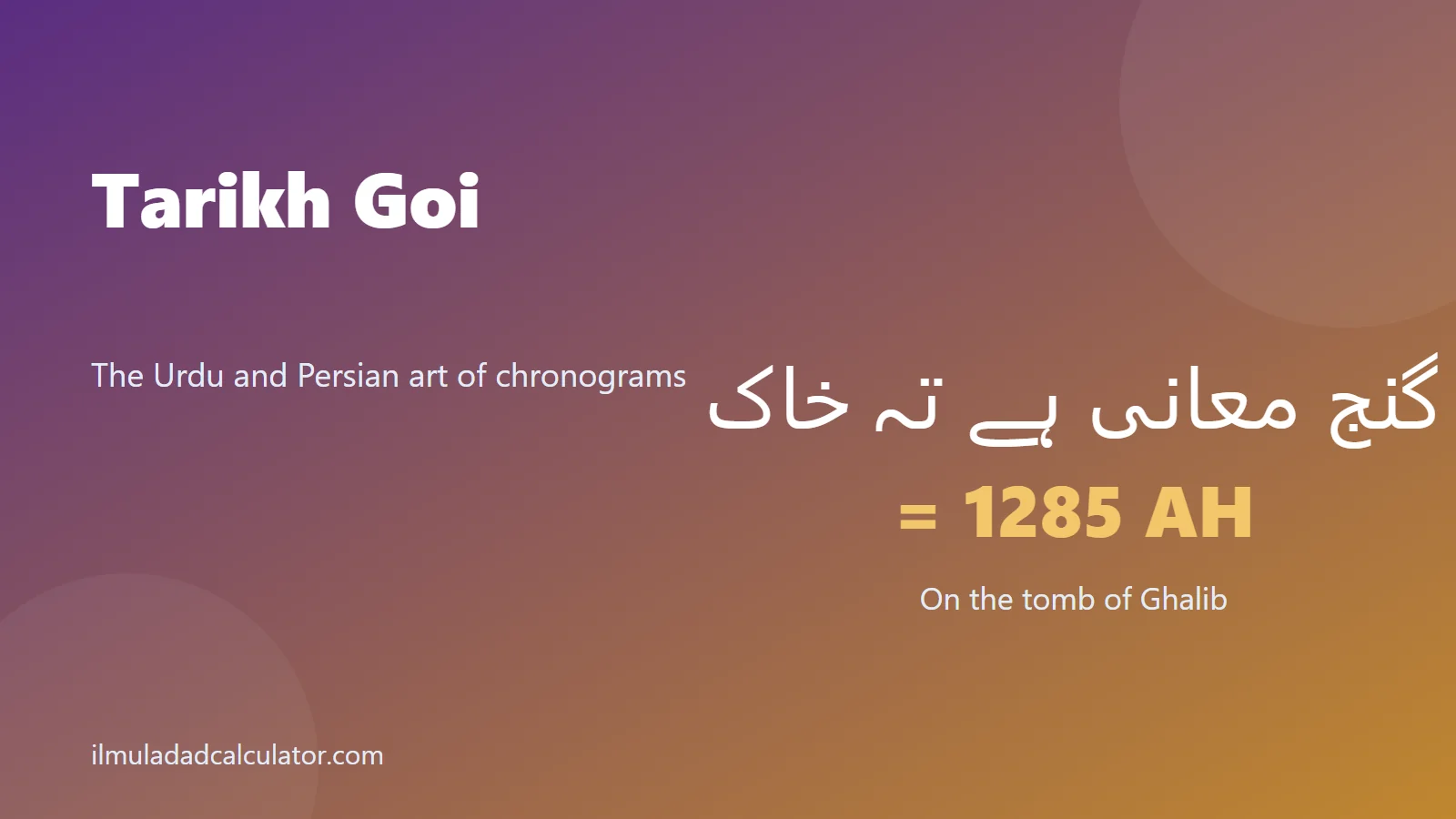
The poet Ghalib died in 1869. His friend and pupil Mir Mahdi Majruh wrote a chronogram that was inscribed on his tomb.
Its key line says the hatif spoke of a treasury of meanings under the dust. The words after the cue form the date:
گنج معانی ہے تہ خاک
The total, 1285, is the Hijri year of Ghalib’s death. The phrase also praises him: the treasure of meaning now rests beneath the ground.
Older Persian chronograms work the same way. The tomb of Hafez in Shiraz carries خاک مصلی, which gives 791, the year he died.
What Occasions Called for a Chronogram?
Poets marked the moments a family or a town wanted to remember. The same craft served joy and grief alike.
- Deaths: chronograms on tombs and in elegies, like the line for Ghalib.
- Births: the poet Momin marked his daughter’s birth with a chronogram.
- Books: authors hid the year of writing in a title or a closing verse.
- Buildings: inscriptions on gates, houses and other buildings recorded the year of completion.
- Weddings and journeys: poets wrote chronograms as gifts for happy events.
Momin’s birth chronogram uses subtraction to reach its year. The decoder page explains that example and the adding device, ta’miya, in detail.
How Do You Find the Chronogram in a Poem?
A chronogram usually announces itself. Look at the last line first, and search for a cue such as hatif, tarikh (date) or sal (year).
Count only the words after the cue. When the total lands near the known year of the event, you have found the madda-e-tarikh.
When it misses, check the poem for an instruction to add or subtract. A short note such as “minus the cord” or “with one more” usually marks the device.
What Mistakes Should Readers Avoid?
- Counting the cue. The words “the hatif said” are not part of the date. Counting them adds hundreds.
- Changing the spelling. Copy each letter exactly. Writing تہہ instead of تہ turns Ghalib’s 1285 into 1290.
- Using the wrong system. Urdu and Persian chronograms use Mashriqi values, not Maghribi.
- Forgetting the calendar. A total is usually a Hijri year. Convert it before comparing it with a Common Era date.
How Did Poets Compose a Chronogram?
A chronogram is built backward from the year. The poet knows the target number first and then searches for the words.
- Find the year of the event, usually in the Hijri calendar.
- Draft a phrase that suits the event and the person.
- Add the letters with their abjad values.
- When the total is close but not exact, swap a word for a synonym with a different value.
- When no swap works, add or subtract a short word and say so in the poem.
- Place the phrase after the cue, in the last line.
The best chronograms need no device at all. Their words fit the meaning and the number at the same time.
What Rules Did Poets Follow?
- Count what is written. Letters count by their written form, not by how they sound.
- Use the common values. Urdu and Persian chronograms use the Mashriqi values.
- Count Urdu letters by their base. On this site, پ counts as ب and ہ as ه.
- Mark any adjustment. An added or removed word must be signaled in the verse.
Most Urdu chronograms give a Hijri year. Some poets used other calendars, such as the Common Era or the Bikram Samvat.
Is Tarikh Goi Still Practiced Today?
Yes, though less widely than before. Rekhta, the large Urdu literature website, holds whole books of chronogram poems.
Its collection runs from an 1896 volume to books printed in 2020. Our reading list links to five of these Urdu books.
Rekhta notes that chronograms were most common in the 18th and 19th centuries. They stayed in use through the 20th century, while their popularity slowly declined.
Chronograms still appear in book prefaces and on some gravestones. Learning the values is the first step to reading them.
How Is Tarikh Goi Related to Ilm-ul-Adad?
Tarikh goi is the best-known literary use of the letter values. Ilm-ul-Adad supplies the numbers, and the poet supplies the meaning.
Anyone who can add letter values can check a chronogram. The guide to what Ilm-ul-Adad is explains where those values come from.
How Can You Read or Write One Yourself?
Start by reading. Paste a famous line into the chronogram decoder and watch the total build word by word.
Then try writing. Pick a year that matters to you, convert it to Hijri, and look for words with the right values. The Abjad quiz helps you learn the values first.
خلاصہ
تاریخ گوئی وہ فن ہے جس میں شاعر کسی واقعے کا سال الفاظ میں چھپا دیتا ہے۔ مادۂ تاریخ کے حروف کی ابجد قیمتیں جمع کرنے سے سال نکل آتا ہے۔ مرزا غالب کے مزار پر میر مہدی مجروح کا مصرع «گنج معانی ہے تہ خاک» اس فن کی مشہور مثال ہے، جس سے ۱۲۸۵ ہجری نکلتا ہے۔
Sources and Further Reading
- Tarikh Nigari: Numbers Speaking Through Words, Rekhta blog (2020). Terms, devices and the Momin example.
- The original tomb of Ghalib with a chronogram by Mir Mahdi Majruh, Rana Safvi.
- Chronogram, Wikipedia. The Hafez inscription.
- Tareekh-Goi ebook collection, Rekhta.
Frequently Asked Questions
Is tarikh goi only for deaths?
No. Poets also wrote chronograms for births, books, buildings, weddings and journeys.
Who is the hatif in chronogram poems?
The hatif is an unseen voice, a poetic device. The poet says the hatif spoke the date.
Do English chronograms exist?
Yes. Latin and English chronograms use Roman numeral letters, such as M, D and C, instead of abjad values.
Which calendar do Urdu chronograms use?
Most give a Hijri year. A few use the Common Era or the Bikram Samvat calendar.
Do I need to know Persian to read Urdu chronograms?
No. You need the Urdu script and the abjad values. Persian helps with older poems.