Hisab al-jummal (حساب الجمل) is the classical Arabic name for the abjad numeral system. In it, each Arabic letter stands for a fixed number. The name means, roughly, reckoning by the total.
What Does Hisab al-Jummal Mean?
The term has two parts. Hisab (حِساب) means reckoning or calculation. Al-jummal (الجُمَّل) points to the total or the sum.
The small word al is simply the Arabic word for the. So al-jummal means the total, the full sum of the letters.
Put together, the phrase names a way of counting with letters. You add the value of each letter in a word. The sum is the word’s hisab al-jummal value.
So the name is a plain description, not a secret code. It simply says: add the letters and read the total.
Some writers translate the term as calculation of the whole. Others render it as reckoning by sentences. Both readings describe one act, adding letter values.
Why Do Letters Stand for Numbers?
In the older Arabic world, the alphabet also served as a set of numerals. The first letter, alif, meant one. The next, ba, meant two, and so on up the scale.
The values climb in steps. First come one to nine, then the tens, then the hundreds, up to one thousand. Each of the 28 Arabic letters sits at one fixed place on that ladder.
This is the heart of hisab al-jummal. Because the values are fixed, any word can be read as a number. You can explore the full scale on the abjad numerals page.
Is Hisab al-Jummal a Secret Code?
The term can sound mysterious at first. In truth, it names plain arithmetic done with letters. There is nothing hidden in the method itself.
The counting is just addition. It does not claim to tell the future, and it does not reveal fate. It only turns a written word into a number.
On this site, the values are facts you can check. Any reading beyond the arithmetic is a separate matter, and it is not our focus here.
Where Does the Word Jummal Come From?
Jummal is linked to the Arabic word jumla (جملة). Jumla comes from the root j-m-l. The root carries the idea of gathering things into one whole.
In everyday Arabic, jumla has two main senses. One is a sentence, a set of words taken together. The other is a total or sum, as in a whole amount.
That second sense fits the counting system well. A word’s value is the total you get when its letters are gathered and added.
The plural of jumla is jumal. The doubled form jummal is an intensive shape, stressing the idea of the full sum.
In short: jumla means a whole or a sum. Hisab al-jummal is reckoning by that sum.
How Do You Spell and Say the Term?
English sources spell the word in several ways. You will see jummal and jumal, and in some books al-jumal. All point to the same Arabic word.
The first part also varies. Hisab is often written hesab in Persian sources. These are spelling choices, not different terms.
The whole phrase sounds roughly like hi-SAAB al-JUM-mal. The doubled m in jummal is held a little longer than a single m. The stress sits on the second part of each word.
Trusted sources use the forms shown here. When you meet a new spelling, read it by its sound. The meaning is almost always the same.
Is Hisab al-Jummal the Same as Abjad?
Yes. Hisab al-jummal and abjad numerals name the same letter-number system. The word abjad comes from the first letters of the old counting order.
Writers pick whichever name suits their language. The table below lists the names you are most likely to meet.
| Name | Language | Meaning or note |
|---|---|---|
| Abjad numerals | English | The common modern name for the system. |
| Ḥisāb al-jummal | Arabic | Reckoning by the total, the classical name. |
| Ḥisāb al-abjad | Arabic | Reckoning by the abjad letters. |
| Jummal kabīr | Arabic | The “great jummal,” the full nine-value scale. |
| Ḥisāb-e jummal | Persian and Urdu | The same term, borrowed into Persian and Urdu. |
These names are not rivals. They are simply labels that different communities placed on one shared method.
The variety of names can confuse a new reader. The safest guide is the method, not the label. If letters are being added for a total, you are looking at hisab al-jummal.
What Are Jummal Kabir and Jummal Saghir?
Writers sometimes split the term in two. The split marks which scale of values a text is using.
Jummal Kabir
Jummal kabir means the “great jummal.” It is the full scale, with values from one up to one thousand. This is the standard system, and the one this site uses.
Jummal Saghir
Jummal saghir means the “small jummal.” It is a reduced scale that drops the larger place values. It appears far less often than the full system.
Unless a source says otherwise, hisab al-jummal means the great scale. That is the version behind almost every example you will read. It is also the one used in the figures on this page.
How Does Hisab al-Jummal Work?
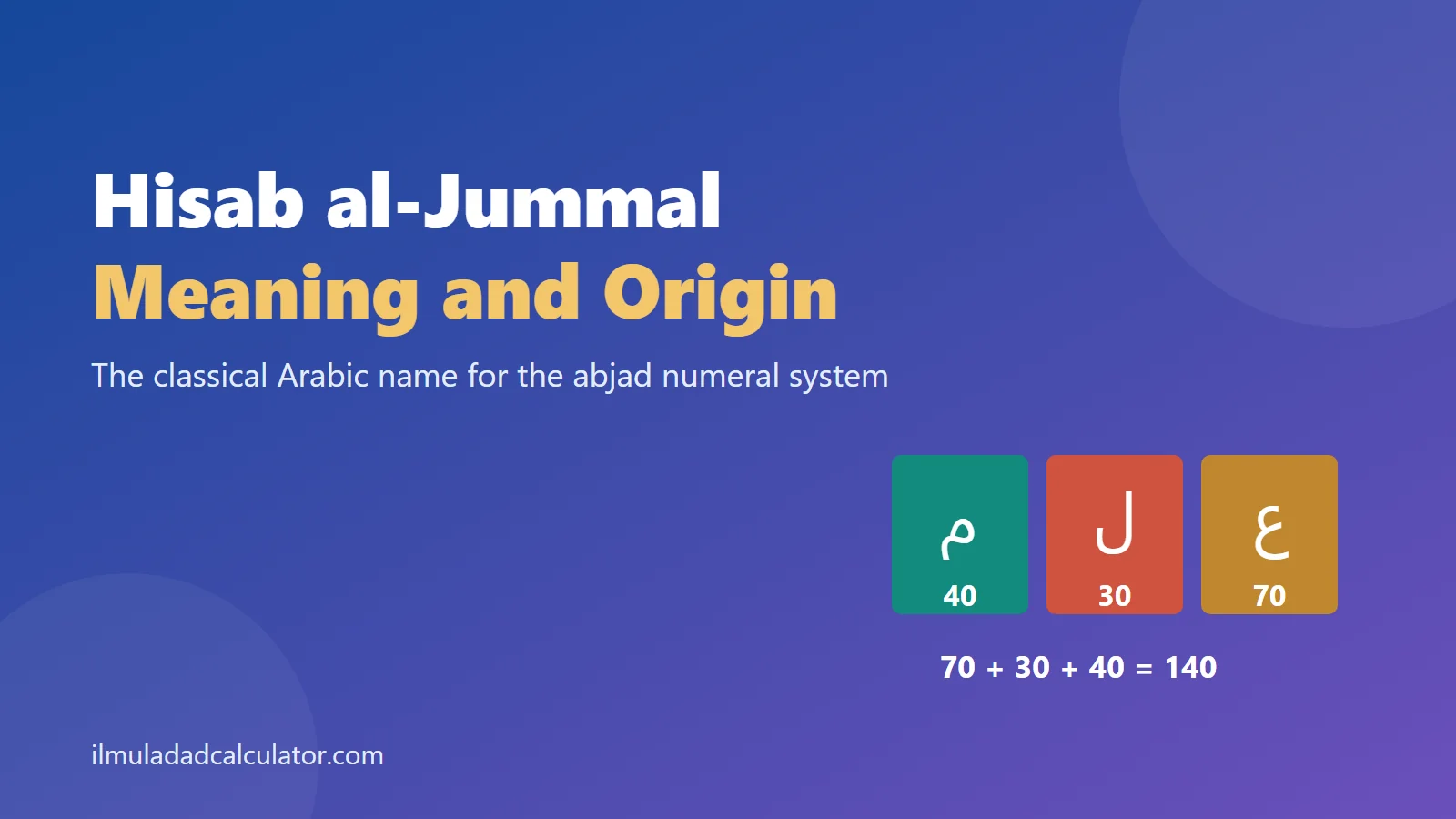
The method is simple arithmetic. Every letter has a set value, and you add them up. Here is the word ʿilm (علم), meaning knowledge.
ع 70 + ل 30 + م 40 = 140
The three letters give 140 in total. That number is the word’s hisab al-jummal value.
The Steps in Order
- Write out the word in Arabic letters.
- Look up the value of each letter.
- Add the values together.
- The sum is the hisab al-jummal value.
A few points help keep the count clean. They matter most with longer words and names.
- Short vowel marks carry no value, so you can ignore them.
- A silent or joined letter still counts if it is written.
- Spelling choices can change a total, so the written form matters.
You can try any word on the Ilm-ul-Adad calculator. It adds the letters for you and shows the total.
How Is the Term Used in Arabic, Persian and Urdu?
In Arabic, the full phrase is hisab al-jummal. Writers also shorten it to al-jummal when the meaning is clear.
Persian and Urdu borrowed the term as hisab-e jummal. The small word “e” links the two parts, in the Persian style.
The idea travels across all three languages without change. Each letter keeps its value, so a name adds up the same way in each. A word written in Arabic, Persian, or Urdu gives one total.
In Persian and Urdu poetry, the method gained a special role. Poets used it to fold a date into a line, a craft studied on the history of letter values page.
Where Was Hisab al-Jummal Used in History?
Before Indian digits spread, letters did the work of numbers. Astronomers wrote figures this way in their tables, called zij.
Poets used the system to hide a date inside a line of verse. These dated phrases are called chronograms. Scribes also used letters to number pages and lists.
Use of letters as numbers faded after digits became common. Yet the method lived on in poetry, tables, and the front pages of books.
The term was useful because it was exact. A reader who knew the values could decode a date or a page number at a glance.
This page keeps the history short. For the full story, see the history of letter values and the page on abjad numerals.
Does the System Have More Than One Order?
Yes. There are two main orders, and they set a few values differently. The eastern order is called Mashriqi, and the western one is called Maghribi.
Six letters change value between them. Most letters keep the same value in both. You can see the full list of Arabic letter values and the abjad hawwaz memory words.
This site uses the Mashriqi order by default. So the value you see here follows the eastern scale unless a page says otherwise.
How Does This Connect to Ilm-ul-Adad?
Ilm-ul-Adad is the study of these letter values and their totals. Hisab al-jummal is the counting method that it rests on.
In other words, hisab al-jummal is the tool, and Ilm-ul-Adad is the wider subject. The method gives the numbers, and the subject studies what people have done with them. To meet that subject in full, read what Ilm-ul-Adad is.
Every value on this site comes from a tested engine, not by hand. You can read how we check them on the methodology page.
Who Uses the Term Today?
The phrase still appears in several settings. Scholars of old manuscripts meet it when they read dated verses and table headings.
Students of Arabic and Persian also learn it as part of script history. The term shows up in grammar notes and in guides to classical poetry.
For most readers today, it is a doorway into a neat piece of history. It links the alphabet, arithmetic, and the written page in one simple idea.
خلاصہ
حسابِ جُمَّل اصل میں ابجد کے نظام کا پرانا عربی نام ہے، جس میں ہر حرف ایک مقررہ عدد رکھتا ہے۔ لفظ جُمَّل کا تعلق جملہ سے ہے، جس کے معنی ہیں پورا یا مجموعہ۔ یوں اس کا مطلب بنتا ہے حروف کو جمع کر کے کُل عدد نکالنا۔ عربی میں یہ حسابِ جُمَّل کہلاتا ہے، اور فارسی و اردو میں اسے حسابِ جُمَّل کہا جاتا ہے۔ تاریخ میں یہ زیج کی جدولوں، تاریخ گوئی اور فہرستوں کی گنتی میں استعمال ہوتا رہا۔
Sources and Further Reading
- Abjad numerals, Wikipedia. The name hisab al-jummal, the letter values, and the Mashriqi and Maghribi orders.
- Abjad, Encyclopaedia Iranica, by Georg Krotkoff (1982). Persian usage, zij tables and chronograms.
- jumla (جملة), Wiktionary. The senses “sentence” and “whole, sum,” and the root j-m-l.
- Abjad values come from this site’s tested engine. See the methodology.
Frequently Asked Questions
What does hisab al-jummal mean in English?
It means, roughly, reckoning by the total. You add the value of each letter in a word.
Is hisab al-jummal the same as abjad?
Yes. Both name the same system in which Arabic letters stand for numbers.
What is the root of the word jummal?
It is linked to jumla, from the root j-m-l. Jumla means a sentence, a whole, or a sum.
What is jummal kabir?
Jummal kabir is the “great jummal,” the full value scale from 1 to 1000.
How do you say the term in Urdu?
In Urdu and Persian it is hisab-e jummal. It means the same thing as the Arabic phrase.