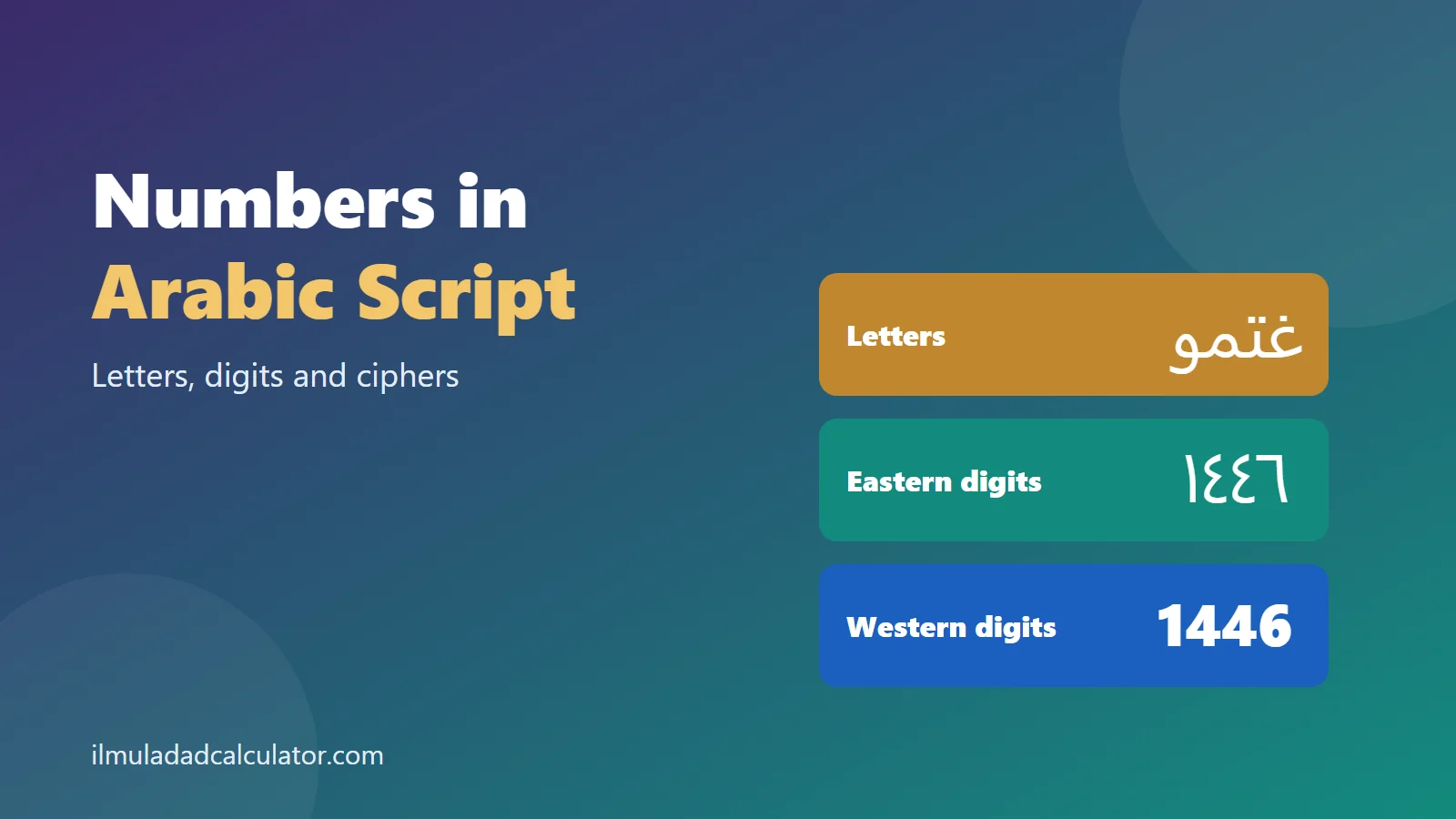
Arabic letters were used as numbers through the abjad system, with values from 1 to 1000. Over time, Indian digits joined the letters, and accountants added special ciphers. This page compares every way numbers were written in Arabic script.
How Were Arabic Letters Used as Numbers?
In the abjad system, the first nine letters stand for 1 to 9. The next nine stand for tens, and the next nine for hundreds. The last letter, ghayn, stands for 1000.
A number is written with its largest part first, and the values add up. So 1446 is غتمو: 1000 + 400 + 40 + 6.
The number to abjad numerals converter writes any number this way. The memory words abjad, hawwaz, hutti help you recall each value.
When Did Digits Join the Letters?
Indian digits with place value reached Arabic mathematicians by the 9th century. Al-Khwarizmi and al-Kindi wrote the books that spread them.
Two families of digits followed. The Mashriq kept the Eastern Arabic numerals, while North Africa used a western set that later became the world’s digits. The full story is in where Arabic numerals come from.
What Other Number Systems Were Used?
Letters and digits were not the only choices. Two specialized systems served particular needs.
Rumi Numerals
Rumi numerals, also called Fez numerals, were used in Fez, Morocco, and elsewhere in North Africa and Spain. They were in use from the 10th to the 17th century.
Siyaq Ciphers
Siyaq was a set of number signs for accounting. Clerks used it in Mughal India from the 17th century and in Ottoman financial records.
Both systems now have their own Unicode blocks, so historians can type them. Neither is in everyday use today.
Which System Should You Use Today?
- For everyday numbers in Arabic text, use Eastern Arabic or Western digits, following local custom.
- For reading dates in poems and inscriptions, use abjad letters and the chronogram decoder.
- For numbering lists the traditional way, use the abjad letters أ, ب, ج.
Explore Numbers in Arabic Script
- Number to Abjad Numerals: Write any number from 1 to 999,999 in abjad letters, with the rule for thousands.
- Eastern Arabic Numerals: Read, write and type the digits ٠ to ٩, with the Persian and Urdu forms.
- Arabic Numerals 1 to 100: A reference chart for writing every number to 100 in Eastern Arabic digits.
- Where Arabic Numerals Come From: How Indian digits reached Baghdad, then Europe.
- History of Letter Values: From the Semitic alphabet to Persian and Urdu chronograms.
- Chronogram Decoder: Read the year hidden in a line of verse.
- Abjad Hawwaz Hutti: The memory words that fix the letter values.
Sources and Further Reading
- Abjad numerals, Wikipedia.
- Rumi Numeral Symbols and Indic Siyaq Numbers, Wikipedia.
- See our sources and bibliography for more reading.
Frequently Asked Questions
Are abjad numerals still used?
Yes, in a few places. Arabic texts number lists with letters, and poets still write dated verses.
Is zero part of the abjad system?
No. Abjad letters have no zero, so they cannot show an empty place the way digits can.
Which came first, letters or digits?
Letters. Arabic writers used them as numbers before Indian digits spread in the 9th century.
Can I convert digits to abjad letters?
Yes. The number to abjad numerals converter turns any number from 1 to 999,999 into letters.