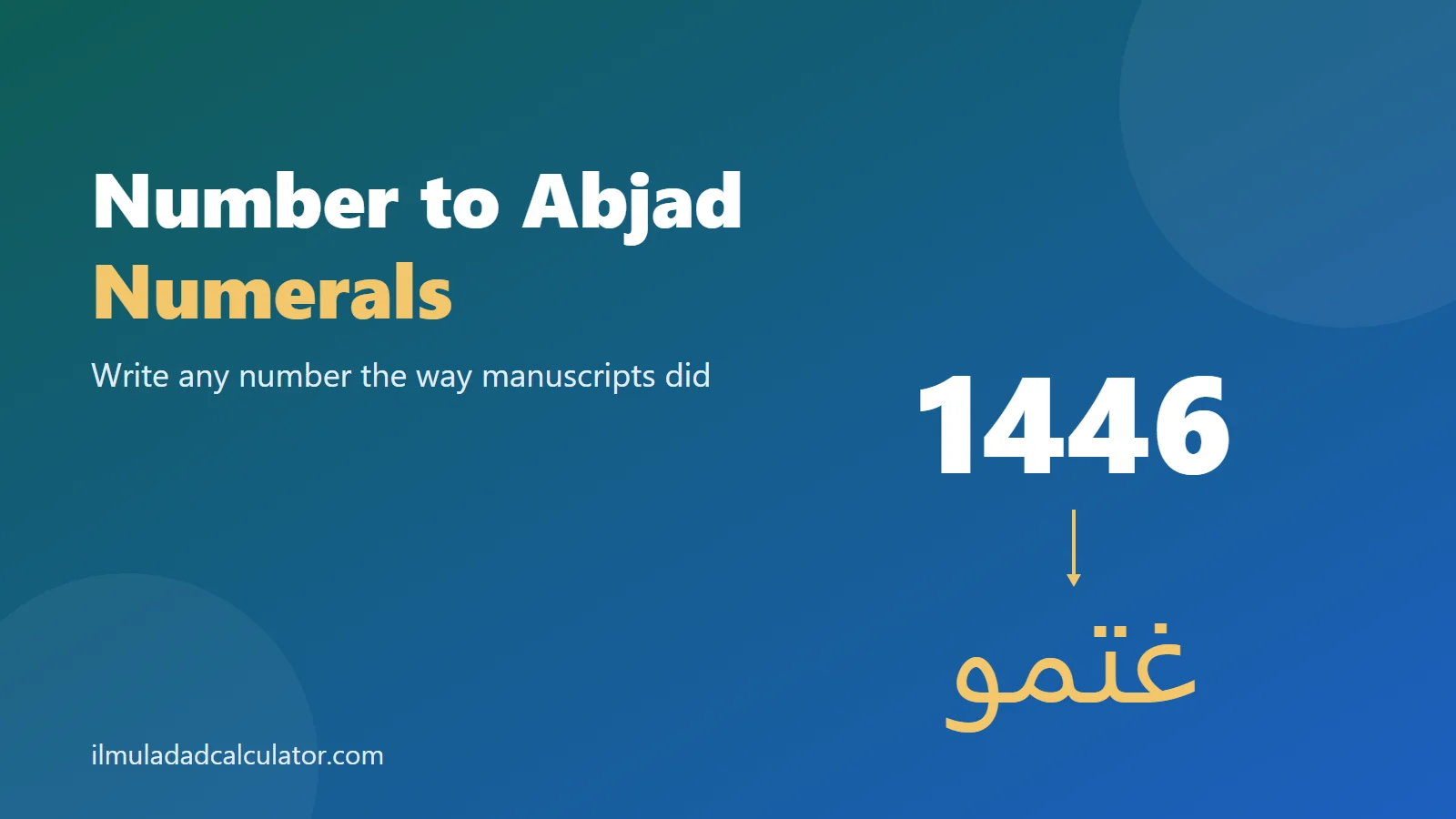
Enter a number to see how it is written in abjad numerals, the letters once used for numbers in manuscripts. Letters run from largest to smallest, so 1446 becomes غتمو (1000 + 400 + 40 + 6). For two thousand or more, a multiplier comes first: 2000 is بغ.
Mashriqi (Eastern)
Maghribi (Western)
| Part | Letter | Value |
|---|
All calculations run in your browser. Nothing you type is sent to a server.
عدد کو ابجد حروف میں لکھیں
کوئی عدد لکھیں اور دیکھیں کہ اسے ابجد حروف میں کیسے لکھا جاتا ہے۔ بڑے عدد سے چھوٹے کی طرف حروف لکھے جاتے ہیں، مثلاً 1446 = غتمو۔ ہزار سے اوپر ضرب کا قاعدہ ہے: 2000 = بغ۔
How Abjad Numerals Work
Before Indian digits spread, Arabic writers used letters as numbers. Each letter stands for a fixed value: a unit, a ten, a hundred or one thousand.
To write a number, pick the letter for each part. Then write the largest part first and add them together.
Writing a Number Step by Step
- Split the number into thousands, hundreds, tens and units.
- Find the letter for each part in the Arabic letter values table.
- Write the letters from the largest value to the smallest.
- For two or more thousands, write the multiplier before the thousands letter.
| Number | Parts | Abjad numeral |
|---|---|---|
| 19 | ten plus nine | يط |
| 92 | ninety plus two | صب |
| 313 | three hundred, ten and three | شيج |
| 1,259 | a thousand, two hundred, fifty and nine | غرنط |
| 2,026 | two thousands, then twenty and six | بغكو |
The Rule for Thousands
The thousands letter is غ in the Mashriqi order. When it stands alone, it means 1000.
Order changes the meaning above 1000. In بغ, the ب comes first and multiplies, so it means 2 × 1000.
In غب, the غ comes first and the letters simply add. That makes 1000 + 2, or 1002.
Where You Will See Abjad Numerals
- Page and leaf numbers in Arabic, Persian and Ottoman manuscripts.
- Numbered prefaces and lists in older printed books.
- Tables and calculations in medieval Arabic mathematics.
- Dates hidden in chronograms on buildings and in poems.
Writers sometimes drew a line over the letters. The line tells the reader that the letters are a number, not a word.
Reading Abjad Numerals Back
To read a numeral, add the value of each letter. When a letter comes before غ, multiply instead.
For example, غرنط is 1000 + 200 + 50 + 9. That makes 1259, the year in Momin’s famous chronogram.
To check any written phrase this way, use the Chronogram Decoder.
Mashriqi and Maghribi Numerals
Six letters have different values in the Maghribi system. So the same number can need different letters.
For example, 1000 is غ in Mashriqi but ش in Maghribi. The number 92 is صب in Mashriqi and ضب in Maghribi.
Check which system a manuscript uses before you convert. A North African source will often use Maghribi values.
Common Mistakes
- Writing the smallest value first. Abjad numerals start with the largest part.
- Putting غ before the multiplier. That turns 2000 into 1002.
- Mixing systems, such as a Maghribi thousands letter with Mashriqi hundreds.
Sources and Further Reading
- Wikipedia: Abjad numerals (multiplication rule for thousands)
- MELA Committee on Cataloging: Alphabetic numeral system (abjad table)
- Abjad numerals recognition in medieval Arabic mathematical texts (CEUR Workshop Proceedings, vol. 3266)
Frequently Asked Questions
Is there a letter for zero?
No. Abjad numerals are additive, so they need no zero. An empty place is simply left out.
How do I write 10,000 in abjad numerals?
Write the multiplier 10, which is ي, before the thousands letter. That gives يغ.
Can I convert the current year?
Yes. Press Use the current Hijri year, and the converter fills it in for you.
Are abjad numerals still used today?
Yes, mostly for numbering. Some Arabic books still number prefaces and lists with letters.
Why does the tool show Arabic-Indic digits too?
They are the digits most Arabic readers use today, such as ١٤٤٦. Seeing both helps you compare old and new forms.
Author: Shakeel Muzaffar
Reviewer: Moulana Haji Abdul Basit (Islamic Scholar and Mentor)