The Hijri calendar is a lunar calendar that numbers its years from the hijra, in 622 CE. Most chronograms in Arabic, Persian and Urdu give their year in it. This page is the map to the Hijri guides on this site.
What Is the Hijri Calendar?
The Hijri calendar counts time in lunar months. Each month follows the moon from one new crescent to the next.
Years are numbered from the hijra, and the letters AH after a year stand for Anno Hegirae. In the tabular calendar, year 1 AH began on Friday, 16 July 622 in the Julian calendar.
The history of the Hijri calendar tells how the count was set up. This page only shows the parts and points you to the guide for each one.
When Does a Hijri Day Begin?
A Hijri day runs from sunset to sunset, not from midnight. So the first evening of a date belongs to the day that begins at that sunset.
This is why the epoch has two descriptions. The civil tabular date is Friday, 16 July 622, but the Islamic day began at sunset on 15 July.
Which Dates Appear in Old Writing?
Hijri dates appear on inscriptions, coins, tombstones, manuscript endings and the title pages of printed books. Authors who wanted a poetic date often gave it as a chronogram.
Readers meet these years long before they meet a day or a month. That is why the year is the part this site cares about most.
Why Do Chronogram Readers Need the Hijri Calendar?
A chronogram adds up to a year. In Arabic, Persian and Urdu verse, that year is usually Hijri.
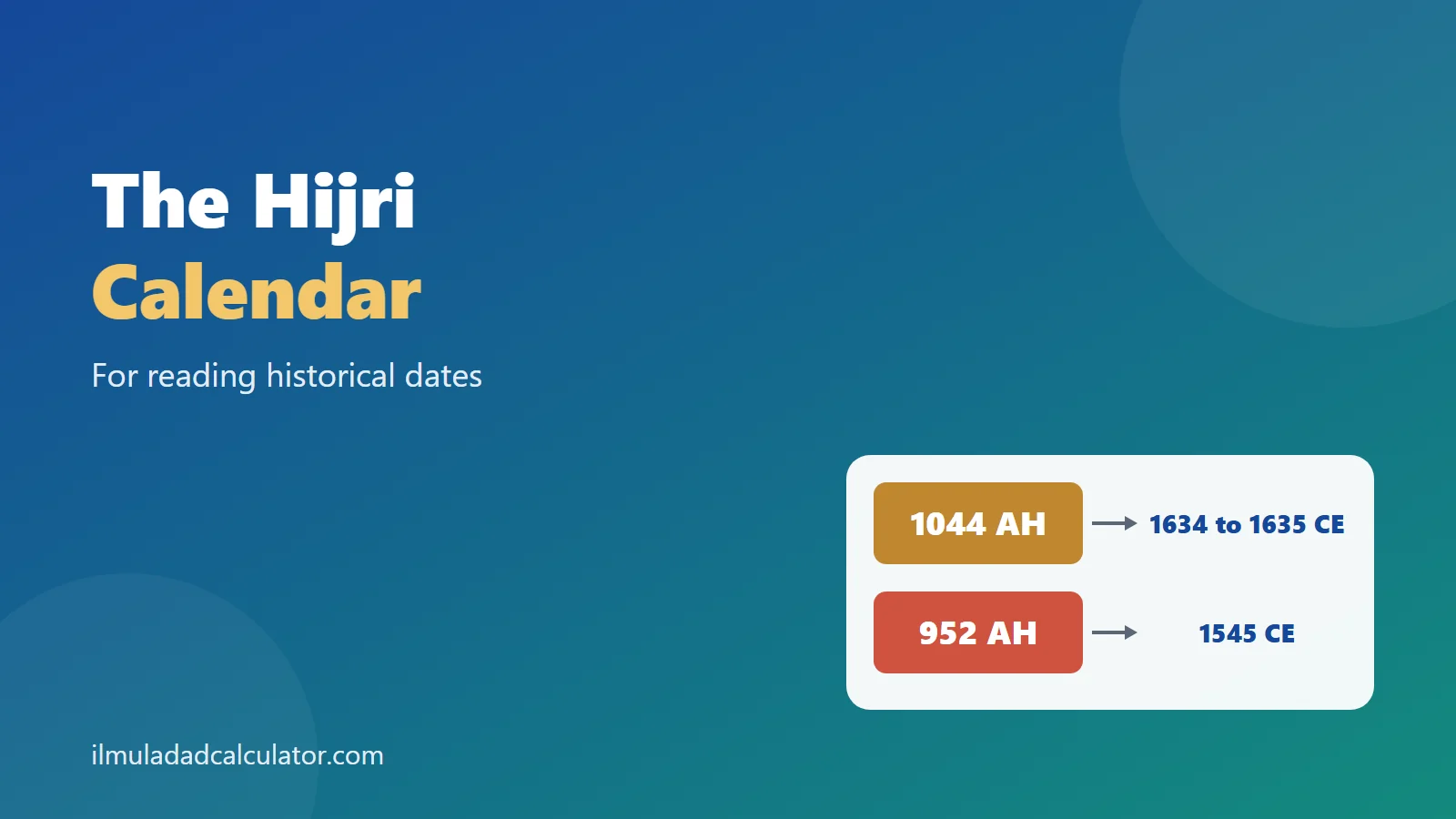
The total must be converted before it can match a date in the Gregorian calendar. Two checked examples show how this works.
| Line | Total | Gregorian span | What it marks |
|---|---|---|---|
| سجدہ گاہ اہل فضل | 1044 AH | 27 June 1634 to 16 June 1635 | Wazir Khan Mosque, Lahore, built 1634 to 1635 |
| ز آتش مرد | 952 AH | 15 March 1545 to 3 March 1546 | Death of Sher Shah Suri, 22 May 1545 |
Working Through the Sher Shah Line
- Add the three words: 7 + 701 + 244 = 952.
- Read the total as a Hijri year: 952 AH.
- Find its span. The tabular calendar starts 952 AH on 15 March 1545 and ends it on 3 March 1546.
- Check the event. Sher Shah died on 22 May 1545, which falls inside that span.
Remember: a Hijri year usually covers parts of two Gregorian years. That is why 1044 AH is written 1634 to 1635 CE and not as one year.
The step-by-step reading guide shows how to find the date line and add it. The chronogram decoder adds a line and converts the year for you.
How Long Is a Hijri Year and How Many Months Does It Have?
A Hijri year has 12 months, and each month has 29 or 30 days. In the tabular calendar, odd-numbered months have 30 days and even-numbered months have 29.
Six months of 30 days and six of 29 make 354 days. A leap year adds one day to the last month and has 355 days.
The Hijri months guide gives the names, their meanings and their order. It also explains how a month ends and the next one begins.
Why Does the Year Move Through the Seasons?
The true lunar month averages about 29.53 days, so 12 of them make about 354.37 days. A Gregorian year is about 365.24 days.
The Hijri year is therefore about 11 days shorter. Its months slide back through the seasons and make a full circuit in about 33 years.
What Is the 30-Year Cycle?
The tabular calendar repeats every 30 years. Of those 30 years, 11 are leap years, so the cycle holds 10620 + 11 = 10,631 days.
In the common pattern, the leap years fall at 2, 5, 7, 10, 13 and 16 of the cycle. The rest are 18, 21, 24, 26 and 29.
Some schemes shift a few of these by one year. For a whole year, that rarely changes the Gregorian years you get.
How Can You Tell Whether a Year Is a Leap Year?
Use the test for this common pattern: multiply the year by 11, add 14 and divide by 30. If the remainder is less than 11, the year is a leap year.
- 1044: 11 × 1044 + 14 = 11498. Divided by 30, the remainder is 8, so it is a leap year of 355 days.
- 952: 11 × 952 + 14 = 10486. Divided by 30, the remainder is 16, so it is a common year of 354 days.
These match the spans in the table: 1044 AH has 355 days and 952 AH has 354. The formula guide uses this same test in full.
Which Versions of the Hijri Calendar Are There?
Three ways of fixing the months are common. They share the same year numbers but can start a month on different days.
- Tabular: a fixed arithmetic scheme with a 30-year cycle. It gives the same date for everyone and is the usual choice for converting historical dates.
- Umm al-Qura: the Saudi calendar, based on astronomical calculation and used for administrative purposes. Its rules were changed more than once around 1420 to 1423 AH.
- Sighting: a month starts at sunset after the new crescent is seen. Start dates can differ between countries.
The variants differ by a day or two at the start of a month. They matter little when you only want the year.
This site uses the tabular calendar for year spans, because its rules are fixed and anyone can repeat the arithmetic.
The Hijri calendar systems guide compares all three in detail. It also says when each one is the right choice.
How Do You Convert a Hijri Year to a Gregorian Year?
There is a quick rule and an exact method. The quick rule is: multiply the Hijri year by 0.97, then add 622.
- Take the Hijri year, for example 1044.
- Multiply by 0.97: 1044 × 0.97 = 1012.68.
- Add 622: 1012.68 + 622 = 1634.68, which rounds to 1635.
The same steps give 1545 for 952 AH. Both results match the spans in the table above.
The rule is an estimate, and it can be off by a year near the edges. The Hijri to Gregorian formula guide shows the exact day-count method that gives a date.
Its checks use two sourced dates. One is 1 Muharram 1 AH on 16 July 622, in the Julian calendar.
The other is 1 Jumada al-Awwal 1448 AH on 13 October 2026.
Which Gregorian Calendar Do Old Dates Use?
Dates before October 1582 are normally written in the Julian calendar. The Gregorian calendar began when Thursday 4 October 1582 was followed by Friday 15 October.
That is why the table gives 15 March 1545 for the start of 952 AH. The same day was 25 March in the Gregorian calendar, which came later.
- Before 15 October 1582: histories give Julian dates, as in the year 622 and the year 1545.
- After 15 October 1582: dates are Gregorian, as in 1634 to 1635.
For a whole year this rarely matters. For a day, the gap was 10 days in 1545 and it grows with the centuries.
What Should You Check Before Trusting a Converted Date?
A conversion is only as good as its inputs. Run through this short list before you quote a date.
- The letters. One missing alif changes the total by 1, as the reading guide shows.
- The calendar of the total. A total near 1000 is usually Hijri. A total near 1800 may be Gregorian.
- The variant. Say whether a date is tabular, Umm al-Qura or sighted.
- The Gregorian type. Say whether an old date is Julian or Gregorian.
Writing these four facts beside a date makes it easy for others to check. It also keeps a one-day gap from looking like a mistake.
Do Chronograms Ever Give a Month or a Day?
A chronogram’s letters normally add up to one number, and that number is a year. A month or a day, when given, usually appears as plain words near the verse.
So a reader often has two pieces: a year from the letters and a month and day from the text. The death-date chronograms guide shows this on real memorial verses.
For a day-level date, the variant matters more than it does for a year. Keep the month name and the variant together, and convert the whole date with one method.
Guides in This Section
Each guide covers one part of the calendar in depth. Start with the one that matches your question.
Every conversion in these guides is checked against sourced dates, and each page names the variant it uses. That keeps one guide from quietly contradicting another.
- Hijri Calendar History: how the era was set and how the count developed.
- The Twelve Hijri Months: names, order and lengths.
- Hijri Calendar Systems: tabular, Umm al-Qura and sighting compared.
- Hijri to Gregorian Formula: the arithmetic, step by step.
- Hijri Dates in Excel and Google Sheets: formulas to show, convert and fill Hijri dates.
- How Many Days Are in a Hijri Year and Month?: the 354 or 355 day rule and month lengths.
- Hijri Shamsi vs Hijri Qamari: the solar and lunar Hijri calendars compared.
- Why the Hijri Date on Your Phone Can Be Wrong: variants, settings and the one-day gap.
- Hijri Year 1 and Why There Is No Year 0: the epoch and how the count starts.
- Julian or Gregorian? Converting Dates Before 1582: why old conversions give Julian dates.
- The Fasli Calendar in Mughal and Deccan Records: the harvest-year era and its regional offsets.
- Bikram Samvat Dates in Urdu Chronograms: the 56 or 57 year offset and a sourced example.
- Akbar’s Ilahi Era: the solar era on Mughal coins and documents.
- The Rumi (Ottoman Fiscal) Calendar: the Julian-based fiscal year and its 584 year offset.
Related pages on this site cover the poems and the tools that use these dates.
- Chronogram Poetry: the art of hiding a year in words.
- Tarikh Goi: the Urdu and Persian name for it.
- Chronogram Decoder: add a line and convert its year.
- History of Letter Values: how letters came to carry numbers.
خلاصہ
ہجری تقویم قمری مہینوں پر مبنی ہے اور اس کے سال ہجرت سے گنے جاتے ہیں۔ اردو، فارسی اور عربی کے مادۂ تاریخ کا مجموعہ عموماً ہجری سال ہوتا ہے۔ مثلاً ایک مصرع کا مجموعہ ۹۵۲ ہجری ہے، جو ۱۵۴۵ عیسوی کے مطابق ہے۔ اس صفحے سے مہینوں، تقویم کی اقسام اور تبدیلی کے طریقے کے صفحات تک پہنچا جا سکتا ہے۔
Sources and Further Reading
- Islamic calendar, Wikipedia. The 12 months, 354 and 355 day years, the 16 July 622 epoch, Umm al-Qura and sighting.
- Tabular Islamic calendar, Wikipedia. Month lengths, the 30-year cycle with 10,631 days, leap years and 1 Jumada I 1448 on 13 October 2026.
- Umm al-Qura calendar, Wikipedia. The Saudi calendar and its rule changes before 1420 and from 1423 AH.
- Deciphering the Construction Date of a Mosque Hidden in Its Mosaic Tiles, ILCAA (2025). The Wazir Khan Mosque chronograms, 1044 AH and 1634 to 1635.
- The Secret of Letters: Chronograms in Urdu Literary Culture, Mehr Afshan Farooqi, Edebiyat 13(2), 2003. The Sher Shah line and its total of 952.
- Sher Shah Suri, Wikipedia. His death on 22 May 1545.
- Gregorian calendar, Wikipedia. Thursday 4 October 1582 followed by Friday 15 October 1582, and the 10 days dropped.
- Abjad values come from this site’s tested engine. See the methodology.
Frequently Asked Questions
What does AH mean after a year?
AH stands for Anno Hegirae, “in the year of the hijra.” It marks a year of the Hijri calendar.
Why is a Hijri year about 11 days shorter?
It has 12 lunar months of 29 or 30 days, so 354 or 355 days. A Gregorian year has about 365.24.
Do all Hijri calendars give the same date?
No. Tabular, Umm al-Qura and sighting calendars can differ by a day or two at a month’s start.
Does a chronogram give a Hijri or a Gregorian year?
Most Arabic, Persian and Urdu chronograms give a Hijri year. A few give the Gregorian year, so check the size of the total.
Can I convert a Hijri year without a formula?
Yes. The chronogram decoder converts a year for you, and the quick rule is the year times 0.97, plus 622.