The Fasli calendar was a harvest-based year used for land revenue in Mughal India and, later, in the Deccan. This page explains what a Fasli year is and how it relates to Hijri and Gregorian years. It also shows why regional versions disagree.
What Is the Fasli Calendar?
Fasli comes from an Arabic word that Britannica glosses as harvest. The term was applied to groupings of the seasons in India.
Britannica describes the Fasli era as a system devised by the Mughal emperor Akbar for land revenue in northern India. The Muslim lunar calendar was inconvenient for that purpose.
Short answer: a Fasli year is a solar revenue year tied to the harvest. Its number began at the Hijri number 963 and then followed a solar count. Details differ by region, so always check the local rule.
What Does a Fasli Year Mean in Practice?
A lunar year runs about 11 days short of the seasons. That drift is a problem when taxes depend on crops.
A solar year keeps the harvest in the same place on the calendar. So revenue clerks could set payment dates once and reuse them.
Modern Indian statutes still use the idea. Several of them define the Fasli year as the twelve months from 1 July to 30 June.
Typical Definitions in Law
- A year commencing on 1 July and ending on 30 June of the next year.
- A period of twelve months commencing on the first day of July.
- In one quoted definition, a year ending on 30 September.
Law Insider collects these definitions from different acts. They show that the label is shared. The start date depends on the text in front of you.
How Was the Fasli Year Numbered?
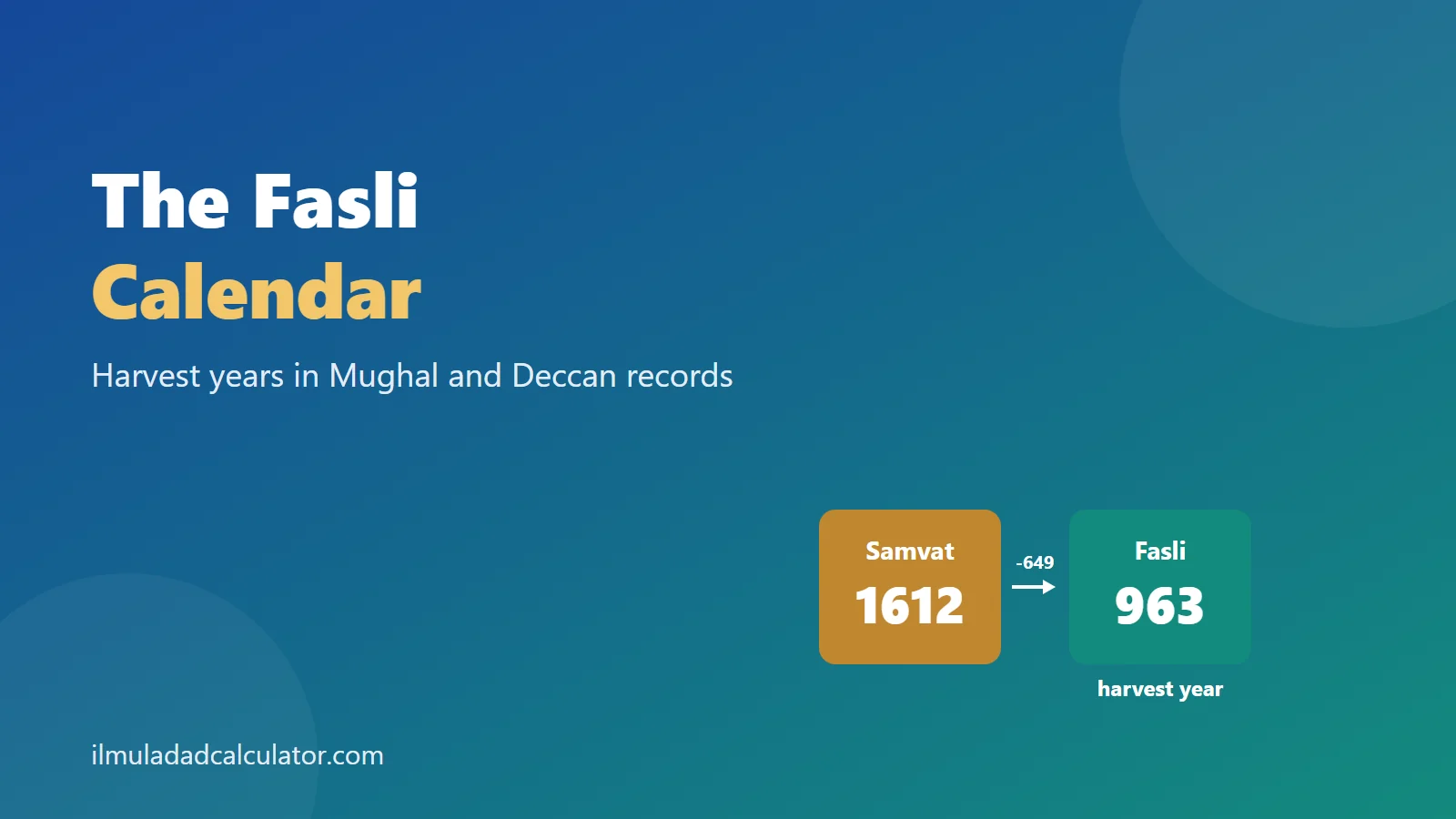
Britannica says the era dated from Akbar’s accession year, AH 963. That year was also Samvat 1612. Akbar took 649 years from the Samvat number to make the Fasli year 963.
Check the subtraction: 1612 – 649 = 963. After that, the sources say the Fasli count moved with the Samvat solar year.
Britannica gives the accession year as 1555 to 1556 CE.
In the tabular civil Hijri calendar, AH 963 ran from 26 Nov 1555 to 13 Nov 1556, using Gregorian labels. Akbar’s Wikipedia page gives his accession as 11 February 1556. That date falls inside AH 963 under either calendar label.
The era was therefore counted from a past starting point. The sources consulted do not say when clerks first wrote Fasli years in documents.
That gap matters for dating. A record with a Fasli year may be from the 1560s or the 1930s. The year number alone cannot place it.
How Does the Fasli Year Relate to Hijri and Gregorian Years?
In 963 the Fasli and Hijri numbers matched. From then on, the Hijri year was shorter, so its number grew faster.
The tabular Hijri year averages 354 and 11/30 days. A solar year is about 365.2425 days, so the ratio is 1.0307.
That ratio means the Hijri number gains one on a solar count about every 32.6 years. Over the 444 years from 1556 to 2000, the lead should be about 13.6.
A Check Against Two Sources
Britannica says to add 592 or 593 to a Fasli year to reach a Gregorian year. By that rule, Fasli 963 gives 1555 or 1556, which matches the accession year.
Wikipedia says that adding 590 gives the Gregorian year for the solar Fasli year. Its example is Fasli 1410, which ran from July 2000 to June 2001, since 1410 + 590 = 2000.
Wikipedia’s caption on a document dated Fasli 1343 agrees with the same rule. It reads 1343 + 590 = 1933.
The three offsets do not agree, and no source consulted explains the gap in full. So this page gives no single conversion formula for the Fasli year.
What Does a Fasli Date Look Like in a Record?
Most Fasli dates appear as a year number beside a Gregorian or Hijri date. Wikipedia reproduces a land document marked with Fasli 1343, which it equates to 1933.
Treat that pairing as a key. Once you have one record with both numbers, other records from that office can often be read the same way.
Worked Offsets for Three Years
The table applies each sourced offset to a Fasli year. It does not claim that any one column is right for your record.
| Fasli year | Add 590 | Add 592 | Add 593 |
|---|---|---|---|
| 963 | 1553 | 1555 | 1556 |
| 1343 | 1933 | 1935 | 1936 |
| 1410 | 2000 | 2002 | 2003 |
For the same Fasli number, the three columns land one to three years apart. That spread is why a second date in the record matters so much.
Why Do Modern Laws Still Use Fasli Years?
Land revenue accounts run on a harvest cycle, and the statutes were written around it. The Telangana land reforms act of 1973 speaks of two crops per Fasli year. It also counts four Fasli years within six.
Wikipedia adds that Andhra Pradesh, Karnataka and Tamil Nadu still use the Fasli year for revenue and court purposes. It marks that statement as needing a better source, so check current rules.
For a historian, the lesson is simple. A Fasli year in an old file is a revenue period, not an event date. It needs its own conversion step.
Which Hijri Years Does One Fasli Year Cover?
Take the Deccan Fasli year 1410. It ran from 1 July 2000 to 30 June 2001, which is 365 days.
In the tabular civil calendar, Hijri 1421 began on 6 Apr 2000. Hijri 1422 began on 26 Mar 2001.
So the Fasli year holds 268 days of one Hijri year and 97 of the next. A Fasli number and a Hijri number therefore can never match in a simple one-to-one way.
In 2000 the Hijri number 1421 was ahead of Fasli 1408 by 13 and ahead of Fasli 1410 by 11. The size of the gap depends on which Fasli rule you use.
How Did the Fasli Calendar Reach the Deccan?
Britannica says Shah Jahan introduced the system into the Deccan in the 1630s. Wikipedia gives 1630 and says it became the official calendar of the Asaf Jahi rulers of Hyderabad State.
Wikipedia also says the Deccan year runs from July to June. It names a separate solar version used historically in Bombay province. It also names a lunisolar version used in the courts of Bihar and Benares.
| Variant | Type | Where it is named | Year start |
|---|---|---|---|
| Lunisolar | Indian month names, solar years | Courts of Bihar and Benares | September, after the Bhadra full moon |
| Solar, Deccan | Twelve months | Deccan, Hyderabad State | July to June |
| Solar, Bombay | Solar year | Bombay province, historical | Not stated in the page |
Another line on the same page gives 7 or 8 June as the first day of the year. That statement does not match the July to June rule, and the page cites a single book for it. It is best treated as an unresolved claim.
How Does Fasli Link to Akbar’s Revenue Reforms?
The Fasli era sits beside a wider set of revenue measures under Akbar. His Wikipedia page notes that a ten-year assessment system called dahsala replaced an earlier scheme in 1580.
Under dahsala, revenue was one-third of the average produce of the previous ten years, paid in cash. Raja Todar Mal set it out in a memorandum of 1582 to 1583.
Those pages do not say that the Fasli era was part of dahsala. They show only that Akbar’s officers worked with harvest-based accounts. For another calendar of that reign, see the page on the Ilahi era.
How Do You Read a Fasli Date Safely?
Follow a short checklist whenever you meet a Fasli date in a record.
- Note the place and the period. Deccan, Bombay and northern usage differ.
- Find the year start used by that source, such as 1 July.
- Look for a second date in the same document, in the Hijri or Gregorian calendar.
- Use the second date to choose among the offsets 590, 592 and 593.
- Write the calendar label next to your result.
Write the result with its working. For example, a note might read Fasli 1343, plus 590 by the Deccan rule, equals 1933. That keeps the choice of offset open to review.
If no second date exists, give the answer as a range. A range of two or three years is honest, and it is better than a false single year.
Common Mistakes
- Treating Fasli as Hijri. The two numbers matched only at the start.
- Using one offset everywhere. The sources give three values.
- Reading a Fasli year as a single Gregorian year. It spans two.
Fasli years are not chronogram years in the sense described on the chronogram pages. No sourced chronogram that encodes a Fasli year was found, so none is shown here.
For the Hijri side of any conversion, see Hijri year length, Shamsi and Qamari, and Julian or Gregorian. The Hijri calendar systems page lists the tabular and observed versions.
For monuments and documents of the same period, read about Mughal chronograms. The calendar hub lists related pages.
خلاصہ
فصلی کیلنڈر ایک شمسی مالی سال تھا جو مغل دور میں زمین کے محصول کے لیے استعمال ہوا۔ بریٹانیکا کے مطابق اس کا آغاز اکبر کے جلوس کے سال ۹۶۳ ہجری سے ہوا۔ بعد میں دکن میں بھی یہ رائج ہوا۔ مختلف علاقوں میں سال کا آغاز اور ہجری یا عیسوی سال سے فرق مختلف بتایا جاتا ہے۔ اس لیے کسی فصلی تاریخ کو پڑھتے وقت علاقہ اور دوسری تاریخ ضرور دیکھیں۔
Sources and Further Reading
- Fasli era, Encyclopaedia Britannica. Akbar, land revenue, AH 963, Samvat 1612, the 649 years, the offset of 592 or 593, and the Deccan.
- Fasli calendar, Wikipedia. The two versions, July to June, the offset of 590, Fasli 1410 and 1343, and Shah Jahan.
- Akbar, Wikipedia. The accession date of 11 February 1556, dahsala in 1580 and the memorandum of 1582 to 1583.
- Islamic calendar, Wikipedia. The epoch of Friday 16 July 622 Julian.
- Tabular Islamic calendar, Wikipedia. The 30-year cycle, the leap years and the 354 and 11/30 day mean year.
- Fasli year definition, Law Insider. Statutory definitions of the Fasli year that begins on 1 July.
- Telangana Land Reforms (Ceiling on Agricultural Holdings) Act, 1973, Government of Telangana. Fasli year in current statute text.
- Calendar arithmetic is computed in code and asserted. See the methodology.
Frequently Asked Questions
What does Fasli mean?
Fasli comes from an Arabic word glossed as harvest. A Fasli year is a revenue year tied to the harvest cycle.
What is the Fasli year meaning in land records?
It is the twelve-month revenue year. Several Indian statutes define it as 1 July to 30 June.
Who started the Fasli calendar?
Britannica credits the Mughal emperor Akbar. It counts from his accession year, AH 963.
Is the Fasli year the same as the Hijri year?
No. They matched at 963, but the Hijri year is shorter, so the numbers drifted apart.
How do I convert a Fasli year to a Gregorian year?
Sources give 590, 592 or 593 by region. Use a second date in the document to choose the right one.