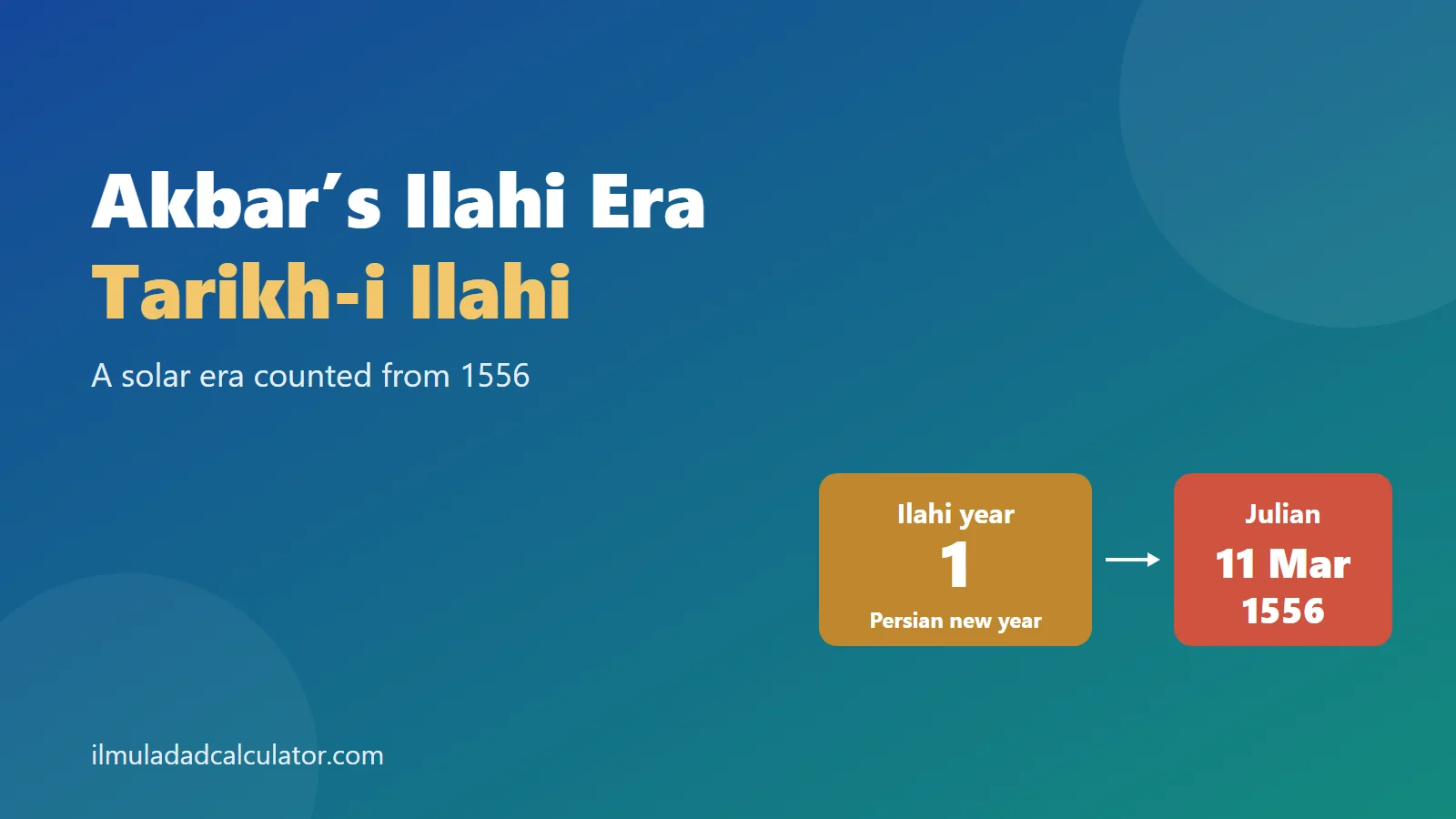
The Ilahi era was a solar year count. Akbar’s court introduced it in 1584 and dated it back to 1556. This page covers its start, months and coins, plus a rule to convert an Ilahi year to a Julian year.
What Was the Ilahi Era?
The Ilahi era, called Tarikh-i Ilahi, was the era of the Mughal emperor Akbar. The word Ilahi means divine. Britannica describes it as a solar era that began with his accession.
It had two jobs. It gave the court a date count tied to the sun. It also replaced a lunar count that did not fit the farming year.
The Hijri calendar stayed in use beside it, so both counts appear in the records.
The era should not be confused with the Fasli year used in revenue records. That story has its own page, the Fasli calendar.
Why Did Akbar Want a Solar Era?
Abul Fazl explains the reason in the Akbarnama. Land revenue was taken by the lunar year, but the harvest follows the sun. Thirty-one lunar years equal about thirty solar years, so payments drifted away from the crop.
A solar count removed that gap. The length of a Hijri year is about 354 days, so a lunar date slips through the seasons.
The Akbarnama gives a second reason. A fixed starting point makes contracts and loans easier to date. The text gives the example of a farm or loan running for four years and four months.
What Is the Starting Point of the Era?
The era is dated from Akbar’s accession in 963 AH, but the sources are careful about the exact day. The Akbarnama says the New Year came twenty-five days after the accession. The count then began from that New Year, and the days before it were counted inside the first year.
Wikipedia gives the accession as 14 February 1556. In the tabular civil calendar, 2 Rabi II 963 falls on Friday, 14 Feb 1556, in the Julian calendar. Britannica writes February 13, so the sources differ by one day.
The Akbarnama then names Wednesday, 28 Rabi II 963 as the world-illuminating New Year. The same tabular calendar puts that Wednesday on 11 Mar 1556. That is 26 days after the accession, and it matches the weekday the text gives.
Short answer: Ilahi year 1 began at the Persian New Year, about 11 March 1556 in the Julian calendar. The accession came a few weeks earlier, and the era was dated back to it.
What Do the Julian and Gregorian Labels Mean Here?
All dates above are Julian. In that century the Gregorian numerals ran 10 days ahead, so 11 Mar 1556 Julian is 21 March 1556 Gregorian. The page on Julian or Gregorian dates explains the gap.
Modern pages often say the Ilahi New Year fell on about 20 March. That is the Gregorian label for the spring equinox date after the reform.
When Was the Era Actually Introduced?
The Akbarnama says the foundation took place in 992 AH, which is 1584 CE.
Abul Fazl then placed the era among the events of the accession year. That way the whole reign could be dated in it.
A petition quoted in the same text calls that moment the twenty-ninth solar year since the throne. The arithmetic agrees. Year 1 began in 1556, so year 29 began in 1584.
A footnote in the translation places the Persian New Year of 992 on 8 Rabi I. The tabular calendar puts that day on 10 Mar 1584. Banglapedia gives 10 or 11 March 1584 for the introduction, which fits within a day.
So the era was counted backward for twenty-eight years. Ilahi years for the early reign were assigned later.
How Did the Months and Days Work?
The Akbarnama says the months took the names of the Persian months, each with the title Ilahi. The thirty day names of the Persian calendar were kept as well. Extra days over thirty were called Roz and Shab, meaning Day and Night.
The intercalary days were abolished, and every year ran on true solar months. A twelve year cycle was also set, with each year named after a month. The first year was Farwardin Ilahi and the second was Ardibihisht Ilahi.
| No. | Month | No. | Month |
|---|---|---|---|
| 1 | Farwardin | 7 | Mihr |
| 2 | Ardibihisht | 8 | Aban |
| 3 | Khurdad | 9 | Azar |
| 4 | Tir | 10 | Dai |
| 5 | Amardad | 11 | Bahman |
| 6 | Shahriyur | 12 | Isfandarmaz |
What Is Known About Month Lengths?
The sources do not agree, so no table of month lengths is given here. A footnote in the Akbarnama translation says the author does not give the number of days per month. One popular list gives lengths that sum to 360.
One check is possible.
The Akbarnama dates 24 Mihr of year 1 as Tuesday, 1 Dhu al-Hijja 963. That is 6 Oct 1556 in the Julian calendar. Counting from 11 Mar 1556, the six months before Mihr add up to 186 days.
That is consistent with six months of 31 days. It is also consistent with other mixes of 30, 31 and 32.
How Do You Convert an Ilahi Year to a Julian Year?
Use a simple rule. Add 1555 to the Ilahi year. The result is the Julian year in which that Ilahi year begins, in March.
- Take the Ilahi year, for example 45.
- Add 1555. That gives 1600.
- The year began about 11 March 1600, so months from Farwardin onward fall in 1600, up to the following March.
Wikipedia’s article on Akbar records a falcon mohur dated Khordad Ilahi 45 and places it in 1600. The rule gives 1600. Khurdad is the third month, so it falls in the first half of the Julian year, and that matches.
The Akbarnama gives a second check. Mihr 24 of year 1 is 6 Oct 1556, and the rule gives 1556 for year 1. The two checks use independent sources.
Dates from January up to about 10 March belong to the Ilahi year that began the previous March. That is the Julian year minus 1556. This rule gives a year, not a day, so month and day need a table or a day count.
- Variants: the sources differ by a day on the start of the era.
- Calendar: every date here is Julian unless marked Gregorian.
- Scope: the rule applies to the era as Akbar’s court used it.
How Does the Era Appear on Coins and Documents?
A coin often carries the Ilahi year and the month name on the reverse. Sarmaya describes a quarter rupee of Lahore with the month Aban on top and 49 below. It also lists a rupee of Agra with Azar and year 48.
Another rupee, from Multan, is dated Ilahi 41, month Khurdad. A catalog listing for the Lahore coin also gives a Hijri year, so one piece can carry both dating systems.
Catalog entries differ in how they give Hijri and Gregorian equivalents. Check them against the rule above before reusing them. The Ilahi year and month are the safer parts of the record.
The court also wrote the era into its histories. The Akbarnama is arranged by Ilahi year, with chapter titles such as the Beginning of the 5th Year Ilahi. That makes it a useful key for dating events of the reign.
Is There a Chronogram for the Accession?
Yes. The Akbarnama quotes an accession chronogram, Nusrat-i Akbar, which it glosses as great victory. Its value is 963, which is the Hijri year of the accession.
The engine’s Mashriqi values give the working below, letter by letter.
Notice that the line dates the accession in Hijri terms, not in the Ilahi count. The Ilahi era was dated backward from that moment. For the wider tradition, see Mughal chronograms and what a chronogram is.
You can test any phrase with the phrase value calculator.
What Happened to the Era Afterward?
The era was tied to Akbar’s reign. Coins dated in Ilahi years run through his 49 years of rule. Dhaka Tribune says it did not last much beyond his lifetime.
The one region where its influence is often discussed is Bengal. Banglapedia connects the Bengali year count to the Tarikh-i Ilahi, with Baishakh made the first month. That is a regional story with its own scholarship, and this page does not try to settle it.
For the Persian solar count in general, see Shamsi and Qamari years. The Ottoman fiscal count is covered in the Rumi calendar article, and the calendar hub lists the rest.
Nothing here makes any claim about the correct day for any observance.
خلاصہ
تاریخِ الٰہی اکبر بادشاہ کا شمسی سنہ تھا۔ اسے ۹۹۲ ہجری یعنی ۱۵۸۴ عیسوی میں جاری کیا گیا، مگر اس کی ابتدا ۹۶۳ ہجری میں اکبر کی تخت نشینی سے مانی گئی۔ پہلا الٰہی نوروز ۱۱ مارچ ۱۵۵۶ جولین کو آیا۔ مہینوں کے نام فارسی تھے، جیسے فروردین اور اردیبہشت۔ الٰہی سال میں ۱۵۵۵ جمع کرنے سے وہ جولین سال ملتا ہے جس میں وہ مارچ میں شروع ہوتا ہے۔ تخت نشینی کا تاریخی مادہ نصرتِ اکبر ۹۶۳ بنتا ہے۔
Sources and Further Reading
- The Akbarnama of Abul Fazl, Volume 2, Packard Humanities Institute Persian texts (English translation). The divine era, the 992 foundation, the New Year, month names, 24 Mihr as 6 October 1556, and Nusrat-i Akbar.
- Ilahi era, Britannica. The era dated from the accession year, the accession on February 13, 1556, and the solar years.
- Akbar, Wikipedia. The accession on 14 February 1556 and a falcon mohur dated Khordad Ilahi 45, 1600.
- Bangabda, Banglapedia. The introduction around 10 or 11 March 1584 and the link to the Bengali year count.
- Akbar, Quarter Silver Rupee of Lahore Mint, Sarmaya. Ilahi year 49, month Aban, and the note that the era starts at Nauroz.
- Akbar, Silver Rupee of Agra Mint, Sarmaya. Ilahi year 48, month Azar.
- Akbar, Silver Rupee of Multan Mint, Sarmaya. Ilahi year 41, month Khurdad.
- Akbar introduced an Ilaahi calendar, Rana Safvi. The order of the twelve month names.
- How Akbar invented the modern Bengali calendar, Dhaka Tribune. The 1584 introduction and the limited life of the era after Akbar.
- Calendar arithmetic is computed in code and asserted. See the methodology.
Frequently Asked Questions
What is the Ilahi era?
It is a solar era introduced in 1584 and dated back to Akbar’s accession in 963 AH (1556 CE). It is also called Tarikh-i Ilahi.
When did Ilahi year 1 begin?
It began at the Persian New Year after the accession, about 11 March 1556 in the Julian calendar. Some sources differ by a day.
How do I turn an Ilahi year into a Julian year?
Add 1555. The result is the Julian year in which the Ilahi year starts, in March. For example, Ilahi 45 gives 1600.
What are the Ilahi month names?
They are the Persian month names: Farwardin, Ardibihisht, Khurdad, Tir, Amardad, Shahriyur, Mihr, Aban, Azar, Dai, Bahman and Isfandarmaz.
Is there a chronogram for the accession?
The Akbarnama quotes Nusrat-i Akbar, meaning great victory. Its Abjad value is 963, the Hijri year of the accession.