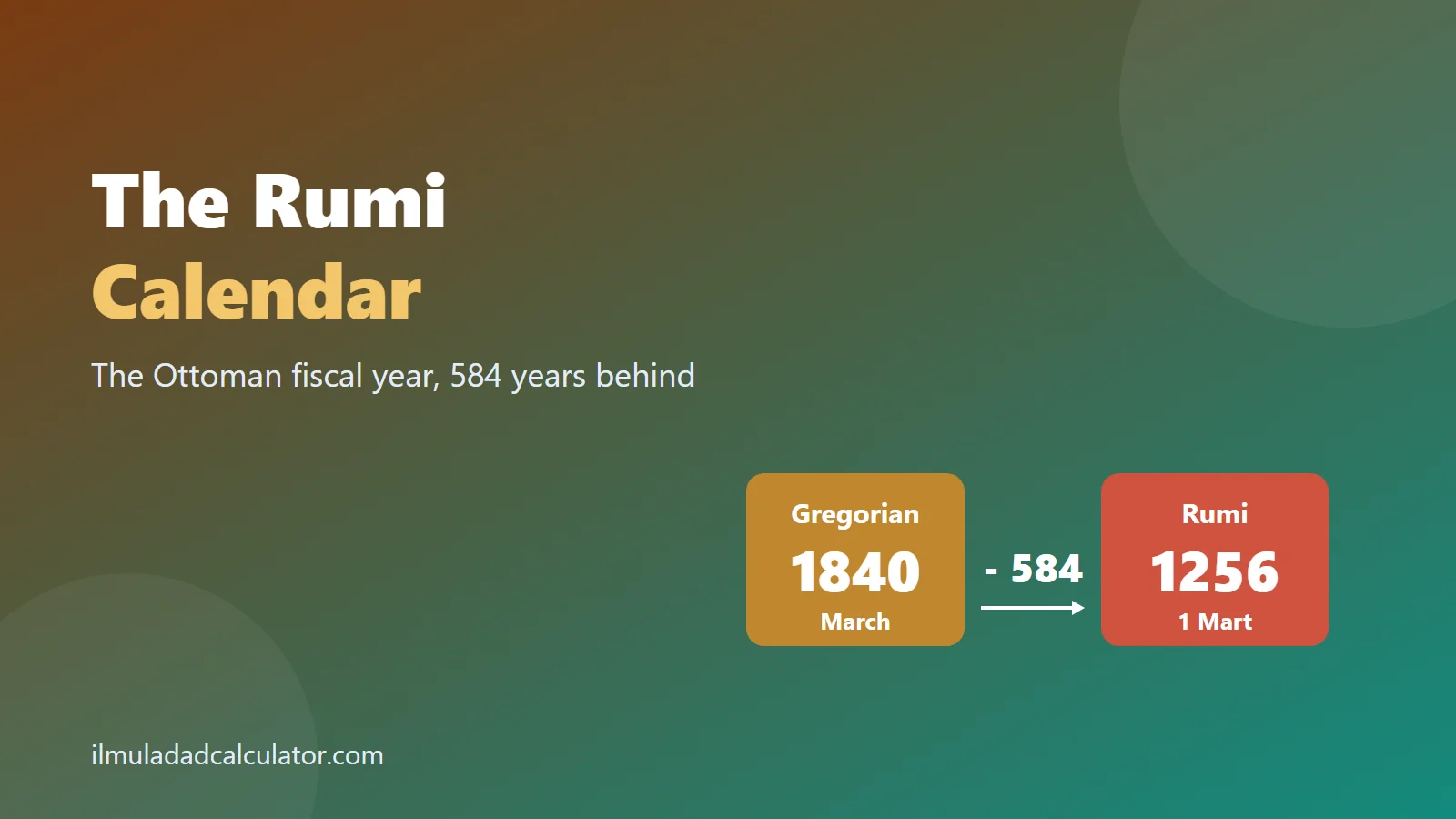
The Rumi calendar was the Ottoman state account year. It used Julian days, started in March, and sat 584 years behind the Gregorian count.
What Is the Rumi Calendar?
The Rumi calendar is a solar calendar built on the Julian calendar. Its Ottoman Turkish name, Rumi takvim, means Roman calendar. People also call it the Ottoman rumi calendar, and the mali calendar, from mali, meaning financial.
The Ottoman state used it for taxes and salaries first, and for civil life later. It stayed in use in the Republic of Turkey until 1926.
Do not confuse it with the Rumi numerals of Fez, which are a separate topic covered on the numerals page.
In short: the Rumi year starts on 1 March (Julian). Its year number is the Gregorian year minus 584 from March to December, and minus 585 in January and February.
Why Did the Ottomans Need a Fiscal Calendar?
The Hijri year is about 11 days shorter than the solar year. Taxes follow harvests, and harvests follow the seasons. A lunar due date drifts through the seasons over about 33 years.
That created a real accounting problem. A Turkish history article puts it simply. The state collected 32 years of taxes but paid 33 years of salaries.
The Skipped Year
The old fix was to skip a year. In 1677 the head treasurer Hasan Pasha proposed dropping one year every 33 years from the financial records. Turkish sources call the dropped year a sıvış year.
Fiscal books then used Julian dates. In 1740, which is 1152 AH, March became the first month of the fiscal year in place of Muharram.
What Are the Key Dates?
The Wikipedia article on the Rumi calendar gives these steps. The timeline shows them in order.
- 1677: the Julian calendar is used for fiscal matters.
- 1740: March becomes the first fiscal month.
- 1794: the fiscal calendar is extended to state expenditure and payments.
- 13 March 1840: the Julian calendar is adopted as the official civil calendar and named Rumi.
- February 1917: the calendar is realigned to the Gregorian calendar.
- 1926: the Gregorian year replaces the Hijri era count in Turkey.
How Does the 584-Year Offset Work?
After 1840 the Rumi year number stopped following the Hijri count. It rose by one every solar year. So it stayed a fixed distance behind the Gregorian year.
That distance is 584 years. The adoption year gives the check: 1840 – 584 = 1256, the number the year 1256 carried.
Where Does 584 Come From?
The Hijra was in 622 CE, and 622 – 584 = 38. By 1840 the lunar count had gained 38 years on the solar count, because 1256 – (1840 – 622) = 38. Freezing the count at that moment fixed the gap at 584.
After that, the Hijri year pulled ahead again at about one year every 33 years. By 1 March 1917 the tabular Hijri year was 1335, while the Rumi year was 1333.
The January and February rule follows from the March start. Dates in those months still belong to the year that began the previous March.
How Do You Convert a Rumi Date to Gregorian?
Two things change between a Rumi date and a Gregorian one. The year number moves by 584 or 585, and the day moves by the Julian gap. For the 1800s that gap is 12 days, and from March 1900 it is 13 days.
- Add 584 to the Rumi year for March to December. Add 585 for January and February.
- Read the result as a Julian date with the same month and day.
- Add the Julian gap to reach the Gregorian numerals.
Worked Example: The Adoption Day
The source gives 1 Mart 1256 as 13 March 1840. Add 584 to 1256 and you get 1840. Read it as Julian 1 March 1840, which has day number 2,393,178.
The gap for that date is 12 days, so the Gregorian date is 13 March 1840, a Fri. That matches the stated date.
Worked Example: A Date Before the 1917 Change
Take 15 Şubat 1332. Şubat falls in February, so add 585: 1332 + 585 = 1917. The Julian date is 15 February 1917, with day number 2,421,288.
The gap in 1917 is 13 days. Adding it gives 28 February 1917, which agrees with the table in the Wikipedia article.
These rules fit the standard Julian calendar. For how the Julian and Gregorian calendars differ, see Julian or Gregorian.
How Does the Rumi Year Differ From the Julian Year?
The days and months are the same as the Julian calendar. Two things differ, the year number and the day the year starts. The Julian year turns over on 1 January, while the Rumi year turns over on 1 March.
The Webtekno article describes the Rumi year as starting at Nevruz, the spring new year. It adds that the year is 365 days long, so the seasons stay in the same months. That steadiness is the point of a fiscal calendar, and it is why the state chose it.
Hijri and Rumi Numbers Side by Side
The table shows the Rumi year, and the tabular Hijri year, on 15 March of three Gregorian years. The Hijri values are computed from the 30-year cycle. The gap between the two numbers grows from 0 to 2 or more.
| Gregorian year | Rumi year | Hijri year (tabular) |
|---|---|---|
| 1840 | 1256 | 1256 |
| 1880 | 1296 | 1297 |
| 1917 | 1333 | 1335 |
The 1840 row shows the two counts together at the changeover. Later rows show the Hijri count pulling ahead.
What Were the Rumi Months?
The months are the Julian months with Ottoman names. Wikipedia notes that most names come from Syriac, while Mart, Mayıs and Ağustos come from Latin.
The fiscal year opened with Mart. The table lists the months in that order, and the lengths add up to 365 days in a common year.
| No. | Month | Days |
|---|---|---|
| 1 | Mart | 31 |
| 2 | Nisan | 30 |
| 3 | Mayıs | 31 |
| 4 | Haziran | 30 |
| 5 | Temmuz | 31 |
| 6 | Ağustos | 31 |
| 7 | Eylül | 30 |
| 8 | Teşrin-i Evvel | 31 |
| 9 | Teşrin-i Sânî | 30 |
| 10 | Kânûn-ı Evvel | 31 |
| 11 | Kânûn-ı Sânî | 31 |
| 12 | Şubat | 28 or 29 |
Şubat gains its twenty-ninth day in leap years, as in the Julian calendar. Four months were renamed in Turkish on 10 January 1945: Ekim, Kasım, Aralık and Ocak.
What Changed in 1917?
In February 1917 the Ottoman state moved its civil calendar to the Gregorian one. The Julian date ran 13 days behind. So the day after 15 Şubat 1332 was not 16 Şubat.
It was 1 Mart 1333, which matched 1 March 1917 in the Gregorian calendar.
As a check, Julian 16 February 1917 has day number 2,421,289. That day reads as 1 March in the Gregorian calendar. So Rumi 16 to 28 Şubat, 13 dates, were skipped.
The Short Year 1333
Year 1333 ran only from 1 March to 31 December 1917.
It had ten months and 306 days. That is the count from day 2,421,289 to day 2,421,594, inclusive. From 1 January 1918, which was 1 Kânûn-ı Sânî 1334, the year began in January.
Why Was 1840 the Turning Point?
Before 1840 the Julian calendar served only the treasury. Ordinary life, courts and religious dating kept the Hijri calendar. The change of March 1840 gave the fiscal system a civil role as well.
The Wikipedia article places this in the Tanzimat reform period, which began in 1839. The state wanted one clear calendar for administration, taxes and pay.
What Happened Between 1917 and 1926?
After the 1917 realignment, the year began on 1 January from 1918. The year number was still counted from the Hijra, so it read 1334 for 1918.
The article records an act of 26 December 1341 AH, in 1925. It ended the Hijri era count in Turkey.
From 1926 the Gregorian year number replaced it, so no new Rumi years were issued. The old Rumi numbers then survive only in books and archives.
How Should You Cite a Rumi Date?
Write the Rumi date as it appears, then add the converted Gregorian date and the rule you used. For example, write 15 Şubat 1332 (Rumi), 28 February 1917 (Gregorian).
That habit helps the next reader, whether a student, an archivist or an editor.
It also separates an Ottoman fiscal date from a Hijri one, which would give a very different day. Add the day number if you want the reader to verify it.
How Do You Spot a Rumi Date in a Document?
Documents from this period often carry a Hijri year and a Rumi year side by side. You can tell them apart by size, because the Rumi number is smaller after 1840.
- A year such as 1333 beside a month name like Mart is probably Rumi.
- A year with Muharram or Safar is Hijri.
- If the two numbers differ by 2 or 3 in the early 1900s, you are looking at the pair.
The same page may also use a chronogram, which is a verse whose letters carry a date. Ottoman poets usually chose the Hijri year for this, as explained on the Ottoman chronograms page. Letter values can be checked with the chronogram decoder.
Common Mistakes
- Using one offset all year. January and February need 585, not 584.
- Treating the number as Hijri. After 1840 the Rumi year stopped tracking the lunar count.
- Forgetting the Julian gap. The numerals match the Julian calendar, so a day shift is still needed.
For the Hijri side of any pair, use the Hijri to Gregorian formula page. The history of the Hijri calendar adds background. The calendar hub lists the other systems.
This page deals with calendar arithmetic only. It makes no statement about any observance.
خلاصہ
رومی کیلنڈر عثمانی سلطنت کا مالی شمسی کیلنڈر تھا جو جولین کیلنڈر پر مبنی تھا۔ ۱۳ مارچ ۱۸۴۰ کو اسے سرکاری حیثیت ملی اور سال کا آغاز یکم مارچ سے ہوتا تھا۔ رومی سال کا نمبر عیسوی سال منفی ۵۸۴ ہے، جبکہ جنوری اور فروری میں ۵۸۵ منفی کیا جاتا ہے۔ فروری ۱۹۱۷ میں تیرہ تاریخیں چھوڑ کر اسے گریگورین کیلنڈر کے برابر کیا گیا۔ ترکی میں یہ نظام ۱۹۲۶ تک رائج رہا۔
Sources and Further Reading
- Rumi calendar, Wikipedia. The Julian basis, the 584-year offset, the dated steps from 1677 to 1926, the month names and the 1917 table.
- Osmanlı sıvış yılı, Webtekno. The skipped year, the 11-day yearly drift, and 1 March 1256 as the new year on 13 March 1840.
- Day numbers and tabular Hijri years are computed in code and asserted. See the methodology.
Frequently Asked Questions
What is the Rumi calendar?
It is the Julian-based solar calendar the Ottoman state used for finance and, from 1840, for civil life. Its year began on 1 March.
How do I convert a Rumi year to a Gregorian year?
Add 584 for March to December and 585 for January and February. Then shift the day by the Julian gap if you need the exact Gregorian date.
Why is the Rumi calendar 584 years behind?
The count was frozen at 1256 in 1840, when the lunar count had gained 38 years on the solar count. 622 – 38 = 584.
What happened to the Rumi calendar in 1917?
The day after 15 Şubat 1332 became 1 Mart 1333, equal to 1 March 1917. Thirteen dates were skipped to match the Gregorian calendar.
When did the Rumi calendar end?
An act of December 1925 ended the Hijri era count in Turkey. The Gregorian year replaced it from 1926.