Tarih düşürme is the Ottoman Turkish art of dropping a date into a line of verse. The letters of the line add up to a Hijri year, using the same abjad values as Arabic and Persian. Poets used it for fountains, mosques, gates, books and gravestones.
What Does Tarih Düşürme Mean?
In Turkish, tarih means date, and düşürmek means to drop or let fall. So tarih düşürme is “dropping a date.” Writers also said tarih söyleme, or saying a date. Another term was tarih yazma, or writing a date.
The Turkish Encyclopedia of Islam defines it as stating an event’s date in a line. The date can sit in a couplet or a phrase, by abjad values. A poet who wrote such lines was called a müverrih, a word that also means historian.
The line that holds the date is the tarih mısraı, the date line. Persian poets called it mâdde-i târîh, and the Urdu form is called tarikh goi.
Where Did the Ottoman Tradition Come From?
The Turkish encyclopedia says the art appeared first in Persian literature in the 12th century. It then passed from the Persians to the Turks, and later from the Turks to the Arabs.
In Turkish, it began to grow in the 14th century and was most productive in the 18th. See the Persian chronograms page for the older tradition.
From Arabic and Persian to Turkish
Until the time of Süleyman the Magnificent, dated inscriptions were mostly Arabic or Persian. From the 16th century they were written more often in Turkish.
Single words and short phrases came first. Poems with the date in the final line became popular later.
Hızır Bey and the Final Line
The encyclopedia credits Hızır Bey, a 15th-century scholar, with starting a new path. Before him, dates were usually a word or phrase, or only the abjad letters.
He placed the date in the last line of a poem. His line for the conquest of Istanbul is one of the examples the encyclopedia gives.
Where Do Ottoman Chronograms Appear?
The tradition left dates on many kinds of objects and in many kinds of books. These are the main places a reader meets them.
- Fountains and sebils. Poems of praise carved on marble, with the date in the last line.
- Mosques, gates and palaces. Plaques above doors named the builder and the year.
- Gravestones. A short line prayed for the dead and gave the year of death.
- Poetry collections. Many divans keep their date poems in a section called tevârih.
- Book titles. Some titles were chosen so that their letters gave the year of writing.
Date poems were also gathered in collections. Ayvansarâyî’s Mecmûa-i Tevârih is one of the best known, with poems on almost every subject.
Poets also dated births, circumcisions, weddings, accessions, campaigns and peace treaties. Some wrote on very small matters, such as the death of a cat.
Lost inscriptions: the Database of Ottoman Inscriptions notes that chronogram poems preserve texts of plaques that no longer survive. The date poems in divans can be the only record.
For plaques on buildings in general, see the page on building chronograms.
How Is an Ottoman Date Poem Built?
Most date poems were short poems of a few couplets. The last line carried the number, and the line before it usually named the poet and said the word tarih.
That signal mattered. Without it, the reader had trouble finding which line to count.
- Find the line that follows the word tarih, usually the last line.
- Write it in Arabic script, as Ottoman Turkish was written.
- Add the letter values. Letters like چ and پ count as their Arabic base.
- Look for a hint that says to add or remove a number.
- Check the year against the event.
Most poets used the Hijri lunar year. In later periods, some used the solar Hijri, the financial (Rumi) or the Common Era year.
What Kinds of Ottoman Chronograms Exist?
Ottoman writers named many types, and the encyclopedia lists the main ones. They differ in how the year is spoken, how it is totaled, and which letters count.
| Term | Meaning |
|---|---|
| Lafzan tarih | The year is spoken in words, with no letter counting. |
| Mânen tarih | The letters add up to the year. This is the most common kind. |
| Tam tarih | The total matches the year exactly, with nothing added or removed. |
| Ta’miyeli tarih | The total is off, and a hint tells the reader what to add or remove. |
| Dütâ tarih | The line gives the year twice, once in each half. |
| Mu’cem tarih | Only letters with dots are counted. |
| Mühmel tarih | Only letters without dots are counted. |
Skilled poets were proud of the harder types. In the 18th century the art turned into a contest of skill.
Why Did Poets Keep Writing Them?
Date poems gave a plain fact a lasting form. A year in digits can be copied wrongly, but a year inside a line is harder to change.
The poem also did social work. A patron who paid for a fountain received praise and a date together, carved where every passer-by could read them.
Readers enjoyed the puzzle as well. Finding the date line and checking its total was a small test of learning.
Why Sources Show Latin Letters
Modern Turkish books print these lines in the Latin alphabet, which Turkey adopted in 1928. The letters of the old script are not visible there.
To check a total, a reader must write the line back in Arabic script. Spelling choices matter, so a total is only trusted when it matches the stated year.
How Did Hızır Bey Date the Conquest of Istanbul?
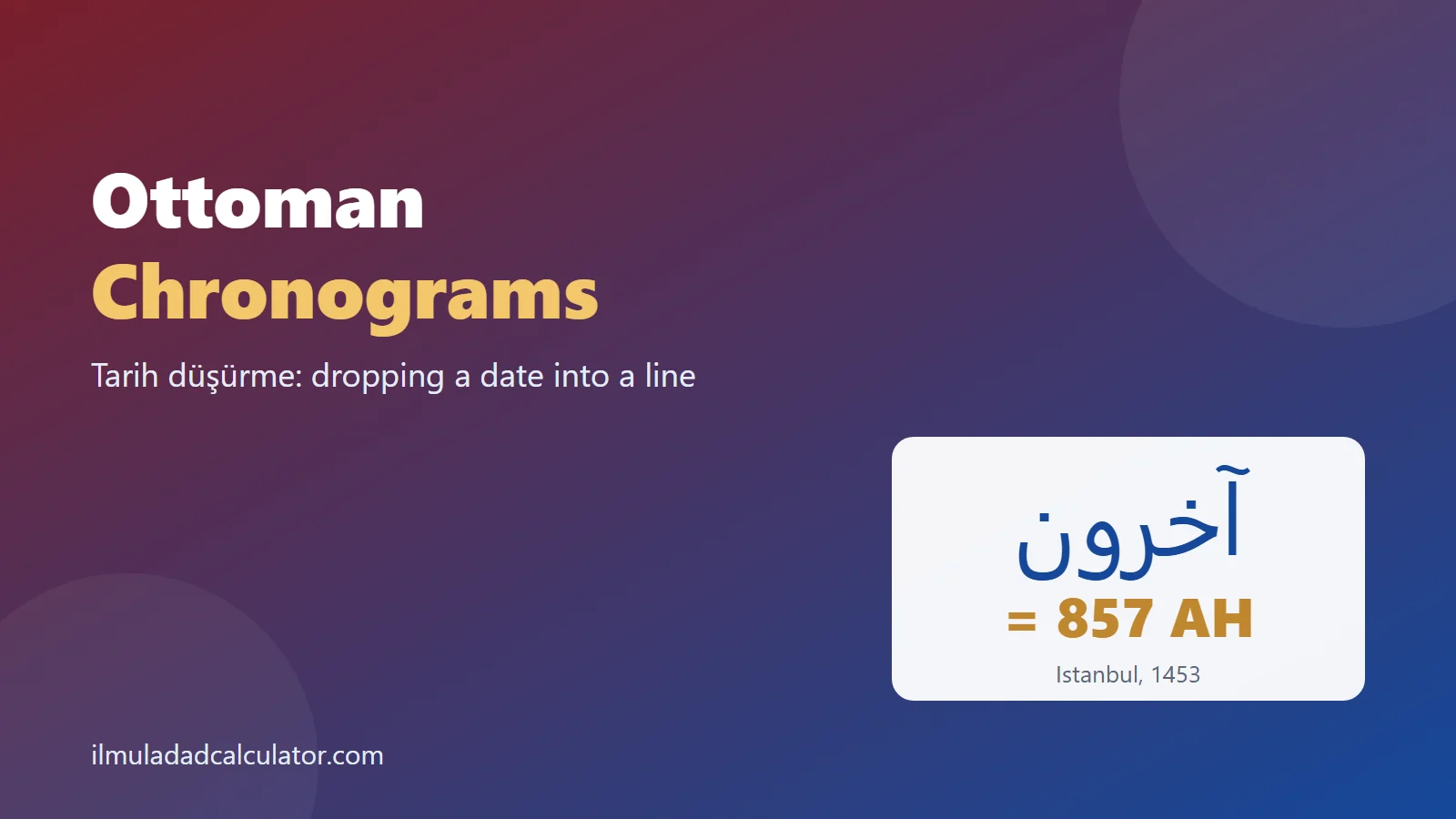
Hızır Bey wrote a couplet about the conquest of Istanbul. Its last word, âhırûn, means “those who came later.”
آخرون
The letters add up as 1 + 600 + 200 + 6 + 50 = 857 AH. That is the year of the conquest, 1453 CE.
The poem says that the earlier ones did not find victory at Istanbul, and that Sultan Muhammad achieved it. The date word is the last word of the verse.
The encyclopedia mentions a second chronogram for the same event, the Arabic phrase beldetün tayyibetün. Written with te at the end of each word, it adds up as 436 + 421 = 857.
Counting the ending: the engine counts ة as 5, which would give 67 here. The total of 857 only works if each ending is counted as te, 400. Chronograms follow the written form.
How Does a Hidden Subtraction Work?
A ta’miyeli tarih needs a small correction. The encyclopedia gives a couplet by the poet Rahmi for a fountain of Prince Seyfeddin in Üsküdar.
نه اعلی چشمه آباد ایلدی شهزاده سیف الدین
The second line adds up to 55 + 111 + 348 + 8 + 55 + 322 + 150 + 95 = 1144. The fountain was built in 1141 AH, so the reader must remove 3.
The first line carries the clue, the word ناسه (nâse). It reads as “people” and also as “nā-se”, meaning “no three.”
This is a hidden hint, because the poem never says “subtract.” The reader must see the pun. The page on add and subtract devices shows more cases.
What Is a Double Chronogram?
A dütâ tarih gives the year twice. The finest kind splits the line in two, so each half is a chronogram.
The poet Sürûrî wrote one for the death of Ali Ağa in 1784. The encyclopedia says each half adds up to 1198.
الله علی آغایی | ره یاب جنت ایتسون
The first half gives 66 + 110 + 1022 = 1198. The second gives 205 + 13 + 453 + 527 = 1198.
The halves mean “God (grant) Ali Ağa” and “may he reach paradise.” Two clean totals marked a master. Few poets managed both halves.
Could a Date Poem Be Funny?
Yes. The encyclopedia quotes Sürûrî’s date for a cat that died of longing for a mouse in 1798.
فاره نك حسرتندن اولدی کدی
The line adds up as 286 + 70 + 772 + 51 + 34 = 1213 AH, which is 1798 CE. The first line says he stuck up his tail and told the date.
The poem shows how far the habit went. Even small domestic events could get a chronogram.
What Is the Story of the Ahmed III Fountain?
The Fountain of Ahmed III stands before the Imperial Gate of Topkapı Palace. Wikipedia says the last stanza of the poem on its northwest face is a chronogram by the sultan himself.
The Turkish encyclopedia entry on the poet Seyyid Vehbi adds a story. The sultan’s own date line came out short, and Vehbi fixed it by adding one word, aç (“open”).
Vehbi wrote 128 date poems, by that entry’s count. His fixing of a sultan’s line shows how exact the counting was.
What Do These Examples Show?
| Line | Event | Year | Method | Source |
|---|---|---|---|---|
| آخرون | Hızır Bey, conquest of Istanbul | 857 AH (1453) | Total | source |
| بلدت طیبت | Phrase tied to the same conquest | 857 AH (1453) | Total | source |
| نه اعلی چشمه آباد ایلدی شهزاده سیف الدین | Rahmi, fountain of Prince Seyfeddin | 1144 − 3 = 1141 AH (1728 to 1729) | Minus 3 | source |
| الله علی آغایی / ره یاب جنت ایتسون | Sürûrî, death of Ali Ağa | 1198 + 1198 (1784) | Each half | source |
| فاره نك حسرتندن اولدی کدی | Sürûrî, a cat’s death | 1213 AH (1798) | Total | source |
How we checked: the sources give these lines in Latin letters. We wrote them in standard Ottoman spelling, and each spelling reaches the stated year. The key word ناسه is given in Arabic script by the encyclopedia.
Paste any line into the chronogram decoder to see the same arithmetic. For the famous cases, see famous chronograms.
To learn the steps, read how to read a chronogram. The Arabic side is on the Arabic chronograms page.
خلاصہ
عثمانی ترک شاعر تاریخ دینے کے فن کو «تاریخ دوشورمہ» کہتے تھے، یعنی ایک مصرعے میں سال چھپا دینا۔ اس کے حروف کی ابجد قیمتیں جمع کرنے سے ہجری سال نکلتا ہے۔ یہ فن چشموں، مساجد، دروازوں، کتابوں اور قبروں پر ملتا ہے۔ خضر بیگ نے فتحِ استنبول کی تاریخ «آخرون» سے ۸۵۷ ہجری نکالی۔
Sources and Further Reading
- Tarih Düşürme, TDV Islam Ansiklopedisi, by Turgut Karabey. Origin, types, and the Rahmi, Sürûrî and cat examples.
- Hızır Bey, TDV Islam Ansiklopedisi. The conquest of Istanbul line (857).
- Seyyid Vehbî, TDV Islam Ansiklopedisi. The Ahmed III fountain story and 128 date poems.
- About the Database of Ottoman Inscriptions. Chronograms as sources for lost inscriptions.
- Fountain of Ahmed III, Wikipedia. Poem and chronogram stanza.
Frequently Asked Questions
What is tarih düşürme?
It is the Ottoman Turkish art of dating an event with a line whose letters add up to a year.
Which script do Ottoman chronograms use?
They are counted in Arabic script, with the same abjad values used for Arabic and Persian.
Which years did Ottoman poets use?
Mostly the Hijri lunar year. Later poets also used the solar Hijri, Rumi and Common Era years.
What is a ta’miyeli tarih?
It is a chronogram whose total is off by a little, with a hint to add or remove a number.
Why do sources give Ottoman lines in Latin letters?
Modern Turkish books transliterate them. To count, the line must be written back in Arabic script.