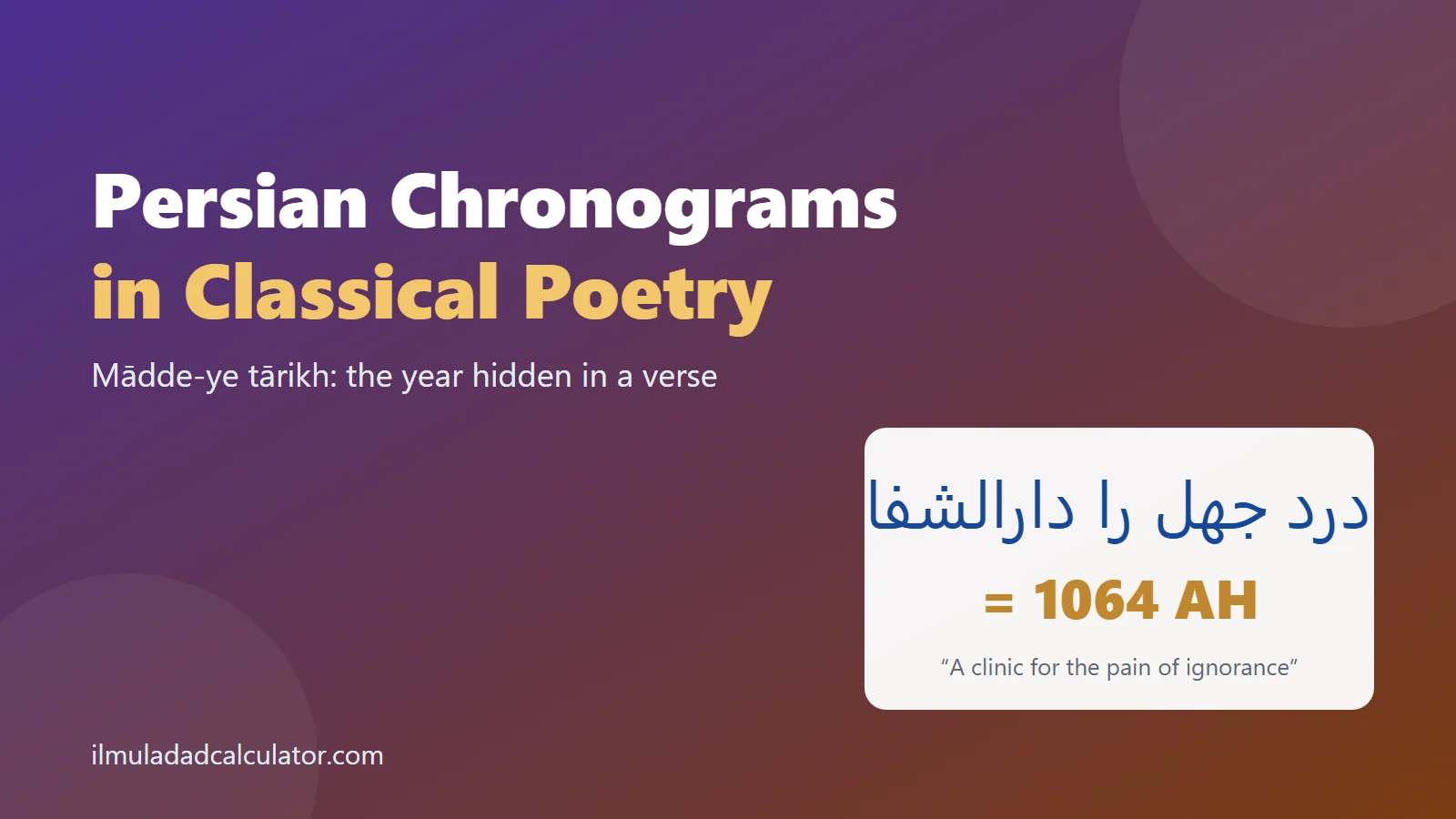
A Persian chronogram is a line of verse whose letters add up to the year of an event. Persian poets called it مادهٔ تاریخ, mādde-ye tārikh. For about six centuries, it was one of the most loved short forms in Persian poetry.
What Is a Persian Chronogram?
Each Persian letter has a number in the abjad system. A poet picks a phrase that suits the event and also adds up to the right Hijri year. The reader adds the letters and finds the date.
Encyclopaedia Iranica defines mādde-ye tārikh as a poetic genre that includes the year of an event. Persian writers often shortened the name to tārikh, “date,” and spoke of the plural as tavārikh.
| Persian | Roman | Meaning |
|---|---|---|
| مادهٔ تاریخ | mādde-ye tārikh | The “material of the date”: the words that add up to the year |
| قطعهٔ تاریخ | qeṭʿa-ye tārikh | A short occasional poem that ends with the date |
| حساب جمل | hesāb-e jommal | Reckoning by phrases: adding letter values to get a number |
| تاریخ صوری | tārikh-e suri | An explicit date, written out in number words |
| تاریخ معنوی | tārikh-e maʿnavi | A “meaningful date” hidden in a word or phrase |
| تاریخ تعمیه | tārikh-e taʿmiye | A riddle date that needs adding or subtracting |
The last three terms come from Qabul Mohammad’s 1822 handbook, Haft Qolzom, as summarized by Iranica. Only the meaningful date and the riddle date use letter values.
How Did Number Words Turn Into Phrase Chronograms?
The earliest Persian poets simply wrote the year in words. Next, some used single letters as number words. Our history of abjad page tells that story, with Kesa’i, Mas’ud-e Sa’d and Hafez.
The poet Khaqani, who died around 1199, also dated his travels with letters. Iranica cites the letters tha, nun and alif:
ثنا
ث 500 + ن 50 + ا 1 = 551 AH, or 1156 CE
Read this way, each letter is just a digit in disguise. The great change came around 1300, when poets began to build real words and phrases with the right total.
The First Meaningful Words
A single well-chosen word could carry a whole date. The death of Abu Saʿid, the last Ilkhanid ruler, was dated this way.
The word is لوذ, lawdh, which means refuge. Its letters give 736 AH, which is 1335. Lam, waw and dhal give 30, 6 and 700.
In the same period, the poet Ebn Yamin wrote about twenty short poems for the deaths of officials. He still wrote the years in words. Yet his short qeṭʿas show the form that soon became standard.
What Does a Qeṭʿa-ye Tārikh Look Like?
The qeṭʿa is a short poem for an occasion. It became the standard home for chronograms, and the result is called a qeṭʿa-ye tārikh.
Iranica lists the parts that stayed stable for centuries:
- The opening verses introduce the person or the event.
- Later verses praise the person or describe the building.
- A clear signal, usually the word tārikh, warns that a date is coming.
- A closing motto gives the year by phrase reckoning.
In the Safavid and Mughal period, a typical poem ran from five to fifteen verses. The motto often filled the whole final half-verse.
How Does the Poet Signal the Date Line?
A chronogram is not hidden in the sense of a secret. The poet points straight at it, so readers know where to start counting.
- The word tārikh. Phrases like “its date” or “the year of his death” come just before the motto.
- A command to seek. Many poems tell the reader to “seek the date from” a phrase.
- A clue for arithmetic. Verbs like “rose” or “fell,” or words like “without,” tell the reader to subtract.
Reading tip: count only the motto, never the signal words before it. Iranica notes that even the trickiest devices are usually marked in the poem itself.
Which Persian Chronograms Show the Craft Best?
The examples below come from Encyclopaedia Iranica. Every total on this page was checked with our letter-value engine.
Mohtasham’s Double Chronogram for a Judge
Mohtasham of Kashan, who died in 1588, closed a poem on a judge’s death with two half-verses. Each one is a complete chronogram:
آه از آن عالم اسرار قدر
وای از آن مفتی احکام رسول
The first half mourns a scholar of the secrets of destiny. The second mourns a judge of the Prophet’s decrees. Both halves praise the man and give the same year.
A Clinic for the Pain of Ignorance
Waʿez of Qazvin, who died in 1678, dated a new madrasa with a witty phrase. It joins a school and a hospital in one image:
درد جهل را دارالشفا
208 + 239 + 617 = 1064 AH, or 1654 CE
Dār al-shefā means a hospital, or house of healing. A madrasa cures the illness of ignorance. So the phrase fits both the building and the year.
Dates Made by Subtraction
Some poets set the reader a small sum. The poem names two values, and a verb or a phrase says to take one from the other.
- Jami (Timurid Herat): one chronogram for his death says that smoke rose from Khorasan. Take smoke, دود (14), out of خراسان (912) to reach 898 AH. Jami died in November 1492, which falls in that year.
- ʿAli-Naqi of Kamara: a mansion is called paradise without its second. Remove the second letter, waw (6), from روضه (1011) to get 1005 AH.
- Najib of Kashan: for Shah Solayman’s death, a cry rose from the throne. Take فریاد (295) from تخت (1400) to get 1105 AH.
Najib’s closing line then lifts سلیمان زمانه, “the Solomon of the age,” from the throne. That gives 1400 − 294 = 1106. Iranica explains that the shah died late in 1105, and the forty days of mourning ran into 1106.
All the Examples at a Glance
| Poet or occasion | Method | Motto | Value (AH) | CE |
|---|---|---|---|---|
| Khaqani | Letters as numbers | ثنا | 551 | 1156 |
| Death of Abu Saʿid, the last Ilkhanid | One word | لوذ | 736 | 1335 |
| Death of Jami, Herat | Subtraction | خراسان − دود | 912 − 14 = 898 | 1492 |
| Mohtasham, death of a judge | Double chronogram | آه از آن عالم اسرار قدر | 972 | 1564 to 1565 |
| Mohtasham, death of a rival poet | Full half-verse | انتقام باطنی دیدی بجان او چه کرد | 987 | 1579 |
| ʿAli-Naqi, a mansion in Qazvin | Subtraction | روضه − و | 1011 − 6 = 1005 | 1596 to 1597 |
| Waʿez of Qazvin, a madrasa | Phrase | درد جهل را دارالشفا | 1064 | 1654 |
| Najib of Kashan, Shah Solayman | Subtraction | تخت − فریاد | 1400 − 295 = 1105 | 1694 |
Read down the table and the methods grow more complex over time. Early poets used bare letters, while later ones built full half-verses and small sums. The Hijri years run from 551 to 1105.
The table also shows how wide the occasions were. A poet’s travels, a ruler’s death, a madrasa and a private mansion all earned a dated verse.
Mohtasham’s line on a rival poet asks what hidden vengeance did to the man’s life. Iranica prints 244 for its last word, کرد. The letters give 224, and only 224 reaches 987.
How Popular Were Chronograms at Persian Courts?
The form spread across the whole Persian-speaking world. Iranica dates its real popularity to the 15th century, under the Timurids.
Timurid Herat
Late Timurid poets loved riddles, called moʿammā. The rules for those riddles were applied to chronograms, which made room for subtraction and other tricks. Jami’s death chronogram belongs to this world.
Safavid Iran
Mohtasham devoted a whole section of his divan to chronograms. For the accession of Esmaʿil II in 984 AH, he wrote six quatrains holding 1,128 chronograms.
In those quatrains, every half-verse gives 984. Its dotted and undotted letters each give 492, half the year.
Three later Safavid poets, ʿAli-Naqi, Waʿez and Najib, each left more than seventy chronogram poems. A literary biographer of the age, Taher of Nasrabad, gave the genre its own chapter.
The Mughal Court
Iranica says the genre was equally popular at the Mughal courts. Kalim of Kashan became Shah Jahan’s poet laureate in 1632, and his divan holds 33 chronograms.
Kalim marked the births and marriages of Shah Jahan’s sons and the deaths of his ministers. He also wrote one for Mumtaz Mahal and others for the emperor’s buildings.
Central Asia and Later Iran
In Samarqand, Mir Sayyed Sharif Raqem wrote a history, finished about 1713, built almost wholly on chronogram poems. Persian journals such as Yaghma and Armaghan still printed them in the 20th century.
Why Did Persian Poets Love Chronograms?
A chronogram is a puzzle, a poem and a record at once. Iranica points out that it records a date more securely than a bare number. A miscopied digit is easy to miss, but a wrong letter breaks the verse.
Chronograms also met a practical need. Tombstones and foundation plaques needed short, elegant lines, and patrons paid poets to write them. Over half of Mohtasham’s chronograms mark deaths, and buildings are the next great theme.
There was a deeper aim as well. By tying a year to a fitting phrase, the poet gave meaning to a passing date. Births, deaths and new rulers became part of the literary memory.
How Can You Check a Persian Chronogram Yourself?
Copy the motto exactly as written, then add its letters. The chronogram decoder shows each step and converts the Hijri year to the Common Era.
- Persian letters: پ counts as ب, چ as ج, ژ as ز and گ as ک. Our page on Urdu and Persian letter values lists them all.
- Old spelling: older texts often join words, as in بجان, meaning to the life. A detached به adds a he worth 5.
- The ezafe: the short “-e” linking words is usually not written after a consonant, so it adds nothing.
- Hijri years: a total of 1064 means 1064 AH, not 1064 CE.
When the total misses, look back at the poem for a verb of rising, falling or removing. That clue usually explains the gap.
Also check the edition you are reading. Printed texts sometimes differ by a letter, and a single letter can move a total by hundreds.
How Did Persian Practice Shape Urdu Chronograms?
Iranica notes that the genre passed from Persian into Ottoman Turkish, Arabic and Urdu. Urdu poets kept the same parts: the occasion, the signal and the closing motto.
Urdu poets used the same letter values and the same cue words, such as tārikh. Our guides to Urdu chronograms and tarikh goi follow the story from there. For the wider picture, start at the chronograms hub.
خلاصہ
فارسی شاعری میں مادۂ تاریخ وہ مصرع یا فقرہ ہوتا ہے جس کے حروف کی ابجد قیمتیں جمع کرنے سے کسی واقعے کا ہجری سال نکلتا ہے۔ یہ فن عموماً قطعۂ تاریخ میں آتا ہے، جس کے آخری مصرع میں لفظ «تاریخ» کے اشارے کے بعد سال چھپا ہوتا ہے۔ محتشم کاشانی، واعظ قزوینی اور کلیم کاشانی جیسے شاعروں نے صفوی اور مغل درباروں میں یہ فن عروج تک پہنچایا۔ مثلاً «درد جهل را دارالشفا» سے ۱۰۶۴ ہجری نکلتا ہے۔
Sources and Further Reading
- Mādda tāriḵ, Encyclopaedia Iranica, by Paul E. Losensky (2006). Form, signals, stages of growth, and the Mohtasham, Waʿez, ʿAli-Naqi and Najib examples.
- Chronograms, Encyclopaedia Iranica, by J. T. P. de Bruijn (1991). The four types, Khaqani, lawdh, the Jami chronogram and Mohtasham’s 1,128 chronograms.
- Kalim Kashani, Wikipedia. Poet laureate in 1632 and the 33 chronograms in his divan.
- Jami, Wikipedia. His death in Herat on 9 November 1492.
- Abu Sa’id Bahadur Khan, Wikipedia. The last Ilkhanid ruler, who died in 1335.
Frequently Asked Questions
What does mādde-ye tārikh mean?
It means “material of the date.” It names the words whose letters add up to the year.
Which calendar do Persian chronograms use?
Almost always the Hijri lunar calendar. Convert the total before comparing it with a Common Era date.
Do Persian letters like gaf and pe have their own values?
No. They count as their Arabic base letters: gaf as kaf (20) and pe as ba (2).
Who wrote the most Persian chronograms?
Mohtasham of Kashan is a leading example. One set of his quatrains holds 1,128 chronograms.
Why do some chronograms need subtraction?
Sometimes no fitting phrase hits the year exactly. The poet then signals a value to remove, often with a verb like “rose.”