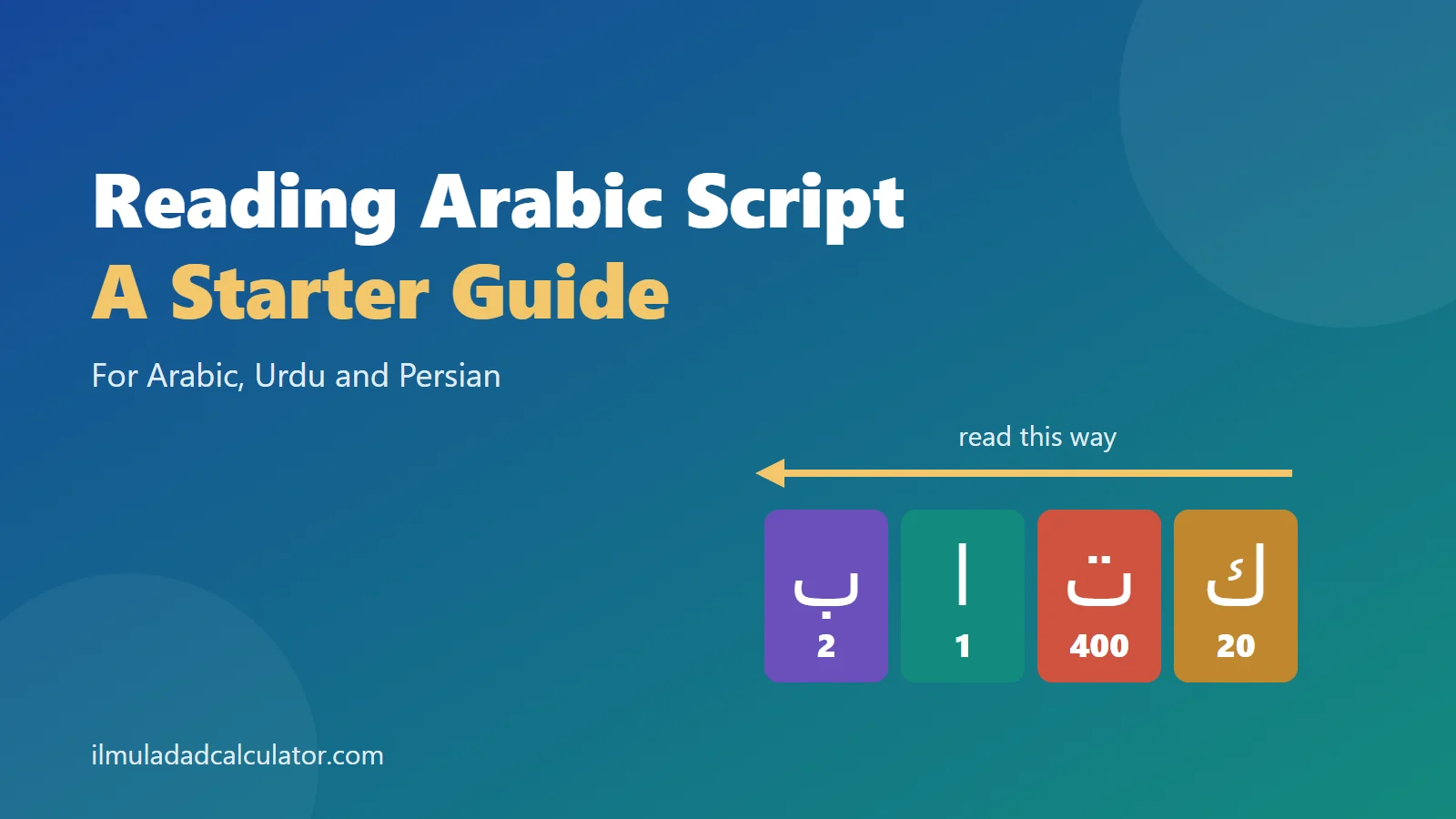
The Arabic script is written from right to left, with letters that join like handwriting. The same script is used for Arabic, Persian and Urdu. This guide gives a first picture of how it works, then points you to the page you need next.
What Is the Arabic Script and Who Uses It?
A script is a set of written signs. A language is the speech those signs record. The Arabic script is used for Arabic, and also for Persian, Urdu, Pashto, Kurdish, Sindhi and many other languages.
This matters for Ilm-ul-Adad, because the method works on letters, not on a language. The same letter ب counts as 2 whether it sits in an Arabic, Persian or Urdu word.
Each language kept the old letters and added a few for its own sounds. You can learn the shared core once and use it for all three.
Which Direction Do You Read the Arabic Script?
You read from right to left. Your eyes start at the right edge of the line and move toward the left. The first letter of a word is therefore the one on the far right.
Numbers are the exception. In Persian text, numbers and dates still read from left to right.
The script also has no capital letters. Each letter keeps one basic design, so you never need to learn upper and lower case.
How Do Letters Change Shape Inside a Word?
The script is cursive, so letters usually join their neighbors. Because of that, most letters have up to four forms, depending on where they sit in a connected group.
| Form | Shape | Where it appears |
|---|---|---|
| Isolated | ب | On its own |
| Initial | ب | First letter of a connected group |
| Medial | ب | In the middle of a group |
| Final | ب | Last letter of a connected group |
The form changes the look but never the value. A ba in the middle of a word is still worth 2.
Six Letters That Stand Apart
Six letters join the letter before them but never the one after them. They are ا, د, ذ, ر, ز and و. After one of them, the next letter starts a fresh connected group, which leaves a small gap.
The full explanation is on the page about letters that do not connect. The shapes of every letter are laid out on the page about Arabic letter forms.
How Do Dots Tell Letters Apart?
Many letters share one body shape and differ only by their dots. For example, ب, ت and ث look alike, with one dot below, two above and three above.
For a beginner, dots are the most important detail. Learn the body shapes first, then the dots, and the alphabet shrinks into a smaller set of families.
- Count the dots before you decide which letter you see.
- Note whether the dots are above or below the shape.
- Check that a dot belongs to this letter and not its neighbor.
Why Are Short Vowels Usually Missing?
Arabic writes mainly consonants. Short vowels are usually left out of everyday writing. Small marks for them appear only in a few kinds of text, such as children’s books and grammar texts.
Writing systems of this kind are called abjads. Readers fill in the missing sounds from context, so a bare word may look incomplete at first.
Why this helps us: Abjad values belong to letters, not to vowel marks. The bare spelling of a word is usually the part you count.
What Do Persian and Urdu Add to the Arabic Letters?
Persian keeps the 28 Arabic letters and adds four, giving 32. The four are pe (پ), che (چ), zhe (ژ) and gaf (گ), for the sounds p, ch, zh and g.
Urdu is a modified form of the Persian alphabet. It adds letters for sounds that Persian lacks, including the retroflex letters ٹ, ڈ and ڑ. Urdu is also usually written in the flowing Nastaliq style, while Arabic is more often printed in Naskh.
| Language | Common count | What changes |
|---|---|---|
| Arabic | 28 | The base alphabet |
| Persian | 32 | Adds پ, چ, ژ and گ |
| Urdu | 39 in most lists | Adds retroflex letters and other signs |
Our pages on Urdu and Persian letters and on how many letters Urdu has cover these additions in detail.
Is the Arabic Alphabet 28 Letters or 29?
Most sources say 28, and that count includes hamza. Some lists give 29 by treating the lam-alif ligature as a letter of its own. Wikipedia describes lam-alif as a required ligature, not a separate letter.
The count depends on what a list chooses to include. A side-by-side comparison is on the page about how many Arabic letters there are.
How Does Reading Help You Calculate Abjad Values?
Calculating a value is just reading a word one letter at a time. You name each letter, look up its number, and add the numbers. Take the word kitab, which means book:
ك 20 + ت 400 + ا 1 + ب 2 = 423
Three small skills make the job easy. You must see each letter and tell similar letters apart by their dots. You must also notice which letters are missing from the spelling.
- Find the right edge of the word and begin there.
- Name each letter, using its dots to avoid mix-ups.
- Write down its number from the Arabic letter values page.
- Add the numbers. The order of addition does not change the total.
Spelling choices can change a total, which is why two writers may reach different numbers. The page on why values differ explains this. For hamza, the trickiest sign, see hamza in Ilm-ul-Adad.
Can You Read Five Starter Words?
Practice makes the script feel familiar. Here are five short words, each read from the right. The romanization is a plain spelling in Latin letters, written the way many learners do it.
| Word | Sounds like | Meaning | Abjad value |
|---|---|---|---|
| كتاب | kitab | book | 423 |
| باب | bab | door | 5 |
| دار | dar | house | 205 |
| قلم | qalam | pen | 170 |
| نور | nur | light | 256 |
Notice how باب and دار contain letters from the stand-apart group. In دار, the first two letters do not join forward, so the word shows a gap after each one.
Try covering the table and reading each word aloud. Then add the letter values yourself and compare your total with the table.
What Mistakes Do Beginners Make Most Often?
Almost everyone makes the same few errors at the start. Knowing them in advance saves time.
Reading in the Wrong Direction
Your eyes want to start on the left because English works that way. Put a finger on the right edge of the word and slide it left.
Ignoring the Dots
A missing or misplaced dot turns ب into another letter, with a different value. Look at the dots every time, even when you think you know the word.
Treating Shapes as Different Letters
The four forms of a letter are one letter. A beginner may see two shapes and think they are two letters. They are one letter in two forms.
Why Does the Same Letter Look Different on Screen?
Fonts matter. Arabic is more often printed in the Naskh style. Urdu is usually written in the Nastaliq style.
Both styles use the same letters. A word in Nastaliq may look different from the same word in Naskh. The letters and values stay the same.
Some systems also show a joined shape poorly if the font is missing. If a letter looks broken on your device, try another browser or font before you assume the spelling is wrong.
How Do Computers Store Arabic Letters?
Every letter has a code number in the Unicode standard. The main Arabic block runs from U+0600 to U+06FF. ا is U+0627, ب is U+0628 and Persian پ is U+067E.
Computers store one code per letter, not one per form. The software then picks the right joined shape for the place in the word. That is why one typed ba can appear in four different shapes.
This also explains why typing is simple. You type the letters in order, and the screen draws the joins for you. The calculators on this site read those stored letters, so the forms never change a result.
How Does Romanization Help a Beginner?
Romanization means writing a word in Latin letters. It is a handy bridge while you learn, but it is not one fixed system.
Different books spell the same name in different ways, for example kitab or kitaab. For that reason, this site keeps the Arabic spelling as the real source for any value.
What Should You Practice First?
A short daily routine works better than one long session. Fifteen minutes is enough to see progress within a week.
- Say the names of the 28 letters in order, then check them against the alphabet in order page.
- Copy five words by hand, starting from the right, and notice where the gaps fall.
- Pick a name and add up its letters with the calculator as a check.
Handwriting helps the shapes stick. It also shows you how the joins really flow, which a typed word hides.
Where Should a Beginner Go Next?
This page is the starting point of a small group of script guides. Read them in the order that matches your goal.
| Page | Read it to learn |
|---|---|
| How many Arabic letters | Why the count is 28 or 29 |
| Arabic alphabet in order | The standard order of the 28 letters |
| Arabic letter forms | The four shapes of each letter |
| Letters that do not connect | The six letters that stand apart |
| History of the Arabic alphabet | Where the letters came from |
| Sun and moon letters | How the article al- sounds before each letter |
| Arabic vs Hebrew alphabet | Shared roots and key differences |
| Hamza writing rules | Where hamza sits on the line |
| Urdu alphabet in order | The Urdu letters with names and sounds |
| Urdu vs Arabic alphabet | The letters, shapes and sounds that differ |
| Do-chashmi he | The aspirated letter and its pairs |
| Arabic calligraphy styles | Kufic, Naskh, Thuluth and Nastaliq |
| Urdu vs Persian alphabet | The 32 and 39 letter sets |
| Nastaliq vs Naskh | Two writing styles, one set of letters |
If you want values right away, go to the letters hub or open the Abjad value calculator. The order that fixes the numbers is explained on the page about Abjad order versus the alphabet order.
خلاصہ
عربی رسم الخط دائیں سے بائیں لکھا جاتا ہے اور عربی، فارسی اور اردو تینوں میں استعمال ہوتا ہے۔ فارسی میں عربی کے اٹھائیس حروف کے ساتھ پ، چ، ژ اور گ شامل ہیں، جبکہ اردو میں مزید حروف بھی ہیں۔ حروف نقطوں سے پہچانے جاتے ہیں اور لفظ میں جڑ کر اپنی شکل بدلتے ہیں۔ ابجد کا حساب لگانے کے لیے ہر حرف کو پہچاننا ضروری ہے۔
Sources and Further Reading
- Arabic alphabet, Wikipedia. The 28 letters with hamza, lam-alif as a ligature, four forms, dots and omitted vowels. Also the six letters that join only backward.
- Arabic script, Wikipedia. Right-to-left cursive writing, no capital letters and the languages that use the script.
- Persian alphabet, Wikipedia. The 32 letters, the four additions and left-to-right numbers.
- Urdu alphabet, Wikipedia. Urdu as a modified Persian alphabet, retroflex additions and Nastaliq.
- Abjad values come from this site’s tested engine. See the methodology.
Frequently Asked Questions
Is Arabic written right to left?
Yes. Arabic, Persian and Urdu all run from right to left. Numbers inside Persian text still read left to right.
Is Urdu the same script as Arabic?
Urdu uses the Arabic script through the Persian alphabet. It adds letters for sounds that Arabic lacks.
Do I need to learn the vowel marks first?
No. Everyday writing leaves most short vowels out, and Abjad values belong to the letters.
Why do some letters leave gaps inside a word?
Six letters do not join the letter after them. The next letter then starts a new connected group.
How many letters does the Arabic alphabet have?
Most sources count 28, including hamza. Some lists reach 29 by adding the lam-alif ligature.