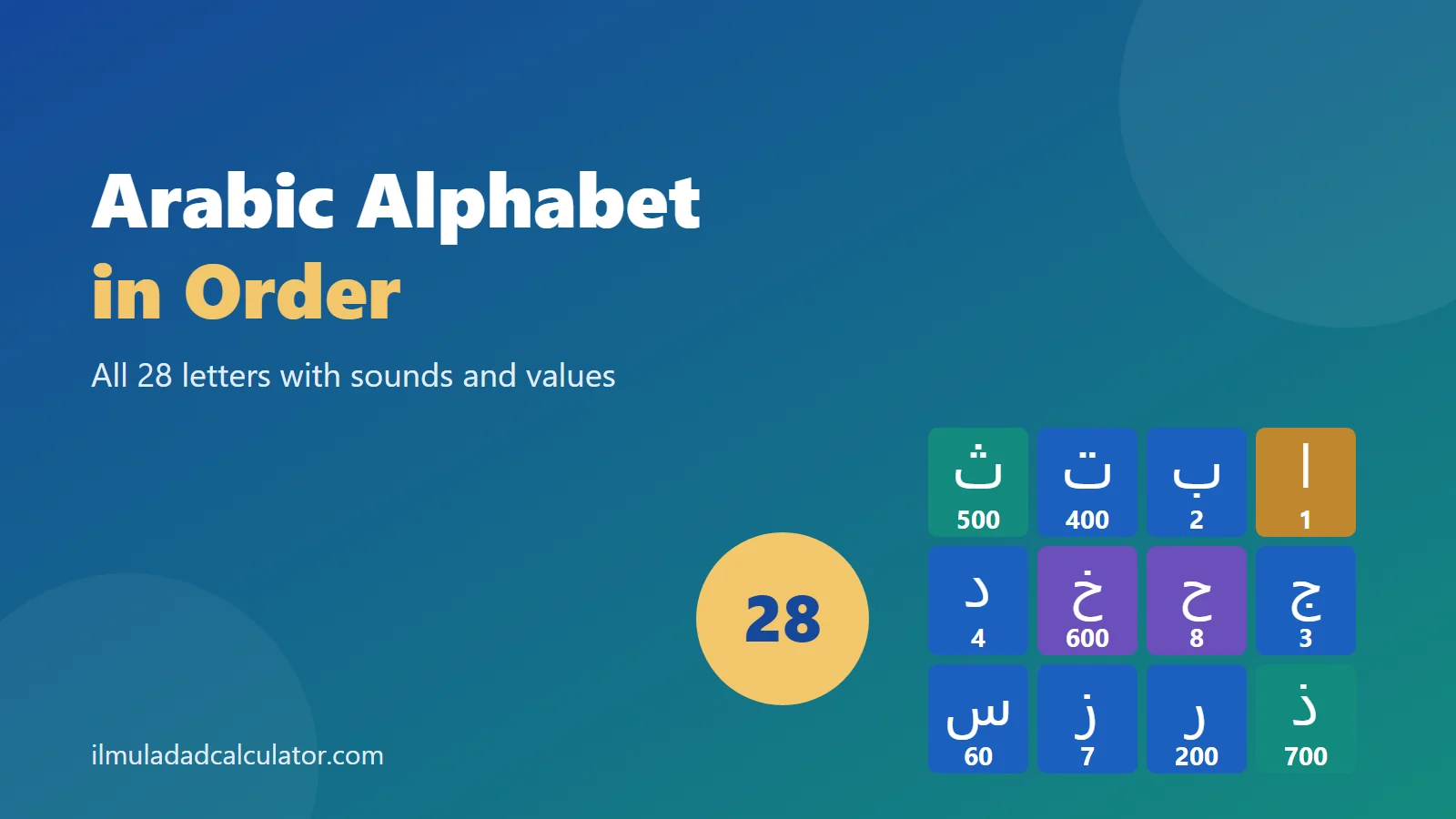
The Arabic alphabet has 28 letters, and it is written from right to left. The standard school order starts ا ب ت ث and ends ه و ي. This page lists all 28 with a name, a Roman spelling, an English sound hint and the Abjad value.
What Is the Standard Order of the Arabic Alphabet?
The standard order is the one taught in schools and used in dictionaries. It is called the hija’i order. It keeps letters with the same base shape side by side.
Count the letters from the right edge of a line, because Arabic runs right to left. Alif is first, and ya is 28th. Picture the alphabet as a row of tiles that you read toward the left.
Hamza (ء) is a sign for a catch in the voice, and most lists do not number it. The page on how many Arabic letters there are explains the 28 versus 29 count.
What Are the 28 Letters, Their Names and Their Sounds?
The table follows the standard order. Each row gives the letter, its name, a Roman spelling and a plain sound hint.
| # | Letter | Name | Roman | Sound hint | Abjad value |
|---|---|---|---|---|---|
| 1 | ا | Alif | ā (ʾ) | long “a” as in father, or a catch in the voice | 1 |
| 2 | ب | Ba | b | b as in bed | 2 |
| 3 | ت | Ta | t | t as in top | 400 |
| 4 | ث | Tha | th | th as in think | 500 |
| 5 | ج | Jim | j | j as in jump | 3 |
| 6 | ح | Ḥa | ḥ | a breathy h from deep in the throat | 8 |
| 7 | خ | Kha | kh | like ch in Scottish loch | 600 |
| 8 | د | Dal | d | d as in dog | 4 |
| 9 | ذ | Dhal | dh | th as in this | 700 |
| 10 | ر | Ra | r | a rolled r | 200 |
| 11 | ز | Zay | z | z as in zoo | 7 |
| 12 | س | Sin | s | s as in sun | 60 |
| 13 | ش | Shin | sh | sh as in ship | 300 |
| 14 | ص | Ṣad | ṣ | a deep, heavy s | 90 |
| 15 | ض | Ḍad | ḍ | a deep, heavy d | 800 |
| 16 | ط | Ṭa | ṭ | a deep, heavy t | 9 |
| 17 | ظ | Ẓa | ẓ | a deep, heavy version of dh | 900 |
| 18 | ع | ʿAyn | ʿ | a tight, voiced sound from the throat | 70 |
| 19 | غ | Ghayn | gh | like a gargled r | 1000 |
| 20 | ف | Fa | f | f as in fish | 80 |
| 21 | ق | Qaf | q | a k made farther back in the throat | 100 |
| 22 | ك | Kaf | k | k as in kite | 20 |
| 23 | ل | Lam | l | l as in light | 30 |
| 24 | م | Mim | m | m as in man | 40 |
| 25 | ن | Nun | n | n as in no | 50 |
| 26 | ه | Ha | h | h as in hat | 5 |
| 27 | و | Waw | w (ū) | w as in we, or long “oo” | 6 |
| 28 | ي | Ya | y (ī) | y as in yes, or long “ee” | 10 |
About the Roman spelling: it follows the ALA-LC scheme of the Library of Congress. Pairs such as th, kh, dh, sh and gh are single letters. A dot under a letter, as in ṣ, marks the deep, heavy sounds.
Why Do Some Letters Have Two Roman Spellings?
Alif, waw and ya can be a consonant or a long vowel. So و is w in one word and a long “oo” in another.
The table shows the vowel use in brackets. The short vowel marks are not letters, and they are not part of the 28.
Which Sounds Will Feel Familiar to an English Speaker?
Sixteen letters sound close to English consonants. Learn these first, and you already know more than half the alphabet.
The other twelve need a little practice. They fall into four groups, shown by color in the figure.
The Two Th Sounds
Arabic has both English th sounds. ث is the th of “think”, and ذ is the th of “this”.
Back of the Mouth and Throat
Five letters are made far back in the mouth or in the throat. They are ح, خ, ع, غ and ق.
English has no exact match for most of them. Listen to a native speaker, and use the hints in the table as a starting point.
Linguists describe ح and ع as pharyngeal, made in the throat. They describe ق, خ and غ as uvular, made near the soft flap at the back of the mouth.
The Four Emphatic Letters
The letters ص, ض, ط and ظ are called emphatic. The back of the tongue rises toward the throat, which gives a deeper, heavier sound.
Each one has a plain partner, shown in the next table. Say the plain letter first, then the heavy one, and listen for the depth.
Which Letters Are Easy to Confuse?
Many learners hear a plain letter and its heavy partner as the same sound. The table pairs each plain letter with a letter that sounds similar but deeper. The Abjad value follows each letter in brackets.
| Plain letter | Deeper partner | Plain sound | Partner sound |
|---|---|---|---|
| س (60) | ص (90) | s | a deep, heavy s |
| د (4) | ض (800) | d | a deep, heavy d |
| ت (400) | ط (9) | t | a deep, heavy t |
| ذ (700) | ظ (900) | dh | a deep, heavy dh |
| ك (20) | ق (100) | k | a k made farther back |
| ه (5) | ح (8) | h | a breathy h from deeper down |
The partners are far apart in value. Swapping س for ص changes a total by 30, so spelling matters.
How Do Dots Help You Tell Letters Apart?
Many Arabic letters share a base shape and differ only in their dots. Counting the dots is the fastest way to tell look-alikes apart.
- The letters ب, ت and ث share one shape. They carry one, two and three dots.
- The letters ج, ح and خ share another. They carry one dot below, none, and one dot above.
- Position matters too. ب has its dot below, and ن has its dot above.
For the full list of shape families, see the page on abjad order and hija’i order.
How Does This Order Differ From the Abjad Order?
The Abjad order is a second list of the same 28 letters. It starts ا ب ج د and gives the values from 1 to 1000. This page uses the school order only to name and sound the letters.
Take the word كتاب, meaning book. Its school places are 22 + 3 + 1 + 2, but that sum means nothing. Its Abjad total comes from the values:
ك 20 + ت 400 + ا 1 + ب 2 = 423
So the place in this list is not the value. Use the Abjad value calculator to check any word.
Why Do Roman Spellings Differ Between Books?
There is no single way to write Arabic in English letters. Libraries, dictionaries and everyday writers each use their own scheme.
So you may see ث written as th, s or t, and ق written as q, k or g. The ALA-LC scheme used here is one standard choice. It keeps one spelling for each letter, so you can trace it back to Arabic.
Can You Read These Five Words by Letter Name?
Practice makes the order stick. Each word below is spelled out by letter name, read from the right. The last column is the Abjad total from the engine.
| Word | Roman | Meaning | Letters, right to left | Total |
|---|---|---|---|---|
| كتاب | kitab | book | Kaf, Ta, Alif, Ba | 423 |
| قلم | qalam | pen | Qaf, Lam, Mim | 170 |
| بيت | bayt | house | Ba, Ya, Ta | 412 |
| شمس | shams | sun | Shin, Mim, Sin | 400 |
| نور | nur | light | Nun, Waw, Ra | 256 |
Cover the last two columns and try to name each letter. Then check yourself against the table. Short words like these use only a few of the 28 letters, so mix in new ones each week.
A simple routine helps. Write one letter five times, say its name, and then find it in a word. After a week you will start to see the letters without checking the table.
What Mistakes Do Beginners Make?
A few slips come up again and again. Knowing them saves time.
- Reading left to right. Start at the right edge of the line, or every word comes out backward.
- Ignoring the dots. A missing dot turns ب into ن or ت, and the word changes.
- Treating heavy letters as plain ones. ص is not just a second س. They are separate letters with different values.
- Counting hamza as a letter. Most lists keep it outside the 28.
- Using the place number as the value. Ta is 3rd in this list, but its Abjad value is 400.
Can You Name the Letter From the Clue?
Try these before you scroll back to the table. The answers follow the list.
- Which letter is the th of “think”?
- Which letter has three dots above and sounds like sh?
- Which letter comes 28th in the school order?
- Which two letters are the deep partners of sin and dal?
The answers are ث, ش, ي, and ص with ض. Check each against the table, and note the Abjad value of every answer: 500, 300, 10, 90 and 800.
How Does the Alphabet Sit on a Line of Writing?
Arabic is written in a joined, cursive style. Most letters change shape depending on where they fall in a word.
That is why a letter in a word can look different from the same letter in the table. The forms page shows all four shapes, and this page lists only the standalone letter.
Is Alif the Same as Hamza?
No. Alif is a letter and comes first, while hamza is a sign for a catch in the voice. Hamza can stand alone or sit on a carrier letter.
In a word like سأل, the hamza rides on an alif. The hamza page shows how Ilm-ul-Adad counts it.
How Do Computers Order the Letters?
Computer text gives every letter a code number. In the Unicode Arabic block, the 28 letters run from U+0627 to U+064A.
If you sort the 28 by code number, you get the school order, starting U+0627 U+0628 U+062A. The block also holds hamza at U+0621 and other signs, so the code numbers are not a count.
What About the Short Vowels?
The 28 letters write consonants and the three long vowels. The short vowels are small marks placed above or below a letter.
Most adult text leaves those marks out, and readers fill the vowels in from context. Beginner books and children’s books often add them, so you can read a word without guessing.
These marks are not letters, so they have no place in the list and no Abjad value of their own.
How Does Urdu Use These 28 Letters?
Urdu keeps all 28 Arabic letters and adds more of its own. The Urdu alphabet page lists all 39.
Some letters sound different in Urdu. For example, ث is called se in Urdu and sounds like an s. Check which language you are reading before you say a letter aloud.
How Can You Learn the Alphabet in Order?
Short daily steps work better than one long session. Try this plan:
- Learn the 16 familiar letters first, a few each day.
- Add the two th letters and alif.
- Practice the five throat letters by listening and repeating.
- Finish with the four emphatic letters and their plain partners.
- Say the whole alphabet aloud from alif to ya.
For Urdu and Persian letters beyond these 28, see the Urdu and Persian letters page. The full value chart is on the letters page.
The next lesson is how letters change shape inside a word. See the four forms of Arabic letters and the six letters that do not connect. The script guide gives the full route.
خلاصہ
عربی حروفِ تہجی اٹھائیس حروف پر مشتمل ہیں اور دائیں سے بائیں لکھے جاتے ہیں۔ معیاری ہجائی ترتیب الف سے شروع ہو کر یا پر ختم ہوتی ہے۔ سولہ حروف کی آواز انگریزی کے قریب ہے، جبکہ حلق کے پانچ اور بھاری آواز والے چار حروف کی مشق سن کر کرنا بہتر ہے۔ ابجد کی ترتیب الگ ہے، اس لیے اس فہرست میں حرف کا نمبر اس کی عددی قیمت نہیں ہوتا۔
Sources and Further Reading
- Arabic alphabet, Wikipedia. The 28 letters in hija’i order, names, sound descriptions, right-to-left writing and hamza listed separately.
- Romanization of Arabic, Wikipedia. The ALA-LC romanization column and its digraphs.
- Arabic phonology, Wikipedia. Emphatic, pharyngeal, uvular and interdental sound groups.
- Arabic (Unicode block), Wikipedia. Code points of the basic letters, with hamza at U+0621.
- Arabic romanization table, Library of Congress. The ALA-LC standard itself.
- Abjad values come from this site’s tested engine. See the methodology.
Frequently Asked Questions
How many letters are in the Arabic alphabet?
There are 28 letters. Hamza is a sign that most lists do not number.
Which direction is Arabic written?
Arabic is written from right to left. Alif, the first letter, sits at the right.
Why do the school order and the Abjad order differ?
They are two lists of the same letters. The school order groups shapes, and the Abjad order carries the values.
Which Arabic letters are hardest to pronounce?
The throat letters and the four emphatic letters are hardest, because English has no exact match.
Is the Urdu alphabet order the same?
It is based on the same order, but Urdu adds more letters such as پ, ٹ and ڈ.