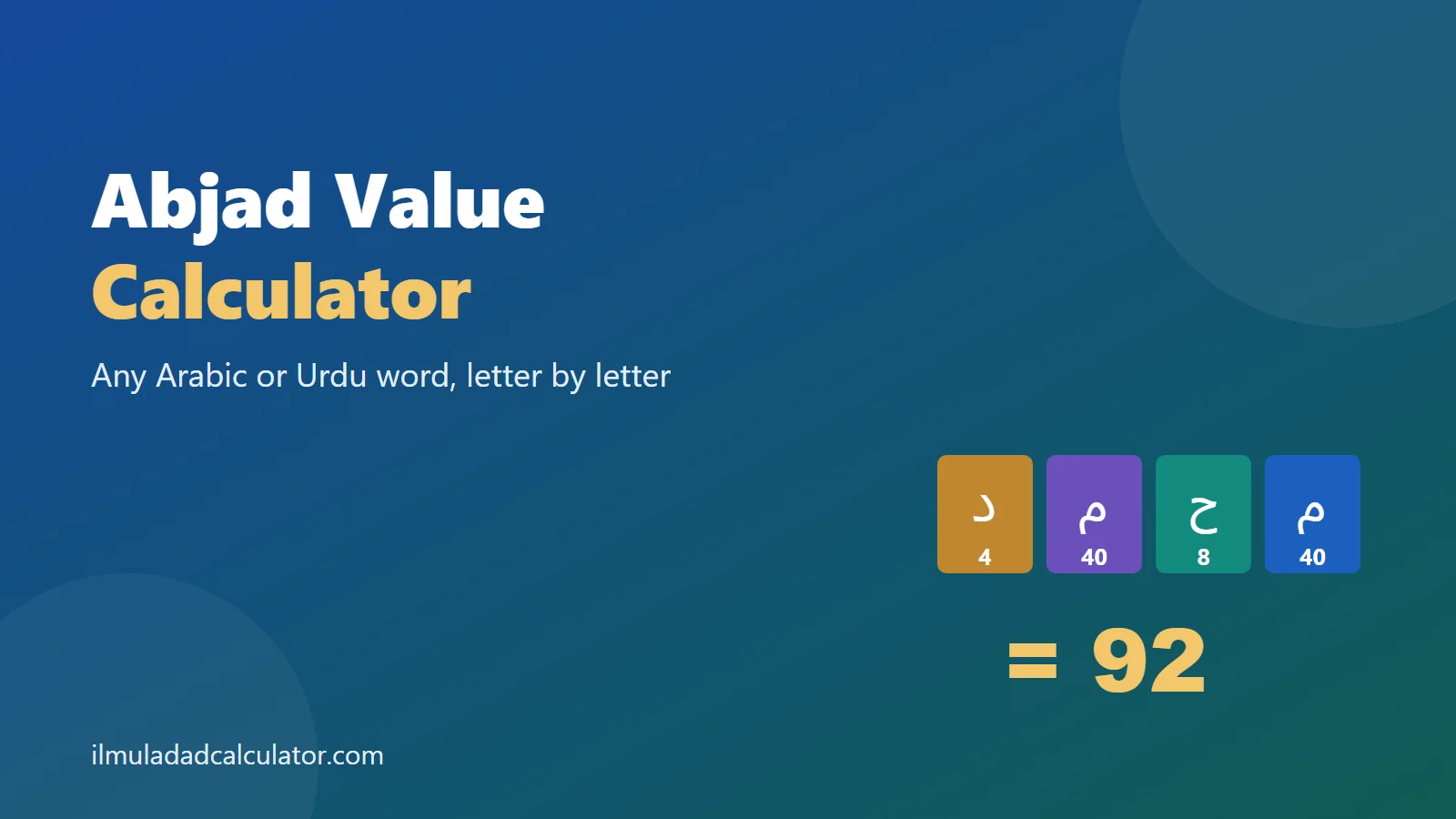
Enter any Arabic or Urdu word and this tool adds each letter’s fixed Abjad number to give the total value. For example, the value of محمد is 92 (40 + 8 + 40 + 4). The default is the Kabir (Mashriqi) system, and you also see the digital root and a full letter-by-letter breakdown.
| # | Letter | Name | Value | Running total |
|---|
All calculations run in your browser. Your text is never sent to a server.
اردو میں ابجد ویلیو کیلکولیٹر
ابجد میں ہر عربی حرف کی ایک مقررہ عددی قیمت ہوتی ہے۔ کسی نام یا لفظ کے تمام حروف کی قیمتیں جمع کرنے سے اُس کی ابجد ویلیو (عدد) حاصل ہوتی ہے، مثلاً محمد = 92۔ اوپر دیے گئے کیلکولیٹر میں عربی یا اردو متن لکھیں، نظام منتخب کریں اور نتیجہ کے ساتھ ہر حرف کی تفصیل دیکھیں۔ تمام حساب آپ کے براؤزر میں ہوتا ہے اور آپ کا متن کہیں نہیں بھیجا جاتا۔
How the Abjad Value Calculator Works
In the Abjad system, every Arabic letter has a fixed number. The value of a word is the sum of its letters.
This calculator reads your text one letter at a time. It matches each letter to its number and adds them up. Marks, spaces, digits and punctuation are skipped.
Worked Examples
| Text | Reading | Letter values | Total |
|---|---|---|---|
| محمد | Muhammad | 40 + 8 + 40 + 4 | 92 |
| علي | Ali | 70 + 30 + 10 | 110 |
| فاطمة | Fatima | 80 + 1 + 9 + 40 + 5 | 135 |
| عبد الله | Abdullah | 70 + 2 + 4 + 1 + 30 + 30 + 5 | 142 |
| نور | nur (light) | 50 + 6 + 200 | 256 |
| پروین | Parveen (Urdu) | 2 + 200 + 6 + 10 + 50 | 268 |
The letter values are listed in reading order, from right to left. Type any of these examples above to see the full breakdown.
How to Use the Calculator
- Type or paste Arabic or Urdu text. You can also tap the letters on the keypad.
- Choose a system. Kabir is the common default.
- Leave Ignore diacritics on unless you want to check a vowelled text.
- Tick Count standalone hamza only if your source counts it.
- Press Calculate value, then read the total and the breakdown table.
The result updates as you type. Use the buttons under the result to copy, print, save an image or share.
How to Read the Results
The large number is the total. The line under it shows the sum, so you can check the arithmetic at a glance.
- Breakdown table: one row per counted letter, with its name, value and running total.
- Digital root: the total reduced to one digit by adding its digits. For 92, 9 + 2 = 11, then 1 + 1 = 2.
- Letters: how many letters were counted. Skipped marks are not included.
- Prime: whether the total is a prime number. It is a math fact only.
If the letter count looks wrong, compare the table with your text. A missing or extra letter is the most common cause of a surprise total.
Kabir and Maghribi Systems
The default is the Kabir system, also called Mashriqi or Eastern. It is the order used in most books from the Middle East, Iran and South Asia.
The Maghribi or Western system was used in North Africa and Andalusia. It gives different values to six letters.
| Letter | Kabir | Maghribi |
|---|---|---|
| س | 60 | 300 |
| ص | 90 | 60 |
| ش | 300 | 1000 |
| ض | 800 | 90 |
| ظ | 900 | 800 |
| غ | 1000 | 900 |
Words without these six letters give the same total in both systems. To see both totals side by side, use the Mashriqi and Maghribi comparison tool.
Spelling Rules That Change the Total
Most differences between calculators come from a few letters with marks. This tool follows the most common rules.
- Vowel marks: harakat and shadda add nothing. So مُحَمَّد with marks is still 92.
- Standalone hamza: اسماء is 102 by default and 103 with the hamza option ticked.
- Urdu letters: each extra letter counts as its Arabic base. See the Urdu and Persian letter values.
Which Calculator Should You Use?
This page gives one clean total for any Arabic or Urdu text. Other tools on the site handle related jobs.
- For names, dates and more modes, use the main Ilm-ul-Adad Calculator.
- For a long phrase word by word, use the phrase value calculator.
- If you only know the English spelling, try the English name calculator.
- To learn the method by hand, read how to calculate Ilm-ul-Adad step by step.
Common Mistakes
- Typing a name in English letters. The calculator only counts Arabic-script letters.
- Mixing systems when you compare two words. Keep the same system for both.
- Reading a value as lucky or unlucky. A total is arithmetic, not a forecast.
Sources and Further Reading
- Abjad numerals (Wikipedia)
- Unicode Standard, Arabic block chart
- Arabic letter values and our methodology
Frequently Asked Questions
What is the Abjad value of my name?
Type your name in Arabic or Urdu script and press Calculate. For example, محمد equals 92.
Is a higher or lower Abjad value better?
No. An Abjad value is a property of the spelling, not a measure of good or bad. This tool reports the arithmetic only.
Why do some sites show a different number?
Most differences come from the system, the spelling, or whether a standalone hamza is counted. Check the breakdown table to see which letters were used.
Does the calculator count vowel marks?
No. Harakat and shadda carry no value, so a vowelled word gives the same total as the plain word.
Can I calculate Urdu text?
Yes. Urdu letters such as پ, ٹ and گ count as their Arabic base letters, so پروین gives 268.
Is my text sent anywhere?
No. The calculation runs in your browser, and your text is not sent to any server.
Author: Shakeel Muzaffar
Reviewer: Moulana Haji Abdul Basit (Islamic Scholar and Mentor)