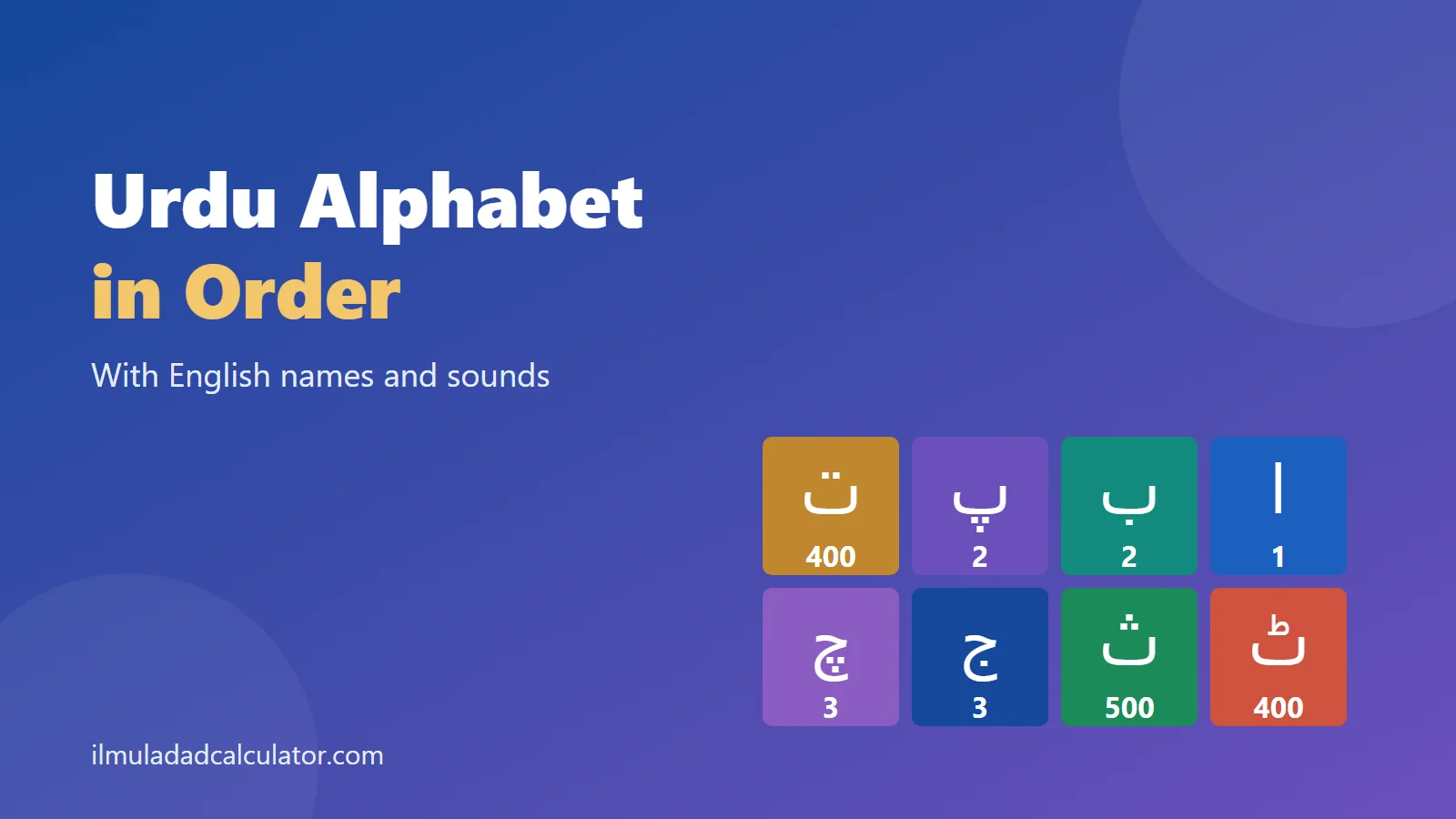
The Urdu alphabet has 39 letters in the usual count, in a set order that starts ا ب پ ت. This guide shows that order in groups, with English sound hints. It also explains which letters sound alike and how each fits into Abjad counting.
What Is the Order of the Urdu Alphabet?
Urdu learners say the letters in a fixed order. It runs alif, be, pe, te, tte, se, jim, che, and on to bari ye.
The order groups letters that share one basic shape. Within a group, dots or small marks tell the letters apart.
The figure below shows all 39 letters in 18 groups. Each row reads from the right, as Urdu does.
The full numbered list is on the page about how many letters are in the Urdu alphabet. That page also covers the debate over the count.
How Do the Letter Groups Work?
A group is a set of letters that look the same except for their dots. Learning the shape once lets you read several letters at a time.
The Largest Groups
- Be group: ب, پ, ت, ٹ and ث share a low curved shape. Nun and ye also use this shape when they sit inside a word.
- Jim group: ج, چ, ح and خ share a hooked shape.
- Re group: ر, ڑ, ز and ژ are small curves that sit on the line.
Groups With Only One or Two Letters
Letters such as lam, mim and wao stand alone in the order. Others come in pairs, such as س ش and ع غ.
Hamza and the Last Groups
Hamza (ء) sits near the end of the order, just before the two ye letters. It marks a catch in the voice between vowels, and it often rides on another letter.
Its Abjad treatment is a separate topic, covered on the page about hamza in Ilm-ul-Adad.
A university course from Texas teaches the letters in these same families. It is listed in the sources below.
Which Urdu Letters Sound Like English Ones?
Many Urdu consonants have a close English match. The table gives a hint for fifteen letters, taken from a university pronunciation guide. The last column shows the Abjad value from the calculator.
| Letter | Roman name | English sound hint | Abjad value |
|---|---|---|---|
| ب | be | like English b | 2 |
| ج | jim | j as in “juice” | 3 |
| چ | che | ch as in “sandwich” | 3 |
| ح | bari he | a breathy h as in “horse” | 8 |
| ش | shin | sh as in “shop” | 300 |
| ف | fe | f as in “finance” | 80 |
| ک | kaf | k as in “park” | 20 |
| گ | gaf | g as in “go” | 20 |
| ل | lam | l as in “letter” | 30 |
| م | mim | m as in “me” | 40 |
| ن | nun | n as in “no” | 50 |
| ژ | zhe | s as in “television” | 7 |
| ہ | chhoti he | h as in “home” | 5 |
| و | wao | v as in “vote” before a vowel | 6 |
| ی | chhoti ye | y as in “yes” before a vowel | 10 |
These hints are only a starting point. A recording of a native speaker will always be more accurate than any English comparison.
Short vowels: alif at the start of a word can carry a, i or u. In the middle or end of a word, it sounds like the long a in “father”.
Why Do Several Urdu Letters Sound the Same?
Urdu borrowed many words from Arabic and Persian. It kept their spellings, even where Urdu speakers say the letters the same way.
So س, ث and ص all sound like the s in “some”. Four letters, ز, ذ, ض and ظ, sound like the z in “zap”. The letters ث, ص, ض and ظ appear only in words borrowed from Arabic.
The sounds match, but the Abjad values do not. Sin is 60, se is 500 and suad is 90.
This is why a name must be spelled with the exact letters before it is counted. The page on why Abjad values differ explains more.
Which Urdu Sounds Have No Plain English Match?
A few Urdu sounds are new to English speakers. They fall into four types.
- Retroflex letters: ٹ, ڈ and ڑ. The tongue curls back toward the roof of the mouth.
- Back-of-the-throat letters: خ sounds like the ch in German “Buch”. غ is its voiced partner.
- Qaf: ق is made further back than the k in “park”. Many speakers say it like plain k.
- Nun ghunna: ں nasalizes the vowel before it, and it never starts a word.
Plain Urdu consonants also carry no puff of air. Say “pencil” with your palm in front of your mouth, and you feel a puff on the p. Say “sip,” and you feel almost none.
The Urdu letter پ always sounds like the p in “sip”. A puff appears only when ھ follows, as shown further below.
Urdu usually writes English t and d with the retroflex letters. So “tea” begins with ٹ, not ت.
Letter ع is the hardest case. Its sound depends on the vowels around it, and at the start of a word it sounds like alif.
How Does Do-Chashmi He Change a Sound?
Do-chashmi he (ھ) has no sound of its own. It follows a consonant and adds a strong puff of air to it.
This puff changes meaning. The word تالی means clapping, and تھالی means plate. Hold your palm near your mouth, and you can feel the puff on the second word.
The pair کھ is not the same as خ. The pair is a breathy k, while خ is the scratchy sound described above.
Why Do Roman Letter Names Look Different in Different Books?
Urdu has no single standard for writing letter names in English letters. One book writes “bay” where another writes “be”. Both are trying to show the same sound.
The Darvazah Urdu course at UNC explains its own choice. It uses “ay” at the end of names such as bay, pay and say. It also writes “retroflex” before the name of letters like tte.
This page uses the plain forms found in Pakistani primers. Some names are descriptions, not sounds:
- Bari and chhoti mean big and small. They separate two he letters (ح and ہ) and two ye letters (ی and ے).
- Do-chashmi means two-eyed, a name for the shape of ھ.
- Double letters such as tte, dde and rre mark the retroflex partners of te, dal and re.
Which Urdu Letters Change Their Sound?
Most Urdu letters keep one sound. A few depend on the letters and vowels around them. A learner needs to watch the word, not only the letter.
Wao
Before a vowel, و sounds like v or w, as in “vote”. After a consonant, it can be a vowel instead.
A Michigan State course lists three vowel sounds. They are o as in “role”, u as in “boot” and au as in “bought”. The short vowel before it decides which one you hear.
Chhoti Ye and Bari Ye
The two ye letters look alike at the start and middle of a word, but they separate at the end. The letter ی ends a word with a long ee sound. The letter ے ends it with an e or ai sound.
Alif, He and Ain
Alif can carry a short vowel at the start of a word. The letter ہ can end a word with an a sound after a short vowel. The letter ع was covered above.
How Do Short Vowels Fit Into the Alphabet?
The 39 letters are consonants and long vowels. Short vowels use three small marks placed above or below a letter.
- Zabar is a small slanted mark above a letter. It gives a short a, like the u in “but”.
- Zer is the same mark below a letter. It gives a short i, as in “bit”.
- Pesh is a small loop above a letter. It gives a short u, as in “put”.
Printed Urdu almost never shows these marks. Readers use the word shape and what they already know to supply them.
How Can You Learn the Order Step by Step?
A steady plan works better than memorizing all 39 letters at once. Here is one simple path.
- Learn the shape groups first, using the figure above.
- Say each group aloud with its English sound hint.
- Add the dots, one letter at a time, inside each group.
- Learn the letters that do not connect forward. Alif, dal, re and wao are the main ones, and the page on letters that do not connect explains them.
- Finish with the aspirated pairs, such as بھ and کھ.
After each step, try writing your own name. It is a quick test of the letters you know.
How Do These Letters Count in Ilm-ul-Adad?
Alphabet order does not set the Abjad value. The value comes from the old abjad order, which starts ا ب ج د. Read more on abjad order versus alphabet order.
Alphabet order and abjad order start the same way, then part ways. The table compares their first eight places, with values from the calculator.
| Place | Alphabet order | Value | Abjad order | Value |
|---|---|---|---|---|
| 1 | ا (alif) | 1 | ا | 1 |
| 2 | ب (be) | 2 | ب | 2 |
| 3 | پ (pe) | 2 | ج | 3 |
| 4 | ت (te) | 400 | د | 4 |
| 5 | ٹ (tte) | 400 | ه | 5 |
| 6 | ث (se) | 500 | و | 6 |
| 7 | ج (jim) | 3 | ز | 7 |
| 8 | چ (che) | 3 | ح | 8 |
Notice that pe has the same value as be, and che has the same value as jim.
Letters that Arabic lacks take the value of the base letter. So ٹ counts as ت (400), ڈ counts as د (4) and ڑ counts as ر (200).
The same holds for ژ (7, like ز) and گ (20, like ک). Here is the word ٹوپی, which means hat:
ٹ 400 + و 6 + پ 2 + ی 10 = 418
Another useful pair is تالی and تھالی. Adding do-chashmi he adds 5, so the two words give 441 and 446.
For the Arabic side of the letters, see the Arabic alphabet in order. Try any Urdu word in the Abjad value calculator.
خلاصہ
اردو حروفِ تہجی کی ترتیب الف، بے، پے، تے سے شروع ہوتی ہے اور ملتی جلتی شکل والے حروف ایک گروہ میں آتے ہیں۔ بہت سے حروف کی آواز انگریزی سے ملتی ہے، مگر ٹ، ڈ، ڑ، خ، غ اور ق کی آوازیں انگریزی میں نہیں ہوتیں۔ دو چشمی ہے کسی حرف کے ساتھ مل کر سانس والی آواز بناتی ہے۔ عدد نکالتے وقت ٹ، ڈ اور ڑ اپنے بنیادی حرف کی قیمت لیتے ہیں۔
Sources and Further Reading
- Urdu Script and Pronunciation, University of Texas at Austin. Letter families, English sound comparisons, aspiration, nun ghunna and ain.
- Alif and Non-Connectors, Basic Urdu, Michigan State University Libraries. The sounds of wao.
- Guide to Pronunciation, Zer o Zabar, Northwestern University Libraries. Khe compared with German “Buch”, and the retroflex and aspirated sounds.
- Note on Transliteration, The Urdu Alphabet, UNC Chapel Hill. Why Roman letter names vary.
- Retroflex TAY, The Urdu Alphabet, UNC Chapel Hill. How tte is made, how it takes aspiration, and its use for English t.
- Urdu alphabet, Wikipedia. Letter names, digraphs and the added Urdu letters.
- Abjad values come from this site’s tested engine. See the methodology.
Frequently Asked Questions
What is the first letter of the Urdu alphabet?
Alif is first, followed by be, pe and te. Alif is written as a simple vertical stroke.
Is the Urdu alphabet in the same order as the Arabic one?
No. Urdu groups letters by shape and adds its own letters, so the order differs from Arabic.
Why does Urdu have four letters that sound like z?
Urdu kept the Arabic spellings of borrowed words. Ze, zal, zuad and zoe now sound alike.
Do letters with the same sound have the same Abjad value?
No. Sin is 60, se is 500 and suad is 90, even though all three sound like s.
How do I say the Urdu letter tte, if English has no such letter?
Curl your tongue back and say t without a puff of air. Urdu also uses it for English t.