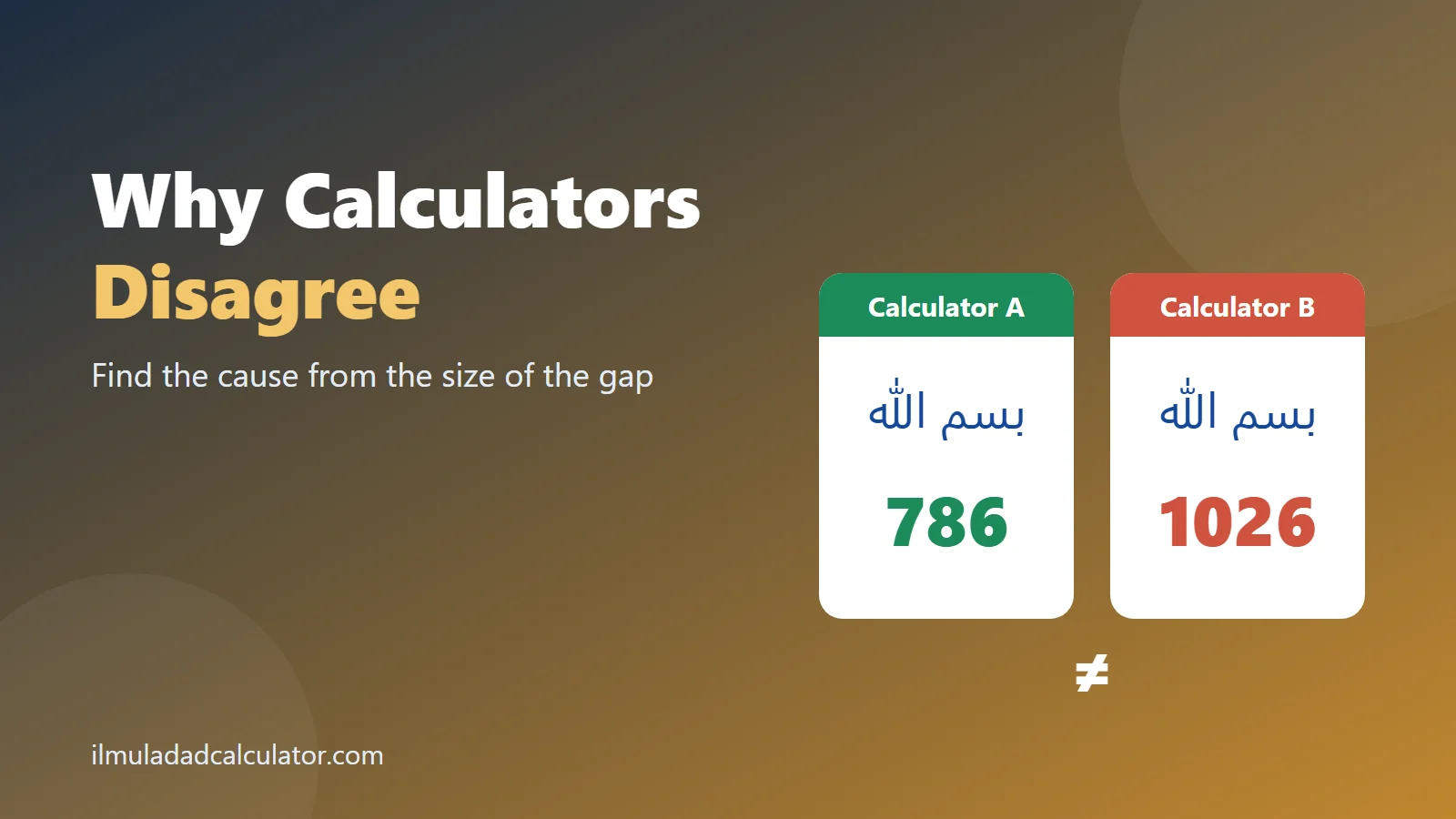
Two calculators give different totals when they make different choices. The usual causes are the letter system, the spelling, and how a few special forms are counted. Some calculators also skip letters they do not recognize, which quietly lowers the total.
What Are the Most Common Causes?
Start by measuring the gap between the two totals. The size of the gap usually points straight to the cause.
| What you see | Likely cause | Example |
|---|---|---|
| Higher by 1 | A standalone hamza was counted as 1 | دعاء: 75 or 76 |
| Higher by 1 | The dagger alif was typed as a full alif | الرحمٰن 329, الرحمان 330 |
| Different by 9 | Alif maqsura was typed as alif | يسرى 280, يسرا 271 |
| Higher by one letter’s value | A doubled letter (shadda) was counted twice | محمّد should stay 92; a second mim adds 40 |
| Much higher | The Maghribi system was used | Bismillah: 786 or 1026 |
| Higher by 395 | Ta marbuta counted as 400, or an open ta | رحمة 253, رحمت 648 |
| Far too low or zero | Unfamiliar characters were skipped | ﻻ should be 31, not 0 |
Which Differences Are Choices, Not Mistakes?
Some gaps come from honest choices that both sides can defend. The system, the hamza rule and the count for ta marbuta all belong here.
Neither total is wrong in these cases. The fix is to state the rule next to the number, such as “Mashriqi, standalone hamza not counted.”
None of these choices says anything about a person. The guide to the reality of Ilm-ul-Adad explains why.
Two of these rules have their own guides: how hamza is counted and whether ta marbuta is 5 or 400.
Spelling is the other big choice. A name with two accepted spellings has two honest totals, and the value comparison tool shows both side by side.
Which Differences Are Real Errors?
A calculator makes a real error when it skips a letter or counts something that is not a letter. These errors are easy to miss, because the tool still shows a number.
- Letters joined into one character, such as the lam-alif ﻻ, can be skipped entirely.
- Urdu forms such as ۃ and ہ can be dropped by tools built only for Arabic.
- Letters for foreign sounds, such as ڤ for v, can count as nothing.
- Vowel marks or a shadda can be counted by mistake, which adds value that is not there.
- Copied text can carry invisible characters, such as the tatweel stroke (ـ) and zero-width marks. They have no value, so a calculator should ignore them.
The calculators on this site convert joined letters and Urdu forms to standard letters before they count. The methodology lists each conversion.
How Does Copied Text Change the Total?
Copied text can look normal and still hold different characters. A calculator reads the hidden character codes, not the shapes you see.
- PDF files may store joined shapes, called presentation forms, as single characters. Unicode keeps these forms only for older systems.
- Urdu text uses its own codes for kaf and ya, ک and ی. They look almost like Arabic ك and ي, but a computer sees different letters.
- Urdu endings such as the gol he in فاطمہ can be missing from a tool built only for Arabic.
- Formatted text from a website or a document may carry the tatweel stroke or zero-width marks between letters.
This site counts each of these codes the same way as its Arabic partner. For example, ک and ك both give 20.
If another tool gives a lower total for pasted text, type the word yourself and try again. A new total means the pasted text held a code that tool did not know.
How Can You Diagnose a Difference Quickly?
Work through a few questions in order. Most differences are solved by the first three.
When no question fits, type the text again by hand. Copied text can hide extra characters that you cannot see.
What Does a Worked Diagnosis Look Like?
Here is one common disagreement, solved step by step. A user types Aisha in its Urdu spelling, عائشہ, into two tools.
- Read both totals. Tool A shows 386, and Tool B shows 381.
- Measure the gap. The difference is 5, the value of ha, ta marbuta and gol he.
- Find a letter with that value. The name ends in gol he (ہ), the Urdu form of ha.
- Test your guess. Type the Arabic spelling عائشة into Tool B. If it now shows 386, you found the cause.
- Decide who is right. Tool B skipped a letter it did not know. That is a real error, so Tool A is right.
The same steps work for any gap. Match the gap to a letter value, then retype that one letter and test again.
Which Calculator Settings Should You Look For?
A good calculator states its rules, either as settings or in a help note. Check these points before you trust a total:
- Letter system: Mashriqi or Maghribi. The two systems give 6 letters different values.
- Standalone hamza: counted as 0 or 1.
- Ta marbuta: counted as 5 like ha, or as 400 like an open ta.
- Shadda: a doubled letter should be counted only once.
- Urdu letters: forms such as پ and ہ should take their Arabic base value.
- Breakdown: a letter by letter list lets you spot a skipped or extra letter.
The multi-system Abjad calculator shows both systems at once. Use it when a source does not say which system it used.
What Should You Ask About a Printed Value?
Books, charts and websites often print a total with no working. Before you compare it with your own result, ask four questions.
- Which exact Arabic spelling was used? Zahra has two reviewed spellings, زهراء (213) and زهرة (217).
- Was the article al- (ال) included? It adds 31 to the total.
- Is the value for one word or the full name? A full name adds the value of every part.
- Which system and rules were used? Without them, nobody can check the number.
Spaces never cause a gap. عبد الله and عبدالله both give 142.
How Can You Test Any Calculator?
Five short inputs reveal most problems in under a minute. Type each one and compare the result:
- محمد (Muhammad) should give 92.
- علي (Ali) should give 110.
- الله (Allah) should give 66.
- فاطمہ (Fatima, Urdu spelling) should give 135.
- ﻻ (lam-alif as one character) should give 31.
A tool that passes all five handles the common Arabic and Urdu forms. Try them in the Ilm-ul-Adad calculator to see the expected results with a full breakdown.
Can You Find the Cause? A Practice Set
Each name below has two totals from two different tools. Measure the gap, guess the cause, then open the answer.
Huda (هدى): 19 or 10?
The gap is 9. The alif maqsura ى was typed as a plain alif ا. This is a typing error, so retype the name.
Hamza (حمزة): 60 or 455?
The gap is 395. The ta marbuta was counted as an open ta, worth 400. Check which rule the second tool uses.
Shayma (شيماء): 351 or 352?
The gap is 1. One tool counts the standalone hamza (ء) as 1. Both totals are honest choices.
Karim, typed in Urdu (کریم): 270 or 250?
The gap is 20. The second tool skipped the Urdu kaf ک, so it made a real error.
For more practice with letter values, try the Abjad quiz.
Sources and Further Reading
- Abjad numerals, Wikipedia. The Mashriqi and Maghribi letter values.
- Arabic Presentation Forms-B, Wikipedia. The joined characters, such as lam-alif, that some text contains.
- Arabic script in Unicode, Wikipedia. The separate Urdu codes for kaf and ya, the tatweel, and why presentation forms exist.
- All values come from this site’s tested engine. See the methodology.
Frequently Asked Questions
Which calculator is the correct one?
Any tool that states its system and rules can be correct. Prefer one that shows the letter by letter breakdown.
Why does copying text from a PDF change the total?
PDFs often store joined letter shapes as single characters. A calculator that does not convert them may skip them.
Does the Arabic font change the total?
No. Fonts change only how letters look. The total depends on the characters themselves.
Can a space or punctuation mark change the total?
Not on a well-built calculator. Spaces, commas and digits have no letter value.
What should I do if two trusted sources disagree?
Find the exact spelling and system each one used. Then recalculate both with the breakdown on.