Type two Arabic or Urdu words, names or phrases to compare their Abjad values. The tool shows both totals, the difference and the letters they share. For example, محمد is 92 and أحمد is 53, a difference of 39.
| Letter | Value |
|---|
| Letter | Value |
|---|
All calculations run in your browser. Nothing you type is sent to a server.
How the Comparison Works
Each side is calculated letter by letter with the same system and the same hamza rule. The tool then shows the two totals and the difference.
It also lists the letters that appear in both. That makes it easy to see exactly where two spellings part ways.
How to Compare Two Spellings
- Type one spelling in each box.
- Read the difference under the two totals.
- Check the two letter tables to find the letter that changed.
Spelling Pairs Worth Checking
Many names have more than one accepted Arabic spelling. Some pairs give the same total, and some do not.
| First spelling | Value | Second spelling | Value | Why |
|---|---|---|---|---|
| عائشة | 386 | عايشة | 386 | ئ and ي both count as 10 |
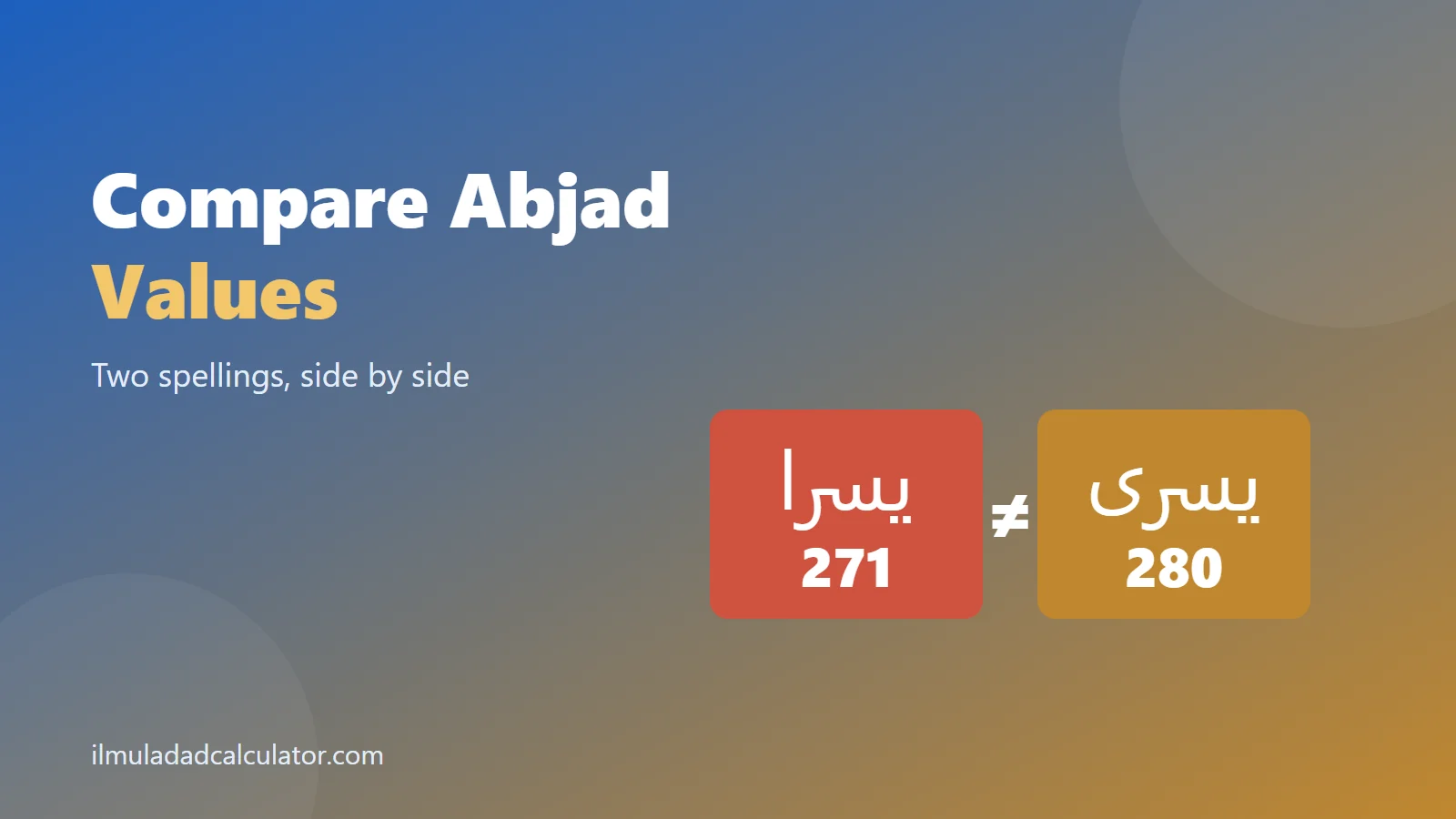
| يسرى | 280 | يسرا | 271 | ى is 10 but ا is 1 |
| زليخا | 648 | زليخه | 652 | ا is 1 but ه is 5 |
| الرحمٰن | 329 | الرحمان | 330 | The dagger alif is not a letter |
Before you quote a value, decide which spelling your family or source uses. Then use that spelling everywhere.
What Equal Values Mean
Two different words can share a total by coincidence. Short words have small totals, so matches are common.
An equal total is a fact about arithmetic. It does not show a link in meaning, and it says nothing about people.
Other Uses
- Checking a name on a document against the spelling you use.
- Testing words for a chronogram line before you finish it.
- Showing students how one letter changes a total.
For one long phrase, the Phrase Calculator gives word subtotals. For both letter systems at once, try the Mashriqi vs Maghribi comparator.
Frequently Asked Questions
Can I compare a word with a whole phrase?
Yes. Each box accepts any length, from one letter to a full sentence.
Does the swap button change the result?
No. It only switches the two boxes, so you can read them in the other order.
Can I compare in the Maghribi system?
Yes. Choose Maghribi at the top, and both sides use its values.
Why are some shared letters missing from the list?
The list shows each shared letter once, even when it appears several times.
Can I compare an Urdu and an Arabic spelling?
Yes. Urdu letters take the value of their Arabic base letter, so both spellings are counted fairly.
Author: Shakeel Muzaffar
Reviewer: Moulana Haji Abdul Basit (Islamic Scholar and Mentor)