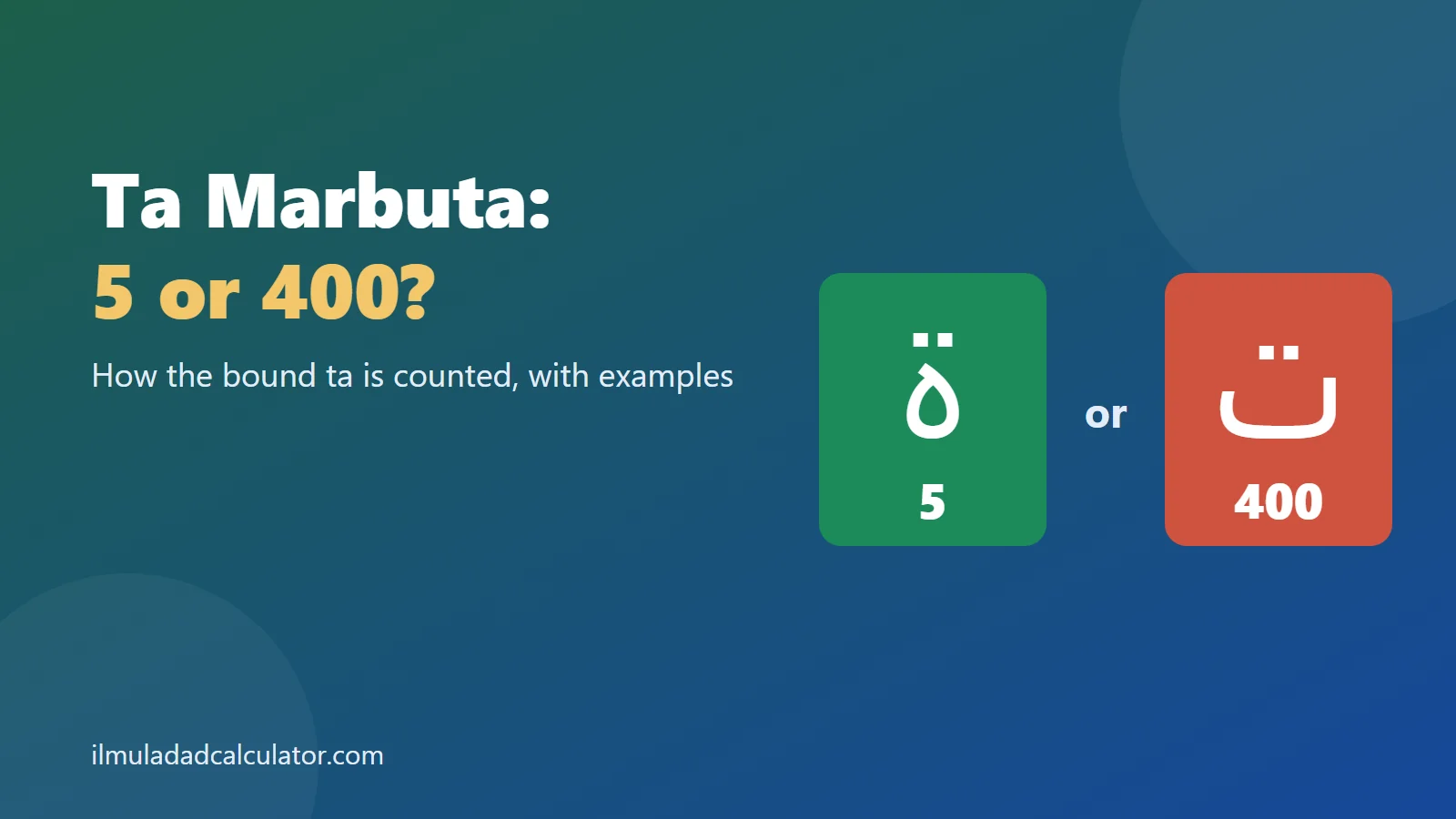
Ta marbuta (ة) is counted as 5 in Ilm-ul-Adad, the same as ha (ه). The rule follows the written shape, which is a ha with two dots. A word written with an open ta (ت) instead counts that letter as 400.
What Is Ta Marbuta?
Ta marbuta, the “bound ta,” marks many feminine nouns and names in Arabic. It appears only at the end of a word.
At a pause it sounds like a short -a, as in risala (letter). When the word joins the next one, a t sound returns, as in risalat.
Why Is It Usually Counted as 5?
Counting follows what is written, and ta marbuta is written as a ha with two dots. The dots do not change the count, so it keeps the value of ha.
Common letter tables use this rule, and so does every calculator on this site. The letter values page lists it with the other special forms.
Is There a Case for 400?
Some readers argue for 400, because the letter is named ta and sounds like t in joined speech. This view counts the sound rather than the shape.
This site uses 5 as the default. When you follow a source that counts 400, state that choice next to the total.
What Does a Chronogram Reveal?
Poets who hid a date in words had to choose one count. Their verses let us test which one they used.
Ahmad Raza Khan gave one of his books a title that is also a chronogram. Counting its bound ta as 5 gives 1327 AH, which is 1909 to 1910 CE.
Counted as 400, the same title gives 1722, a year that fits nothing about the book. You can test the title yourself in the chronogram decoder.
When Does the Spelling Itself Change?
Urdu and Persian often write the same words with an open ta. The Arabic رحمة (mercy) becomes رحمت in Urdu.
| Meaning | Arabic | Total | Urdu | Total |
|---|---|---|---|---|
| mercy | رحمة | 253 | رحمت | 648 |
| blessing | نعمة | 165 | نعمت | 560 |
| power | قدرة | 309 | قدرت | 704 |
| wealth, state | دولة | 45 | دولت | 440 |
Here the rule is simple: count the letter that is written. Check two spellings side by side with the value comparison tool.
How Do Names Ending in Ta Marbuta Count?
Many women’s names end in ta marbuta, such as Khadija (خديجة, 622) and Amina (آمنة, 96). Here is Fatima in the Mashriqi system:
ف 80 + ا 1 + ط 9 + م 40 + ة 5 = 135
Urdu often writes these names with ہ, which also counts 5. So فاطمہ gives the same 135.
Which Names Keep the Same Total in Urdu?
Most names that end in ة in Arabic end in ہ in Urdu. Both endings count 5, so the total does not change.
| Name | Arabic | Urdu | Total |
|---|---|---|---|
| Aisha | عائشة | عائشہ | 386 |
| Saima | صائمة | صائمہ | 146 |
| Rabia | رابعة | رابعہ | 278 |
| Sadia | سعدية | سعدیہ | 149 |
| Hafsa | حفصة | حفصہ | 183 |
| Halima | حليمة | حلیمہ | 93 |
| Nadia | نادية | نادیہ | 70 |
Some middle letters change as well. The Arabic ي and the Urdu ی are typed with different keys, but both count 10.
A name only changes value when its ending becomes ت. When Arabic words pass into Persian, ta marbuta usually becomes a plain ha or an open ta.
Ta marbuta is not only for women’s names. Men’s names such as Hamza (حمزة) and Usama (أسامة) end in it too.
How Can You Tell ة From ه, ہ and ھ?
Look at the end of the word first. Ta marbuta only appears there, and it always has two dots above it.
| Letter | Name | Where you see it | Value |
|---|---|---|---|
| ة | Ta marbuta | Arabic word endings, a ha shape with two dots | 5 |
| ۃ | Urdu ta marbuta | Some Urdu words, such as زکوٰۃ | 5 |
| ه | Arabic ha | Arabic text, with no dots | 5 |
| ہ | Choti he | Urdu text, with no dots | 5 |
| ھ | Do-chashmi he | Urdu sounds like bh, as in بھائی | 5 |
| ت | Open ta | Any place in a word, a flat base with two dots | 400 |
For counting, the base shape matters most. Every ha shape counts 5, with or without dots, while the flat ta counts 400.
In some fonts, the dots are tiny or sit close to the letter. Zoom in, or paste the word into a calculator and read its letter list.
How Do You Type ة, ۃ and ہ?
Each form has its own key, and the key depends on your keyboard layout. Keys below are named by their place on a US keyboard.
- Windows Arabic (101): ة is the M key, ه is I, and ت is J.
- Windows Urdu: ہ is the H key, ۃ is Shift + U, and ت is U.
- Windows Urdu: ھ is the E key.
The Windows Urdu layout has no key for the Arabic ة. A name typed on it will end in ہ or ۃ instead, and the total stays the same.
Does the Joined T Sound Change the Count?
No, the count stays 5 as long as the letter is written ة. In a joined phrase, the t is spoken but the spelling stays the same.
Take the book title Risalat al-Ghufran (The Epistle of Forgiveness). You hear “risalat,” yet the first word is still spelled with ة.
So رسالة الغفران totals 1658. Counting that letter by its sound, as 400, would give 2053 instead.
Why Do English Spellings End in -a or -ah?
English spellings show ta marbuta as -a or -ah, as in risala or risalah. Names follow the same pattern, such as Fatima and Fatimah.
The final h in English is not an extra Arabic letter. Both spellings point to the same ending, worth 5.
So do not count from the English spelling. Find the Arabic or Urdu form first, then write your name in Arabic if you need help.
Can You Solve These Ta Marbuta Practice Problems?
Find the Mashriqi total of each word. Then open the answers to check your work.
- مدرسة, madrasa (school), Arabic
- مدرسہ, madrasa, Urdu
- حمزة, Hamza, a man’s name
- صحت, sehat (health), Urdu
- أسامة, Usama, a man’s name
Show the answers
- مدرسة gives 309.
- مدرسہ gives 309.
- حمزة gives 60.
- صحت gives 498.
- أسامة gives 107.
How Do the Calculators Handle It?
Every calculator on this site counts ة, the Urdu ۃ and ہ as 5. To count an open ta, type the word with ت.
The Abjad value calculator shows each letter it counted, so you can see which form you typed. Our methodology lists every special form.
A related rule covers hamza, explained in hamza in Ilm-ul-Adad. For other causes of different totals, see why calculators give different values.
Sources and Further Reading
- Taw, Wikipedia, section on ta marbuta. How the bound ta is written, pronounced and borrowed into Persian.
- رسالة, Wiktionary. The construct form keeps the spelling with ta marbuta.
- Arabic (101) keyboard layout and Urdu keyboard layout, KbdLayoutInfo. Key positions for each form.
- Abjad numerals, Wikipedia. The 28 letters and their values.
- The chronogram example is explained on the chronogram decoder page.
Frequently Asked Questions
Is the Urdu ۃ the same as ة?
Yes, for counting. The Urdu form is written differently, but it is also worth 5.
Does the Maghribi system change ta marbuta?
No. Ha is 5 in both systems, so ta marbuta is 5 in both.
Is ta marbuta one of the 28 abjad letters?
No. It is a special ending form, not a separate letter in the abjad order.
What about alif maqsura (ى) at the end of a word?
It is another ending form. It is counted as ya, worth 10.
Does the Urdu ۂ with a hamza count more than ہ?
No. The hamza mark adds nothing, so ۂ is also worth 5.
Should I change the ending of my name to get a new total?
No. Count the spelling you really use. A total only describes that written form.
Why does one name website give a different total for my name?
It may count the ending as 400 or use another spelling. Ask which rule it used.