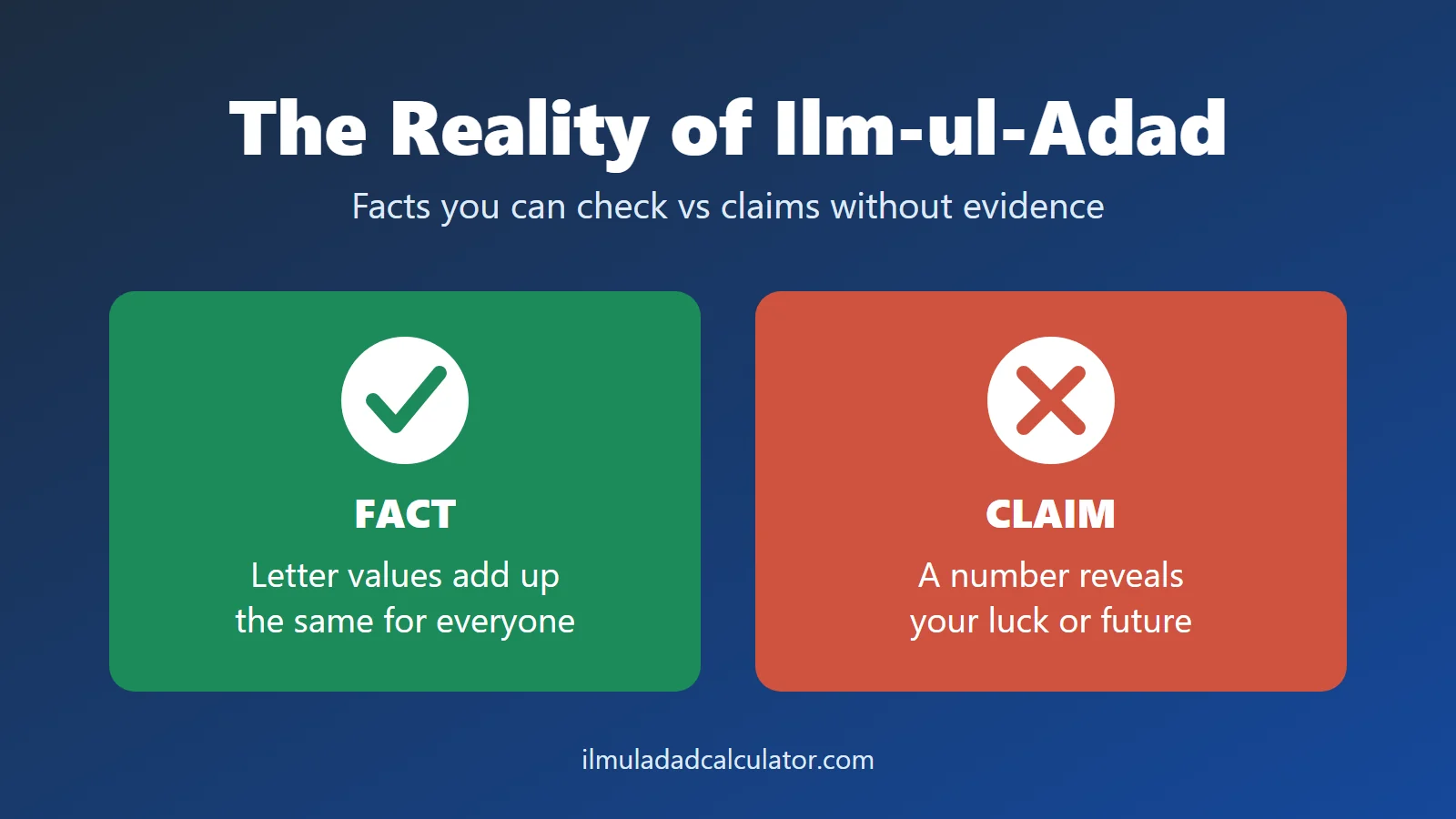
Ilm-ul-Adad is real as arithmetic: each Arabic letter has a fixed value, and anyone can check a total by hand. Claims that a total reveals character, luck or the future have no evidence behind them. Islamic teaching also warns against using numbers to foretell events.
What Is Real in Ilm-ul-Adad?
The letter values are real in the same way a multiplication table is real. They are fixed, written down for centuries, and the same in every reliable source. Two careful people adding the same spelling will always reach the same total.
The history is real too. Poets hid dates in verse, and scribes numbered pages with letters. These uses are recorded in manuscripts and on buildings you can still visit.
You can test this yourself. Pick any word, add its letters with the letter value table, then compare your answer with the Ilm-ul-Adad calculator. For the full background, read what Ilm-ul-Adad is and where it came from.
What Is Claimed, and Where Does It Come From?
In some traditions, people go further. They link totals to planets, elements, lucky days or a person’s future. Some books and websites sell readings built on these links.
These claims are not part of the arithmetic. They are added on top of it, and different writers often give different meanings to the same number. This site explains the values and their history, and it does not offer readings.
Can a Number Describe a Person?
No, and you can see why with four simple checks. Each one shows that a total depends on choices that have nothing to do with the person.
The Spelling Decides the Total
The name Ibrahim has two common spellings. ابراهيم gives 259 in the Mashriqi system. The Quranic spelling ابرهيم, without the middle alif, gives 258.
The person is the same, but the totals differ. A reading based on one spelling would change if the family wrote the name the other way.
The System Decides the Total
The letter س is 60 in the Mashriqi system but 300 in the Maghribi system. So Yusuf, يوسف, is 156 in Mashriqi and 396 in Maghribi.
Both systems are historically genuine. A number that changes with the reckoning cannot be a fixed fact about a person. The Mashriqi and Maghribi comparison tool shows the gap for any word.
Small Conventions Decide the Total
The name Asma, اسماء, ends with a standalone hamza. Most calculators skip it and give 102 (Mashriqi). Others count it as 1 and give 103.
Neither answer is wrong. They follow different counting rules, which is why the rule must always be stated.
Many People Share One Total
Very different names can add up to the same number. Musa, Wasim and Aliya all total 116 in the Mashriqi system:
م 40 + و 6 + س 60 + ى 10 = 116
و 6 + س 60 + ي 10 + م 40 = 116
ع 70 + ا 1 + ل 30 + ي 10 + ة 5 = 116
We checked this across our reviewed list of 1,040 Arabic name spellings. They produce only 517 different totals. In all, 771 of the names share their total with at least one other name.
Single-digit reductions make this even clearer. Reduced to one digit from 1 to 9, every digit covers between 96 and 147 names on the list. A one-digit “personality number” would put over a hundred different names in each group.
Same Name, Very Different Lives
The Prophet Musa (Moses) shares his name with Musa ibn Nusayr. Musa ibn Nusayr was the Umayyad governor who sent armies into Spain in 711. Their names give the same total, 116, yet their lives and times had nothing in common.
Millions of people today carry the same names as well. A total that is identical for all of them cannot describe any one of them.
What Would a Fair Test Look Like?
A fair test would hide the names from the person giving readings. Give them ten totals and ten written life stories, and ask them to match each total to its story.
Guessing at random gets about one of the ten right. A real effect would need to beat chance clearly, again and again, with different readers. Readings offered online are almost never tested this way.
Why Do Readings Sometimes Seem to Work?
Readings often feel accurate because of two well-studied habits of the mind. Neither has anything to do with letter values.
The first is the Barnum effect. People accept vague statements, such as “you are generous but sometimes doubt yourself,” as personal.
In a 1949 classroom test, psychologist Bertram Forer gave all his students the same “personal” profile. Most of them rated it as highly accurate.
The second is confirmation bias. People remember the predictions that came true and forget the ones that failed. Over time, a few lucky hits feel like proof.
What Do Islamic Scholars Say?
Islamic teaching draws a clear line at fortune-telling. A hadith in Sahih Muslim (number 2230) addresses this directly. It says the prayer of someone who consults a fortune-teller is not accepted for forty nights.
Many scholars apply this warning to number readings that claim to reveal the unseen. Using letter values to number pages or decode a dated verse is different. Scholars generally treat that as ordinary knowledge.
This page reports these views and does not issue a ruling. Ask a qualified scholar about your own situation. Our methodology and disclaimer explain where this site draws the line.
How Can You Check a Claim Yourself?
Any claim based on a letter total can be tested in a few minutes. Work through these steps:
- Ask for the exact Arabic or Urdu spelling the claim used.
- Recalculate the total with the Ilm-ul-Adad calculator and confirm the arithmetic.
- Ask which system was used, Mashriqi or Maghribi, and how hamza was counted.
- Change the spelling or the system and see whether the claim still holds.
- Look for other names with the same total using the value comparison tool. A claim about one person should then apply to all of them.
A claim that breaks under these changes was never about the person. It was about one spelling, in one system, under one rule.
Where Is Ilm-ul-Adad Genuinely Useful?
The honest uses are about reading and recording, not predicting. A student can decode the year hidden in a Persian or Urdu verse with the chronogram decoder.
A researcher can read the letter numbers in an old manuscript with the abjad numerals converter. These uses give answers you can check, which is the real strength of the system.
خلاصہ
علمِ اعداد کی حقیقت یہ ہے کہ حروف کی قیمتیں اور ان کا حساب درست ہے، اور ہر شخص اسے خود جانچ سکتا ہے۔ کسی عدد سے کسی شخص کی قسمت، مزاج یا مستقبل جاننے کا دعویٰ کسی ثبوت پر قائم نہیں، اور علماء نے غیب کی خبر دینے سے منع کیا ہے۔ یہ سائٹ صرف حساب، تاریخ اور زبان کی تعلیم دیتی ہے۔
Sources and Further Reading
- Sahih Muslim 2230, Sunnah.com. The hadith on consulting a fortune-teller.
- Barnum effect, Wikipedia. Includes Bertram Forer’s 1949 classroom experiment.
- Confirmation bias, Wikipedia.
- Abjad numerals, Wikipedia. The Mashriqi and Maghribi letter orders.
- Name statistics: our reviewed list of 1,040 Arabic name spellings, totals computed by this site’s tested engine. See sources and bibliography.
Frequently Asked Questions
Why does my name have a different value on another website?
The other site may use a different spelling, the Maghribi system, or a different hamza rule. Ask which choices it made, then compare.
Are the letter values Islamic in origin?
No. The letter order comes from older Semitic alphabets used before Islam. Muslim scholars and poets later used it for numbering and dating.
Does a higher total mean anything?
No. A high total only means the word uses letters from late in the order. One ghayn (غ) alone is worth 1000.
Did classical Muslim scholars use letter values?
Yes, for practical tasks. They numbered pages, wrote dates in chronograms and recorded values in tables.
Why does this site show totals if they predict nothing?
The totals are useful for study. They help readers decode dated verses, check old manuscripts and learn the Arabic letters.