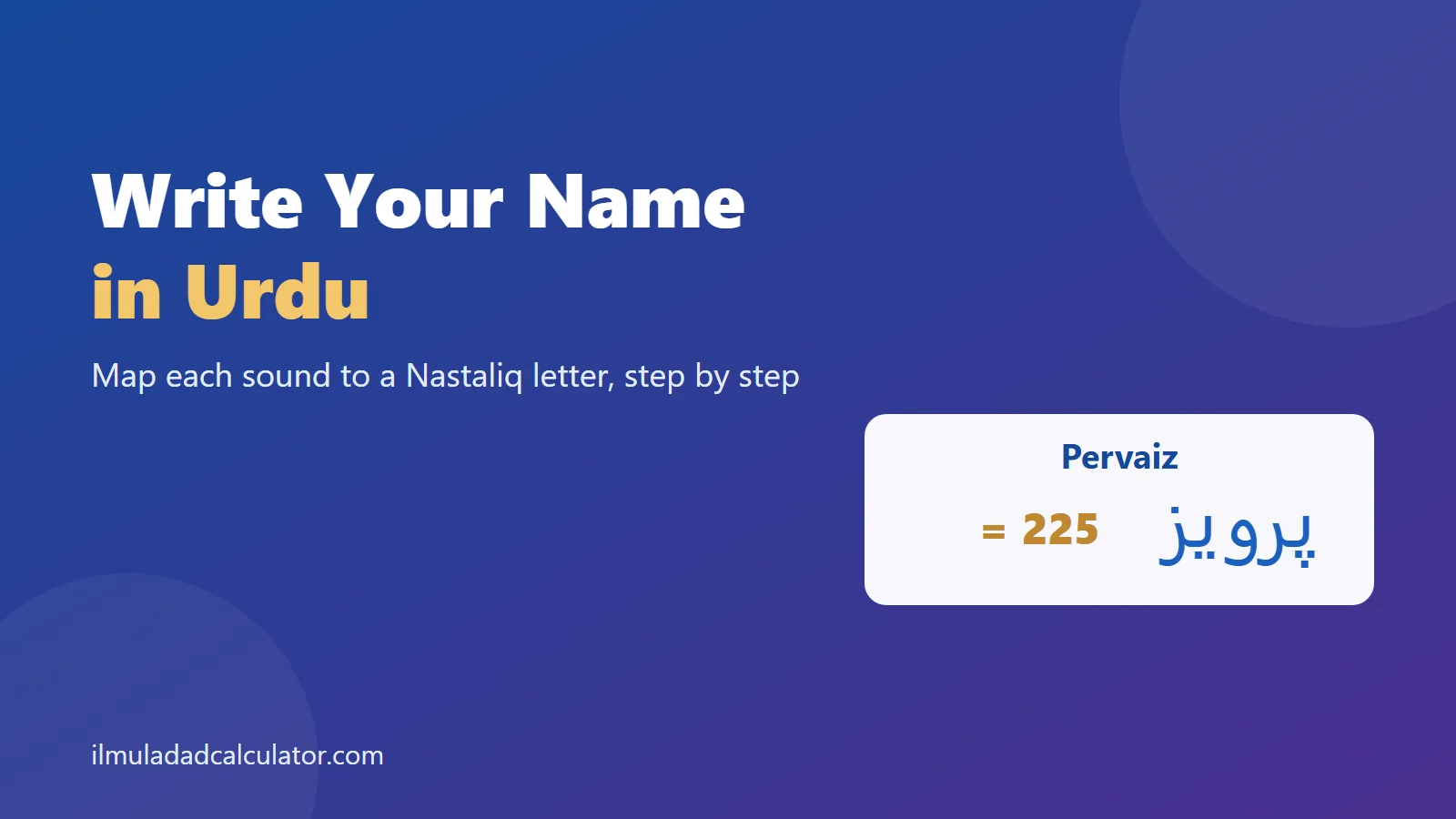
Writing your name in Urdu means matching each sound to a letter in the Urdu (Nastaliq) script. Urdu uses the Arabic alphabet and adds a few letters of its own. This guide shows the method, the extra letters, and how the Abjad value compares with the Arabic spelling.
How Do You Write Your Name in Urdu, Step by Step?
Start from the sounds of your name, not its English letters. English spelling often hides or doubles sounds. Your ear is a better guide than the page.
- Break your name into its spoken sounds.
- Match each consonant to its Urdu letter.
- Write long vowels with ا, و or ی, and leave short vowels out.
- Choose the right letter for any word ending.
- Keep one spelling once you are happy with it.
The name Pervaiz shows the method in action. Each sound takes one letter, and the short “e” is not written.
Say your name slowly before you write. The sounds you hear decide the letters, so a slow run-through catches the long vowels you might miss.
What Letters Does Urdu Add to the Arabic Script?
Urdu keeps all 28 Arabic letters and adds eight more for its own sounds. Four of these came from Persian. The rest were made for Urdu.
You need these letters for sounds that Arabic does not have, such as p, ch and g. The Urdu and Persian letters guide covers them in full. The count of Urdu letters explains the debated total.
| Urdu letter | Sound | Counts as | Value |
|---|---|---|---|
| پ | p, as in Pervaiz | ب | 2 |
| چ | ch, as in Chanda | ج | 3 |
| ژ | zh, as in Zhivago | ز | 7 |
| گ | g, as in Gul | ک | 20 |
| ٹ | hard t, as in Tony | ت | 400 |
| ڈ | hard d, as in Dino | د | 4 |
| ڑ | rolled r, inside words | ر | 200 |
| ے | long e at a word end | ی | 10 |
The three dotted letters ٹ, ڈ and ڑ are retroflex. You make them with the tongue curled back. This sound is common in South Asian names.
Persian gave Urdu four of these letters: پ (p), چ (ch), ژ (zh) and گ (g). Urdu then added the retroflex letters and bari ye for its own sounds.
Each extra letter takes the value of the Arabic letter it is built from. So پ counts as ب, worth 2, and گ counts as ک, worth 20.
How Do You Match English Sounds to Urdu Letters?
Most English consonants have a clear Urdu letter. The sounds that trip people up are the ones Arabic lacks. Urdu can write these directly.
- p becomes پ, as in Pervaiz or Pinky.
- v becomes و, or وی when the sound is strong.
- g (hard, as in “go”) becomes گ, as in Gul.
- ch becomes چ, as in Chanda.
- hard t and d become ٹ and ڈ, as in Tony and Dino.
A soft English “g” sounds like “j” and takes ج instead. George becomes جارج, with jim at both ends. The total is 207.
Silent English letters are usually dropped. You write what you hear, so a silent letter adds nothing to the Urdu spelling or its total.
Sounds With More Than One Choice
Some sounds have two fair spellings. The “r” inside a name can be the plain ر or the rolled ڑ. The choice depends on how you say it.
The “th” sound is written as تھ, a pair of letters. Keep whichever choice sounds closest to your own name.
How Do You Write a Western Name in Urdu?
Western names use the same method. The extra Urdu letters make them easier to write than in Arabic alone.
Peter starts with a p and a hard t, so it becomes پیٹر and totals 612. Victor has a v and a hard t, giving وکٹر and a total of 626.
Names with an “ee” or “oo” sound take a long vowel letter. A short name like Gul stays short at گل, worth 50, since it has no long vowel inside it.
How Are Vowels Written in Urdu Names?
Urdu, like Arabic, often leaves short vowels unwritten. The short “a,” “i” and “u” are shown by small marks. Most writers skip these marks.
Long vowels are written with full letters. Long “aa” takes ا, long “ee” takes ی, and long “oo” takes و.
A name that begins with a vowel usually starts with alif. The alif holds the first vowel sound in place at the start of the word.
Choti Ye and Bari Ye
Urdu has two forms of the “y” letter. Choti ye (ی) is used inside words and for a long “ee” sound.
Bari ye (ے) is used only at the end of a word. It writes a long “e” or “ay” sound. Both forms count as 10, so the choice never changes a total.
How Do You Write Common Name Endings?
Name endings follow a few steady habits. Knowing them helps you spell the last part of a name with confidence.
- Final -a or -ah is written with ا or gol he (ہ). Saba is صبا (93), while a he ending gives صبہ (97).
- The -een ending uses ین, as in Yasmeen (یاسمین, 171) and Shaheen (شاہین, 366).
- The -ullah ending adds اللہ, the word for God. Nasrullah is نصراللہ, which totals 406.
The two spellings of a final “a” are both correct. They give slightly different totals. Alif is worth 1 and gol he is worth 5.
Is Your Urdu Name the Same as Its Arabic Spelling?
Often the two spellings match letter for letter. Urdu writes ک where Arabic writes ك, and ی where Arabic writes ي. These count the same.
The guide to writing your name in Arabic uses the Arabic forms. The main style difference is the flowing Nastaliq hand that Urdu prefers.
Because every Urdu letter takes its Arabic base value, the two spellings usually give the same number. A retroflex ٹ counts as ت, and a gol he ہ counts as ه.
When the total does change: it changes only if the two spellings use different letters. Saba spelled صبا gives 93, but spelled صبہ it gives 97, a gap of 4 from alif versus he.
Do You Need the Small Vowel Marks?
Urdu has small marks for short vowels, called zabar, zer and pesh. They sit above or below a letter to guide the reader.
You rarely need them in a name. Most Urdu is written without these marks, and readers fill in the short vowels on their own.
The marks also carry no Abjad value. So adding or leaving them out never changes your name’s total.
Why Does Urdu Look Different in the Nastaliq Style?
Urdu is usually written in Nastaliq, a flowing, slanted hand. Arabic is more often printed in the upright Naskh style.
In Nastaliq, words seem to cascade from top right to bottom left. The letters are the same as in Naskh, so the values do not change.
Your name keeps its spelling and its total in either style. Only the shape of the writing is different on the page.
What Mistakes Should You Avoid?
A few small slips change how a name reads or counts. Watch for these when you check your spelling.
- Doubling letters from English. A double letter in English is usually one letter in Urdu.
- Writing short vowels as full letters. A short “a” or “i” is not written, so adding one changes the total.
- Missing the retroflex dots. The small sign over ٹ, ڈ and ڑ tells them apart from plain letters.
- Using bari ye inside a word. Bari ye belongs only at a word’s end.
When in doubt, read the name aloud from your draft. If it sounds right, the spelling is usually right.
How Do You Type Your Name in Urdu?
Phones and computers include Urdu keyboards. On Android and iPhone, add Urdu in the keyboard settings. A phonetic layout places each letter on the English key with the closest sound.
Windows and macOS offer Urdu layouts in their language settings. The extra letters sit on their own keys or on a shifted key.
The calculators on this site also have an on-screen Urdu keypad. You can tap your name letter by letter without installing anything.
How Do You Write a Two-Part Name in Urdu?
Many Pakistani names have two parts, such as a first name and a family name. You write each part on its own, with a space between them.
Pervaiz Ahmad is written پرویز احمد and totals 278. The space carries no value, so the total is just the two parts added together.
You can count the whole name or only one part. The Arabic names guide explains which parts people usually include. State your choice next to the total so a reader knows what you counted.
How Do You Find the Abjad Value of Your Urdu Name?
Once your name is spelled, the value is simple arithmetic. Add the value of each letter, exactly as you would for any word.
You can let a tool do the adding. The Ilm-ul-Adad calculator accepts Urdu text and shows a breakdown for each letter.
To start from English, the English name to Abjad tool suggests a spelling and its total. To check two spellings side by side, use the compare tool.
A total is only arithmetic. It says nothing about a person. Two different names can share the same number by chance.
Writing your name is the first step, and the value is the second. Once you have a spelling you trust, the number follows in seconds.
خلاصہ
اپنا نام اردو میں لکھنے کے لیے ہر آواز کو ایک حرف سے ملائیں۔ اردو عربی حروف کے ساتھ اپنے چند حروف بھی رکھتا ہے، جیسے پ، چ اور گ۔ لمبی آوازیں الف، و اور ی سے لکھی جاتی ہیں، جبکہ چھوٹی آوازیں عام طور پر نہیں لکھی جاتیں۔ چونکہ ہر اردو حرف اپنی عربی بنیاد کی قیمت لیتا ہے، اس لیے کسی نام کے اردو اور عربی ہجے عموماً ایک ہی عدد دیتے ہیں۔
Sources and Further Reading
- Urdu alphabet, Wikipedia. The letters Urdu adds, the retroflex marks, and choti and bari ye.
- Nastaliq, Wikipedia. The flowing style used for Urdu writing.
- Romanization of Urdu, Wikipedia. How Urdu sounds map to and from Roman letters.
- Abjad values come from this site’s tested engine. See the methodology.
Frequently Asked Questions
How do I write a name with a “p” sound in Urdu?
Use the letter pe (پ). Arabic has no p, but Urdu writes it directly, as in Pervaiz.
What is the difference between ی and ے?
Choti ye is used inside words. Bari ye is used only at the end of a word.
Does my Urdu name have the same value as the Arabic spelling?
Usually yes. Every Urdu letter takes its Arabic base value, so matching spellings give the same total.
Should I write short vowels in my name?
No need. Urdu usually leaves short vowels unwritten, and the small marks carry no Abjad value.
How do I write a name ending in “-a”?
Use a final alif (ا) or gol he (ہ). Both are correct, and they give slightly different totals.