To read a chronogram, find the phrase that holds the date, count only its letters, and add their abjad values. Then check the total against a known year and calendar. This guide walks through each step with three sourced examples.
What Do You Need Before You Start?
You need the exact text, a table of letter values, and a way to add. The abjad mnemonic gives the values for all 28 letters.
Urdu and Persian chronograms use the Mashriqi table, so use that one. The page on why values differ explains where the Maghribi table departs from it.
Write the words from right to left, as the script runs. The order does not change the sum, but it keeps your list easy to check against the page.
Copy the text from a trusted edition or a photo of the stone. One wrong letter can move the total by hundreds.
How Do You Read a Chronogram Step by Step?
The method is the same in Urdu, Persian and Arabic. Five steps take you from a poem to a year.
- Find the date line. It is usually the last line or half-line of a short poem.
- Spot the cue. A word such as tarikh (date) or sal (year) often points at the phrase.
- Count the letters. Take only the words after the cue, never the cue itself.
- Add the values. Use one table for the whole phrase, and keep a running total.
- Check the year. Compare it with the known date, and convert Hijri to Common Era.
The next sections explain steps 1 and 2. Three worked examples then show steps 3 to 5 in action.
How Do You Find the Date Line?
Most chronogram poems end with the date. An Urdu or Persian qita-e-tarikh saves it for the final line, as the guide to tarikh goi explains.
On a building, the date line is often the last panel of a tile or stone inscription. In a book, it sits near the colophon.
Look for a signal that tells you where to start. The table lists the common ones.
| Signal | Meaning | What to do |
|---|---|---|
| tarikh | date | Count the words that follow |
| sal | year | Count the answer to “which year?” |
| hatif | an unseen voice | Count what the voice says |
| seek, find, take out | a command | Count the phrase named, then look for a sum |
| without, minus, rose, fell | a hint to subtract | Take that value away, as in the add and subtract devices |
Sometimes there is no cue at all, and the whole line is the date. Then the heading or the story around the poem tells you what to count.
What Does a Worked Reading Look Like?
Each example below gives the line, the source, and a letter-by-letter total. The totals come from this site’s abjad engine, using Mashriqi values.
Example 1: Two Answers on One Mosque
The Wazir Khan Mosque in Lahore has a Persian verse in blue tiles over its main entrance. The verse asks “Wisdom” for the year of construction and gives two answers.
The first answer is سجدہ گاہ اہل فضل. It means “the place of worship of the virtuous.”
The second is بانی مسجد وزیر خان. It means “the builder of the mosque, Wazir Khan.”
The Tokyo University of Foreign Studies source prints both in Latin letters. We wrote them in standard Persian spelling, then added each word.
| Word | Letters | Value |
|---|---|---|
| سجدہ | س 60 + ج 3 + د 4 + ہ 5 | 72 |
| گاہ | گ 20 + ا 1 + ہ 5 | 26 |
| اہل | ا 1 + ہ 5 + ل 30 | 36 |
| فضل | ف 80 + ض 800 + ل 30 | 910 |
| Answer 1 total | 1044 | |
| بانی | ب 2 + ا 1 + ن 50 + ی 10 | 63 |
| مسجد | م 40 + س 60 + ج 3 + د 4 | 107 |
| وزیر | و 6 + ز 7 + ی 10 + ر 200 | 223 |
| خان | خ 600 + ا 1 + ن 50 | 651 |
| Answer 2 total | 1044 | |
Both answers give 1044, which is 1634 to 1635 CE. That matches the start of construction recorded for the mosque.
Example 2: One Short Word Changes the Year
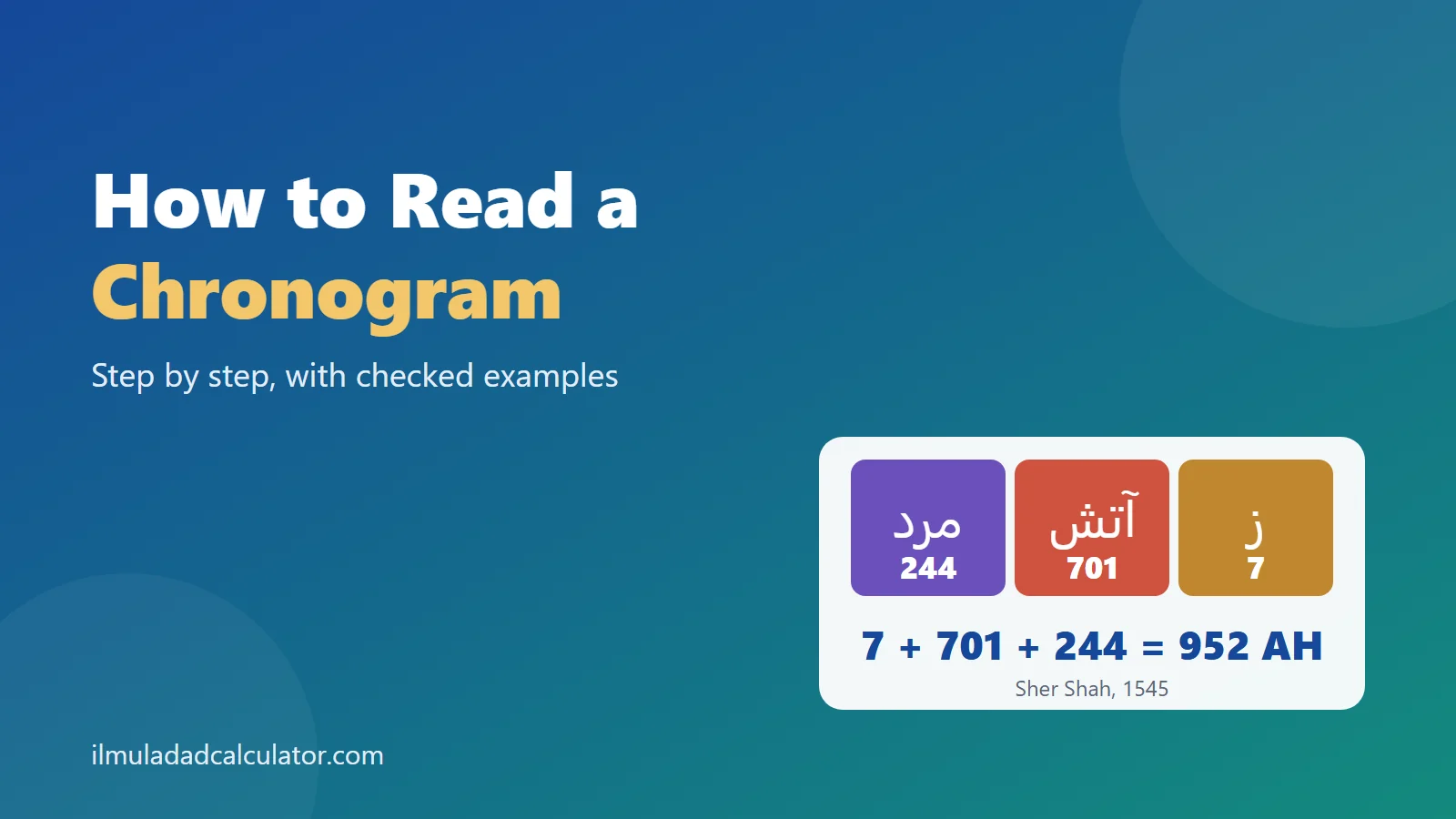
Sher Shah Suri died on 22 May 1545 after an explosion at the siege of Kalinjar. A famous chronogram says that he died by fire.
ز 7 + آ 1 + ت 400 + ش 300 + م 40 + ر 200 + د 4 = 952
The phrase ز آتش مرد means “by fire he died.” The first word is the short ze, worth 7.
The total is 952 AH. That falls in 1545, the year of his death.
Now write the first word as the long az, از. The extra alif adds 1, and the total becomes 953.
The short form gives the recorded year. A reader who writes the long form will count one year too many.
Example 3: Two Dates in One Couplet
Qadr Bilgrami, a pupil of Ghalib, wrote a ghazal on his teacher’s death. In each couplet, the first line gives the Common Era year and the second gives the Hijri year.
مراد حشر کیا دہلی کا خط تھا = 1869
فلک ٹوٹا ہے مجھ پر آہ ناگاہ = 1285
The first line adds up to 1869 CE, and the second to 1285 AH. Ghalib died on 15 February 1869, which falls in 1285 AH.
Giving both calendars spared the reader any conversion. It also acts as a built-in check, since two lines must reach two different totals.
Check the pair with the rule of thumb. Multiply 1285 by 0.97 and add 622, and you get 1868, within a year of 1869.
Which Words Count and Which Do Not?
Only the date phrase counts. The cue, the opening verses and the name of the poet stay outside the sum.
- Counted: every word of the date phrase, including small words like و (and) and از (from).
- Not counted: the cue word, such as tarikh, and any lines of praise before it.
- Not written, so not counted: the short ezafe sound in Persian, which links two words but has no letter.
- Counted as written: two words joined by the poet. They add up as if they were one word.
When in doubt, test each candidate phrase against the known year of the event.
Counting the cue is the most common mistake. The words “the hatif said” are scenery, and counting them adds hundreds.
How Can You Tell a Real Chronogram From a Coincidence?
Almost any phrase adds up to some number. A lucky total proves nothing by itself.
A real chronogram passes three tests. The total matches a known year, the words fit the event, and no hidden change was needed.
All three examples above pass. The mosque verse names the builder, and the line for Sher Shah names his death by fire. The couplet for Ghalib states the death in plain words.
Encyclopaedia Iranica notes that devices for adding or subtracting are usually marked in the poem itself. A change nobody signals is a sign of a doubtful reading.
What Snags Trip Up Readers?
Most wrong totals come from a few small slips. The table lists the common ones, with the engine’s value for each.
| Snag | Rule | Example |
|---|---|---|
| Vowel marks and tashdid | Marks add nothing, and the shadda counts once. See shadda value. | محمّد and محمد both give 92 |
| Hamza on a seat | The seat letter counts. A standalone hamza is not counted. See hamza. | ہائے gives 26, ہاے gives 16 |
| Alif with madd | It counts as one alif. | آتش gives 701 |
| Urdu and Persian letters | Each counts as its Arabic base. See Urdu and Persian letters. | پاک and باک both give 23 |
| Spelling variants | Count exactly what is written. | ز gives 7, از gives 8 |
| Dagger alif | A vowel mark, so it adds nothing. See dagger alif. | رحمٰن gives 298 |
Tip: when two spellings are possible, test both. The one that matches the known year is almost always the poet’s choice.
How Do You Check the Year and the Calendar?
Most Urdu, Persian and Arabic chronograms give a Hijri year. The Hijri year is about 3 percent shorter than the Gregorian year, so the two drift apart slowly.
For a quick check, multiply the Hijri year by 0.97 and add 622. Applied to 1044, it gives 1635, and to 952 it gives 1545.
This gives the Common Era year within a year or so. For the exact date, use the chronogram decoder, which adds the letters and converts the year.
Sometimes a poem gives the Common Era year directly, as in Example 3. In that case the total will be near 1800 or 1900, not near 1200.
What Should You Do When the Total Misses?
A miss does not always mean the line is false. Work through these checks in order.
- Check each letter. Look for a missing alif, a doubled letter or a swapped he.
- Check the edition. Printed texts sometimes differ by one letter.
- Check the cue. You may have counted a word that only introduces the date.
- Look for a device. The poem may ask you to add or subtract a value.
- Check the calendar. The total may be Hijri, and your date Gregorian.
If none of these works, treat the claim with care. A chronogram that needs a hidden change is not a clean one, and the famous chronograms guide drops such cases.
Can a Tool Do the Adding for You?
Yes, a tool can add, but you still make the key choices. You supply the exact spelling, and you decide which words are the date.
The chronogram decoder shows the total word by word, so you can see where a miss comes from. The multi-system calculator compares the Mashriqi and Maghribi totals side by side.
Use the tool to check your own sum. Do not let it replace the reading of the poem.
Does the Same Method Work for Latin Chronograms?
The idea is the same, but the letters differ. A Latin chronogram counts only the Roman numerals M, D, C, L, X, V and I.
Writers usually marked those letters with capitals. The guide to Latin chronograms shows how to pick them out and add them.
Where Can You Practice Reading?
Start with short phrases, then move to full lines. The Persian and Urdu guides give many checked lines to try.
Paste your own line into the phrase value calculator to see each word’s value. To check by hand, follow the steps in how to calculate by hand.
Once you can read one, try writing one. The writing guide reverses these steps, and the overview of chronograms covers the idea itself.
خلاصہ
مادۂ تاریخ پڑھنے کے لیے پہلے وہ مصرع تلاش کریں جس میں سال چھپا ہے، عموماً آخری مصرع۔ پھر اشارے کا لفظ دیکھیں، صرف مادے کے حروف گنیں اور ان کی ابجد قیمتیں جمع کریں۔ آخر میں مجموعے کو معلوم سال سے ملائیں اور ہجری سے عیسوی سال نکالیں۔ مثلاً «ز آتش مرد» سے شیر شاہ کی وفات کا سال ۹۵۲ ہجری نکلتا ہے۔
Sources and Further Reading
- Deciphering the Construction Date of a Mosque Hidden in Its Mosaic Tiles, ILCAA (2025). The two Wazir Khan Mosque chronograms and the year 1044 AH.
- Wazir Khan Mosque, Wikipedia. Location in Lahore and the 1634 to 1635 construction dates.
- The Secret of Letters: Chronograms in Urdu Literary Culture, Mehr Afshan Farooqi, Edebiyat 13(2), 2003. The Sher Shah chronogram, the Bilgrami ghazal and the counting conventions for hamza and tashdid.
- Sher Shah Suri, Wikipedia. His death on 22 May 1545 at Kalinjar.
- Mirza Ghalib, Wikipedia. His death on 15 February 1869.
- Madda Tarik (chronogram), Encyclopaedia Iranica, by Paul E. Losensky (2006). Signals and devices in the poem.
Frequently Asked Questions
How do you read a chronogram?
Find the date line and skip the cue word. Add the abjad values of the letters, then check the year and calendar.
Which letters do you count?
In Arabic script, count every letter of the date phrase. Vowel marks and the shadda add nothing.
Is the total always a Hijri year?
Usually, yes. A few poems give a Common Era year, so compare the total with both calendars.
Why does my total miss by one?
Often a spelling variant is the cause, such as a short or long form of a word. Test both spellings.
Can I read a chronogram without knowing Persian or Urdu?
Yes. You need the letters, the values and the exact text. A decoder tool can add them for you.