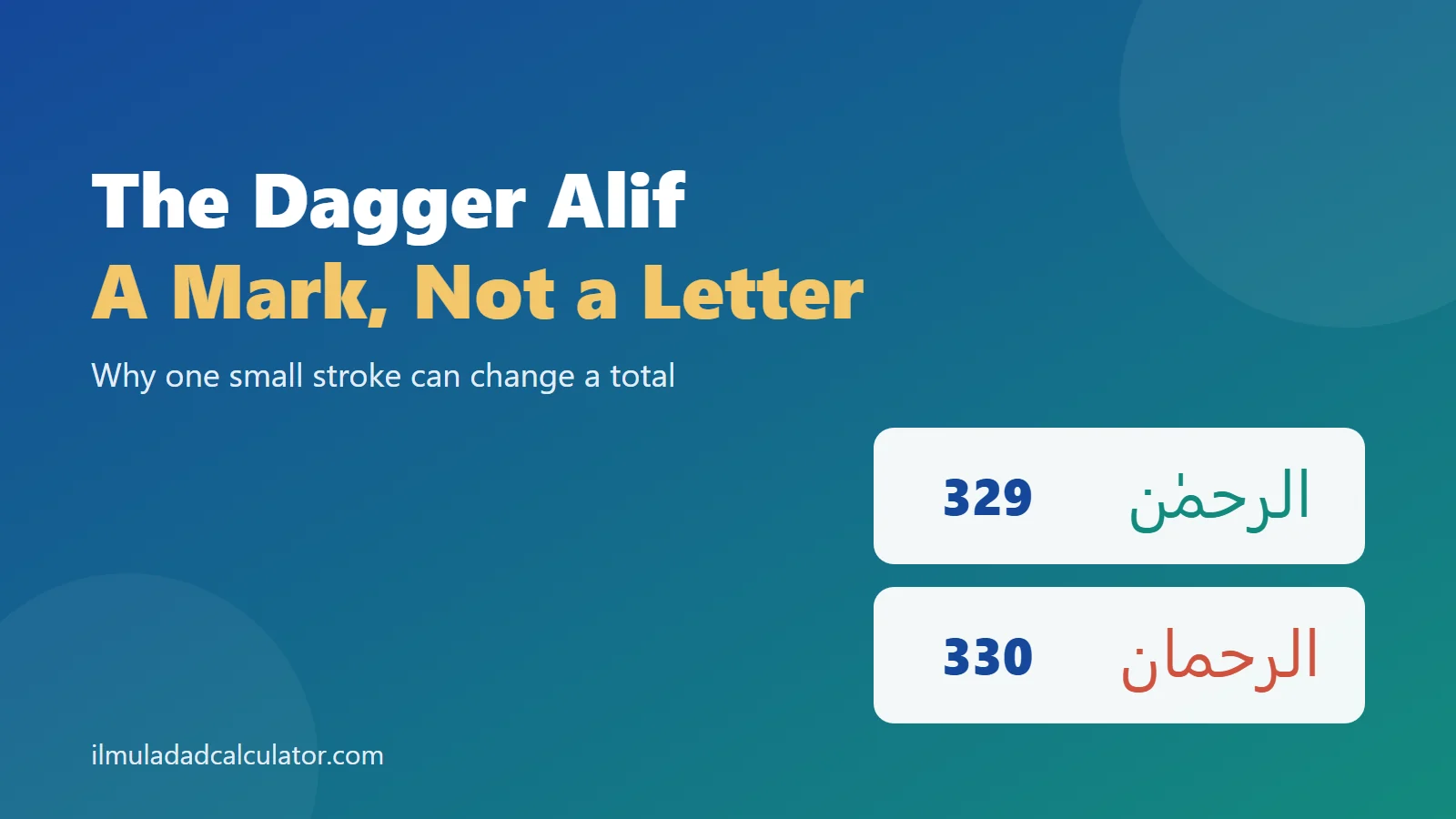
The dagger alif (ـٰ) is a small upright stroke written above a letter. It shows a long “aa” sound, but it is a vowel mark, not a letter. That is why الرحمٰن gives 329 while الرحمان, with a full alif, gives 330.
What Is the Dagger Alif?
The dagger alif is also called the superscript alif. In Arabic it is ألف خنجرية, the alif khanjariyya, named for its dagger shape. Urdu teachers call it کھڑا زبر, the khari zabar or “standing zabar.”
It tells the reader to hold an “aa” sound where no alif is written on the line. The word هٰذا is read hadha, with a long first vowel. Yet the line itself shows only he, dhal and alif.
The mark appears in only a few words. Some of those words are very common, so readers meet it often in Arabic and Urdu text.
Why Is the Dagger Alif a Mark and Not a Letter?
Arabic writing has two layers. The base layer holds the letters, joined along the line. The top layer holds small signs for vowels and other sounds.
Zabar, zer, pesh, shadda and sukun all live in that top layer. The dagger alif lives there too. It changes how a word sounds, but it never joins the line as a letter.
Unicode makes the same split. The full alif is encoded as a letter, U+0627. The dagger alif is U+0670, which Unicode lists as a nonspacing mark that sits on the letter before it.
Does Ilm-ul-Adad Count the Dagger Alif?
No. Ilm-ul-Adad adds the values of letters, and the 28 letters of the abjad order are the only ones with values. Vowel marks have no place in that order, so they add nothing.
This site’s engine follows that rule. Before it adds, it removes every vowel mark, including U+0670. So الرحمٰن and الرحمن give the same total, 329.
ا 1 + ل 30 + ر 200 + ح 8 + م 40 + ن 50 = 329
This matches how the other marks work. For two related spelling rules, see the guides to the hamza and ta marbuta.
How Does the Dagger Alif Compare With Other Marks?
Every vowel mark gets the same treatment in Ilm-ul-Adad. The table puts the dagger alif beside its neighbors in the top layer.
| Mark | Urdu name | What it shows | Adds |
|---|---|---|---|
| ـَـ | zabar | short a | 0 |
| ـِـ | zer | short i | 0 |
| ـُـ | pesh | short u | 0 |
| ـّـ | tashdid | a doubled letter | 0 |
| ـْـ | jazm | no vowel | 0 |
| ـًـ | do zabar | an -an ending | 0 |
| ـٰـ | khari zabar | a long aa | 0 |
The shadda is worth a closer look. It shows a doubled sound, yet the letter is still written once, so it is counted once.
What About the Word Allah?
The word الله is often drawn with a small dagger alif above the second lam. Fonts usually add it on their own, as part of a joined shape.
Typed with four plain letters, the word gives 66.
The single character ﷲ also exists in Unicode. The engine breaks it back into its letters first, so it gives 66 as well.
Which Common Words Carry a Dagger Alif?
Arabic Words
A small group of everyday Arabic words is written with the mark. The table shows each one with the mark and again with a full alif in its place.
| With dagger alif | Word | Total | With full alif | Total |
|---|---|---|---|---|
| هٰذا | hadha, “this” | 706 | هاذا | 707 |
| ذٰلك | dhalika, “that” | 750 | ذالك | 751 |
| لٰكن | lakin, “but” | 100 | لاكن | 101 |
| الرحمٰن | al-Rahman | 329 | الرحمان | 330 |
| إلٰه | ilah, “god” | 36 | إلاه | 37 |
Every row moves up by exactly 1. The full alif is worth 1, and nothing else in the word changes.
Many everyday texts drop the mark and write هذا, ذلك and لكن. These plain forms give the same totals as the marked forms, since the mark counted for nothing anyway.
Urdu Words
Urdu borrowed several Arabic words that keep the khari zabar. Here the mark usually sits on a ye or a waw, which stays in the word as a full letter.
- عیسیٰ (Isa): the mark sits on the ye. Total 150.
- موسیٰ (Musa): the mark sits on the ye. Total 116.
- زکوٰۃ (zakat): the mark sits on the waw. Total 38.
- صلوٰۃ (salat): the mark sits on the waw. Total 131.
In these words the ye or waw is still counted. Only the stroke above it is skipped, so removing the mark leaves each total unchanged.
How Does a Full Alif Change the Total?
The rule is simple. Each dagger alif written as a full alif adds 1 to the total.
A word with one mark rises by 1. A phrase with three marks rises by 3 if all three are written out.
Watch the Urdu endings: some writers swap the waw for an alif instead of adding one. The Arabic spelling زكاة gives 33, while Urdu زکوٰۃ gives 38. Likewise صلاة gives 126 and صلوٰۃ gives 131.
Those gaps are not 1, because a letter was replaced, not added. Waw is worth 6 and alif is worth 1, so the swap lowers the total by 5.
For Isa and Musa, the Urdu forms عیسیٰ and موسیٰ match the Arabic عيسى and موسى. Both end in a ye shape worth 10, so both spellings agree.
Why Does the 786 Total Depend on This Spelling?
The well-known total of 786 comes from the Basmala written in plain modern spelling. In that spelling, الرحمن has no full alif after the mim.
If the same phrase is typed with الرحمان, one alif is added. The total becomes 786 + 1 = 787.
The phrase value calculator explains how 786 is built, word by word. The only point here is that 786 assumes the mark is not turned into a letter.
Why Count Written Letters and Not Sounds?
Ilm-ul-Adad has always worked from the written page. A word is counted the way it is spelled, not the way it is spoken.
Sound and spelling often agree. In الرحيم, the long “ee” sound is written with a full ye, so that ye is counted as 10.
The dagger alif is the case where sound and spelling part ways. The long “aa” is heard, but no letter stands on the line for it.
Does the Mark Change the Meaning?
No. With or without the mark, هذا still means “this.” The mark only guides the reader’s voice.
A full alif does not change the meaning either. It changes only the spelling, and so it changes the count by 1.
Where Do These Written Forms Come From?
The dagger alif comes from the spelling of early Quran copies. That spelling wrote the long “aa” without an alif in some common words.
Later, when vowel signs came into use, a small alif was added above the line to show the sound. The letters on the line stayed as they were.
Printed editions differ a little in how they draw it. Wikipedia notes that South Asian and Turkish editions usually show it without a zabar, while Middle Eastern editions add one.
How Do You Type the Dagger Alif?
Most keyboards have no key for the mark. You can still enter it in a few ways:
- Type the letter that carries it first, such as the mim in الرحمن.
- Then insert U+0670 right after that letter. In Microsoft Word, type 0670 and press Alt+X.
- On a phone, copy the mark from a page that already has it, then paste it in place.
- Check your layout’s key map, since some Urdu and Arabic layouts place it on a shifted key.
Why Does the Dagger Alif Look Different on Different Screens?
The mark is drawn by the font, not by the keyboard. Good Arabic fonts place it neatly above the letter, upright or slightly slanted.
Weaker fonts may set it too high or too far to one side. Some show a dotted circle or an empty box, which means the font lacks the mark.
When a Full Alif Slips In
Some keyboards, apps and auto-correct tools write a full alif where the mark belongs. A person typing by sound may also add one, because the word is spoken with a long “aa.”
The screen may then show الرحمان instead of الرحمٰن. Both look normal, but the hidden letter adds 1 to the total.
How to Check Your Text
- Zoom in and look for a full alif standing on the line after the mim.
- Paste both spellings into the compare tool to see the gap side by side.
- Count the letters in each version and see which one has one more.
How Can You Check a Phrase Step by Step?
A short routine catches most dagger alif problems before they reach a total.
- Paste the phrase exactly as you found it, with all its marks.
- Look for words from the lists above, such as هٰذا or الرحمٰن.
- Check whether each one has a mark or a full alif on the line.
- Note the total, then subtract 1 for each full alif that stands in for a mark.
The result is the total for the marked spelling. If two sources still disagree, the gap is coming from somewhere else.
The two common Abjad systems agree here as well. In the Maghribi order, الرحمٰن gives 329 and الرحمان gives 330, again a gap of 1.
How Does This Fit With Other Spelling Differences?
The dagger alif is one of several reasons two calculators disagree. A gap of exactly 1 often points to a dagger alif or a hamza.
Other gaps have other causes, such as alif maqsura or ta marbuta. The guide on why values differ sorts these gaps by size.
The full list of letter values is on the Arabic letters page. Every value there is a letter value, and no vowel mark appears on it.
خلاصہ
کھڑا زبر (ٰ) ایک چھوٹی عمودی علامت ہے جو کسی حرف کے اوپر لکھی جاتی ہے اور لمبی «آ» کی آواز ظاہر کرتی ہے۔ یہ اعراب ہے، حرف نہیں، اس لیے علمِ اعداد میں اس کی کوئی قیمت نہیں۔ الرحمٰن کا عدد 329 ہے، لیکن اگر اسے الرحمان یعنی پورے الف کے ساتھ لکھا جائے تو عدد 330 ہو جاتا ہے۔ اسی لیے بسم اللہ کا مشہور عدد ۷۸۶ اس املا پر قائم ہے جس میں زائد الف نہیں لکھا جاتا۔
Sources and Further Reading
- Dagger alif, Wikipedia. The name alif khanjariyya, examples, its origin in Quran spelling and how editions draw it.
- Arabic diacritics, Wikipedia. The mark as a long “aa” sign, its rarity and keyboard support.
- Rasm, Wikipedia. The bare letter skeleton of early Arabic writing, without vowel signs.
- Urdu alphabet, Wikipedia. Khari zabar listed among Urdu diacritics.
- U+0670 Arabic Letter Superscript Alef, Compart. Unicode name and its class as a nonspacing mark.
- Abjad values come from this site’s tested engine. See the methodology.
Frequently Asked Questions
What is the dagger alif called in Urdu?
It is called khari zabar, which means “standing zabar.”
Is the superscript alif the same as alif madda (آ)?
No. Alif madda is a full alif with a mark on top, so it counts as 1. The superscript alif is only a mark.
Why does one calculator give 330 for al-Rahman?
That calculator was given الرحمان, with a full alif. The marked form الرحمٰن gives 329.
Does removing the dagger alif change the value?
No. The mark has no value, so the total stays the same with or without it.
Is the dagger alif used in modern Arabic writing?
Rarely. Most modern texts drop it, but it stays in the Quran and in some Urdu words.