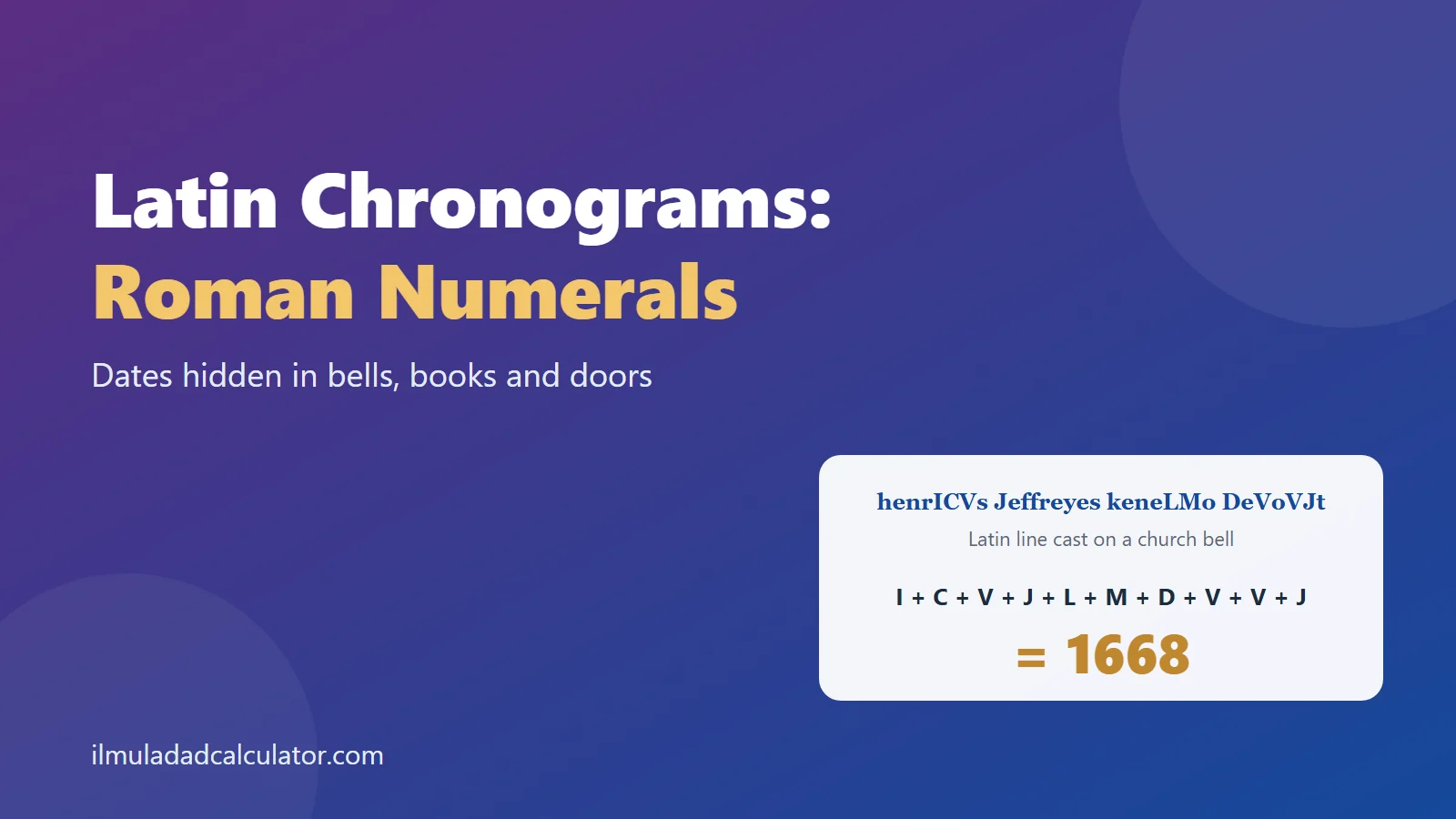
A Latin chronogram hides a year inside a sentence. The letters I, V, X, L, C, D and M are picked out and added as Roman numerals. The total is the date of the event.
What Is a Latin Chronogram?
A Latin chronogram is a line of words, usually in Latin, in which some letters double as numbers. The reader adds those letters to find a year. Writers used the same trick in English, German and other languages that share the Latin alphabet.
The tradition is old, and sources differ on its start. One account dates the earliest Latin chronogram to 1210. Another says the earliest confirmed Roman-numeral ones come from the mid 14th century.
The craft reached its height in Europe between about 1650 and 1750. The author of the Glossographia blog gives those years for the craze, based on a large catalog of examples.
For the wider idea, see what a chronogram is. This page looks only at the Roman-numeral method.
Which Letters Count in a Latin Chronogram?
Only seven letters of the alphabet are Roman numerals. Every other letter is just part of the words.
| Letter | Value | Note |
|---|---|---|
| I | 1 | One. J is read as I. |
| V | 5 | Five. U is read as V. |
| X | 10 | Ten. |
| L | 50 | Fifty. |
| C | 100 | One hundred. |
| D | 500 | Five hundred. Some writers left it uncounted. |
| M | 1000 | One thousand. |
How Did Writers Mark the Counted Letters?
A reader needs a way to tell numerals from ordinary letters. Glossographia says the numeral letters were usually set in larger size or in a different color.
In print and carving, capitals did the same job. That is why the examples on this page show the counted letters in capitals and the rest in small letters.
Why Are U and J Treated Differently?
Old Latin had no separate U and J. Writers used V for both V and U, and I for both I and J.
So a chronogram counts U as 5 and J as 1. World Wide Words adds that a W can be read as a double U, which is VV and gives 10.
Rule of thumb: look for the capitals first. In the examples on this page, the writer capitalized the letters meant to count and left the rest small.
How Do You Read a Latin Chronogram?
The method is plain addition. You do not apply the subtraction rule of ordinary Roman numerals, where IV means 4.
- Copy the line exactly as it is written.
- Pick out the capital letters that are I, V, X, L, C, D or M. Treat J as I and U as V.
- Give each letter its value from the table.
- Add them all. The order of the letters does not matter.
- Compare the total with the year of the event.
The same steps work for any line. Our guide to how to read a chronogram covers the habit in more detail.
What Does a Real Latin Chronogram Look Like?
Each example below comes from a published collection or a field report, and its total is checked in code. The first two come from James Hilton, who gathered thousands of them in the 1880s and 1890s.
A Church Bell in Worcestershire, 1668
Hilton records a line for the great bell at Clifton-on-Teme, which was recast in 1668. The Latin reads henrICVs Jeffreyes keneLMo DeVoVJt, meaning that Henry Jeffreyes dedicates the bell to Kenelm.
The letters add up to 1668. Notice the two J’s. Both are capitals, and both must count as I to reach the year.
A Funeral Sermon Title Page
The second example sits on the title page of a funeral sermon for Lady Mary Farewell, near Taunton. Two verses are printed together: one for her death, and one for her age.
The first line gives 1660. The second gives 74, the years she lived. The second line also plays on her name with the closing word Vale, which means farewell.
The letter D opens the first line as an abbreviation. It counts here, as the total of 1660 shows.
Three More Inscriptions and Lines
The table below adds one door, one pamphlet and one wall. Each total matches the year given in its source.
| Line | Where | Values added | Total |
|---|---|---|---|
| saCrVM paroChIaLe DIVI IoannIs baptIstae | Above the baptistery door of Aachen Cathedral | 100 + 5 + 1000 + 100 + 1 + 50 + 500 + 1 + 5 + 1 + 1 + 1 + 1 | 1766 |
| LorD haVe MerCIe Vpon Vs | A pamphlet of 1666, attributed to George Wither | 50 + 500 + 5 + 1000 + 100 + 1 + 5 + 5 | 1666 |
| saeCLa DeCeM repLens Legat Vrbs VestIgIa prIsCa | Bock Casemates, Luxembourg, marking 1,000 years of the city | 100 + 50 + 500 + 100 + 1000 + 50 + 50 + 5 + 5 + 1 + 1 + 1 + 100 | 1963 |
The 1666 line is English, not Latin. It reminds us that any language written in Latin letters can carry a chronogram. World Wide Words makes the same point.
How Did a Writer Build a Latin Chronogram?
The writer worked backward from the year. For 1668, the plain Roman form is MDCLXVIII, but a chronogram does not need that exact mix.
Any letters that add to 1668 will do, and a letter may repeat as often as the words require. The bell line uses 1 M, 1 D, 1 C, 1 L, 3 V’s, 3 I’s.
- Fix the year and the message, such as a dedication or a death.
- Draft words that suit the message, in good Latin verse if possible.
- Capitalize the numeral letters that are needed and leave the others small.
- Add the capitals. If the total is too high or too low, swap a word for another with different letters.
Letters such as V and I appear in nearly every Latin word, which makes the small values easy to reach. The large values are the hard part, so M, D and C often drive the choice of words.
Can an English Sentence Be a Chronogram?
Yes. The 1666 line, LorD haVe MerCIe Vpon Vs, is English. Its capitals give L, D, V, M, C, I, V and V, which add to 1666.
Wikipedia also records a double chronogram of 1642, with a Latin half and an English half. The English half writes W as two V’s, which is why W counts as 10.
Our famous chronograms page decodes that pair letter by letter.
Where Do Latin Chronograms Appear?
Writers placed them wherever a date had to last. The sources describe several settings.
- Bells: founders often recorded the casting year in a short Latin line, as at Clifton-on-Teme.
- Title pages and books: Hilton notes that many books print a chronogram on the title page instead of figures.
- Medals and coins: Wikipedia says many medal inscriptions include chronograms, though they are scarcer on coins.
- Buildings and doors: church doors, house fronts, and foundation stones recorded the year of building.
- Tombstones: gravestones used them for the year of death.
The same line could serve a bell, a door or a page. Only the surface changed, while the method stayed the same.
Some books went further. Hilton describes whole odes and poems written so that many lines each gave the same year.
How Is It Different From the Abjad Method?
A plain Roman date such as MDCLXVIII is written openly. A chronogram spreads the same value through ordinary words, so the date stays hidden until someone adds the letters.
Both traditions hide a year in words, but they count letters differently. The Latin method picks out seven letters, while the abjad method gives a value to every letter.
| Feature | Latin (Roman numerals) | Arabic script (abjad) |
|---|---|---|
| Which letters count | Only I, V, X, L, C, D and M | Every letter in the phrase |
| How you know | The writer marks them with capitals or larger type | Nothing is marked; you add them all |
| Words in the line | Many letters are ignored, so the line reads freely | Every letter must fit the total |
| Usual calendar | Common Era | Usually Hijri |
| Number of values | Seven | Twenty-eight base letters |
To see the other side, read about tarikh goi, the Urdu and Persian art. Our famous chronograms page puts examples from both traditions together.
What Mistakes Should You Avoid?
- Using subtractive Roman rules. In a chronogram, I before V is 1 plus 5, not 4.
- Counting small letters. A lowercase i or v is ignored when the writer marked the numerals.
- Forgetting U and J. Read U as V, and J as I, unless the source says otherwise.
- Skipping W. A W, written VV in some lines, adds 10.
- Assuming every capital counts. Hilton notes a 1635 line whose initial J, although a large capital, was not counted.
The Aachen door shows the checking habit well. The line simply names Saint John the Baptist, yet its capitals add to 1766.
One more caution comes from Hilton. Flemish writers often treated D as zero, so check each line against its known year.
Who Collected These Chronograms?
James Hilton published three large volumes of them in 1882, 1885 and 1895. The Glossographia author analyzed 10,342 chronograms from his catalog.
Hilton labels some of them by length. A chronostichon is a chronogram in a single line of verse, and a chronodistichon is one in a couplet.
His catalog is arranged by country and diocese. It lists many parish church bells in German towns, each with its line and year.
Thousands more chronograms never reached print. Glossographia says Hilton’s unpublished papers are held at the British Library.
The fashion faded, and critics of the 1800s mocked it as a pointless exercise. Even so, new ones appeared in the twentieth century. The Luxembourg line of 1963 is one case.
How Can You Check a Latin Chronogram Yourself?
You need only a pencil and the seven values. Write the counted letters in a row. Add the M’s first, then D, C and the smaller ones.
If the total misses the year, test the spelling first. Then test the J, U and D rules, since those cause most differences.
Keep a short record of your working. Note each counted letter and its value, so a second reader can repeat your sum and agree.
For Arabic, Persian or Urdu lines, use the chronogram decoder, which adds abjad values for you.
خلاصہ
لاطینی کرونوگرام ایسا جملہ ہے جس میں صرف رومی ہندسوں والے حروف جمع کرنے سے سال نکلتا ہے۔ لکھنے والے ان حروف کو بڑا لکھتے تھے، اور جے کو آئی اور یو کو وی شمار کیا جاتا تھا۔ یہ سال گھنٹیوں، کتابوں کے سرورق، تمغوں اور عمارتوں پر ملتے ہیں، مثلاً ۱۶۶۸ کی ایک گھنٹی کا کتبہ۔
Sources and Further Reading
- Chronograms, 5000 and more in number, James Hilton (1882), Internet Archive. The Clifton-on-Teme bell, the Farewell title page, and notes on D and J.
- Catch ’Em All: Discoveries in Vexing Secret Signs, Glossographia (2025). The Aachen and Luxembourg lines, U and V, I and J, and catalog statistics.
- Chronogram, World Wide Words. The 1666 line, J, U and W, and uses on medals and bells.
- Chronogram, Wikipedia. Earliest Latin chronogram, medals and coins, and the double chronogram of 1642.
Frequently Asked Questions
What is a Latin chronogram?
It is a Latin sentence in which the Roman numeral letters, added together, give a year.
Do I count the small letters?
No. When the writer capitalized the numerals, only the capitals count.
Is U counted as V in a chronogram?
Yes. U counts as V (5), and J counts as I (1), following old Latin spelling.
Why does IV not equal 4 in a chronogram?
Chronograms simply add every counted letter, so I and V make 6.
Do chronograms use Roman numerals only?
In the Latin tradition, yes. Arabic, Persian and Urdu chronograms use abjad letter values.