Takhrija and ta’miya are the two best-known ways a poet adjusted a chronogram. When the letters of a phrase missed the year, the verse told the reader what to take away or add. This page defines each term and checks real examples letter by letter.
What Are Adding and Subtracting Devices in Chronograms?
A plain chronogram needs one sum. The letters of the date line add up to the year, and nothing else is needed. Our page on what a chronogram is explains that base case.
Sometimes the best phrase for an event was a few points too high or too low. Instead of dropping the phrase, a poet could signal one correction inside the verse.
That signal is the device. This page covers only the correction itself. For a full poem, see how to read a chronogram and how to write one.
What Do Takhrija, Ta’miya and Mu’amma Mean?
These terms are easy to mix up. The sources do not always use them the same way, so the table names the source for each meaning.
| Romanized term | Script | Meaning | Source |
|---|---|---|---|
| takhrija (also takhrij) | تخرجہ | Subtraction. The numbers of some letters are deducted from the total to reach the year. | Rekhta Dictionary |
| ta’miya (also ta’miyya, ta’amiya), Urdu use | تعمیہ | Addition. A letter, word or phrase is added to cover a shortfall, by nine at most. | Rekhta Dictionary |
| ta’miya, Persian use | تعمیه | A chronogram built as a riddle. It may call for adding or subtracting. | Encyclopaedia Iranica |
| mu’amma | معمہ | A riddle or puzzle in general. It is not a chronogram device by itself. | Rekhta Dictionary |
Spelling note: ta’miya and ta’miyya are two romanizations of one word. The plain Arabic word takhrij means drawing out, and other fields use it in other senses. In tarikh goi, the chronogram term is takhrija.
The Persian tradition used ta’miya more widely. Encyclopaedia Iranica describes it as a chronogram in the form of a riddle, governed by the rules of riddles.
Subtraction counted as part of that riddle art. So the same word can mean addition in an Urdu dictionary and a whole riddle type in a Persian study.
How Does Takhrija Work in Momin’s Verse?
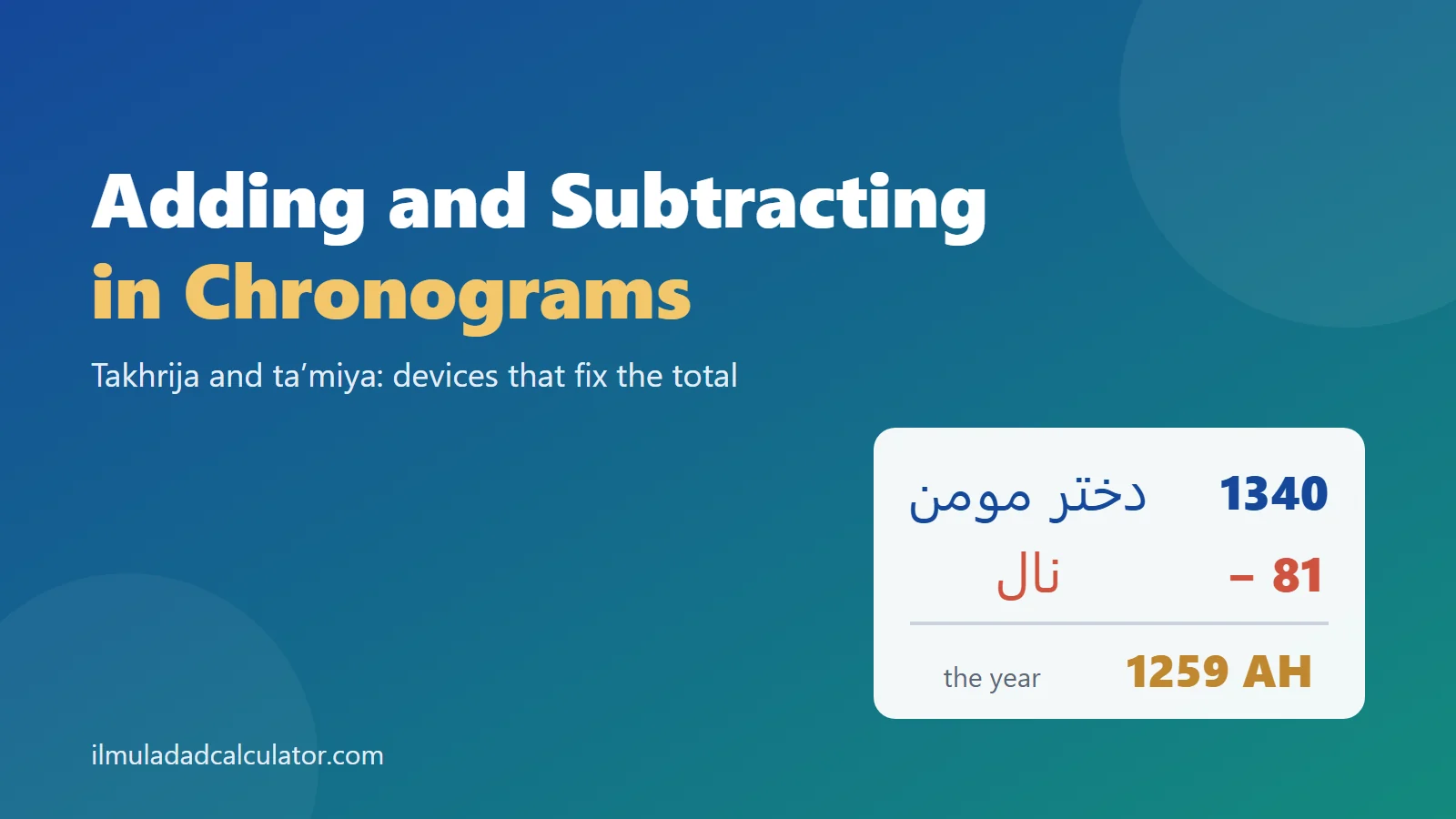
The best-known Urdu example is a verse by the poet Momin on the birth of his daughter. Rekhta gives it in Roman letters. It says that when the cord was cut, the hatif (the unseen voice) spoke the date “Dukhtar-e-Momin.”
The date phrase is two words. Its letters give 1340, which is too far ahead of the daughter’s birth.
د 4 + خ 600 + ت 400 + ر 200 + م 40 + و 6 + م 40 + ن 50 = 1340
The word naal, the cord, is worth 81.
ن 50 + ا 1 + ل 30 = 81
The verb katna, “to cut,” signals subtraction. Taking 81 from 1340 leaves 1259.
That is 1259 AH, which Rekhta converts to 1843 to 1844 CE. The poem names its own correction, so the reader needs no outside rule.
How Can One Word Be Subtracted From Another?
Persian poets did the same with whole words. Iranica reports a line for the death of the Prophet Muhammad in 11 AH. In Roman letters it reads Az Muhammad zamana khali mand, “time remained empty of Muhammad.”
The line says that time, زمانه, is left empty of the name محمد. So the value of the second word leaves the first.
103 − 92 = 11
Iranica gives more subtraction lines from Safavid poets. We cover them on the Persian chronograms page, so they are not repeated here.
What Does Cutting the Head of a Word Mean?
The Rekhta Dictionary entry for takhrija gives a small illustration of an exact cut. The letters alif, lam and mim total 71, but the poet needs 70.
If the first line speaks of cutting the head of the word, the head is the alif. Its 1 is removed, and 70 remains.
This is the dictionary’s own example, not a quoted poem. It shows how exact the instruction can be: one named letter, one fixed value.
How Does Ta’miya Add to a Total?
The Urdu dictionary defines ta’miya as adding a letter, word or phrase when the date line falls short. The Hindi gloss of the same entry adds the limit: the added number cannot exceed nine.
The poet Muhammad Husain Azad writes of the same limit in his history of Urdu poets, Ab-e Hayat. He says the rules of the art allow no more adding or subtracting than nine.
The sources differ on subtraction: the dictionary caps only the adding and sets no fixed limit on subtracting. Azad names both. Momin’s daughter verse takes away 81, so the limit did not stop practice.
Azad adds that critics had long counted adding and subtracting as faults. He says Momin’s skill ranked them among the beauties of the chronogram.
The sources used for this page give the rule for plain addition but no quoted poem. So this page shows the rule and does not invent an example.
How Can Two Halves Be Added to Give a Year?
One more kind of addition appears in Rekhta’s article on tarikh nigari. When Gandhi died in 1948, Hamid Hasan Qadiri wrote a couplet that counts in the Bikram Samvat calendar.
The first line gives a part from the phrase بلاد عالم, and the second line gives a larger part. Rekhta says the two parts are added.
178 + 1826 = 2004
The result is 2004 Bikram Samvat, which Rekhta places in 1948. Note that only the marked phrase in the first line counts. The whole first line would give a different number.
Why Did Poets Need These Devices?
A chronogram has two jobs at once. Its words must fit the event, and its letters must add up to the year.
Few phrases do both perfectly. A poet could swap a word for a synonym, but sometimes the best phrase still missed by a small amount.
Adding or subtracting kept the good phrase and paid for the miss inside the verse. The cost was extra work for the reader, who had to find the clue and apply it.
How Can You Spot the Signal in a Poem?
The poem rarely hides its correction. It usually puts a clue in the same verse as the date.
- A verb of removal, such as katna, “to cut,” in Momin’s verse.
- A phrase of emptiness, such as “time remained empty” in the Persian line.
- A named part of a word, such as its head or its first letter.
- A named word, whose value matches the gap between the total and the year.
Count the plain letters first. When the total misses by a clean number such as 81, look for a matching word in the verse.
Which Device Fits Which Situation?
Think of the choice as a short test. Compare the total with the year, then look at the gap.
A gap of zero needs no device. When the total is higher than the year, the poem calls for takhrija. When it is lower, the poem calls for ta’miya, usually by nine or less.
In Momin’s verse the gap was 81 too high, so the poem subtracted. Reading the gap first saves a lot of guessing.
What Are the Devices at a Glance?
| Device | Rule | Worked check | Source |
|---|---|---|---|
| Takhrija by a named word | The poem names a word. Subtract its value from the phrase total. | دختر مومن 1340 − نال 81 = 1259 AH | Momin, birth of his daughter (Rekhta) |
| One word taken from another | The verse says one word is “empty” of another. Subtract the second value from the first. | زمانه 103 − محمد 92 = 11 AH | Persian line, 11 AH (Iranica) |
| Cutting the head of a word | The poem says the head is cut. Remove the first letter from the count. | الم 71 − ا 1 = 70 | Dictionary illustration (Rekhta) |
| Ta’miya by a small addition | A letter or word is added to a total that falls short. The added value is nine or less. | Rule check only: 70 + 1 = 71, and 1 is within nine | Rule from Rekhta Dictionary and Azad |
| A year split in two parts | Each half of a couplet gives one part. Add the parts. Count only the marked words. | بلاد عالم 178 + 1826 = 2004 Bikram Samvat | Hamid Hasan Qadiri on Gandhi (Rekhta blog) |
The fourth row is an arithmetic check of the rule, not a poem.
How Do Selection Tricks Differ From Adding and Subtracting?
Iranica describes other devices that change which letters are counted. A poet might count only the dotted letters, or only the undotted ones.
Wahshi of Bafq used this to make one motto give 966 AH four times. He counted the dotted, undotted, joined and unjoined letters separately.
These tricks choose letters. They do not add or take away a named value. They belong with Persian chronograms rather than with takhrija.
Iranica also notes that even obscure devices are usually marked in the poem itself. It points modern readers to a dictionary of such devices by Mahdi Sadri.
How Do You Test a Chronogram That Seems to Miss?
- Copy the date line exactly as written, with the same letters.
- Add the letters with the Mashriqi values. The phrase value calculator does this step.
- Compare the total with the known Hijri year.
- Find the gap, and note whether the total is too high or too low.
- Search the verse for a word or letter whose value equals the gap.
- Check that a verb or phrase tells you to remove it or add it.
The chronogram decoder has boxes for an added word and a removed word. It also converts the Hijri year to the Common Era.
What Mistakes Should You Avoid?
- Counting the cue. The words “the hatif said” are not part of the date.
- Counting a whole line. In the Gandhi couplet, only the marked phrase counts in the first line.
- Mixing up ta’miya and mu’amma. A mu’amma is a riddle. A ta’miya in the Urdu sense is an addition.
- Forcing the gap. If no word fits, check your spelling and the value system first.
خلاصہ
تاریخ گوئی میں جب حروف کا مجموعہ سال سے کم یا زیادہ نکلے تو شاعر شعر ہی میں اشارہ کر دیتا ہے۔ سال سے زیادہ عدد کم کرنے کو تخرجہ اور کمی پوری کرنے کے لیے عدد بڑھانے کو تعمیہ کہتے ہیں۔ مومن کی بیٹی کی پیدائش کے قطعے میں «دختر مومن» کے ۱۳۴۰ میں سے «نال» کے ۸۱ نکالنے سے ۱۲۵۹ ہجری حاصل ہوتا ہے۔
Sources and Further Reading
- Tarikh Nigari: Numbers Speaking Through Words, Rekhta blog (2020). The two devices, Momin’s verse in Roman letters, and the Gandhi couplet. The Urdu script above is set from that Roman text.
- takhrija, Rekhta Dictionary. Definition and the alif-lam-mim illustration.
- ta’miih, Rekhta Dictionary. Definition, with the limit of nine in the Hindi gloss.
- mu’ammaa, Rekhta Dictionary. Meaning of the riddle.
- Chronograms, Encyclopaedia Iranica, by J. T. P. de Bruijn (1991). The four types, ta’miya as a riddle, and the 11 AH line.
- Mādda tāriḵ, Encyclopaedia Iranica, by Paul E. Losensky (2006). Clear marking of devices, Wahshi’s four-fold motto, and Sadri’s dictionary.
- Ab-e Hayat: Momin chapter, Muhammad Husain Azad, translated by Frances W. Pritchett. The remarks on adding, subtracting and the limit of nine.
Frequently Asked Questions
What is takhrija in a chronogram?
Takhrija is subtraction. The poem tells the reader to deduct the value of a letter or word from the total.
What is ta’miya in a chronogram?
In Urdu use it means adding a small value to fill a shortfall. Persian writers also use it for riddle chronograms.
Is ta’miya the same as mu’amma?
No. A mu’amma is a riddle in general. Ta’miya is a chronogram device or a riddle-style chronogram.
Is there a limit to adding or subtracting?
Sources name a limit of nine for adding. For subtracting, they differ, and Momin’s verse takes away 81.
Which example shows takhrija best?
Momin’s verse on his daughter’s birth. Its phrase gives 1340, and subtracting naal (81) gives 1259 AH.