Before 15 October 1582, almost every historical date you will meet is Julian. Here is why, how the two calendars differ, and how to convert between them with a day number.
Why Do Historic Hijri Conversions Give Julian Dates?
The Hijri era began in 622 CE. At that time the only Western calendar in use was the Julian one. So the standard statement of the epoch, 1 Muharram 1 AH, is Friday 16 July 622 in the Julian calendar.
The Gregorian calendar did not exist until 1582.
A converter that follows the usual historical convention stays Julian for early dates. It switches only at the reform. So a Hijri date from 1100 AH may read ten days behind a modern calendar app.
The same date in the Gregorian calendar is 19 July 622. This is a proleptic date, meaning the Gregorian rules are extended backward to a time before they were invented. Both dates name the same day.
Short answer: pick the calendar that the source used. Before 15 October 1582, that is normally Julian. After it, check the country, because adoption was gradual.
Why Did the Calendar Need Fixing?
The Julian year is a little longer than the solar year. Over centuries, the calendar date of the March equinox slid earlier.
Ten days may sound small, yet the error had been building for over a thousand years. Astronomers and church calendar keepers both wanted it corrected.
By 1582 the date 21 March had drifted about ten days from the equinox. The reform reset the calendar and changed the leap rule so the drift would slow down.
What Happened in October 1582?
Pope Gregory XIII issued the bull Inter gravissimas on 24 February 1582. It corrected a calendar that had drifted from the seasons.
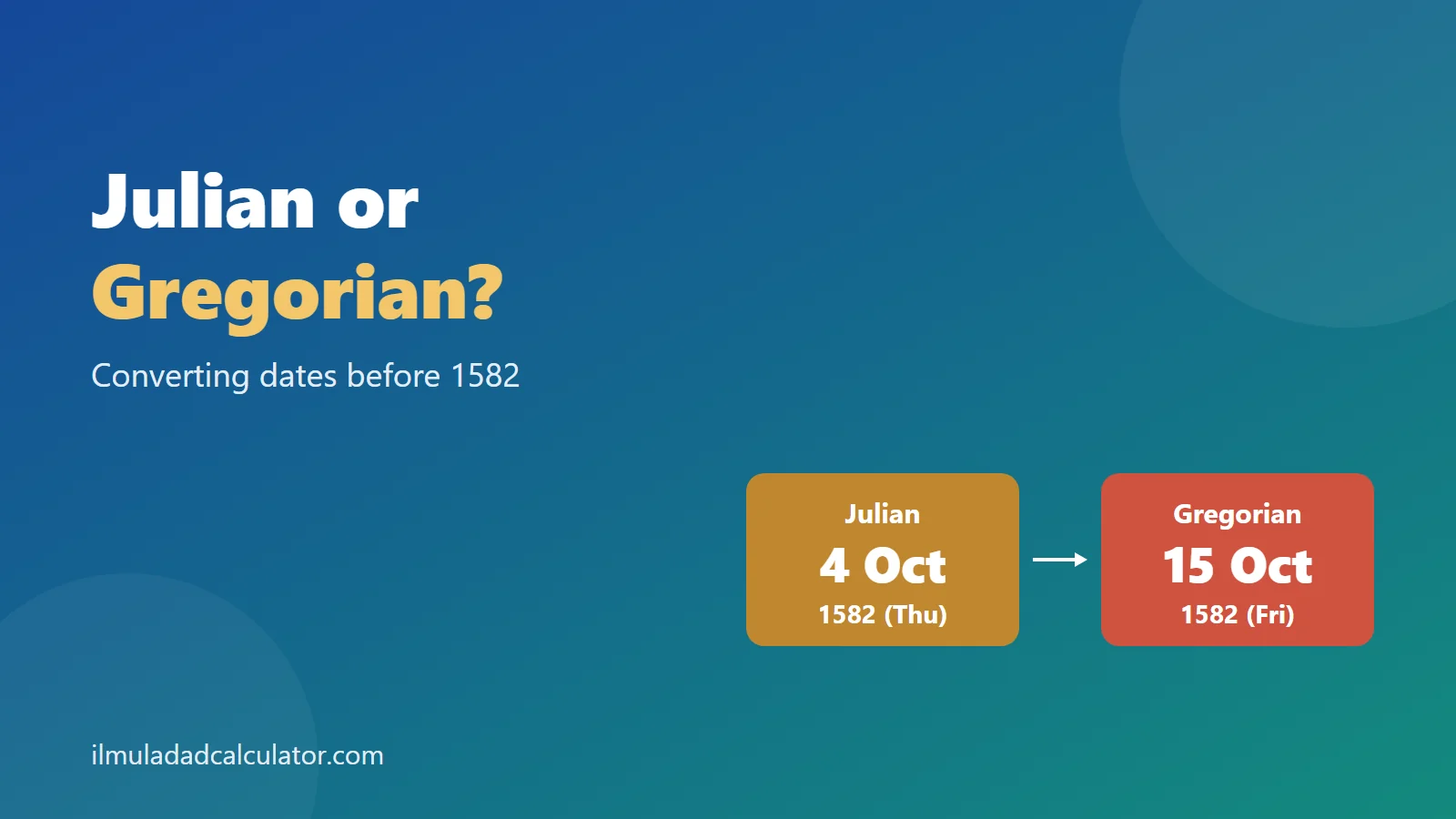
In the countries that adopted it at once, Thursday 4 October 1582 was followed by Friday 15 October 1582. Ten calendar dates were skipped, but no weekday was lost.
The Two Leap Rules
The Julian calendar adds a leap day every fourth year, without exception. That makes the average year 365.25 days.
The Gregorian calendar keeps that rule but removes the leap day from century years that 400 does not divide. So 1600 and 2000 were leap years, while 1700, 1800 and 1900 were not.
| Feature | Julian | Gregorian |
|---|---|---|
| Leap year rule | Every fourth year | Every fourth year, except century years not divisible by 400 |
| Leap days in 400 years | 100 | 97 |
| Average year | 365.25 days | 365.2425 days |
| Is 1700 a leap year? | Yes | No |
| Is 1600 a leap year? | Yes | Yes |
The difference is small, 0.0075 days a year. Even so, it adds up to one extra day about every 133 years.
How Big Is the Gap Between the Two Calendars?
The gap is not fixed. It grows by one day each time a century year is a leap year in the Julian calendar only.
In July 622 the gap was 3 days. By October 1582 it had reached 10, which is exactly the number of days the reform removed.
The gap then stepped up in March of 1700, 1800 and 1900. From March 1900 it has been 13 days, and it stays there until 2100.
Which Countries Switched, and When?
The Gregorian calendar spread country by country over more than 300 years. So a date in the 1600s or 1700s needs the place as well as the year.
| Place | Adopted |
|---|---|
| Spain, Portugal, Italy | 1582 |
| France | December 1582 (9 December was followed by 20 December) |
| Prussia | 1610 |
| Great Britain and its empire | 1752 (11 days dropped) |
| Japan | 1873 |
| Russia | 1918 |
| Greece | 1923 |
Notice that France and Britain skipped different numbers of days. France dropped ten and Britain dropped eleven, because the gap had grown in between.
What Are Old Style and New Style Dates?
Writers used Old Style, or O.S., for a Julian date. They used New Style, or N.S., for a Gregorian one. During the changeover they sometimes wrote both, as in 10/21 February 1750/51.
The slash in the year reflects a second issue. In England the legal year began on 25 March until 1752, so January and February carried the earlier year number. The label New Style can also mean a Julian date with the year starting on 1 January.
How Do You Convert With a Julian Day Number?
A Julian day number, or JDN, is a running count of days from a fixed starting point. Because it ignores months and leap rules, it is the safest bridge between calendars.
- Turn the date into a JDN using the rules of the calendar the date is written in.
- Turn that JDN back into a date using the rules of the other calendar.
- Check the weekday, which is the same in both calendars.
The method below shifts the year to start in March.
For day D, month M and year Y, let a = (14 – M) ÷ 12. Then y = Y + 4800 – a and m = M + 12a – 3.
Drop every remainder. The base value is D + (153m + 2) ÷ 5 + 365y + y ÷ 4.
- For a Julian date, subtract 32083.
- For a Gregorian date, subtract y ÷ 100, add y ÷ 400, and subtract 32045.
These routines reproduce the published day number for 1 January 2000, which is 2451545. They also agree with the two formulas printed in the Wikipedia article on the Julian day. That holds for every date used on this page.
How Do You Convert 1 Muharram 1 AH Step by Step?
Take 16 July 622, the date of the epoch in the Julian calendar. Here D = 16 and M = 7, so a = (14 – 7) ÷ 12 = 0. Then y = 622 + 4800 – 0 = 5422, and m = 7 – 3 = 4.
- (153 × 4 + 2) ÷ 5 = 614 ÷ 5 = 122.
- 365 × 5422 = 1,979,030.
- 5422 ÷ 4 = 1,355.
- Add them with D: 16 + 122 + 1,979,030 + 1,355 = 1,980,523.
- Subtract 32083 for the Julian calendar: 1,980,523 – 32083 = 1,948,440.
Now read the same day number in the Gregorian calendar. Use y ÷ 100 = 54 and y ÷ 400 = 13. Reading the number back gives 19 July 622, a Fri.
As a check, apply the Gregorian formula to the numerals 16 July 622. It gives 1,980,523 – 54 + 13 – 32045 = 1,948,437. That is 3 days earlier, which matches the 3-day gap shown above.
Converting a Date Just Before the Reform
Try the last Julian day, 4 October 1582. Its day number is 2,299,160, and that is a Thu.
Read the same number in the Gregorian calendar and you get 14 Oct 1582. The next day number, 2,299,161, is 15 October. So the reform changed the numerals and left the day count alone.
A Second, Independent Check
The tabular civil calendar has its own day-number formula, built from the 30-year cycle with 11 leap years. For 1 Muharram 1400 it gives 2,444,199.
The Wikipedia article on the Islamic calendar gives that date as 21 November 1979 in the Gregorian calendar.
The Gregorian formula above returns 2,444,199 for that day. The two numbers match. The same Hijri formula returns 1,948,440 for year 1, as in the epoch conversion.
How Can You Tell Which Calendar a Converter Used?
Many online converters do not say. You can test one with a single known pair of dates.
- Enter 1 Muharram 1 AH, or the year 1 with the first month.
- If the result is 16 July 622, the tool shows Julian dates.
- If the result is 19 July 622, the tool shows proleptic Gregorian dates.
Both answers are correct for the tabular civil calendar. They are the same day written in two ways. Trouble starts only when a table mixes them.
Does the Gap Change a Hijri Year Conversion?
It can, but only near a boundary. A gap of ten days moves a date from late December into early January in rare cases.
The year-level rule on the Hijri to Gregorian formula page gives a two-year range. That range is wide enough to absorb the Julian gap for most dates.
If you need a single day, the calendar label matters. The same Julian date can carry two different Gregorian numerals. They sit three to thirteen days apart, depending on the era.
Which Calendar Should You Use for a Given Date?
Use a short decision path. It keeps you from mixing calendars in one table.
- Before 4 October 1582: use Julian unless the source states otherwise.
- From 5 to 14 October 1582: these dates did not exist where the reform applied.
- After 15 October 1582: use the calendar of the country in the table above.
- After 1923: every country in the table was on the Gregorian calendar for civil use.
When you quote a date, write the calendar next to it, for example 16 July 622 (Julian). That one habit prevents most confusion.
Three Common Mistakes
- Adding 13 days everywhere. The gap was 3 days in 622 and 10 days in 1582. Thirteen applies only from March 1900.
- Mixing styles in one table. A column of Julian dates beside Gregorian ones will not sort correctly.
- Assuming a year starts on 1 January. Before the change, England counted the year from 25 March.
For the formula that converts a Hijri year to a Gregorian year, see the Hijri to Gregorian formula page. For the era itself, read the history of the Hijri calendar and Hijri calendar systems. The page on year 1 explains the year count, and the calendar hub lists the rest.
Keep the working in view when you publish a conversion. A reader can then check the day number and see which calendar you meant. A short note such as JDN 1948440 costs little and settles most disputes between sources.
Nothing here makes any claim about the correct day for any observance.
خلاصہ
پندرہ اکتوبر ۱۵۸۲ سے پہلے کی تقریباً تمام تاریخیں جولین کیلنڈر میں لکھی جاتی ہیں۔ ہجری سال کا آغاز ۱۶ جولائی ۶۲۲ جولین کو ہوا، جو گریگورین میں ۱۹ جولائی ۶۲۲ بنتا ہے۔ ۱۵۸۲ میں جمعرات ۴ اکتوبر کے بعد جمعہ ۱۵ اکتوبر آیا اور دس تاریخیں چھوڑ دی گئیں۔ جولین اور گریگورین کیلنڈر میں فرق وقت کے ساتھ بڑھتا ہے، اس لیے ملک اور سال دونوں دیکھنا ضروری ہے۔ جولین ڈے نمبر کے ذریعے ایک تاریخ کو دوسرے کیلنڈر میں محفوظ طریقے سے بدلا جا سکتا ہے۔
Sources and Further Reading
- Gregorian calendar, Wikipedia. The bull of 24 February 1582, the dropped days, the leap rule, the mean year and the adoption dates.
- Julian calendar, Wikipedia. The leap year every fourth year, the 365.25 day year, and Old Style and New Style.
- Islamic calendar, Wikipedia. The epoch of Friday 16 July 622 Julian and 1 Muharram 1400 AH as 21 November 1979.
- Julian day, Wikipedia. The day number definition, the published formulas and the value 2451545 for 1 January 2000.
- Tabular Islamic calendar, Wikipedia. The 30-year cycle with leap years.
- Calendar arithmetic is computed in code and asserted. See the methodology.
Frequently Asked Questions
Are dates before 1582 Julian or Gregorian?
They are Julian unless a source says otherwise. Where a proleptic Gregorian date is given, it is labeled as such.
How many days were dropped in 1582?
Ten. Thursday 4 October 1582 was followed by Friday 15 October 1582, with no break in the weekday order.
What is 1 Muharram 1 AH in the Gregorian calendar?
It is 19 July 622, which is 16 July 622 in the Julian calendar. Both are the same Friday in the tabular civil calendar.
What do Old Style and New Style mean?
Old Style usually means a Julian date and New Style a Gregorian one. They can also describe the year starting on 25 March or 1 January.
Why did Britain drop 11 days instead of 10?
Britain adopted the calendar in 1752. By then the Julian calendar had run one more day behind because 1700 was a Julian leap year.