The Mughals ruled in India for more than three centuries, and their court language was Persian. Poets wrote verses for mosques, gates and tombs, and some of them hid the year of building in the letters. This guide shows how that worked, with one checked example from Delhi.
Why Did Mughal Builders Put Verse on Their Buildings?
A Mughal monument was a public statement. Its inscription named the patron, praised the building and told visitors when it was finished.
Encyclopaedia Iranica notes that Persian replaced Arabic almost everywhere under the Mughals. Long inscriptions at Agra, Delhi and Lahore are fine examples of Persian prose. Many others were set in verse.
Verse suited a court that valued poetry. A patron could hire a court poet, and a gifted calligrapher could then carve or inlay the lines.
- The patron paid for the building and its inscription.
- The poet composed the verse, often a court historian or a poet laureate.
- The calligrapher wrote the lines, usually in the Nastaliq script.
- The craftsmen carved them in stone or set them in glazed tile.
Iranica says Nastaliq was almost universal in the Mughal period. It adds that some men were both poets and calligraphers, like Amanat Khan.
How Did Mughal Inscriptions Give the Year?
A Mughal wall could carry a date in several forms. Iranica lists three that matter here.
The Hijri Year
The Hijri calendar is the lunar calendar of the Muslim world. Early inscriptions wrote the year in words, and later ones used numerals. Abjad chronograms gave it as a phrase.
The Ilahi Year
Akbar started the Ilahi era, which follows a Persian solar calendar. Iranica says a few of his successors also used it. It gave way to the regnal year, which counts years of the ruler on the throne.
Which One Does a Chronogram Use?
A chronogram adds letter values, so it almost always gives the Hijri year. The result must then be converted to the Common Era, as we do below.
Iranica also notes a trend. Abjad chronograms appear early, but they are far more common in inscriptions of the 18th to 20th centuries.
What Does a Mughal Chronogram Look Like?
Most follow a simple shape. The poem praises the building, then a short signal tells the reader that a date follows. The final phrase carries the year.
The signal is often the word tarikh, تاریخ, which means date. The words before the signal are not counted. Our guide on how to read a chronogram explains the steps in more detail.
Mughal poets used the same Persian letter values as poets in Iran. Our page on Persian chronograms covers the Safavid side of the story. Mughal poets such as Kalim of Kashan also dated the emperor’s building projects, according to Iranica.
Which Mughal Building Has a Checked Chronogram?
The best example for this page is a mosque in Delhi called Khair ul Manazil. Wikipedia describes a Persian inscription on a marble plaque above the arch of its central gate.
The plaque is credited to Maulana Shihabuddin Ahmad Khan, who wrote under the pen name Baazil. He was Akbar’s court historian and poet. The last line of his verse reads:
که شد تاریخ او خیر المنازل
Wikipedia gives the meaning as “the abode of goodness.” So the name of the mosque is the date.
The poet chose a name that praises the building and also holds the year. That double job is what makes it a chronogram.
Step 1: Spot the Cue
The verse says “its date became” before the name. The word تاریخ is the signal. The words که, شد, تاریخ and او are not part of the date.
If you add every word on the line, you get 2516. That is far too high for any Hijri year of Akbar’s time, so the cue words must stay out.
Step 2: Add the Letters of the Phrase
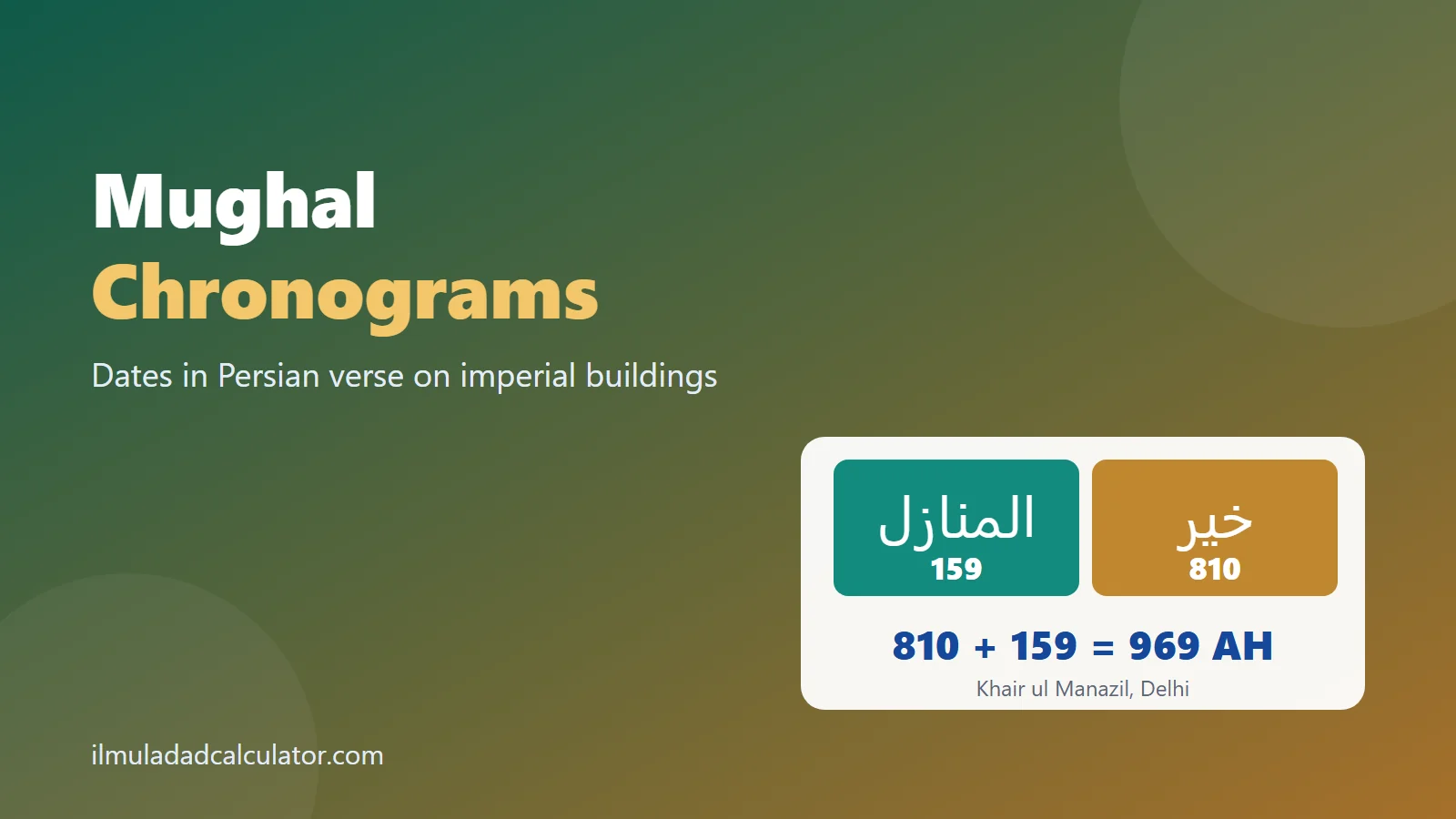
The date phrase is خیر المنازل, khair ul manazil. Each Persian letter has its Abjad value from the engine.
خ 600 + ی 10 + ر 200 = 810
ا 1 + ل 30 + م 40 + ن 50 + ا 1 + ز 7 + ل 30 = 159
Together the two words give 810 + 159 = 969. The year is 969 AH.
Step 3: Convert the Hijri Year
The Hijri year is shorter than the solar year. A quick rule from our Hijri to Gregorian formula page is G = H × 0.970224 + 621.57.
For 969, multiply to get 940.15. Add 621.57 and you reach 1561.72. The Hijri year starts in 1561 and ends in 1562.
That matches the 1561/1562 CE that Wikipedia gives for the mosque. This quick rule gives the year in which the Hijri year begins, so it is exact only to the year.
Note on method: the formula is a mean-year approximation. The Hijri year also depends on which calendar variant a source follows. Our page on Hijri calendar systems explains the options.
What Does a Date Without a Chronogram Look Like?
Many Mughal inscriptions simply state the year. Wikipedia reports that the foundation inscription on the western gateway of Sarai Amanat Khan gives 1050 Hijri.
The same page says the text is in the first person. So Amanat Khan himself is assumed to be its scribe.
Apply the same rule. Multiply 1050 by 0.970224 to get 1018.74, then add 621.57 to reach 1640.31. The range is 1640 to 1641, which agrees with the 1640 to 1641 CE Iranica gives.
This is a useful contrast. The sarai gate gives its date openly, while Khair ul Manazil hides it inside the name.
Which Kinds of Mughal Buildings Carried Dated Verse?
Dated Persian inscriptions appear across the whole range of Mughal architecture. Encyclopedia.com lists several examples from Agra and Fatehpur Sikri.
- Mosques: the Persian inscription in the central portal of the Jami Masjid at Fatehpur Sikri records its construction in 1571.
- Tombs: the tomb of Sheikh Salim Chishti was completed in 1581, and the date is inscribed on the porch entrance.
- Palaces: a Persian inscription in the Diwan-i-Khas of Agra Fort is dated 1635 and praises the king and the palace.
- Large projects: an inscription on the Moti Masjid of Agra Fort records seven years of work, from 1647 to 1654.
Encyclopedia.com gives these years in the Common Era and does not call them chronograms. We list them only to show how widely dates were carved. Each one would first have to be checked line by line before anyone could call it a chronogram.
Why Did Poets Hide the Year in Letters?
A date in plain numerals is easy to copy wrongly. A date inside a verse is harder to damage, because a wrong letter spoils the meaning and the metre.
The device also showed skill. A poet had to find words that praised the building and also added up to the right year. A patron could read that skill as a sign of a refined court.
It was a small puzzle on a public wall, placed where every visitor could see it.
Such a clue also made a modest building feel more important. Visitors who knew the letter values could solve it quickly. The rest could simply admire the verse.
How Do the Two Dating Methods Compare?
| Monument | How the year is given | Hijri year | Common Era |
|---|---|---|---|
| Khair ul Manazil, Delhi | Chronogram in the name, خیر المنازل | 969 | 1561 to 1562 |
| Sarai Amanat Khan, west gateway | Year stated in the foundation text | 1050 | 1640 to 1641 |
The second row is not a chronogram, so we add no letters there. The table shows why a reader must first ask how the year is given.
How Can You Check a Mughal Chronogram Yourself?
You need the exact text of the date phrase and a letter-value table. Then follow these steps.
- Find the line that holds the date, usually the last one.
- Mark the cue words that only point to the date, and leave them out.
- Add the letter values of the date phrase.
- Treat the total as a Hijri year unless the poem says otherwise.
- Convert it to the Common Era and compare it with the history.
The chronogram decoder does the adding and the conversion for you. For a deeper look at the subject, see the chronograms hub and the guide on building chronograms.
Be careful with spelling. A Persian text may write the same word with one letter more or less, and that changes the total. Always compare your total with a year known from the history.
What Did We Leave Out, and Why?
Many famous Mughal lines circulate online. We kept only those with a printed source that gives the line, the monument and the year.
Some well-known examples are already covered elsewhere on this site. Our famous chronograms page covers several. This page adds only one fully checked example, because a second one could not be verified from an open source.
خلاصہ
مغل دور میں فارسی درباری زبان تھی، اس لیے مسجدوں، دروازوں اور مقبروں پر فارسی اشعار کندہ کیے جاتے تھے۔ کئی کتبوں میں سنِ تعمیر ہجری سال کی صورت میں ملتا ہے اور بعض میں ابجد کے حروف سے چھپایا گیا۔ مثلاً دہلی کی مسجد «خیر المنازل» کا نام ہی مادۂ تاریخ ہے، جس کے حروف کا مجموعہ ۹۶۹ ہجری بنتا ہے۔ اس سال کو عیسوی میں بدلنے پر ۱۵۶۱ تا ۱۵۶۲ عیسوی نکلتا ہے۔
Sources and Further Reading
- Khairul Manazil, Wikipedia. The marble plaque, the poet Baazil, the chronogram line, its translation and the 969 AH (1561/1562 CE) date.
- Sarai Amanat Khan, Wikipedia. The foundation inscription of 1050 Hijri (1640 to 1641 CE) and its first-person text.
- Epigraphy v: Inscriptions from the Indian subcontinent, Encyclopaedia Iranica. Persian under the Mughals, the Hijri, Ilahi and regnal dating, Nastaliq, and the rise of chronograms.
- Madda Tarik (chronogram), Encyclopaedia Iranica, by Paul E. Losensky. The genre at the Mughal court and Kalim’s chronograms for Shah Jahan’s buildings.
- Monuments: Mughal, Encyclopedia.com. The dated Persian inscriptions at Fatehpur Sikri and Agra Fort.
- Abjad values come from this site’s tested engine. See the methodology.
Frequently Asked Questions
Did the Mughals write inscriptions in Persian or Arabic?
Mostly in Persian. Iranica notes that Persian replaced Arabic almost everywhere under the Mughals.
Which calendar do Mughal chronograms use?
Almost always the Hijri calendar. Convert the total to the Common Era before comparing it with history.
What is the Ilahi era?
Akbar started it as a solar era based on the Persian calendar. A few of his successors used it, then the regnal year took its place.
Does every Mughal inscription hide a chronogram?
No. Many simply state the year, as the foundation text of Sarai Amanat Khan does.
Why is the whole line of Khair ul Manazil not counted?
Only the date phrase counts. The cue words before it would raise the total to 2516, which is far too high.