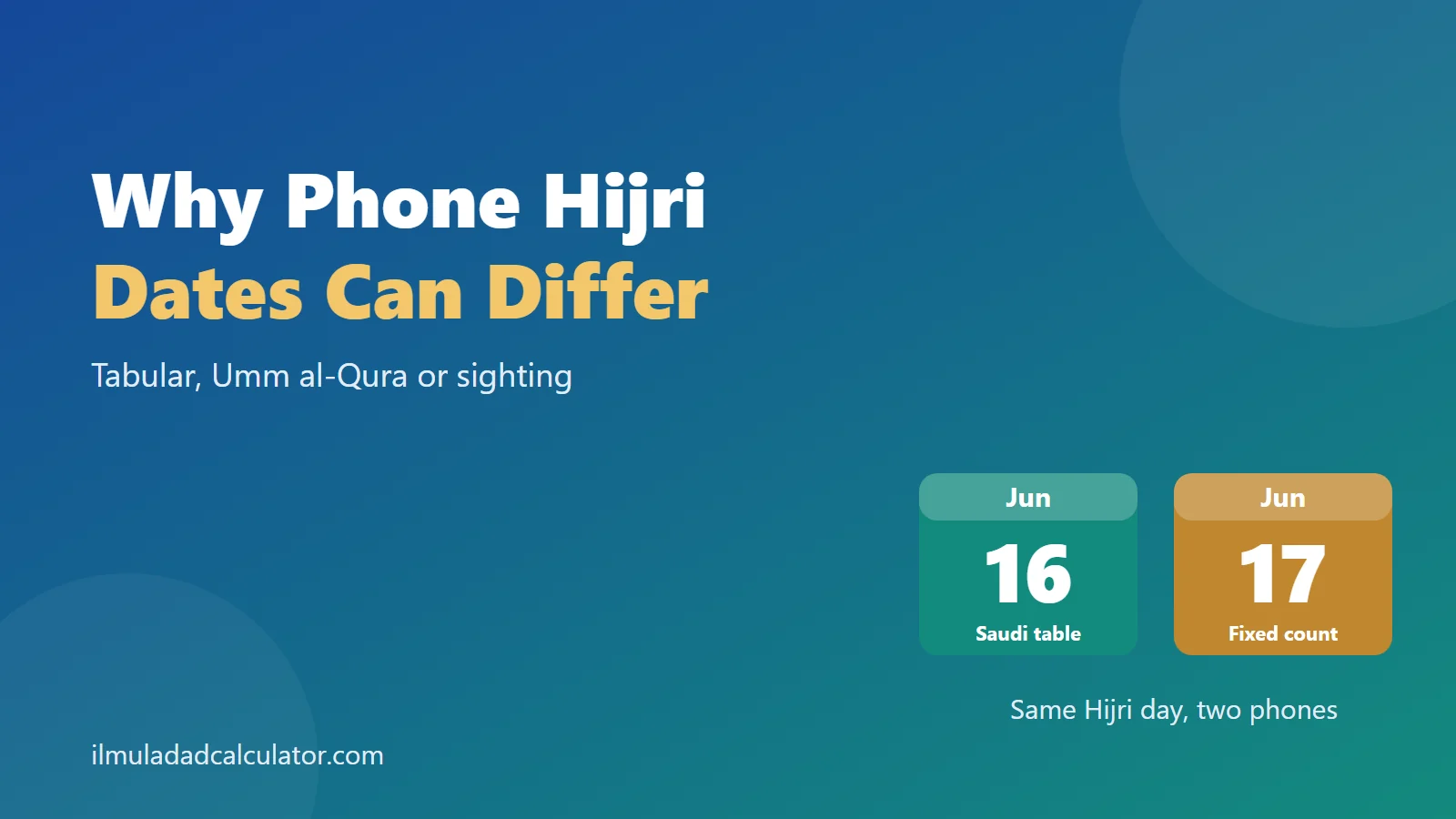
A phone may show a Hijri date that differs from the one your family or mosque uses. The phone is usually not broken. It is following a different rule for starting each month, and the rules can land one or two days apart.
Is the Hijri Calendar on iPhone Wrong?
Usually the better question is which rule it follows. A Hijri month can begin by moon sighting, by a calculation, or by a fixed count. The three can disagree by a day or two.
The pages we could read do not say that a phone has a fault. They show that more than one way of fixing a Hijri date exists. This page does not say which date is right for any observance.
Scope of this page: it explains why displayed dates differ. We could not test devices, so it states only what the vendor and reference pages we opened say.
What Rules Can a Phone Use for a Hijri Date?
Software has to turn a Gregorian date into a Hijri date, and it needs one rule to do that. Documentation from Microsoft and from the ICU library describes the main choices.
A Fixed Count (Tabular)
Microsoft’s HijriCalendar documentation describes a 30-year cycle. Years 2, 5, 7, 10, 13, 16, 18, 21, 24, 26 and 29 are leap years of 355 days. A common year has 354 days.
The ICU documentation calls this the civil calendar. It describes a fixed cycle of alternating 29-day and 30-day months. This is easy to calculate in advance, and several Arab countries use it as a civil calendar.
A Published Table (Umm al-Qura)
Microsoft’s documentation says its Um Al Qura class uses a table-based algorithm licensed from the Saudi government. Months have 29 or 30 days, usually in no discernible order.
That class supports only dates from 30 April 1900 to 16 November 2077. Outside that window, software must fall back on something else.
A Regional Adjustment
Microsoft’s HijriCalendar adds or subtracts zero to two days. The documentation says this accommodates variances in the start and end of Ramadan and date differences between countries and regions.
If the value is not set, it comes from the regional and language options of the system. The Um Al Qura class does not support this adjustment.
| Rule | How the month start is fixed | Source |
|---|---|---|
| Fixed count | Alternating 30 and 29 days in a 30-year cycle | Microsoft HijriCalendar; ICU IslamicCalendar |
| Umm al-Qura | Published table, irregular month lengths | Microsoft UmAlQuraCalendar; ICU IslamicCalendar |
| Sighting | Based on the crescent, can differ from the civil count by up to three days | ICU IslamicCalendar |
| Regional adjustment | Plus or minus up to 2 days from the system setting | Microsoft HijriCalendar |
How Big Is the One-Day Gap in Numbers?
Take 1 Rabi II 1448 AH.
The Umm al-Qura table gives 12 September 2026. A fixed count on the Thursday epoch gives 13 September. A fixed count on the Friday epoch gives 14 September.
Two phones can therefore differ by a full two days. The Friday epoch makes 1 Muharram 1 AH Friday, 16 July 622 in the Julian calendar. The Thursday epoch moves every date one day earlier.
The Same Check for Five Months
The table lists the first day of each month from Muharram to Jumada I 1448 AH. The fixed-count dates are computed in code from the 30-year cycle. The table dates were checked against a second source.
| Month | Umm al-Qura table | Fixed count, Thursday epoch | Fixed count, Friday epoch |
|---|---|---|---|
| 1. Muharram | 16 June | 16 June | 17 June |
| 2. Safar | 15 July | 16 July | 17 July |
| 3. Rabi I | 14 August | 14 August | 15 August |
| 4. Rabi II | 12 September | 13 September | 14 September |
| 5. Jumada I | 12 October | 12 October | 13 October |
The Friday-epoch count lands one day after the table in months 1, 3 and 5. It lands two days after it in months 2 and 4. A fixed correction of one day would fix some months and spoil others.
Why Does the Gap Come Out as One or Two Days?
Three things add up. First, the moon takes about 29.53 days between new moons. A month must therefore be 29 or 30 days, and no whole number fits exactly.
Second, the fixed count has an average month of 10,631 ÷ 360 = 29.5306 days. That matches the true mean of 29.5306 to four decimals. It stays close to the moon over the long run.
But a repeating 30 and 29 pattern cannot follow each real month. Single months drift ahead of or behind it by a day or two.
Third, a sighted or calculated month start depends on the position of the moon on a given evening. So a table or a human report can start a month a day before or after the count.
ICU documentation puts the span for its religious calendar at up to three days from the civil one. Wikipedia reports that the tabular calendar deviates up to two days from observation in the short term.
What Does “Wrong” Mean for a Calendar Date?
A date is wrong when the software breaks its own rule. It is different when the rule itself is not the one you expected. Most phone complaints turn out to be the second case.
- A bug: the app gives a date that its own rule does not produce. This is rare and should be reported to the vendor.
- A different rule: the app counts days, reads a table or applies a regional setting. Your source uses another method.
- A different day boundary: the Hijri day starts at sunset. A calendar view lists one date for a whole civil day.
The Wikipedia article on the Umm al-Qura calendar says the first day of a month begins at sunset. A view that lists one Hijri date for a civil day must pick a single answer. So an evening can read a day apart.
Why Does the Gregorian Date Still Match?
The Gregorian date comes from a fixed solar rule that every phone shares. The Hijri date depends on a lunar rule that varies. So the Gregorian date on two phones agrees, and the Hijri date may not.
That is why the examples above give a Gregorian date for every Hijri start. It is the part of the pair that two systems can both read the same way.
Why Is the iPhone Islamic Calendar Off by One Day?
The iMore guide we read says to open Settings, then Mail, Contacts, Calendars, and tap Alternate Calendars. It lists Chinese, Hebrew and Islamic as the choices.
That guide does not name the Islamic variant. We could not open Apple’s own pages for the calendar identifiers. So we make no claim about which rule an iPhone uses.
What the sources do support is simple. A one-day gap from a local announcement fits the documented gap between a calculated date and a sighted one.
Why Is the Samsung Hijri Date Wrong?
A Samsung support page for the United Arab Emirates describes the setting. In the Calendar app, you open the menu, choose Settings, then Calendar settings, and pick a calendar type. Hijri is one of the listed types, with Shamsi and several lunar calendars.
The page says nothing about how Hijri dates are computed or how accurate they are. We found no official Samsung page that names the rule or offers a day adjustment.
So the reasons above apply, but we cannot confirm which one a given Galaxy model uses.
Does the Region or Language Setting Matter?
Sometimes.
Microsoft’s documentation says the regional adjustment is read from the regional and language options when it is not set. Van Gent also notes that the Arabic setting of Microsoft software uses Umm al-Qura as the default Islamic calendar.
Those facts describe Windows and .NET, not phones. They show that a region or language choice can change the rule. Check your own vendor’s pages, since the ones we read list no such steps.
What Can You Do About a Date That Looks Off?
Treat the phone date as one valid reading, not as a verdict. Then compare it with the source you care about, such as the calendar your community publishes.
- Find which calendar type your Calendar app is set to, using the path in your device menu.
- Note the Gregorian date next to the Hijri date, because that part is not in doubt.
- Compare with a calendar that names its variant, such as a published Umm al-Qura table.
- Label any date you write down with its variant, and note that it may differ by a day or two.
For the technical side, see our guide to the tabular, Umm al-Qura and sighting systems. The Hijri months page lists the months in order, and the calendar hub links the rest of the series.
خلاصہ
فون پر ہجری تاریخ کبھی ایک یا دو دن کے فرق سے نظر آتی ہے۔ اس کی وجہ عام طور پر خرابی نہیں بلکہ مہینہ شروع کرنے کا مختلف اصول ہوتا ہے۔ ایک اصول حسابی گنتی کا ہے، دوسرا ام القریٰ کی شائع شدہ جدول کا، اور تیسرا چاند دیکھنے کا۔ ان میں فرق ایک سے دو دن، اور کبھی تین دن تک ہو سکتا ہے۔ یہ صفحہ یہ نہیں بتاتا کہ کون سی تاریخ کسی عبادت کے لیے درست ہے۔ اپنی تاریخ لکھتے وقت کیلنڈر کی قسم ضرور لکھیں۔
Sources and Further Reading
- HijriCalendar Class, Microsoft Learn. The 30-year cycle, leap years, and the zero to two day adjustment from regional settings.
- UmAlQuraCalendar Class, Microsoft Learn. The table-based algorithm, irregular month lengths, supported date range and lack of adjustment.
- IslamicCalendar, ICU4J documentation. The civil, religious and Umm al-Qura variants and the gap of up to three days.
- Islamic calendar, Wikipedia. The tabular calendar’s deviation of up to two days from observation.
- Umm al-Qura calendar, Wikipedia. The sunset start of a Hijri day and the sighting tradition.
- The Umm al-Qura Calendar of Saudi Arabia, R.H. van Gent. Its use in software and differences of one to three days from sighted dates.
- How to use Chinese, Hebrew, and Islamic calendars on iPhone and iPad, iMore. The Alternate Calendars setting path.
- How to Add an Alternate Calendar on a Galaxy Phone, Samsung Support (UAE). The Calendar settings path and the Hijri option.
- Fixed-count dates are computed in code. Umm al-Qura month starts for 1448 AH were checked against the hijri-converter Python library. See the methodology.
Frequently Asked Questions
Why is the Hijri calendar on my iPhone wrong by one day?
It may follow a different rule for starting months than your local announcement. A calculated date and a sighted date can differ by a day or two.
Why does my Samsung Hijri date not match my country?
Samsung lists Hijri as a calendar type, but its page does not say how the date is computed. A table, a count or a sighting can land a day apart.
Can a phone show a Hijri date that is two days off?
Yes, in principle. In 1448 AH, the Friday-epoch fixed count lands two days after the Umm al-Qura table in some months.
Is the phone date a mistake?
Not necessarily. It is one valid reading of a rule. This page does not say which date is right for any observance.
How should I write down a Hijri date from my phone?
Give the Gregorian date beside it and name the calendar variant. Add that it may differ by a day or two elsewhere.