When a poet died, friends and pupils often answered with a short poem whose last line held the year. This kind of verse is called a qita-e-tarikh-e-wafat, a date-of-death chronogram.
This page looks at its form, its usual words and the people who wrote it. It then works through three sourced examples, letter by letter.
What Is a Death-Date Chronogram?
In Urdu and Persian, tarikh-e-wafat means the date of a death. A qita is a short poem on one theme.
Put together, the term names a few verses that mourn a person. The final line then gives the year of the loss.
The letters of that final line add up to the Hijri year. The idea is the same as in any chronogram, only the occasion is a death.
For the wider art of dating events in verse, see tarikh goi. For the history of Urdu poets and their chronograms, see Urdu chronograms.
A note on tone: every example on this page is a memorial to a real person. We read the verse, add its letters and move on. We do not judge the people or their lives.
What Does a Death Qita Look Like?
Most death qitas follow a simple path. They begin with grief or praise and say that the person has gone. They then point to the date and end with the chronogram line.
A plaque on the gateway of the tomb of Mah Laqa Bai in Hyderabad shows this clearly. It praises her, says death arrived, and then notes that a voice called for her chronogram. Its last line gives 1240 AH.
The same pattern appears on the old tombstone of Ghalib in Delhi.
Mir Mahdi Majruh sat by the grave and thought about a date. He wrote that an unseen voice said گنج معانی ہے تہ خاک. That line gives 1285 AH, as the tarikh goi guide shows.
The Parts, in Order
- Grief or praise. One or two lines on who the person was.
- The passing. A plain statement that the person has died or left.
- The cue. A signal such as hatif, the unseen voice, or the word tarikh.
- The date line. The words whose letters give the year.
Which Words and Images Do These Poems Use?
Poets had a small stock of ideas for a death. The table gathers the ones found in the lines on this page.
| Idea | Example, in English | For whom |
|---|---|---|
| Alas, a cry of grief | “Alas! Mah Laqa of the Deccan departed for heaven” | Mah Laqa Bai, 1240 AH |
| Leaving this world | “Mirza Bedil departed from this world” | Bedil, 1133 AH |
| Treasure under the ground | “The treasury of meanings is under the ground” | Ghalib, 1285 AH |
| Praise at the end | “Alive, he was praised; dead, he was a martyr” | Mazhar, 1195 AH |
| The unseen voice | “The voice of the invisible speaker called for her chronogram” | Mah Laqa Bai |
The wording stays close to the person. A poet was mourned with an image of speech and meaning, and a noble with his title. The line for Khan-e-Khana below simply repeats his rank.
The Mah Laqa Bai and Bedil lines reach us only in English translation. So we quote them for their images and do not add their letters here.
Who Wrote Them?
Mostly friends, pupils and fellow poets. Majruh, who wrote the qita on Ghalib’s tomb, was Ghalib’s friend and pupil. Bindraban Das Khushgo, a devoted disciple of Bedil, asked his own mind for the date when his master died.
Several poets often wrote for the same person. Azad’s history of Urdu poetry, Ab-e Hayat, records three chronograms for the death of Sauda alone. They came from Fakhr ud-Din, Mushafi and Minnat.
The habit also spread through the press. When Munshi Hargopal Tafta died in 1879, numerous chronograms for his death appeared in the Lucknow paper Awadh Akhbar. A scholarly article in the journal Urdu has collected and assessed them.
Where Do They Appear?
- Tombstones and tomb gateways. The plaque for Mah Laqa Bai and the stone on Ghalib’s original grave both carry a date verse.
- Poets’ biographies. Ab-e Hayat gives the lines for Sauda and Mazhar right beside the story of their lives.
- Newspapers. Awadh Akhbar printed many for Tafta in 1879.
- Books of chronograms. Rekhta lists whole volumes of tarikh goi, with print years such as 1914 and 2012.
- Other calendars. For Gandhi’s death in 1948, Hamid Hasan Qadiri gave a Bikram Samvat year, not a Hijri one.
What Do Three Sourced Examples Show?
Each example below has a named source for the line and for the year. We then added the letters with our engine, using Mashriqi values. Urdu and Persian letters count as their Arabic base: پ as ب, گ as ک.
| Line | Poet | Person mourned | Total | Common Era |
|---|---|---|---|---|
| سودا کجا و آن سخن دلفریب او | Mushafi | Sauda, poet, Lucknow | 1195 AH | 1780 to 1781 |
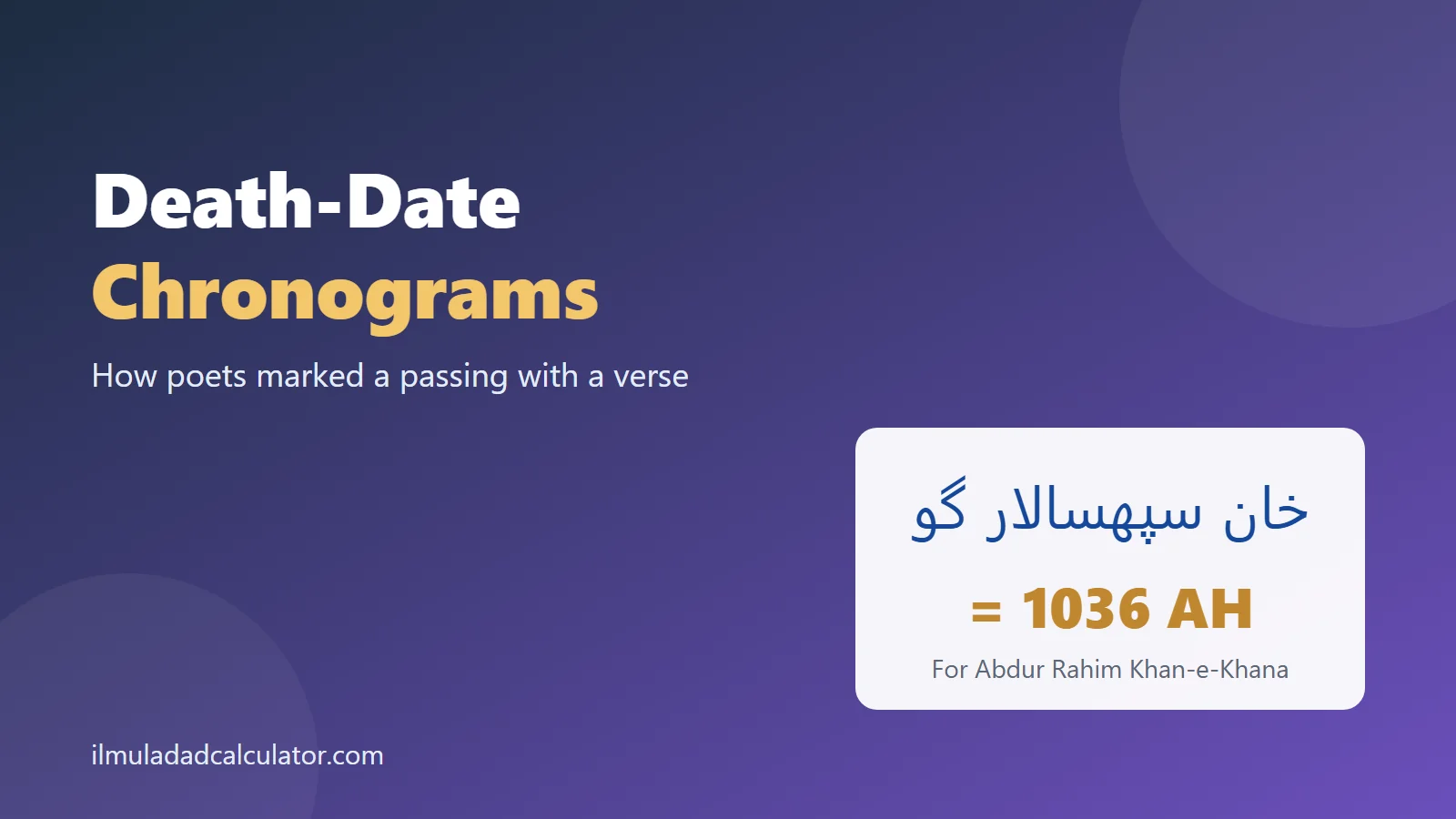
| خان سپهسالار گو | Not named in the source | Abdur Rahim Khan-e-Khana, noble and patron, Delhi | 1036 AH | 1626 to 1627 |
| عاش حمیدا مات شهیدا | Minnat | Mirza Mazhar Jan-e-Janan, Sufi and poet, Delhi | 1195 AH | 1780 to 1781 |
Mushafi on Sauda (1195 AH)
Mirza Muhammad Rafi Sauda, a leading poet of his age, died in Lucknow. Rana Safvi’s photo page of his grave in the Agha Baqar Imambara shows a note. It names a date-of-demise chronogram by Mushafi, 1195 AH.
The line reads سودا کجا و آن سخن دلفریب او. A rough reading is, “Where is Sauda now, and where is that charming speech of his?”
| Word | Letters added |
|---|---|
| سودا | س 60 + و 6 + د 4 + ا 1 = 71 |
| کجا | ک 20 + ج 3 + ا 1 = 24 |
| و | و 6 = 6 |
| آن | آ 1 + ن 50 = 51 |
| سخن | س 60 + خ 600 + ن 50 = 710 |
| دلفریب | د 4 + ل 30 + ف 80 + ر 200 + ی 10 + ب 2 = 326 |
| او | ا 1 + و 6 = 7 |
The seven words give 71 + 24 + 6 + 51 + 710 + 326 + 7 = 1195. That equals the year Ab-e Hayat gives for his death, with no addition or removal.
Khan Sipahsalar Go (1036 AH)
Abdur Rahim Khan-e-Khana was a general, statesman and patron of poets in the Mughal court. He is buried in a tomb near Humayun’s tomb in Delhi.
Rana Safvi quotes the 1856 edition of Asar-us-Sanadid, which says the chronogram خان سپهسالار گو gives his date of death. The title Khan Sipahsalar means “Khan, commander-in-chief.”
| Word | Letters added |
|---|---|
| خان | خ 600 + ا 1 + ن 50 = 651 |
| سپهسالار | س 60 + پ 2 + ه 5 + س 60 + ا 1 + ل 30 + ا 1 + ر 200 = 359 |
| گو | گ 20 + و 6 = 26 |
Here the word گو, “say,” is part of the count. Without it, the title totals 1010, which is 26 short. With it, the line reaches 1036.
The Encyclopaedia Iranica gives his death as 1036 AH, or 1627 CE. Asar-us-Sanadid gives 1626 CE, and 1036 AH ran across both years.
Minnat on Mazhar (1195 AH)
Mirza Mazhar Jan-e-Janan, a Delhi Sufi and poet, died in Muharram of 1195 AH.
Azad notes that many people wrote chronograms. He ranks Minnat’s first, because its Arabic words come from a saying and happen to fit the meter.
The line is عاش حمیدا مات شهیدا, “alive, he was praised; dead, he was a martyr.”
| Word | Letters added |
|---|---|
| عاش | ع 70 + ا 1 + ش 300 = 371 |
| حمیدا | ح 8 + م 40 + ی 10 + د 4 + ا 1 = 63 |
| مات | م 40 + ا 1 + ت 400 = 441 |
| شهیدا | ش 300 + ه 5 + ی 10 + د 4 + ا 1 = 320 |
The four words add up to 1195. The translation of Ab-e Hayat by Frances Pritchett gives the year 1195 AH, or 1780 to 1781 CE.
What Should a Reader Keep in Mind?
A death chronogram is both a poem and a record. Cut into a stone, a number can be read again long after the mourners are gone.
It also invites care. The poet had to fit grief, a title and a total into a few words. The best lines do all three without strain.
Why Check the Numbers Yourself?
Printed lines can carry slips.
In the Wikisource text of Ab-e Hayat, Mushafi’s line for Sauda is printed with different words. Those words total 1145, not 1195. The line on the grave note gives 1195 exactly.
The same text gives a line for Mir Taqi Mir that totals 1221, against a stated year of 1225. We left it out for that reason.
The lesson is gentle. A date verse is a record, and a record is only as good as its copy. When the sum does not match, the text may be at fault, not the poet.
Why Is the Common Era Year Sometimes Unclear?
A Hijri year does not line up with a Common Era year. It begins about eleven days earlier each time, so one Hijri year usually spans two Common Era years.
That is why the table gives ranges such as 1626 to 1627. The sources for Khan-e-Khana differ by a year for this reason, and both can be right.
The month and day, when a source gives them, settle the question.
Dr. Abdul Ghani places Bedil’s death on Thursday, 4 Safar 1133 AH, which he gives as 5 December 1720. Without such a date, a range is the honest answer.
How Can You Read One Yourself?
- Find the date line. Look for a cue such as hatif, tarikh or go.
- Write the line exactly as printed, letter by letter.
- Add the values with the chronogram decoder or the phrase value calculator.
- Compare the total with the Hijri year in your source.
- Convert to the Common Era only after the sum matches.
For more famous lines, see the famous chronograms page. Persian examples are in Persian chronograms.
خلاصہ
قطعۂ تاریخِ وفات چند اشعار کی وہ نظم ہے جس کا آخری مصرع مرحوم کے سالِ وفات کو ظاہر کرتا ہے۔ عام طور پر پہلے غم یا تعریف ہوتی ہے، پھر ہاتف یا «تاریخ» کا اشارہ، اور آخر میں مادۂ تاریخ۔ مصحفی کا مصرع «سودا کجا و آن سخن دلفریب او» ۱۱۹۵ ہجری دیتا ہے، «خان سپہ سالار گو» ۱۰۳۶ ہجری، اور منت کا «عاش حمیدا مات شہیدا» ۱۱۹۵ ہجری۔ ہر مثال کا حساب حرف بہ حرف جانچا گیا ہے۔
Sources and Further Reading
- Mirza Mohd Rafi Sauda’s grave in Agha Baqar Imambara Lucknow, Rana Safvi. The line for Sauda and the note naming Mushafi and 1195 AH.
- Ab-e Hayat, chapter on Sauda, Muhammad Husain Azad, Urdu text on Wikisource. Three chronograms for 1195 AH.
- Ab-e Hayat, chapter on Sauda, translated by Frances W. Pritchett.
- Abdur Rahim Khan-e-Khana’s tomb in the two editions of Asar-us-Sanadid, Rana Safvi. The line Khan Sipahsalar go.
- Abd-al-Rahim Khan Khanan, Encyclopaedia Iranica. Death in 1036/1627.
- Ab-e Hayat, Urdu text on Wikisource. The account of Mazhar and Minnat’s chronogram.
- Ab-e Hayat, chapter on Mazhar, translated by Frances W. Pritchett. The year 1195 AH and the English rendering.
- Mahlaqa Bai’s resting place in Hyderabad, Rana Safvi. The gateway plaque and 1240 AH.
- Mah Laqa Bai, Wikipedia. The same plaque in English.
- The original tomb of Ghalib with a chronogram by Mir Mahdi Majruh, Rana Safvi.
- Bagh e Bedil, Rana Safvi. Khushgo’s chronogram for Bedil’s death in 1133 AH.
- Awadh Akhbar and the chronograms for Tafta’s death, journal Urdu, Anjuman Taraqqi-e-Urdu (2016).
- Tarikh Nigari: Numbers Speaking Through Words, Rekhta blog. The 1948 chronogram on a Bikram Samvat year.
- Tareekh-Goi ebook collection, Rekhta.
Frequently Asked Questions
What does qita-e-tarikh-e-wafat mean?
It means a short poem that gives the date of a death. The final line holds the letters that add up to the year.
Who wrote death chronograms?
Friends, pupils and fellow poets. Several poets often wrote one for the same person.
Where did death chronograms appear?
On tombstones and gateways, in biographies, in newspapers and in printed books of chronograms.
Which calendar do they use?
Most give a Hijri year. A few, like one written for Gandhi in 1948, use another calendar.
Why does a total sometimes miss the year?
The printed text may have a slip or a changed word. Check the line against a reliable source.