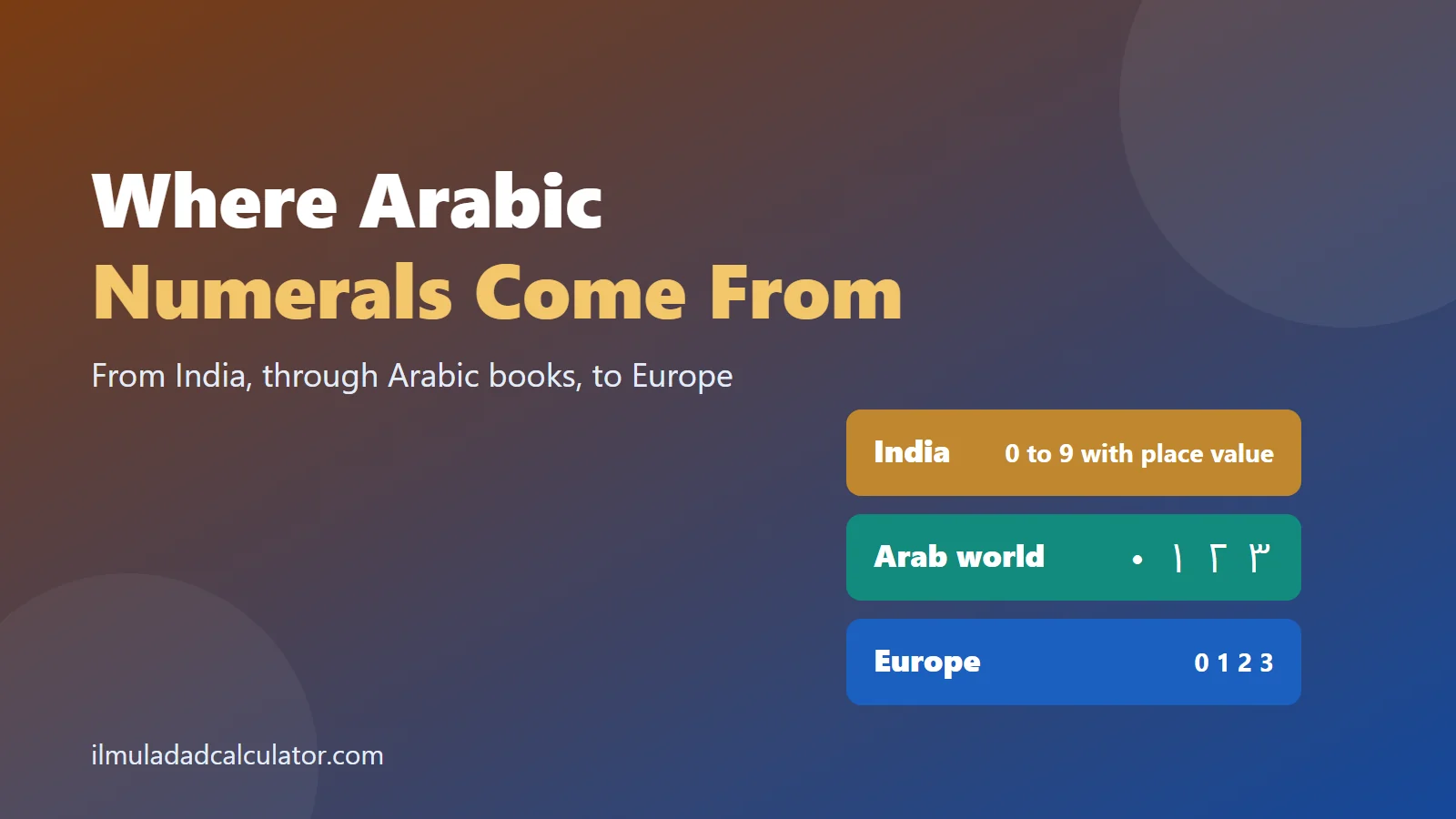
The digits 0 to 9 are called Arabic numerals, but the system began in India. Indian mathematicians developed decimal place value with zero between the 1st and 4th centuries. Arabic scholars adopted it by the 9th century, and Europe learned it from their books.
What Did India Invent?
India gave the world two ideas that work together: place value and a sign for zero. With them, ten symbols can write any whole number.
The shapes of the digits also began in India. They descend from Brahmi numerals and changed over many centuries.
How Did the Digits Reach the Arabic-Speaking World?
Scholars in Baghdad wrote the key books. Around 825, the Persian mathematician al-Khwarizmi wrote On the Calculation with Hindu Numerals.
Around 830, the Arab philosopher al-Kindi wrote On the Use of the Hindu Numerals. Arabic mathematicians also extended the system to handle fractions.
Al-Khwarizmi’s name, Latinized as Algoritmi, later gave English the word algorithm.
How Did Europe Learn the Digits?
Europeans first met the digits around the 10th century, through Arabic speakers in Spain and North Africa. The spread was slow at first.
In the 13th century, the Italian Fibonacci learned the digits in Béjaïa, in today’s Algeria. His book Liber Abaci made them known in Europe.
Even then, use stayed mostly in northern Italy. Printing in the 15th century finally carried the digits across Europe.
Why Are They Called Arabic Numerals?
Europe learned the digits from Arabic books, so it called them Arabic. Arabic speakers learned them from India, so they call them Indian numbers, arqam hindiyya.
Historians often use the fuller name Hindu-Arabic numerals. It credits both the origin and the route.
Why Do Eastern and Western Digits Look Different?
The early digits came in many shapes, and two families grew apart. The Mashriq, from Egypt to Iraq, kept the forms now called Eastern Arabic numerals.
North Africa and Spain used a western set, sometimes called Ghubar digits. That set reached Europe and became the digits used worldwide today.
The links between some shapes are clear. The Western 1, 2, 3, 4, 5 and 9 relate closely to their Eastern partners. The history of 6, 7 and 8 is less clear.
How Did Arabic Writers Count Before the Digits?
Before the Indian digits spread, Arabic writers used letters as numbers. This system, the abjad, gives each of the 28 letters a value from 1 to 1000.
Letters stayed in use long after digits arrived, for dates in poetry and for numbering. The abjad numerals converter writes any number in letters, and the guide to what Ilm-ul-Adad is explains the system.
Sources and Further Reading
- Hindu-Arabic numeral system, Wikipedia. Origin in India, al-Khwarizmi, al-Kindi and Fibonacci.
- Arabic numerals, Wikipedia. The western branch, Béjaïa and the spread through Europe.
- The Hindu-Arabic Numerals by Smith and Karpinski (1911), free on Project Gutenberg.
Frequently Asked Questions
Did Arabs invent the numbers 0 to 9?
No. The system began in India. Arabic scholars adopted it, improved it and passed it on to Europe.
Who invented zero?
Indian mathematicians developed zero as a written number within the place-value system. Other cultures had zero-like signs, but this form spread worldwide.
Why is the word algorithm linked to Arabic numerals?
It comes from the Latin form of al-Khwarizmi’s name. His book taught the Indian method of calculating.
Are Roman numerals older than Arabic numerals in Europe?
Yes. Europe used Roman numerals for centuries before the Hindu-Arabic digits took over.
Which digits do Arabic countries use today?
Many use Eastern Arabic digits, some use both, and North Africa uses Western digits.