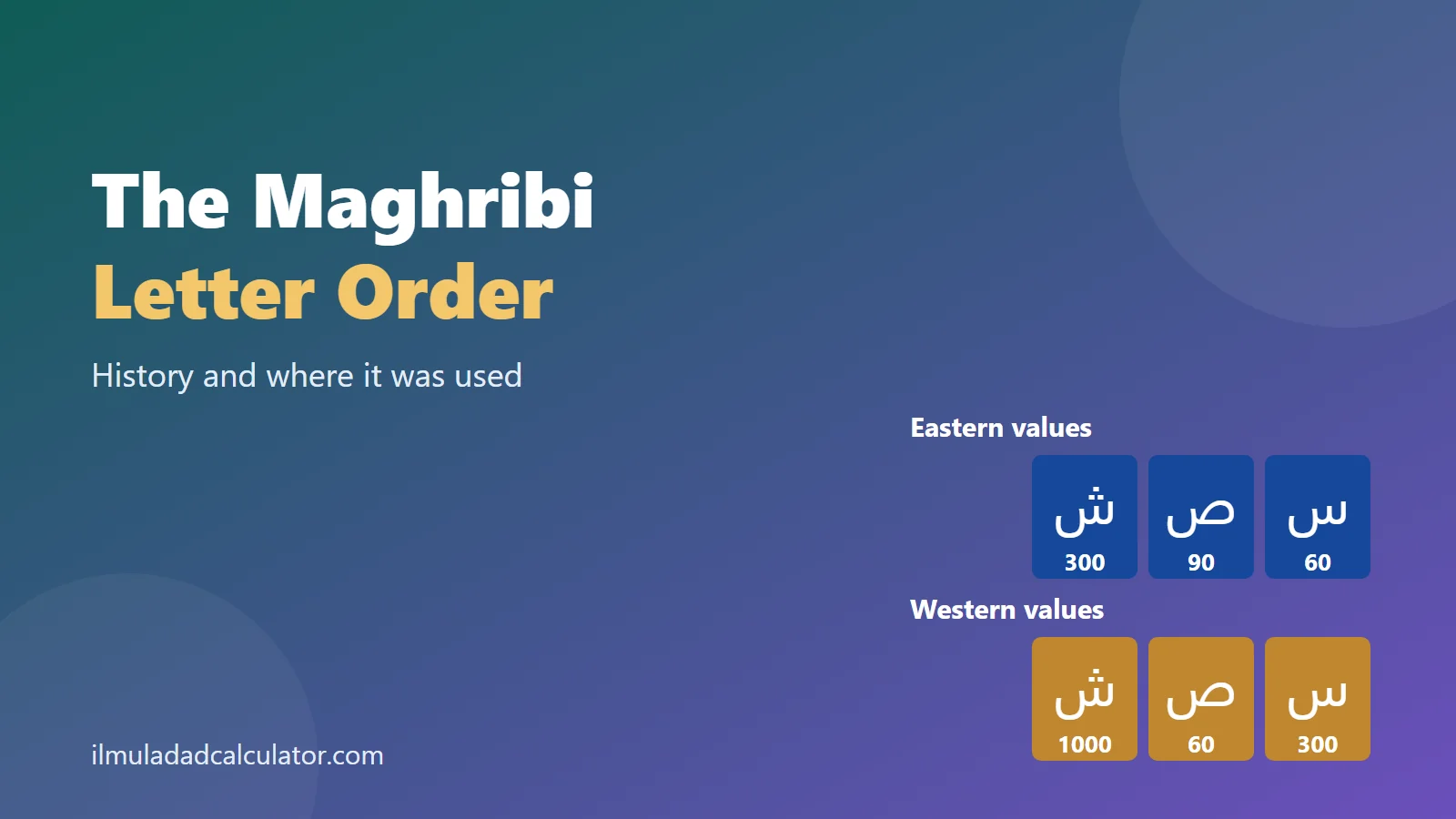
The Maghribi letter order is the western version of the abjad. Sources link it to North Africa and al-Andalus, and it gives six letters different values from the eastern order.
What Does Maghribi Mean in the Letter Order?
Maghrib means the west. It names the western part of the Islamic world, which includes North Africa and al-Andalus. The east is called Mashriq.
So the Maghribi order is the western way of listing the 28 letters for counting. The Mashriqi order is the eastern way, and it is the one this site uses by default.
The two orders share most of their sequence. For the letter strings side by side, see the abjad and hija’i orders page. This page keeps to the history and the places.
Which Letters Have Different Values?
Six letters change value between the two sets. The other 22 letters keep exactly the same number.
| Letter | Name | Mashriqi value | Maghribi value |
|---|---|---|---|
| ص | Sad | 90 | 60 |
| ض | Dad | 800 | 90 |
| س | Sin | 60 | 300 |
| ظ | Za | 900 | 800 |
| غ | Ghayn | 1000 | 900 |
| ش | Shin | 300 | 1000 |
The values belong to the places in the sequence. Six places hold a different letter in the west, so six letters carry a different number.
Note: a word with none of these six letters has the same total in both sets. محمد gives 92 either way.
Where Was the Western Order Used?
The name points to the western Islamic world. Scholars describe a family of round scripts from this region, now called Maghribi or Maghrebi. They grew from Kufic and spread across several regions.
North Africa and al-Andalus
An Oxford study of these scripts dates the earliest surviving examples to the 10th century. It places them in the Iberian Peninsula, North-West Africa and the Balearic Islands.
Later dynasties such as the Almoravids, Almohads and Marinids supported the script. It was used for Qur’an copies and for Andalusi and Moroccan literature.
The West African Sahel
The script family also reached the Sahel, where related Sudani styles developed. Wikipedia lists Fulani and Hausa styles among them.
What the Sources Do Not Say
The sources for this page link the script to these regions. They give no date for when the western values first appeared.
They also give no border for where each order was used. Treat any exact map you see with care.
What Is the Timeline of Maghribi Writing?
The dates below come from the sources listed below. They describe the script, because the sources give no dates for the value sets themselves.
- 643 to 709: Arabic script arrives in the Maghreb during the Islamic conquests.
- Late 9th century: the earliest dated manuscripts in the Oxford study, from 270 AH (883 CE).
- 10th century onward: distinct round scripts appear in Iberia and North-West Africa.
- Late 12th or 13th century: the Qur’an leaves with abjad verse counts.
- 19th century: the flamboyant Qandusi style develops in Fes.
Reading the list, notice how long the tradition ran. Many centuries of manuscripts left room for habits to differ from one scribe, city or period to another.
What Were the Main Maghribi Script Styles?
Maghribi writing was never one single hand. Wikipedia lists several styles, each with its own job. They show how many kinds of documents might carry abjad letters.
| Style | Typical use |
|---|---|
| Maghribi Kufic | Decoration and coins, including the Almoravid kind |
| Mabsut | Body text and Qur’an copies |
| Mujawher | A cursive for royal announcements, later used in printing at Fes |
| Thuluth Maghribi | Book titles and mosque walls |
| Musnad | Court and notary documents |
The styles describe handwriting, not value sets. A reader cannot tell the order from the hand alone.
Where Do Abjad Letters Appear in Maghribi Manuscripts?
Abjad letters often serve as numbers in manuscripts. A Sotheby’s sale note describes two Qur’an leaves in large Maghribi script. They come from North Africa or Andalusia, about the late 12th or 13th century.
The roundels between verses carry abjad letters, which mark the exact verse count. The note calls this use unusual.
It shows the craft well. A scribe writes a number as a letter, and a reader turns it back. The note does not say which value set the scribe used.
Is the Western Order Older?
Some scholars think so. The scholar Michael Macdonald treats the western sequence as the older one, because early authorities seem to quote it.
Wikipedia reports his view and also flags its own sourcing as thin. So this is one scholar’s reading, not a settled fact.
The Link to Samekh
Hebrew has a letter called samekh, valued at 60, that Arabic did not keep. In the western order, ص takes that place and the value 60.
In the eastern order, س takes the value 60. Both orders also keep a 90 and a 300, as Hebrew does with tsade and shin.
The table lines up three Hebrew letters with the Arabic letters at the same value. It shows each Arabic set.
| Hebrew letter | Value | Mashriqi letter | Maghribi letter |
|---|---|---|---|
| Samekh | 60 | س | ص |
| Tsade | 90 | ص | ض |
| Shin | 300 | ش | س |
No Arabic letter descends directly from samekh. Sources describe the western order as filling that slot with sad, and the eastern order as filling it with sin.
Do the Two Sets Use the Same Numbers?
Yes, the same 28 numbers appear in both sets. Only the assignment to six letters changes.
The top three values show it clearly. In the east, they belong to ض, ظ and غ. In the west, they belong to ظ, غ and ش.
Because the numbers are the same, the sum of all 28 letters is 5995 in both sets. That check is a quick way to confirm that a chart is complete.
Why Is the Western Order Seen Less Today?
Wikipedia notes that Latin script became dominant in education and public life under the French Protectorate.
Nationalists in the region worked to preserve Maghribi script. That concerns the handwriting, and the sources for this page do not link it to the value sets directly.
Did the Dictionary Order Differ Too?
Yes. Wikipedia notes a separate western hija’i order for sorting, which is now obsolete. Modern schools in the Arab world teach the eastern dictionary order.
The values never followed that order anyway. As the abjad and hija’i orders page explains, only the counting order carries numbers.
What Memory Words Did the West Use?
The east learned eight memory words, covered on the abjad hawwaz hutti page. Wikipedia gives the western tail as saʿfaḍ qurisat thakhudh ẓaghush.
These words are only a tool for memory. Their sounds preserve the order of the letters, not any meaning.
How Do Totals Change With the Western Values?
Only words with one of the six letters move. Here are three examples from the engine.
The Basmala shows the size of the gap. It totals 786 in the eastern set and 1026 in the western set.
The change comes from one letter. Sin (س) moves from 60 to 300, and every other letter in the phrase stays put.
Do Maghribi Letter Shapes Change the Value?
No. Maghribi script writes some letters differently, but the shape does not change the number. Wikipedia notes that the western fa has its dot below the letter and the western qaf has one dot above.
The western forms are ڢ and ڧ. They are still the letters ف and ق, so they count 80 and 100 in both sets. The difference between the two orders sits in the six letters above, not in the shapes.
How Can You Tell Which Order a Source Used?
Old books rarely say. A careful reader can test the question with a short routine.
- Check whether the text contains any of the six letters. If not, the order does not matter.
- Count the text in both value sets.
- Compare each total with the number the source claims, such as a year or a page.
- Note where and when the source was written, as a clue and not a proof.
The multi-system calculator shows both totals at once. The why values differ page covers the other reasons for a mismatch.
How Does This Site Handle the Western Set?
The site’s engine includes a Maghribi mode next to the default Mashriqi mode. Both modes use the same 28 letters and the same method of adding.
Nothing on this page asks you to switch sets. The compare values tool shows the two totals together, which is useful when you study an old text.
The method itself is the same in both modes. Read the methods hub for the full steps from spelling to total.
How Should a Historian Report a Total?
A bare number can mislead when two value sets exist. A short note makes the work easy to check later.
- Name the value set used, Mashriqi or Maghribi.
- Give the second total too if the text holds any of the six letters.
- Write the exact spelling, because a different spelling is a different count.
- Cite the manuscript or edition, with its region and date when known.
خلاصہ
مغربی ترتیب شمالی افریقہ اور اندلس سے جوڑی جاتی ہے۔ اس میں چھ حروف ص، ض، س، ظ، غ اور ش کی قیمتیں مشرقی ترتیب سے مختلف ہیں، باقی بائیس حروف کی قیمتیں وہی رہتی ہیں۔ بعض ماہرین اسے زیادہ قدیم سمجھتے ہیں، مگر یہ حتمی بات نہیں۔ ماخذ میں اس کے آغاز کی صحیح تاریخ یا سرحد بیان نہیں کی گئی۔
Sources and Further Reading
- Abjad numerals, Wikipedia. The Maghrebi value table, the samekh and tsade explanation, the memory words and the Macdonald reference.
- Arabic alphabet, Wikipedia. The two abjadi sequences, the obsolete Maghrebi hija’i order and the dotting of fa and qaf.
- Sin (letter), Wikipedia. Sad taking samekh’s place in the western sequence and the older-order view.
- Maghrebi script, Wikipedia. Regions, dynasties and styles of Maghribi writing.
- Gematria, Wikipedia. The Hebrew values of samekh, tsade and shin.
- The origin and development of Maghribi round scripts, U. Bongianino, University of Oxford thesis. Regions and the 10th century start.
- Two Qur’an leaves in Maghribi script, Sotheby’s. Abjad letters marking verse counts.
- Letter values on this page come from this site’s tested engine. See the methodology.
Frequently Asked Questions
How many letters change value in the Maghribi order?
Six letters change: sad, dad, sin, za, ghayn and shin. The other 22 keep the same value.
Is the Maghribi order the same as the Maghribi script?
No. The script is a style of handwriting. The order is a way of listing letters for counting.
Which letter is worth 1000 in the Maghribi order?
Shin is worth 1000 in the western set. In the eastern set, ghayn is worth 1000.
Is the Maghribi order older than the eastern order?
Some scholars think so, but the evidence is thin. Treat it as a view, not a fact.
Did the Maghribi order change the shape of letters?
No. Shapes such as the dotting of fa and qaf are a writing style and do not change values.