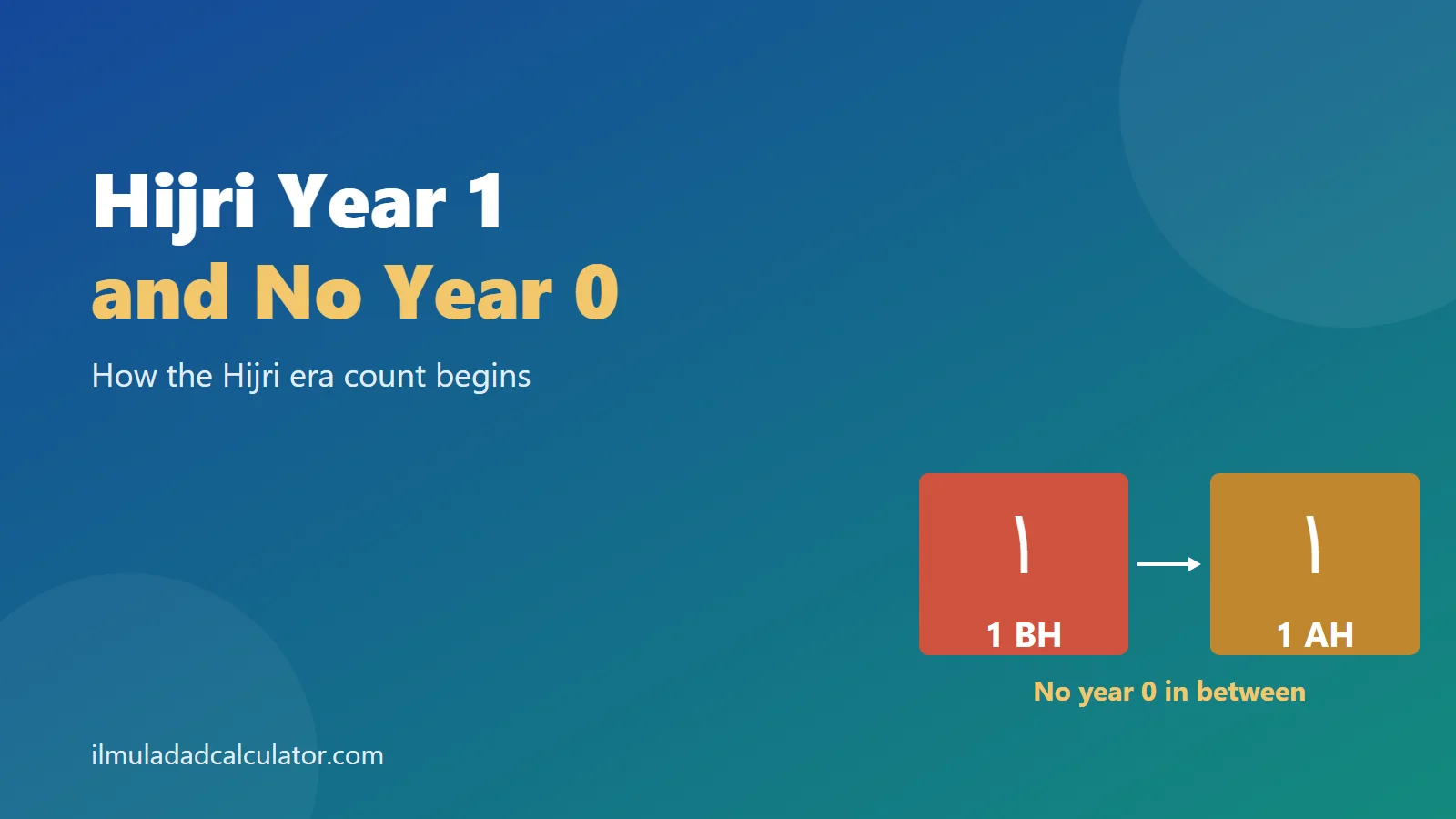
Hijri year 1 is the first year of the era, and the count has no year 0. The year before it is year 1 BH, and the year after it is year 2 AH. This page shows how that works and how to do the arithmetic.
Does the Hijri Calendar Have a Year 0?
No. The sources I opened start the count at year 1 and give no year 0. Years before the start are labeled BH, short for “Before the Hijra”.
The phrase “no year 0” confuses many people at first. It does not mean a year is missing. It means the first year of the era is called 1, not 0.
In one line: the order is 2 BH, 1 BH, 1 AH, 2 AH. There is no 0 BH and no 0 AH in the usual count.
What Happens at the Start of Year 1?
Year 1 begins on 1 Muharram. In the tabular civil calendar, that day is Friday, 16 July 622 in the Julian calendar. The Anno Hegirae and Islamic calendar articles on Wikipedia both give this date.
The same day in the Gregorian calendar is 19 July 622. The two calendars differ by three days at that point in history.
The Date Written as a Day Number
Astronomers label each day with a Julian Day Number, or JDN. The day 1 Muharram 1 AH has JDN 1,948,440 in the tabular count.
The tabular formula is JDN = d + ceil(29.5 × (m − 1)) + (y − 1) × 354 + floor((3 + 11y) ÷ 30) + 1948439. For y = 1, m = 1 and d = 1, the pieces are 1 + 0 + 0 + 0 + 1948439, or 1,948,440.
Notice the (y − 1). Year 1 contributes zero full years, because no year has finished yet. That is the arithmetic form of “year 1 is the first year”.
How Does the Year Count Work in Days?
The count is ordinal. Year 1 means the first year, and a year number n means that n − 1 full years have already passed.
In the tabular civil calendar, the first year has 354 days. The second year is a leap year with 355 days, and the full 30-year cycle holds 10,631 days.
A Check Against a Second Date
A second anchor is 1 Muharram 1400 AH, which is 21 November 1979 in the Gregorian calendar. That date is given in the Wikipedia article on the Islamic calendar.
- Full years passed before 1400 AH: 1400 − 1 = 1399.
- Leap years among them: floor((11 × 1400 + 3) ÷ 30) = floor(15,403 ÷ 30) = 513.
- Days: 1399 × 354 + 513 = 495,246 + 513 = 495,759.
- Gregorian count: 19 July 622 to 21 November 1979 is also 495,759 days.
The two counts agree, so the epoch and the formula are consistent. This holds for the tabular civil calendar only. Umm al-Qura and sighting calendars can differ by a day.
What Do the First Few Years Look Like?
The table below lists the first six years of the tabular civil calendar. Each start date is worked out in code from the day number, and then shown in the Gregorian calendar.
| Year | Days | Leap year? | 1 Muharram (Gregorian) | Weekday |
|---|---|---|---|---|
| 1 AH | 354 | No | 19 July 622 | Friday |
| 2 AH | 355 | Yes | 8 July 623 | Tuesday |
| 3 AH | 354 | No | 27 June 624 | Sunday |
| 4 AH | 354 | No | 16 June 625 | Thursday |
| 5 AH | 355 | Yes | 5 June 626 | Monday |
| 6 AH | 354 | No | 26 May 627 | Saturday |
Count the days to check one row. From 19 July 622 to 8 July 623 is 354 days, which is exactly the length of year 1. Adding 355 days more reaches 27 June 624, the start of year 3.
Year 1 is a common year of 354 days, and year 2 is the first leap year. The leap years of the 30-year cycle are 2, 5, 7, 10, 13, 16, 18, 21, 24, 26 and 29.
The weekday column is worked out as (JDN + 1) mod 7. A result of 5 is Friday, and 6 is Saturday. The epoch lands on a Friday, as the sources state.
Why Is There No Year 0 in BC and AD?
The Anno Domini system has the same gap. The year 1 BC is followed directly by AD 1. The Wikipedia article on year zero says that no year 0 exists in that system.
The reason is that year numbers are ordinals, like “first” and “second”. A “zeroth” year was not part of the thinking when these counts were set.
Where a Year 0 Does Exist
Astronomers use a variant that does have a year 0. Astronomical year numbering keeps AD years unchanged, and calls 1 BC “0”. Then 2 BC becomes −1, and a year n BC becomes 1 − n.
ISO 8601, the date standard, uses the same scheme. The figure compares the three systems around their epochs.
| Historical label | Signed number (1 − n) |
|---|---|
| 1 BC or 1 BH | 0 |
| 2 BC or 2 BH | -1 |
| 3 BC or 3 BH | -2 |
| 44 BC or 44 BH | -43 |
Treat the second column as a bookkeeping device. It is not a Hijri convention, and the sources I opened do not describe the Hijri count this way. Its only job is to make subtraction work in one step.
How Do You Count Years Across the Epoch?
Suppose you want the number of years from 5 BH to 5 AH. A quick subtraction of 5 from 5 gives zero, which is plainly wrong.
- Count from the start of 5 BH to the start of 1 AH. That is 5 years: 5 BH, 4 BH, 3 BH, 2 BH and 1 BH.
- Count from the start of 1 AH to the start of 5 AH. That is 4 years: 1 AH, 2 AH, 3 AH and 4 AH.
- Add them. 5 + 4 = 9 years.
The shortcut is a + b − 1, where a is the BH year and b is the AH year. Check it: 5 + 5 − 1 = 9.
The signed method agrees. Write 5 BH as 1 − 5 = −4, then subtract: 5 − (−4) = 9.
The same trick gives the span from 44 BC to AD 14. It is 44 + 14 − 1 = 57 years. Both pairs of years cross an epoch with no year 0.
Historians often meet BH years when they work out the date of an event before the Hijra. The same a + b − 1 rule applies there. Always check which side of the epoch a year sits on.
Within the AH Era the Gap Disappears
For two years that are both AH, just subtract. From 1400 AH to 1447 AH is 1447 − 1400 = 47 years, with no correction.
The correction only matters when the span crosses the epoch. That is rare for Hijri dates, since most documents sit well inside the AH era.
What Does a Year Number Tell You?
A year number n names the year. The value n − 1 counts the full years before it. So 1447 AH means 1,446 full years have passed since the epoch.
In the tabular count, those years add up to 512,414 days. The sum is 354 × 1446 + floor((11 × 1447 + 3) ÷ 30), or 511,884 + 530. Dividing by 365.2425 gives about 1402.9 Gregorian years.
That is why a Hijri year number runs about 43 ahead of the Gregorian count from 622. The lunar year is shorter, so more Hijri years fit in the same time.
The Hijri year length page explains that gap. The Hijri to Gregorian formula page shows the rule of thumb for this gap.
Was Year 1 Numbered at the Time?
No. The era was set up afterward. The Anno Hegirae article says the caliph Umar established it 17 years after the Hijra, which is around 638 CE.
The Islamic calendar article adds a detail from the historian al-Biruni. The first ten years after the Hijra were not numbered, and were named for events instead. So “year 1” is a label applied back in time.
This is common in calendars. You can read more on the history of the Hijri calendar page.
Which Day Marks the Start?
The era starts on 1 Muharram, not on the day of the journey itself. The Anno Hegirae article places the journey about two months into year 1.
That article credits Uthman with the proposal to begin the months with Muharram. So year 1 of the era began before the event it is named for.
How Should You Write a Date Near the Epoch?
A date near the start of the era has three things that can go wrong. The era label, the calendar variant and the Julian or Gregorian system all need to be clear.
- Put the era label next to the year, such as 1 AH or 1 BH.
- Name the calendar variant, such as tabular civil, if you give a day number.
- Say whether the Common Era date is Julian or Gregorian.
For example, write “1 Muharram 1 AH (tabular civil) = 16 July 622 Julian”. That one line carries the era, the variant and the system.
Why the Julian Label Matters Here
The gap between the two Common Era calendars was only three days in 622. It was computed in code from the day number, not copied from a table.
So a date from the early Hijri centuries is normally quoted in Julian form. The Julian or Gregorian page explains the two systems. A converter that silently switches to Gregorian will give a result three days later.
What Mistakes Should You Avoid?
- Treating 0 AH as a real year. If a source prints “0 AH”, it is almost certainly a software value, not a calendar year.
- Subtracting across the epoch without correction. Use a + b − 1 for a BH year and an AH year.
- Mixing the Julian and Gregorian labels. Dates before 15 October 1582 are usually Julian, so say which one you mean.
- Mixing calendar variants. A tabular date and an Umm al-Qura date can differ by a day.
To see how the variants differ, read the Hijri calendar systems page. For month order and names, see the Hijri months page. Everything here is calendar arithmetic only, and nothing here takes a position on any observance.
خلاصہ
ہجری سن کا آغاز سال ۱ سے ہوتا ہے اور اس میں سال صفر نہیں ہے۔ سال ۱ ہجری کا پہلا دن یکم محرم ہے، جو جولین کیلنڈر میں جمعہ ۱۶ جولائی ۶۲۲ عیسوی بنتا ہے۔ ہجرت سے پہلے کے سالوں کو قبل از ہجرت لکھا جاتا ہے، اور ۱ قبل از ہجرت کے بعد سیدھا ۱ ہجری آتا ہے۔ عیسوی میں بھی ایسا ہی ہے کہ ۱ قبل مسیح کے بعد ۱ عیسوی آتا ہے۔ اگر حساب اس نقطے کو عبور کرے تو دونوں سالوں کو جمع کر کے ایک گھٹائیں، مثلاً ۵ قبل از ہجرت سے ۵ ہجری تک ۹ سال بنتے ہیں۔
Sources and Further Reading
- Anno Hegirae, Wikipedia. Year 1 on 1 Muharram, 16 July 622 Julian, the BH label, and Umar setting up the era.
- Islamic calendar, Wikipedia. The epoch, the unnumbered first ten years, the 30-year cycle, and 1 Muharram 1400 AH.
- Year zero, Wikipedia. No year 0 in the Anno Domini system, and 1 BC followed by AD 1.
- Astronomical year numbering, Wikipedia. 1 BC as year 0 and the rule 1 − n for BC years.
- Tabular Islamic calendar, Wikipedia. The 30-year cycle, leap years and the Julian Day Number formula.
- Day counts are computed by this site and checked against two dated anchors. See the methodology.
Frequently Asked Questions
Is there a year 0 in the Hijri calendar?
No. The sources I opened start the count at year 1. The year before it is 1 BH, meaning one year before the Hijra.
What does BH mean?
BH stands for Before the Hijra. It labels years before year 1 AH, in the same way BC labels years before AD 1.
When did year 1 AH begin?
On 1 Muharram, Friday 16 July 622 Julian, which is 19 July 622 Gregorian. This is the tabular civil epoch.
Is there a year 0 in BC and AD?
No. The year 1 BC is followed directly by AD 1. Only astronomical year numbering uses a year 0, and it calls 1 BC “0”.
How many years from 5 BH to 5 AH?
Nine. Count 5 years to the epoch and 4 more after it, or use a + b − 1 = 5 + 5 − 1.
Was year 1 called “1” when it happened?
No. The era was set up around 638 CE, 17 years after the Hijra. Earlier years were named by events, per al-Biruni.