A Hebrew chronogram is a word or phrase whose Hebrew letters add up to a year. Writers used it on title pages, in poems and on gravestones for many centuries. This page decodes three sourced examples and shows how the small count works.
What Is a Hebrew Chronogram?
Hebrew writes numbers with letters, so every word already has a number. Writers noticed that a well chosen word could also name a year. The method is called gematria when used for numbers in general, and the dated word is a chronogram.
The Jewish Encyclopedia says the idea was encouraged by gematria itself. It cites the earliest Jewish example in a Hebrew poem of 1205 by Al-Harizi. Wikipedia repeats that date and adds that thirteenth century German epitaphs also use the device.
For the general idea in any language, see what a chronogram is. This page looks at the Hebrew practice and compares it with abjad.
How Do Hebrew Letters Become Numbers?
The first nine letters are 1 to 9. The next nine are 10 to 90, and the last four are 100 to 400. There is no zero, and the order of letters in a word does not change the sum.
| Group | Letters and values |
|---|---|
| Ones | א 1 ב 2 ג 3 ד 4 ה 5 ו 6 ז 7 ח 8 ט 9 |
| Tens | י 10 כ 20 ל 30 מ 40 נ 50 ס 60 ע 70 פ 80 צ 90 |
| Hundreds | ק 100 ר 200 ש 300 ת 400 |
How Are 500 and Above Written?
Hebrew has no single letter above 400. Stephen Morse’s guide says that 500 is written tav and qof, and so on.
It adds that an older scheme gave the five final letters the values 500 to 900. This scheme is not common.
In the examples below, a final letter keeps the same value as its ordinary form. That is the usual rule.
Why Is Fifteen Written Differently?
Fifteen is normally written tet and vav, which is 9 + 6. The usual spelling of 10 + 5 would form part of a divine name, so writers avoid it.
Wikipedia notes the same for sixteen, written tet and zayin. The sum is still 15, so the arithmetic is unchanged.
What Is the Prat Katan, or Small Count?
Hebrew years are counted from creation, so the current year has four digits. Writers often drop the thousands and give only the last three. This is the small count, in Hebrew prat katan or lifrat katan, meaning the lesser reckoning.
The Yale library guide gives the example 5786, written with letters that total 786. The large count keeps the thousands, and the guide says it is less common.
The small count appears on stones and in books as three letters, lamed, pe and qof. A Mosaic article reads this abbreviation as meaning in the short count. In its Amsterdam inscription, it closes the line after a verse from Psalms.
Reading rule: when a Hebrew date has no thousands letter, add 5000 to the total. Then subtract 3760 to reach the common year, as the next section shows.
How Do You Convert the Hebrew Year to a Common Year?
Wikipedia’s article on the Hebrew calendar gives the rule. Add 3760 to a common year before the Hebrew new year, or 3761 after it. Going backward, subtract 3760 or 3761.
The Hebrew year begins in September or October, so one Hebrew year spans two common years. The examples below use the simple subtraction of 3760, which matches the year given by each source.
- Add the letter values of the counted letters.
- Add 5000 if the thousands were left out.
- Subtract 3760 to get the common year.
- Check the result against the known date of the book or death.
What Does a Chronogram on a Title Page Look Like?
Early printed Hebrew books often gave the year as a word or verse. The Jewish Encyclopedia says that many books were dated only by chronograms, and that this caused errors in bibliographies.
The Soncino Talmud, 1484
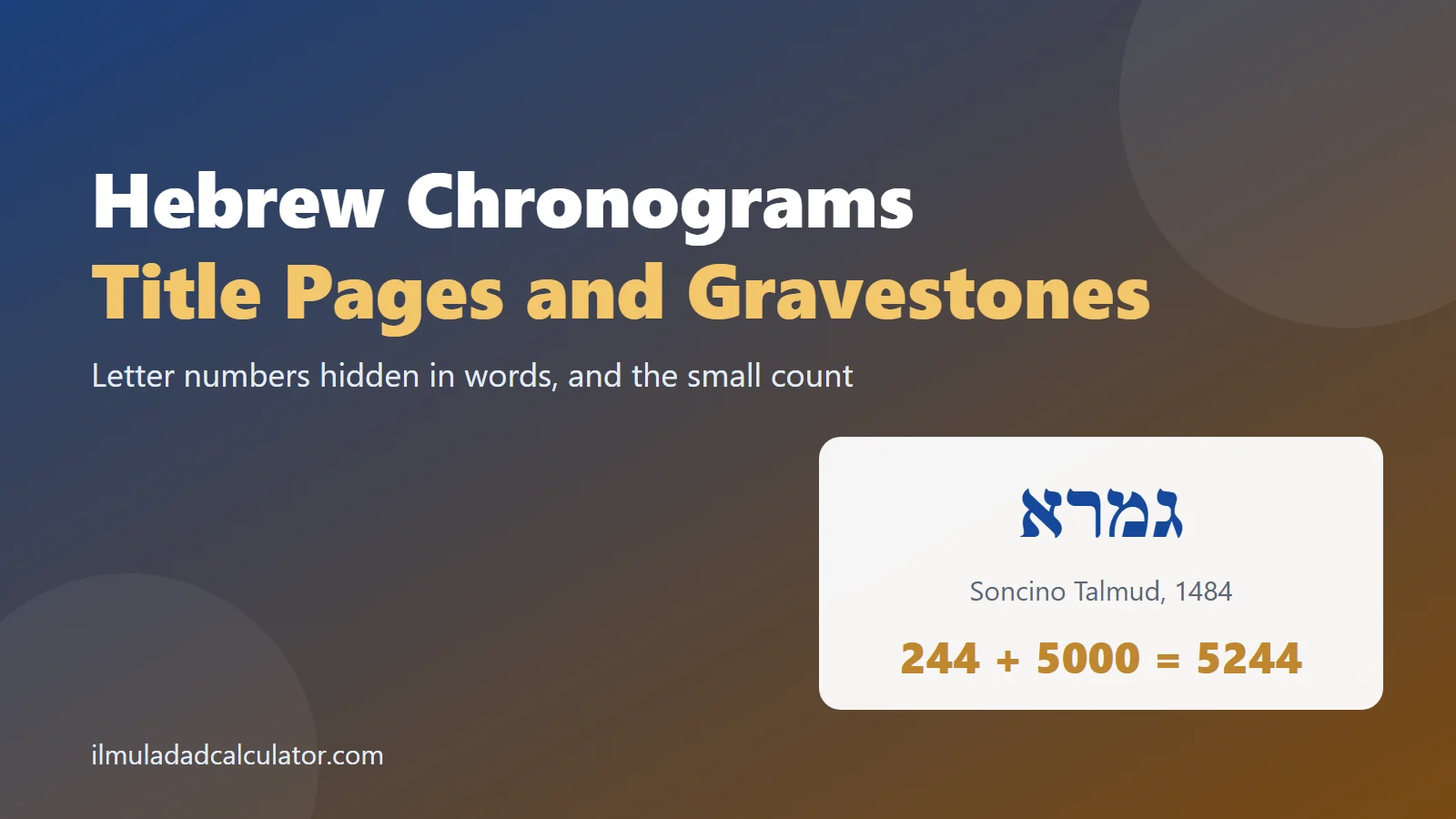
Wikipedia names the Soncino edition of the Talmud as the earliest printed chronogram it cites. The word is גמרא, Gemara. Its letters give 3 + 40 + 200 + 1 = 244.
Add 5000 to reach 5244. Subtract 3760 and the year is 1484, which is the date the sources give for the edition.
One Word for 1492
The same sources note that the word מזרה, mezareh, meaning “scatterer,” marks the year of the expulsion from Spain. Its letters give 40 + 7 + 200 + 5 = 252. Then 5000 + 252 − 3760 = 1492.
The Jewish Encyclopedia says the word comes from the book of Jeremiah. The writers chose it because its sense fits the event, which is the same ideal that Persian poets followed.
Whole Verses and Marked Letters
Later books used full Bible verses instead of single words. The Yale guide says the verse often relates to the book’s contents or the printing. It may also relate to the name of the author or printer.
Because a verse has more letters than the year needs, the writer marks the counted ones. The guide says specific letters are enlarged or bolded for this purpose. That is why the Hebrew method differs from a plain sum of every letter.
What Does a Chronogram on a Gravestone Look Like?
The Jewish Encyclopedia says that chronograms were common on European Jewish epitaphs for about five centuries. They were more frequent and more inventive in Bohemia and Poland than in Germany. Wikipedia adds that German examples were sparing, only about twenty-five among roughly 6,000 inscriptions.
Wikipedia’s article on Hebrew numerals adds a note on dots. Some old manuscripts placed a dot above each counted letter, and a 1935 tombstone in Baiersdorf still does so. It is another way to mark the letters that carry the date.
A Physician in Prague, 1680
Wikipedia quotes the epitaph of the physician Menahem Mazzerato, who died in Prague in 1680. The first letter of each descriptive word is marked, so the line reads as a string of initials.
The ten marked letters add up as 1 + 10 + 90 + 8 + 6 + 5 + 40 + 40 + 200 + 40 = 440. With 5000 restored, the Hebrew year is 5440, and 5440 − 3760 = 1680.
A Rabbi and the Fire of 1689
Wikipedia also gives the epitaph of Zalman, an associate rabbi of Prague who died in the great fire of 1689. The line is באש יצא מאת ד. The sentence reads, in effect, “fire went out from the Lord.”
Only the marked letters count, and they are the ones in באש יצא מא and the final ד. Their sum is 2 + 1 + 300 + 10 + 90 + 1 + 40 + 1 + 4 = 449. Then 5000 + 449 − 3760 = 1689.
The letter tav at the end of the third word is left out. It shows how a chronogram can sit inside a longer, ordinary phrase.
How Does the Hebrew Method Compare With Abjad?
The two systems are close relatives. They both assign numbers to letters in steps of 1, 10 and 100, and many letters match one for one. The word גמרא has the same four-letter shape as the Arabic جمرا, which also adds to 244 under the Mashriqi table.
| Feature | Hebrew | Abjad (Mashriqi) |
|---|---|---|
| Number of letters | 22 | 28 |
| Highest single letter | 400 (tav) | 1000 (ghayn) |
| Hundreds above 400 | Combine letters, such as tav and qof for 500 | Single letters carry them |
| Order of letters | Aleph to tav, with values in steps of 1, 10 and 100 | Abjad order, with the same steps |
| Year count | Years from creation, thousands often omitted | Hijri years, usually written in full |
| Marked letters | Often only enlarged, dotted or bold letters count | Usually every letter counts |
Our Urdu and Persian letters page shows how the abjad table extends to extra letters. The tarikh goi guide explains the poetic side, and Latin chronograms cover the third great tradition.
Hebrew chronograms also appear in poems. Wikipedia says that some nineteenth century Hebrew poets wrote verse with a fixed value. Every line had the same total, usually the year of writing.
Why Did Writers Choose Chronograms Over Plain Numbers?
A date in letters is easy to miscopy, and a copyist may not notice the error. A phrase that fits the event is harder to alter by accident. The reader can also test it, since a wrong letter breaks the sum.
The Jewish Encyclopedia describes the later fashion as one of joy words. Writers favored words of gladness for books, and verses that matched a book’s title or its author. The chronogram was part of the book’s ornament as well as its date.
The same encyclopedia notes a modern use. Printed New Year greeting cards in Palestine carried chronograms, so the tradition reached ordinary readers as well as scholars.
What Mistakes Should You Avoid?
- Forgetting the thousands. A total of 244 means 5244, not 244.
- Counting every letter. If letters are enlarged, dotted or bold, only those count.
- Subtracting 3761 by habit. The year changes in autumn, so check the month when it matters.
- Misreading similar letters. Dalet and resh look alike, and a small error changes the year.
- Treating a source as proof. Wikipedia flags its chronogram article for more citations, so confirm with a printed source.
How Can You Check a Hebrew Date Yourself?
Write the letters in a row and place the value under each one. Add them, then add 5000 if the thousands are missing. Compare the result with the date you expect.
For the Arabic script side of the comparison, use the chronogram decoder. For Hijri conversions, see the Hijri to Gregorian formula.
خلاصہ
عبرانی کرونوگرام ایسا لفظ یا جملہ ہے جس کے عبرانی حروف کی قیمتیں جمع کرنے سے سال نکلتا ہے۔ عام طور پر ہزار والا ہندسہ چھوڑ دیا جاتا ہے، جسے چھوٹی گنتی کہتے ہیں۔ مثلاً لفظ «گمرا» کے حروف ۲۴۴ دیتے ہیں، یعنی ۵۲۴۴، اور تقریباً ۱۴۸۴ عیسوی کی ایک کتاب کی تاریخ بنتی ہے۔ یہ طریقہ ابجد سے بہت ملتا ہے، مگر اس میں اکثر صرف نشان زدہ حروف شمار ہوتے ہیں۔
Sources and Further Reading
- Chronogram, Wikipedia. The Gemara and mezareh examples, the Mazzerato and Zalman epitaphs, the 1205 poem, and the count of German epitaphs.
- Chronogram, Jewish Encyclopedia. Use on epitaphs and books, the Soncino Talmud, the word for the year 1492, and the bibliographic errors.
- Gematria, Yale University Library, Hebrew manuscripts guide. Marked letters, verses on title pages, and the small and large counts.
- In the Year of the Small Count, Mosaic magazine. The lamed, pe and qof abbreviation read as the short count.
- Hebrew numerals, Wikipedia. Letter values, the forms for 15 and 16, final letters, and omitting the thousands.
- Hebrew Numerals Explained, Stephen P. Morse. Hundreds above 400 and the older scheme for final letters.
- Hebrew calendar, Wikipedia. The era count and the rule for converting a Hebrew year to a common year.
Frequently Asked Questions
What is a Hebrew chronogram?
It is a Hebrew word or phrase whose letters add up to a year. The thousands are often left out.
What does prat katan mean?
It means the small or lesser count, a year written without its thousands digit, such as 786 for 5786.
How do I turn the total into a common year?
Add 5000 if the thousands are missing, then subtract 3760. For example, 244 gives 5244, then 1484.
Do all the letters in the phrase count?
Not always. Writers often enlarged, dotted or bolded the counted letters, and only those are added.
Is Hebrew gematria the same as abjad?
They are close relatives with matching values for many letters. The Hebrew table stops at 400 and has 22 letters.