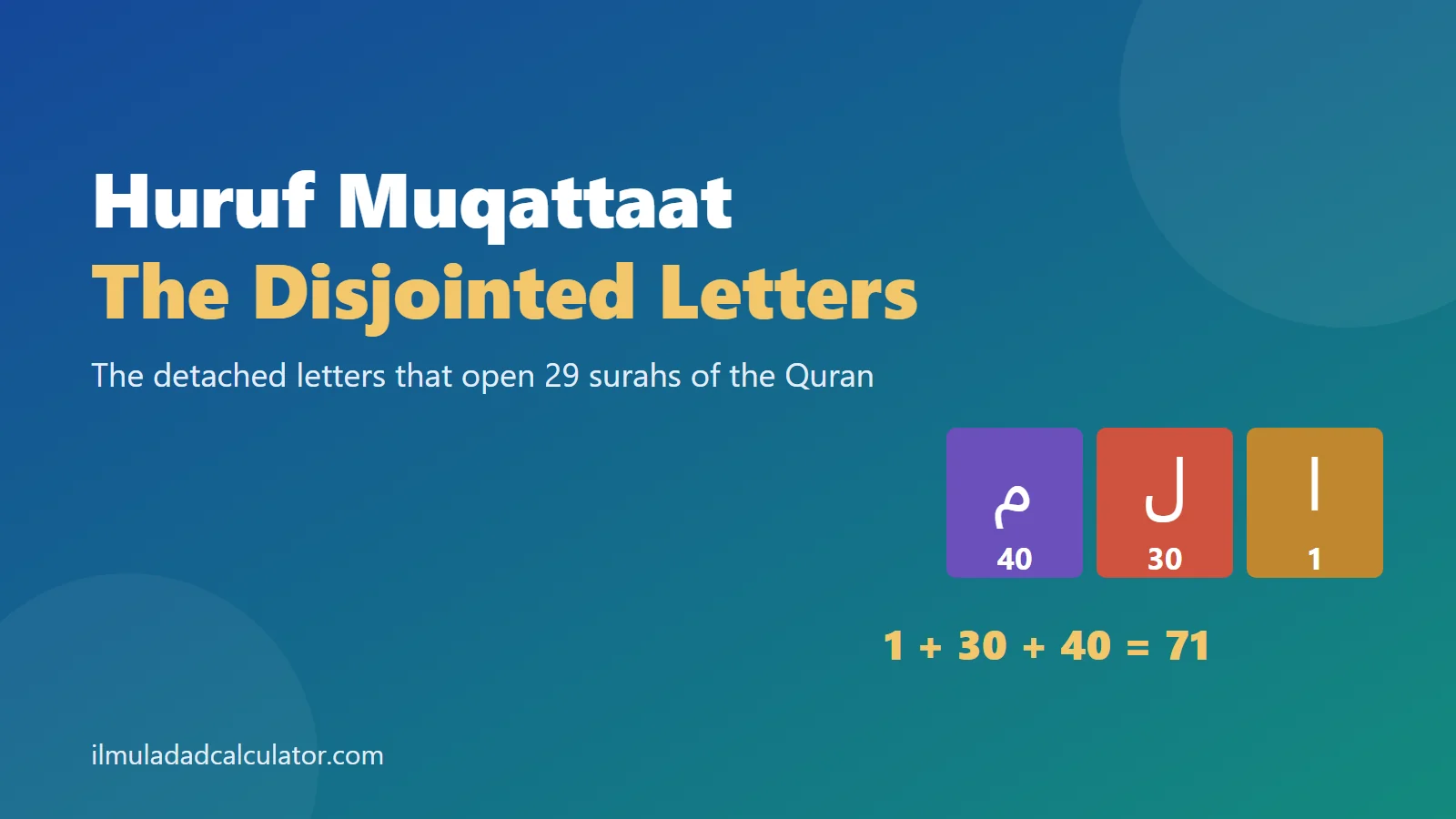
The huruf muqattaat are the detached, or disjointed, letters that open 29 of the Quran’s 114 surahs. They sit right after the Bismillah. There are 14 distinct letters, arranged in 14 combinations.
What Does Huruf Muqattaat Mean?
The Arabic phrase huruf muqattaat means the disjointed letters. The word muqattaat comes from a root that means to cut or to separate. So the name points to letters that stand apart.
These letters are also called fawatih, a word that means openers. They are named this way because each set forms the opening verse of its surah. In the written text, they look like a short cluster of letters.
Each opening uses from one to five letters. The 14 letters involved are exactly half of the 28 Arabic letters. No surah opens with more than five of them.
The term is often written in a few ways in English. You may see huruf e muqattaat, huruf al muqattaat, or huroof muqattaat. These are all the same Arabic phrase, spelled by ear.
This page is a plain reference, not a commentary. It reports what the letters are, where they appear, and how they are read. It does not offer any interpretation of their purpose.
How Are the Disjointed Letters Read?
The letters are read one at a time, by their letter names. They are not blended into a single spoken word. This is the key point that many new readers miss.
Take the opening الم. It is read as three names: alif, then lam, then mim. It is never read as the word “alam”.
The same rule holds for every opening. Each letter keeps the name it has in the alphabet. A short pause falls between the names.
- الر is read as alif, lam, ra.
- طه is read as ta, ha.
- يس is read as ya, sin.
- حم is read as ha, mim.
These letters are among the few spots where single letters are recited by name. Elsewhere in the text, letters join to form whole words. The muqattaat are read apart, just as they are written apart.
The names follow the normal Arabic letter names. So ص is read as sad, and ق is read as qaf. A reader who knows the alphabet can read every opening with no new rule.
This is also why the openings look unusual on the page. The letters sit side by side, yet they do not spell a word. A learner reads them slowly, name by name.
Which Surahs Open With the Muqattaat?
The 14 combinations are spread across 29 surahs. Some combinations open several surahs. Others open only one.
The very first case comes early in the Quran. Surah al-Baqarah, the second and longest surah, opens with الم. The same الم opens five more surahs.
The opening حم also appears six times, across a run of nearby surahs. Single letters such as ص, ق and ن each open just one surah.
One opening is split across two verses. In Surah ash-Shura, حم is the first verse, and عسق is the second. Lists count this case in different ways.
How to count: some lists give slightly different totals because of the two-verse Shura opening. The letters themselves are the same in every list. Only the way of grouping them changes.
Where Do the Disjointed Letters Appear in a Surah?
The muqattaat always come at the very start of their surah. They follow the Bismillah and lead the first line. Nothing else comes before them in the text.
In the standard verse count, these letters are counted as their own verse in many surahs. That is why they carry a verse number of their own. This counting can vary slightly between traditions of numbering.
Observers have long noted a pattern in these openings. In many of the surahs, the verse right after the letters speaks of the Book or the revelation. This is an observed pattern in the text, stated here only as a description.
How Are the Combinations Grouped by Length?
It helps to sort the openings by how many letters they hold. The groups run from one letter up to five. This is a simple way to see the whole set at a glance.
- One letter: ص, ق and ن.
- Two letters: طه, طس, يس and حم.
- Three letters: الم, الر and طسم.
- Four letters: المص and المر.
- Five letters: كهيعص and the حم عسق pair.
The shorter openings are the most common. The longest openings are the rarest. Only two surahs open with five letters.
How Do the Letters Relate to the Arabic Alphabet?
The 14 muqattaat letters are ordinary Arabic letters. They are the same shapes used in every other word. What stands out is that exactly half the alphabet appears this way.
The other half of the alphabet never appears as a disjointed letter. So the set is a fixed group of 14, not a random pick. Writers have long noted this even split.
A few letters repeat across many openings. Alif, lam and mim are the most frequent. Others, such as kaf and ayn, appear in only one opening each.
Which Letters Appear Most Often?
Alif and lam lead the set, since they begin several openings together. Mim and ha also appear many times. The rarer letters sit in a single combination.
Knowing the frequent letters makes the openings easier to recall. Once you know the common shapes, the longer sets fall into place.
The split into 14 letters is fixed and does not change. Every printed Quran shows the same openings in the same places. This stability is one reason the set has drawn so much study.
What Explanations Have Scholars Offered?
Commentators have discussed the muqattaat for many centuries. They have offered several kinds of explanation. No single reading is agreed upon by all of them.
The most widely held position is that their certain meaning is known only to God. The table below groups the main kinds of view in neutral terms. It names each view in general, without quoting any one writer.
| Category | Short description | Attribution |
|---|---|---|
| Known only to God | The certain meaning is left to God, and this is the most widely held view. | held by many classical commentators |
| Names or short forms | The letters may stand for names of God or short forms of words. | suggested by some scholars |
| An opening call | The letters may draw the listener in at the start of a surah. | proposed by some commentators |
| Echo of the language | The letters may point to the sounds that make up Arabic itself. | noted by some writers |
| Numerical reading | The letters have been linked to number values in later writing. | discussed in some later works |
This site does not take a side among these views. It reports them as a matter of record. It does not endorse or rank any one reading.
Why the Views Differ
The letters form no fixed sentence, so readers approach them in different ways. Some study the sounds, some the shapes, and some the history. Each path leads to a different kind of answer.
Because there is no single proof, scholars often describe their views as opinions. Many state plainly that the full answer rests with God. That caution is itself part of the record.
These views are not ranked against one another here. A reader who wants more can turn to full works of commentary. The goal on this page is only to list the kinds of view that exist.
What Do the Abjad Values of the Muqattaat Add Up To?
Because the letters are ordinary Arabic letters, each one has an Abjad value. So the sum of any opening can be worked out as plain arithmetic. This is only counting, and it carries no claim of meaning.
Take the opening الم again. Adding the three letter values gives a simple total:
ا 1 + ل 30 + م 40 = 71
The opening الر works the same way. The sum of its letter values is 231:
ا 1 + ل 30 + ر 200 = 231
History records that writers computed such sums over the years. This is a fact about what people did, not a claim about what the letters mean. You can check any sum with the phrase value calculator or the Abjad value calculator.
The same method works for any opening. Simply add the value of each letter in the set. The engine on this site does this step for you and shows the total.
Note: a sum like 71 is arithmetic only. It is not a hidden message or a prediction. This page makes no such claim.
Where Can You Explore the Letters and Their Values?
The muqattaat use ordinary Arabic letters, so their values match the standard chart. You can look up each letter and its value in one place. The same values apply whether a letter stands alone or inside a word.
- See the full value chart on the Arabic letter values page.
- Learn the counting order with the abjad hawwaz memory words.
- Read how the whole system works on the methodology page.
- See how numbers are written in Arabic numerals.
For a surah-by-surah table of every opening, see the full list of the disjointed letters. That page sets out all 14 combinations beside their surahs. The Ilm-ul-Adad calculator also accepts these letters directly.
Together these pages cover the letters, their values, and their place in the text. Each one sticks to facts you can check for yourself. None of them offers a reading of what the letters mean.
خلاصہ
حروفِ مقطعات قرآن کی اُنتیس سورتوں کے شروع میں آنے والے الگ الگ حروف ہیں۔ یہ کل چودہ حروف ہیں جو چودہ مختلف ترکیبوں میں آتے ہیں، اور انہیں نام لے کر پڑھا جاتا ہے، جیسے الم کو “الف، لام، میم”۔ علما نے ان کی کئی توجیہات بیان کی ہیں، مگر سب سے مشہور رائے یہ ہے کہ ان کا یقینی مطلب صرف اللہ ہی جانتا ہے۔ یہ صفحہ صرف حقائق بیان کرتا ہے اور کوئی تعبیر یا پیش گوئی نہیں کرتا۔
Sources and Further Reading
- Muqattaʿat, Wikipedia. The 29 surahs, the 14 letters and combinations, the reading method and the categories of explanation.
- Abjad values come from this site’s tested engine. See the methodology.
Frequently Asked Questions
What does huruf e muqattaat mean?
It means the disjointed letters. They are detached letters that open 29 surahs of the Quran.
How many muqattaat letters are there?
There are 14 distinct letters, used in 14 different combinations across 29 surahs.
How is الم read?
It is read letter by letter as alif, lam, mim. It is not blended into one word like alam.
What do the disjointed letters mean?
Scholars have offered several views. The most widely held position is that their certain meaning is known only to God.
Do the muqattaat have Abjad values?
Yes. Each is an ordinary Arabic letter, so its value matches the standard chart. Any sum is arithmetic only.
Which surah opens with the most letters?
Two surahs open with five letters: Maryam with كهيعص and ash-Shura with the حم عسق pair.