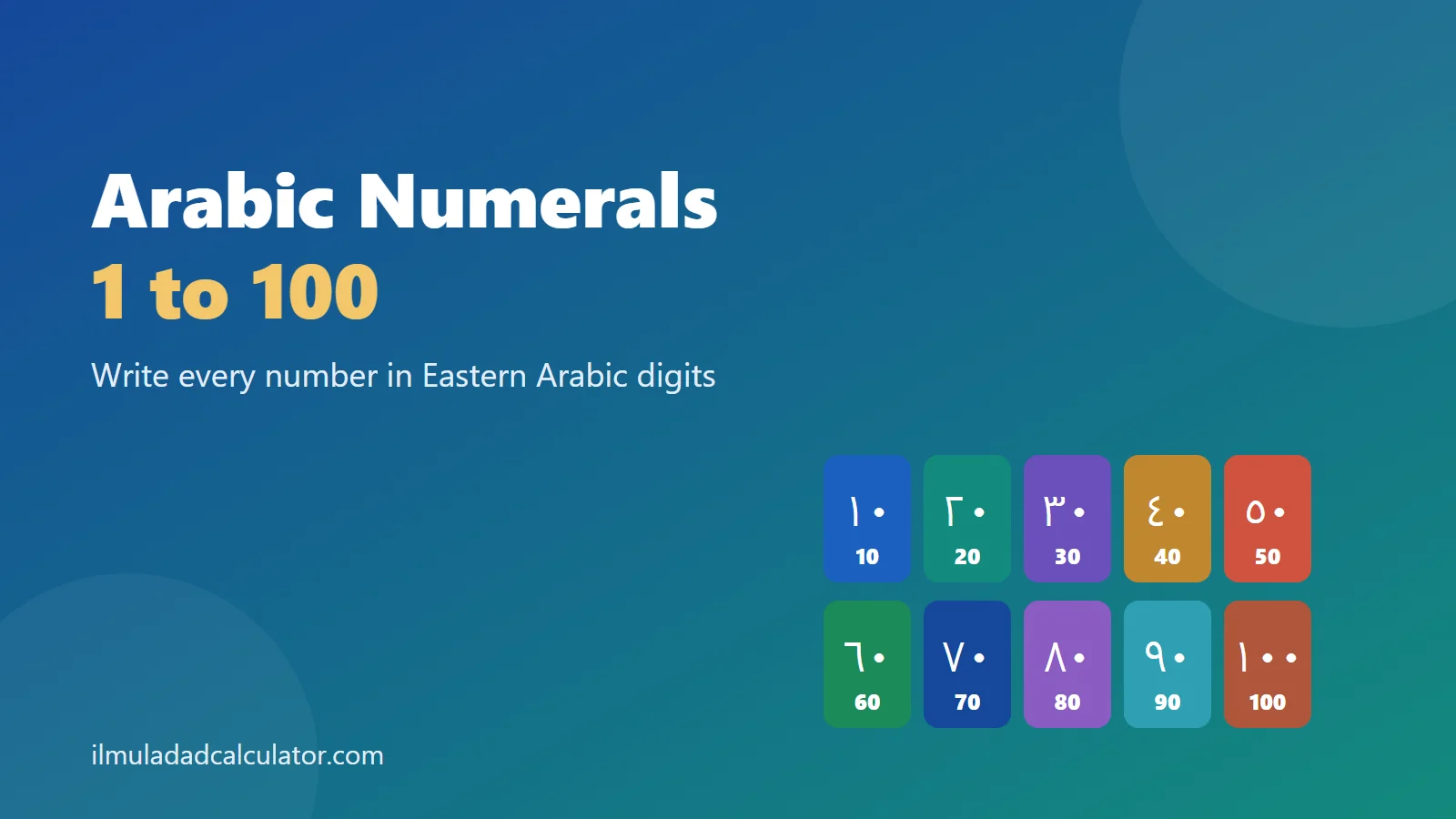
This page is a reference chart for the numbers 1 to 100 in Eastern Arabic digits. These are the shapes ١ to ٩ used with Arabic script. You will see every number from 1 to 20, then the tens to 100 and a rule for the rest.
Is This Page About Digits or Abjad Letters?
It is about digits. Eastern Arabic digits are the number shapes ٠ to ٩. They work by place value, in the same way as 0 to 9.
These digits are not the same as Abjad values. In the Abjad system, each letter stands for a fixed number instead of a digit shape.
The letter system is a separate topic with its own chart. You can see it on the Arabic letter values page. You can also turn a number into letters with the number to Abjad numerals tool.
For the wider story of every system, see the numbers in Arabic script overview. If you only want the ten digit shapes explained in depth, read the Eastern Arabic numerals guide.
Why Is the 1 to 100 Chart Worth Learning?
Numbers from 1 to 100 cover most of daily reading. Prices, dates, ages, page numbers and room numbers all sit in this range.
Once you know these shapes, Arabic street signs and receipts become far easier to read. The same shapes also appear in Urdu and Persian print.
This chart is a quick reference, not a full course. It gives you the pattern first, then the tables to confirm any single number.
Travelers find the range useful for bus numbers and shop prices. Students meet it in textbooks and worksheets across the Arabic-speaking world.
Learning the pattern also helps with larger numbers later. The same ten shapes build hundreds and thousands in exactly the same way.
Many beginners try to learn the digits one list at a time. A chart works better, because it shows how the parts fit together.
What Are the Ten Digits You Need?
Every number from 1 to 100 is built from just ten digits. Learn these shapes first, and the rest of the chart falls into place.
Each digit holds the same value as its Western partner. Only the shape on the page is different.
The digit ٠ is zero, drawn as a small dot or circle. The digit ١ is one, a simple upright stroke.
The rest follow in order up to nine. Spend a minute matching each shape to its Western value before you read on.
How Do You Write 1 to 20?
The numbers 1 to 9 each use a single digit. From 10 onward, you join two digits together.
The tens digit goes on the left, and the units digit goes on the right. This is the same order you use in English.
The table below lists 1 to 20 so you can check any number at a glance. The left pair covers 1 to 10, and the right pair covers 11 to 20.
| Number | Digits | Number | Digits |
|---|---|---|---|
| 1 | ١ | 11 | ١١ |
| 2 | ٢ | 12 | ١٢ |
| 3 | ٣ | 13 | ١٣ |
| 4 | ٤ | 14 | ١٤ |
| 5 | ٥ | 15 | ١٥ |
| 6 | ٦ | 16 | ١٦ |
| 7 | ٧ | 17 | ١٧ |
| 8 | ٨ | 18 | ١٨ |
| 9 | ٩ | 19 | ١٩ |
| 10 | ١٠ | 20 | ٢٠ |
Notice that 11 to 19 all start with a one on the left. The second digit then counts up from one to nine.
How Are the Tens Written From 10 to 100?
The tens follow the same pattern as the single digits. You write the single digit, then add a zero on the right.
So 20 is a two with a zero, and 90 is a nine with a zero. The table gives each ten in full.
| Number | Digits |
|---|---|
| 10 | ١٠ |
| 20 | ٢٠ |
| 30 | ٣٠ |
| 40 | ٤٠ |
| 50 | ٥٠ |
| 60 | ٦٠ |
| 70 | ٧٠ |
| 80 | ٨٠ |
| 90 | ٩٠ |
| 100 | ١٠٠ |
One hundred is ١٠٠, a one followed by two zeros. It is the only three-digit number in this chart.
The tens are the backbone of the whole range. Every number between them simply swaps the final zero for a units digit.
It helps to read the tens aloud in order first. That fixes the shapes in memory before you tackle the numbers in between.
How Does Zero Work in This System?
Zero is a key part of the chart, even though it is not a counting number. It holds the units place open in every ten.
In the Eastern set, zero is a small dot or circle, ٠. Readers new to the script sometimes mistake it for a full stop.
Without zero, you could not tell 2 from 20 on the page. The empty place is what gives each digit its value.
How Do You Build Every Number From 21 to 99?
You do not need to memorize all one hundred numbers. Any two-digit number uses its tens digit and its units digit, in that order.
Take 47 as an example. Here is how to write it step by step:
- Find the tens digit, four, written ٤.
- Find the units digit, seven, written ٧.
- Place the tens on the left and the units on the right: ٤٧.
The same steps give every number in between. For instance, 21 joins a two and a one, while 99 joins two nines.
This is why ten digits are enough for the whole chart. You are reusing the same shapes in new positions.
Quick check: read the two digits as tens then units. The shape ٦٣ is six-tens and three, which is 63.
Why Do Numbers Read Left to Right in Right-to-Left Text?
Arabic script runs from right to left. Yet numbers keep their highest place value on the left, just like English.
So the number one hundred still reads as one, then zero, then zero. The reading direction of the words does not flip the digits.
This surprises many learners at first. Inside a sentence of Arabic text, a number is an island that keeps its own left-to-right order.
Think of the digits as a small block dropped into the line. The line flows right to left, but the block does not turn around.
The numbers in Arabic script overview explains this direction rule in more detail. It applies to every place-value system, not only Arabic.
Do Spoken Numbers Follow the Same Order?
The written order is fixed, but speech can differ. In spoken Arabic, the units are often said before the tens.
So 25 can be spoken as five and twenty, even though it is written with the two first. This is a feature of the language, not the digits.
The chart on this page is about writing, so you can ignore the spoken order while you read it. The shapes stay the same no matter how a number is said.
How Do Persian and Urdu Digits Differ?
Persian and Urdu use the same number system, but a few digits take different shapes. The clearest differences are in four, five and six.
In Arabic these are ٤, ٥ and ٦. In Persian and Urdu they appear as ۴, ۵ and ۶.
Urdu also gives seven a slightly different look. The other digits are shared, so most of the chart reads the same in all three.
These variant digits are common in Iran, Afghanistan and Pakistan. Urdu newspapers and signs still use them widely, even where screens often show Western digits.
What Are the Arabic Words for 1 to 10?
The digits above are shapes, not spoken words. The table gives the Arabic word for each number from 1 to 10, written in simple Roman letters.
| Value | Digit | Arabic word |
|---|---|---|
| 1 | ١ | wahid |
| 2 | ٢ | ithnan |
| 3 | ٣ | thalatha |
| 4 | ٤ | arba’a |
| 5 | ٥ | khamsa |
| 6 | ٦ | sitta |
| 7 | ٧ | sab’a |
| 8 | ٨ | thamaniya |
| 9 | ٩ | tis’a |
| 10 | ١٠ | ashara |
These words are a guide to pronunciation only. The written chart does not change when you say a number aloud.
The spellings here are a rough Roman guide. Actual Arabic pronunciation varies a little from region to region.
Knowing the words helps you link a shape to a sound. It also makes counting out loud much easier for a beginner.
Numbers above ten combine these words in set phrases. The written digits, though, stay simple and follow the chart above.
How Do You Type Eastern Arabic Digits?
Arabic keyboard layouts carry the digits on the number row. On a phone, the Arabic keyboard shows them, often behind the numbers key.
Each digit also has a fixed code point in Unicode. That is how the same shape appears the same way across apps and fonts.
- The Arabic digit set runs from U+0660 to U+0669 in Unicode.
- The Persian and Urdu set runs from U+06F0 to U+06F9.
- Most fonts that support Arabic script include both sets.
If you only need a few digits, copy them from the chart above. For long numbers, add an Arabic or Urdu keyboard in your device settings.
On a computer, you can add the same layouts in the language settings. A phonetic layout keeps the digits on the familiar number keys.
Some apps also switch digit style on their own. They may show Eastern digits when the text language is set to Arabic or Urdu.
If a number looks wrong, check the font first. A font without full Arabic support can fall back to plain Western digits.
خلاصہ
یہ صفحہ عربی رسم الخط میں ایک سے سو تک کے ہندسوں کا حوالہ ہے۔ ہر عدد صرف دس ہندسوں ٠ سے ٩ تک سے بنتا ہے، اور دو ہندسوں والے عدد میں دہائی بائیں اور اکائی دائیں لکھی جاتی ہے۔ یہ ہندسے ابجد کی حرفی قدروں سے الگ ہیں، اور فارسی اور اردو میں چار، پانچ اور چھ کی شکلیں قدرے مختلف ہوتی ہیں۔
Sources and Further Reading
- Eastern Arabic numerals, Wikipedia. Digit shapes, the Persian and Urdu forms, Unicode ranges and regional use.
- Arabic numerals, Wikipedia. The place-value system and the left-to-right order of digits.
- The chart is generated from the digit code points. See this site’s methodology.
Frequently Asked Questions
What are the Arabic numerals from 1 to 100?
They are the numbers written with the digits ٠ to ٩. Each number uses the same place value as 0 to 9.
How do I write 100 in Arabic digits?
One hundred is ١٠٠, a one followed by two zeros. It reads left to right, like 100.
Are these digits the same as Abjad values?
No. These are digits with place value. Abjad values give each letter a number, which is a separate system.
Do Arabic numbers read right to left?
No. The digits inside a number keep the tens on the left, even though the script runs right to left.
Which digits differ in Persian and Urdu?
Mainly four, five and six. Arabic uses ٤ ٥ ٦, while Persian and Urdu use ۴ ۵ ۶.
Is zero needed to write 1 to 100?
Yes, for the tens and for 100. Zero is a small dot or circle in the Eastern set.