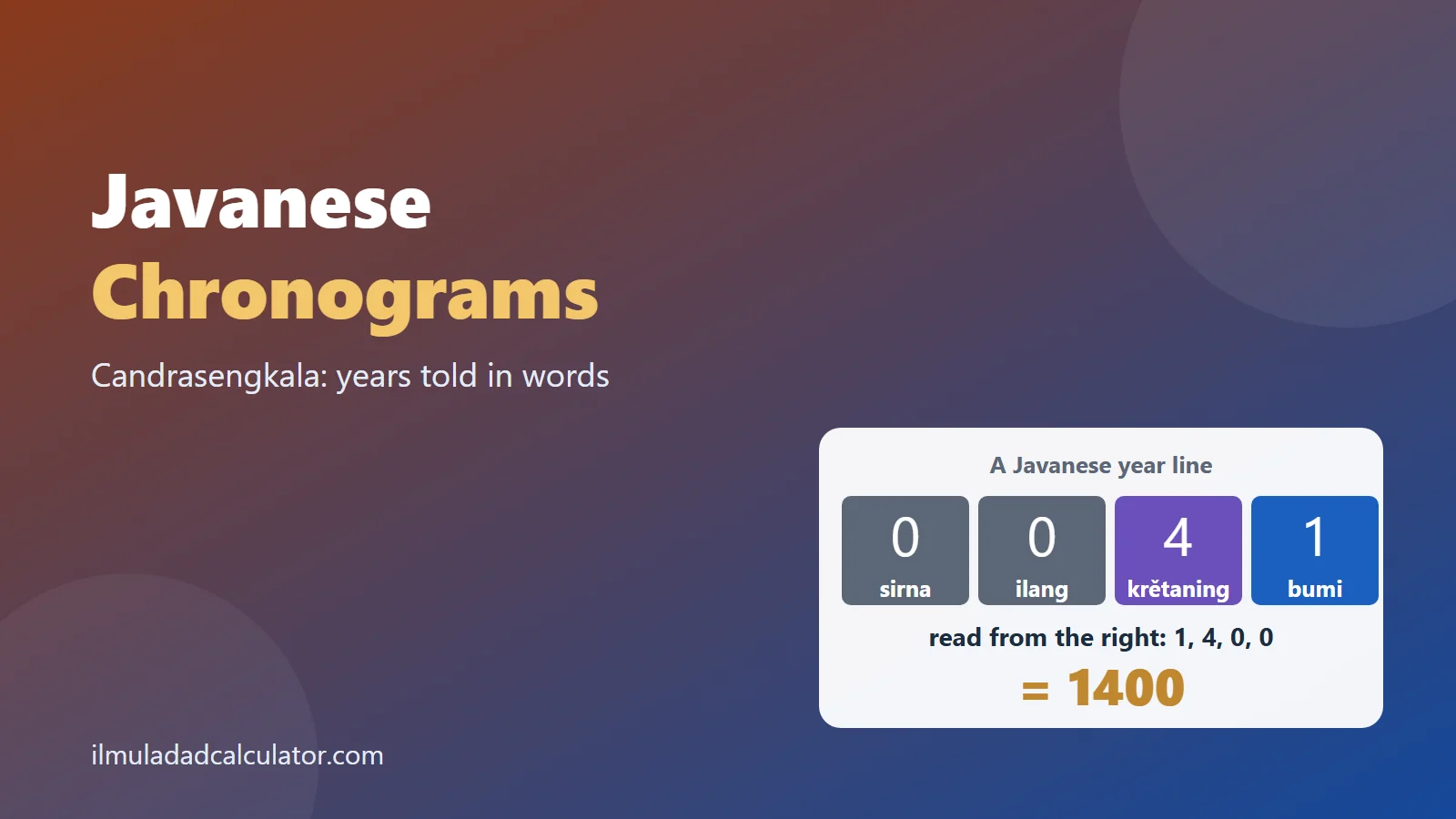
A Javanese chronogram hides a year in a short sentence. Each word stands for one digit, and the digits are read backward. Java and Bali call this art sengkalan, and when the year is a lunar one it is called candrasengkala.
What Is a Javanese Chronogram?
A Javanese chronogram is a sentence that writes a year as words. The Indonesian Wikipedia entry on sengkala describes it as a code in which every word, or object, symbolizes a number. The practice is found in Javanese and Balinese culture.
The word sengkalan comes from saka and kala, according to the Javanese Wikipedia. Saka is the name of an old era, and kala means time. A sengkalan is therefore a saying that gives the number of a year.
This is a different principle from the abjad method. Nothing is added up. For the wider idea of hiding a date in words, see what a chronogram is.
How Do Words Stand for Digits?
The basic rule is substitution. Each digit from 0 to 9 is replaced by a word that symbolizes it. A sentence is then built from those words.
One digit can be written with many words. The ten words below are samples from the published lists.
The link between a word and its digit is not always obvious. The Indonesian entry notes that the same word may be read in several ways. A reader has to know the traditional lists.
Why Does One Digit Have So Many Words?
The Javanese Wikipedia lists eight kinds of word grouping. Words with the same meaning share a digit, so gunung, giri and arga all stand for 7. Words of the same class share one too, so the moon, the sun and the earth all stand for 1.
Other groupings follow function, sound or quality. Prabowo and colleagues call the whole rule set astha guru, the eight instructions. A poet could therefore choose the word that best fits the story.
Why Is a Javanese Chronogram Read Backward?
The digits are taken from the last word to the first. The first word gives the units digit, and the last word gives the thousands digit. Prabowo and colleagues trace this to the Sanskrit principle angkanam vamato gatih, which means numbers go from the right.
The Javanese Wikipedia compares it with reading Arabic, which also runs right to left. The writer sets the units first. The reader flips the order.
- Look up the digit for each word.
- Write the digits in the order the words appear.
- Reverse the row of digits.
- Read the result as an ordinary number.
A Worked Example: Sirna Ilang Krětaning Bumi
The Javanese Wikipedia gives this line as its model. Sirna and ilang both mean vanished, so each is 0. Krětaning is 4, and bumi, the earth, is 1.
The digits in order are 0, 0, 4, 1. Reversed, they make 1400. The year is a Saka year, so the Common Era figure by the simple rule below is 1400 + 78 = 1478.
Key point: the sum of the digits is never used. Sirna ilang krětaning bumi has a digit total of 5, which means nothing. Only the reversed row matters.
Which Calendars Do Sengkalan Date?
A sengkalan gives only a year number. The text around it names the calendar. Otherwise the script, language and period suggest it.
Sources describe two families. A suryasengkala counts solar years, and a candrasengkala counts lunar years. Prabowo and colleagues place the Javanese and Hijri years in the lunar family.
The Indonesian Wikipedia also lists the Saka year with the lunar ones, so the sources differ on that point.
People often use candrasengkala as a general name for all of them. This page does the same when it speaks of the art.
How Do You Convert the Year?
Prabowo and colleagues give simple conversions. Saka plus 78 gives the Common Era year. For the Javanese and Hijri calendars, the number added falls by 1 about every 33 Common Era years.
| Calendar | Year | Add | Common Era year |
|---|---|---|---|
| Saka | 1555 | + 78 | 1633 |
| Javanese | 1555 | + 78 | 1633 |
| Hijri | 1043 | + 590 | 1633 |
| Javanese | 1947 | + 67 | 2014 |
| Hijri | 1435 | + 579 | 2014 |
These are rule-of-thumb figures, not date-exact conversions. For exact day conversions, see the Hijri to Gregorian formula and Hijri calendar systems.
What Do Real Examples Look Like?
Each line below is taken from a source we opened. Its digits were looked up and reversed in code, and the result matches the year the source gives.
| Line | Digits in order | Reversed | Year | Where |
|---|---|---|---|---|
| Sirna ilang krětaning bumi | 0, 0, 4, 1 | 1 4 0 0 = 1400 | Saka year 1400 | A widely quoted line, listed on Javanese Wikipedia |
| Miyat ngaluhur trusing budi | 2, 0, 9, 1 | 1 9 0 2 = 1902 | Javanese year 1902 | Inauguration of the Museum Dewantara Kirti Griya |
| Nora tinghal bhuttha tunggal | 0, 2, 5, 1 | 1 5 2 0 = 1520 | Saka year 1520 (1598 CE) | Fall of Balambangan, in the Balinese Babad Gumi |
| Cruti indria rasa | 4, 5, 6 | 6 5 4 = 654 | Saka year 654 (732 CE) | The Canggal inscription, in Sanskrit |
| Nayana wasu rasa | 2, 8, 6 | 6 8 2 = 682 | Saka year 682 (760 CE) | The Dinoyo inscription, in Sanskrit |
One Inscription, Two Lines
A palace inscription of Paku Buwana X shows how the art serves two calendars. The text gives a date in the Javanese calendar and then the same date in the Common Era.
Gapura rinengga samadyaning praja gives 9, 6, 8, 1, which reads 1869. Esthi uninga gapuraning ratu gives 8, 3, 9, 1, which reads 1938. The text sets the second against 26 September 1938.
A Line From Bali
Balinese chronicles use the same art. The Indonesian Wikipedia quotes the Babad Gumi line nora tinghal bhuttha tunggal. Its digits are 0, 2, 5, 1, which read 1520 Saka.
That is 1598 CE by the Saka rule, and the article says Dutch records of the time support the date.
What Are the Kinds of Sengkalan?
The Javanese Wikipedia and Prabowo and colleagues describe the main forms.
- Sengkalan lamba: plain words, as in all the examples above.
- Sengkalan miring: oblique words. A word points to a digit through an association, so lungid means a sharp weapon, which stands for 5.
- Sengkalan memet: the date is shown in a picture, statue, gate or building, not in words.
The Indonesian entry gives a modern memet case. The Syuhada Mosque in Yogyakarta has 17 steps, an eight-sided gate pillar and four plus five domes. These stand for 17-8-1945, a date in the Common Era.
Prabowo and colleagues note that a memet design must be turned back into words first.
How Old Is the Tradition?
Prabowo and colleagues report the oldest Javanese example as the Canggal inscription of Central Java. Its line is Cruti indria rasa, which reads 654 Saka, or 732 CE. It is written in Sanskrit and Early Pallava script.
The Dinoyo inscription of East Java follows. Nayana wasu rasa gives 2, 8, 6 and reads 682 Saka, or 760 CE.
The authors place the start of the practice about 1,300 years ago. They also note a Cambodian and Cham counterpart called bhutasamkhaya.
Can a Reading Be Disputed?
Yes, and this is a useful caution. The Pasir Muara inscription in West Java has the line kawihaji panyca pasagi. Read backward in the usual way, its digits 8, 5, 4 give 458 Saka, or 536 CE.
The historian Hasan Djafar, cited by Prabowo and colleagues, argues for the opposite direction. That reading gives 854 Saka, or 932 CE, which he says fits the history better.
Where Did Writers Place a Sengkalan?
The Javanese Wikipedia says a sengkalan usually stood at the start or the end of a book or chronicle. It was often worked into a line of macapat verse. The poet then had to fit the word count and the syllable count of the meter.
The same page quotes lines from chronicles held at the Reksapustaka library in Surakarta. Each states a year in the line itself, often beside the day and the month of the Javanese calendar.
- Books and chronicles: the year of writing, placed in the opening or closing verses.
- Inscriptions: the Canggal and Dinoyo stones, and the Paku Buwana X text.
- Buildings and gates: sengkalan memet in carvings and in the plan itself.
- Museums and public works: the Dewantara Kirti Griya line is one case.
How Does It Compare With the Abjad Method?
Both arts hide a year in a phrase, but they work in opposite ways. In the Arabic-script tradition, every letter carries a value and the values are summed. In the Javanese tradition, every word carries a digit and the digits are placed in a row.
| Feature | Javanese sengkalan | Abjad chronogram |
|---|---|---|
| What is counted | Words, each standing for one digit | Letters, each with its own value |
| How the year is built | Digits are placed side by side | Letter values are added together |
| Reading order | From the last word back to the first | Any order, then add |
| Size of each part | Always one digit, 0 to 9 | Anything from 1 to 1000 |
| Zero | Has its own words, such as sirna | No letter stands for zero |
| Script | Any script or language | Arabic letters |
That is why the chronogram decoder on this site cannot read a sengkalan. It adds letter values, and a sengkalan has none. To see the abjad side, read about tarikh goi and Persian chronograms.
The Roman-numeral method is a third kind. It adds a few marked letters, as our page on Latin chronograms shows.
How Can You Write One Yourself?
The steps mirror the reading steps in reverse.
- Choose the year, such as 1400.
- List its digits from the units up: 0, 0, 4, 1.
- Pick a word for each digit from the traditional lists.
- Arrange the words into a phrase with a clear meaning, keeping that order.
- Test it by reversing the digits and checking the year.
The order is the common slip. A writer who lists digits from the thousands will give a reader the wrong year.
What Mistakes Should You Avoid?
- Reading forward. The first word is the units digit, not the thousands.
- Adding the digits. The digits stay separate. They are never summed.
- Forgetting the calendar. Say whether the year is Saka, Javanese or Hijri before converting it.
- Trusting one list. A word may have a different digit in another list, so check the context.
- Copying a total from a web page. Test each line yourself, as sources can contain slips.
خلاصہ
جاوی کرونوگرام، جسے سنگکلن یا چندر سنگکلا کہا جاتا ہے، ایسا جملہ ہے جس کا ہر لفظ ایک ہندسے کی نمائندگی کرتا ہے۔ ہندسے آخری لفظ سے پہلے لفظ تک الٹی ترتیب میں پڑھے جاتے ہیں، مثلاً «سرنا ایلنگ کرتنِنگ بومی» سے ۰، ۰، ۴، ۱ ملتے ہیں اور سال ۱۴۰۰ ساکا بنتا ہے۔ یہ ابجد سے مختلف ہے، کیونکہ یہاں حروف کی قیمتیں جمع نہیں کی جاتیں۔
Sources and Further Reading
- Sengkala, Wikipedia Indonesia. The definition, the types, the digit table, the Dewantara Kirti Griya line, the Syuhada Mosque and the Babad Gumi line.
- Sengkalan, Wikipedia Jawa. The word origin, the word lists for each digit, the choice rules, the reading order and the sirna line.
- Suryasengkala Lamba: The Indonesian-Javanese Chronogram, Agung Prabowo, Agus Sugandha and Agustini Tripena, 2016, Global Journal of Pure and Applied Mathematics. Oldest inscriptions, Paku Buwana X lines, conversions and the Pasir Muara dispute.
Frequently Asked Questions
What is a candrasengkala?
It is a Javanese chronogram. Its words stand for digits that give a lunar year, such as a Javanese or Hijri year.
Why are sengkalan read backward?
The first word is the units digit and the last is the thousands digit. The digits are reversed to get the year.
Is a sengkalan the same as an abjad chronogram?
No. A sengkalan places digits side by side, and an abjad chronogram adds letter values.
Can one digit have several words?
Yes. Many words share a digit, such as sirna and ilang for 0. The poet picks the one that fits the story.
What is a sengkalan memet?
It is a date shown in an image, a statue or a building instead of written words.