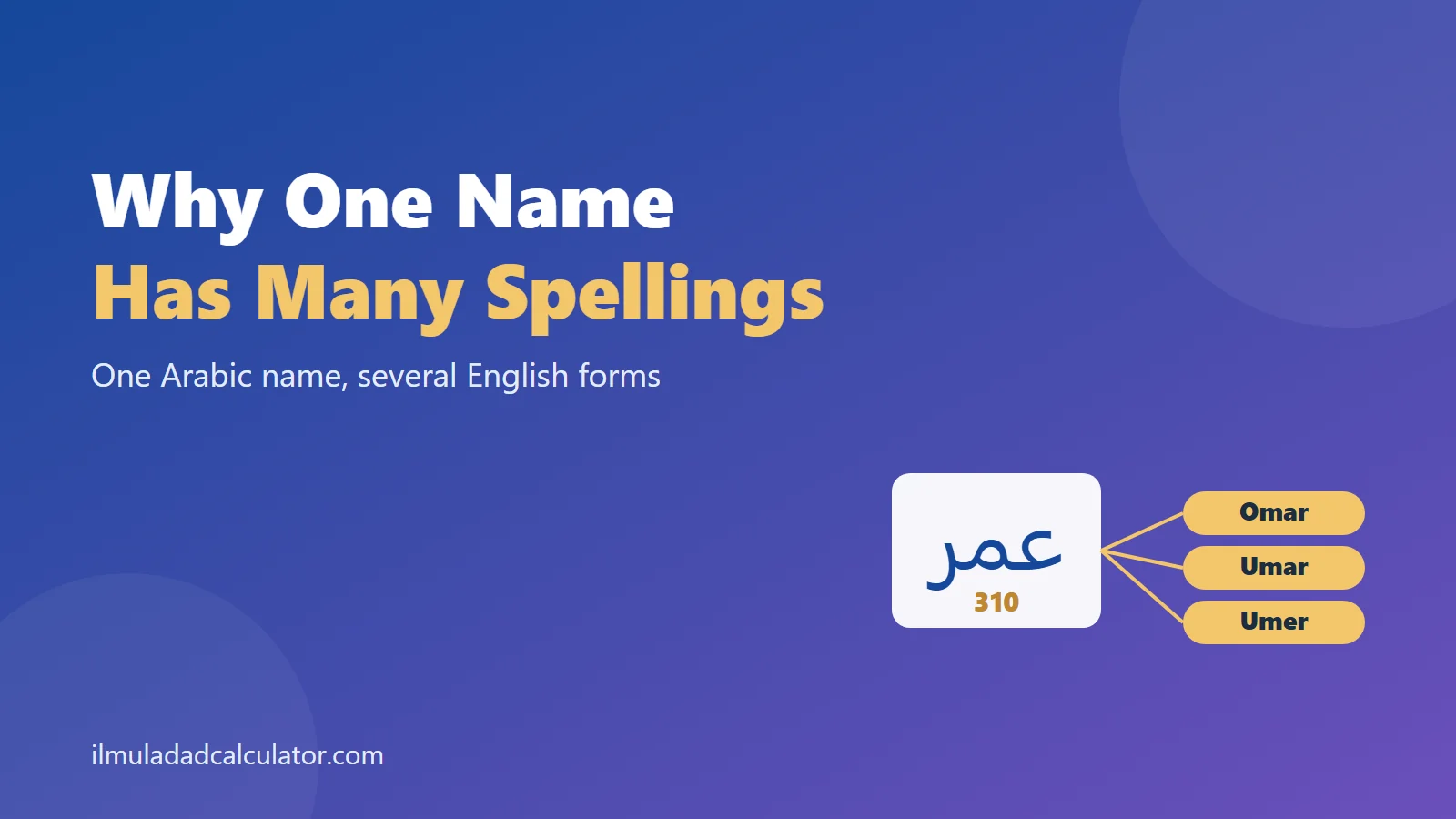
One Arabic name can appear in English as Omar, Umar or Umer. The spellings differ because English letters cannot show every Arabic sound, and because no single rulebook decides the spelling. This page explains the reasons, and what they mean for the Abjad value.
Why Does One Arabic Name Have So Many Spellings?
English and Arabic use different alphabets and different sounds. When a name crosses from one to the other, something always has to be approximated.
Writers make small choices at each step, and those choices add up. The result is several spellings that all point to the same name.
A person who knows Arabic may copy the letters carefully. Someone writing by ear simply hears the name and spells it the English way. Both results are common.
Five reasons explain almost every spelling you will meet:
- Arabic has sounds that English has no letter for.
- Short vowels are not written in Arabic, so writers guess them.
- The word for “the” can be written al-, el- or ul-.
- Regions say the same name in different ways.
- No official body sets one correct spelling.
Which Arabic Sounds Does English Lack?
Arabic has several consonants with no exact English match. Writers reach for the nearest letter, and different writers pick differently.
The letter ayn (ع) is the clearest case. It is a sound made deep in the throat. English has no letter for it, so writers may use a, use e, or leave it out.
Arabic also has two h sounds. The breathy ha (ح) and the soft ha (ه) both become a plain h in English. A reader cannot tell which one a name used.
Hard Letters That Look Alike in English
Arabic has a q sound, qaf (ق), and a k sound, kaf (ك). Both are often written k, so Qasim and Kasim can mean the same name.
The emphatic letters add more overlap. The heavy sad (ص) and the light sin (س) both become s. The letters kha (خ) and ghayn (غ) turn into the pairs kh and gh.
These sounds are the main reason a name fans out. A name with an ayn or a heavy letter almost always has more than one English form.
Why Do the Vowels Keep Changing?
Arabic writes long vowels but usually leaves short vowels out. A reader adds the short vowels from memory, so English has to fill the gaps.
The short u sound sits between English u and o. That is why one name appears as Muhammad and Mohammed, or Umar and Omar.
The same choice appears with e and i. Writers pick Nabil or Nabeel, and Zainab or Zaynab, for one Arabic spelling.
A long vowel is written in Arabic, so it is more stable. Even then, a long a can be shown as a or aa, as in Aisha and Aaisha.
Single or Double Consonants
Arabic marks a doubled consonant with a small sign called shadda. English shows it by writing the letter twice, but this is only a habit.
So the same name turns up as Abdullah or Abdallah, and Hussain or Husain. The doubling is a spelling choice, not a new letter.
Why Is the Name Sometimes Abdul, Abdel or Abdur?
Many names join abd (عبد, servant) with the word for God and the Arabic article al- (ال). The article is the same “the” you see in al-Rahman.
English writers spell that article al-, el- or ul-, which gives Abdul, Abdel and Abdal. The vowel is short, so each writer hears it a little differently.
There is a second twist with certain letters. Before a “sun letter” such as r, the l of al- is not pronounced, so Abd al-Rahman is said Abdur-Rahman.
Key point: the Arabic still writes alif and lam every time. So Abdul-Rahman, Abdel-Rahman and Abdur-Rahman all share one Arabic spelling, عبد الرحمن, worth 405.
How Does Region Change the Spelling?
The same Arabic name travelled across many languages. Each region kept its own way of saying it, and English spelling followed the local sound.
Persian and Urdu soften some letters, so Rida becomes Raza or Reza. Turkish writes names in its own Latin alphabet, so Uthman becomes Osman.
Urdu says several Arabic letters as s or z. The letter in Uthman is one example, which is why Pakistani records usually show Usman.
Persian and Urdu also prefer o and e where Arabic prefers u and i. That single habit explains many of the spelling pairs on this page.
| Arabic | Arab world | Persian and Urdu | Turkish | Value |
|---|---|---|---|---|
| عثمان | Uthman, Othman | Usman | Osman | 661 |
| عمر | Umar, Omar | Umar, Umer | Ömer | 310 |
| رضا | Rida | Raza, Reza | Rıza | 1001 |
Every form in one row writes the same Arabic letters. The pronunciation moved, but the letters, and the value, stayed the same.
This is a useful rule to remember. A change you can only hear, and not see in the Arabic, never moves the total.
Is There One Official Spelling?
No. There is no single authority that sets the English spelling of an Arabic name.
Academic libraries use careful systems with dots and lines, such as Muḥammad. These are precise, but most families never use them.
In daily life the spelling on a passport or birth record wins. A family often keeps one spelling for everyone, and that choice can differ from the next family.
Older records add their own layer. A clerk long ago may have written a name by ear, and the family kept that form ever since.
So a spelling is really a small piece of history. It records who wrote the name, where they lived, and how they heard it.
Does the English Spelling Tell You the Arabic Letters?
Not reliably. An English spelling flattens several Arabic sounds into one letter, so you cannot always work backward from it.
The letter s is a good test. In English it could stand for sin (س), sad (ص), or the th sound of ث.
The same is true of h, t and z. Each English letter can hide two or three different Arabic letters behind it.
This matters for counting, because each Arabic letter has its own value. To be sure of a total, you need the Arabic spelling, not the English one.
Do Different Spellings Change the Abjad Value?
Usually not. The Abjad value counts Arabic letters, not English ones, so the English spelling does not matter by itself.
When two English spellings stand for the same Arabic letters, the value is identical. It only changes when the Arabic letters themselves change.
Omar and Umar both write عمر, so both give 310. The o and u are the same short vowel, which Arabic does not write at all.
You can see this by counting the three Arabic letters directly:
ع 70 + م 40 + ر 200 = 310
Neither the o nor the u appears in that sum. The value comes from ayn, mim and ra, and nothing else.
Aamir and Amir look like one name in English, but they can be two Arabic names. Aamir (عامر) gives 311, while Amir (أمير) gives 251.
The difference is the Arabic letters, not the English spelling. One starts with ayn and a long a, and the other starts with a hamza.
This is why the Arabic spelling must come first. Two people named Amir in English may hold two different Arabic names and two different totals.
The name Muhammad is the best-known example of one Arabic spelling with many English forms. Its full breakdown lives on the Muhammad, Mohammed or Mohamed guide.
How Do You Find the Value When Spellings Differ?
The safe method is to start from the Arabic, not the English. These steps keep your total clear and repeatable.
- Find the Arabic spelling of the name, from a document or a trusted dictionary.
- Ignore the English form, since it has no letter values of its own.
- Add the Arabic letters, or paste the name into a calculator.
- If two Arabic spellings are possible, total each one and note which you used.
Here is Khalid as an example, counted from its Arabic letters:
خ 600 + ا 1 + ل 30 + د 4 = 635
The English name to Abjad tool takes an English name and shows its Arabic spelling first. To check two spellings side by side, use the value comparison tool.
For more on why one name can total two different numbers, see why calculators give different values. The full letter values table lists each Arabic letter.
To go the other way and build the Arabic form yourself, read how to write your name in Arabic. For more naming background, see the Arabic names guide.
خلاصہ
ایک ہی عربی نام انگریزی میں کئی طرح لکھا جاتا ہے، جیسے عمر کو کبھی اومر اور کبھی عمر کے انگریزی حروف میں۔ اس کی وجہ یہ ہے کہ انگریزی حروف ہر عربی آواز نہیں دکھا سکتے، اور کوئی ایک سرکاری املا بھی مقرر نہیں۔ عین، دو طرح کی ہے، خ، غ اور ق جیسی آوازوں کے لیے انگریزی کا کوئی ٹھیک حرف موجود نہیں۔ اہم بات یہ ہے کہ ابجد کی قیمت عربی حروف سے نکلتی ہے، اس لیے مختلف انگریزی املا عموماً ایک ہی قیمت دیتے ہیں۔ قیمت صرف تب بدلتی ہے جب عربی حروف خود بدل جائیں۔
Sources and Further Reading
- Romanization of Arabic, Wikipedia. Why one Arabic spelling has many Latin forms, and the lack of one standard.
- Arabic definite article (al-), Wikipedia. The article, sun and moon letters, and forms like Abdur-Rahman.
- Arabic name, Wikipedia. Name parts and regional variation.
- All values come from this site’s tested engine. See the methodology.
Frequently Asked Questions
Does the English spelling change the Abjad value?
No. The value counts Arabic letters. Different English spellings of the same Arabic name give the same value.
Why are there so many ways to spell Muhammad?
The short vowels and the doubled m can be written several ways. See the Muhammad spellings guide for the full breakdown.
Is Omar or Umar more correct?
Both are fine. They write the same Arabic name, and families choose the form they prefer.
When do two spellings give different values?
Only when the Arabic letters differ. Aamir (عامر) and Amir (أمير) are two Arabic names with different totals.
Why is it Abdul in some names and Abdur in others?
The article al- changes sound before certain letters. Before r it is said Abdur, as in Abdur-Rahman, but the Arabic letters stay the same.
Which spelling should I use for my own name?
Use the spelling on your official documents, and keep it consistent. For the value, the Arabic spelling is what matters.