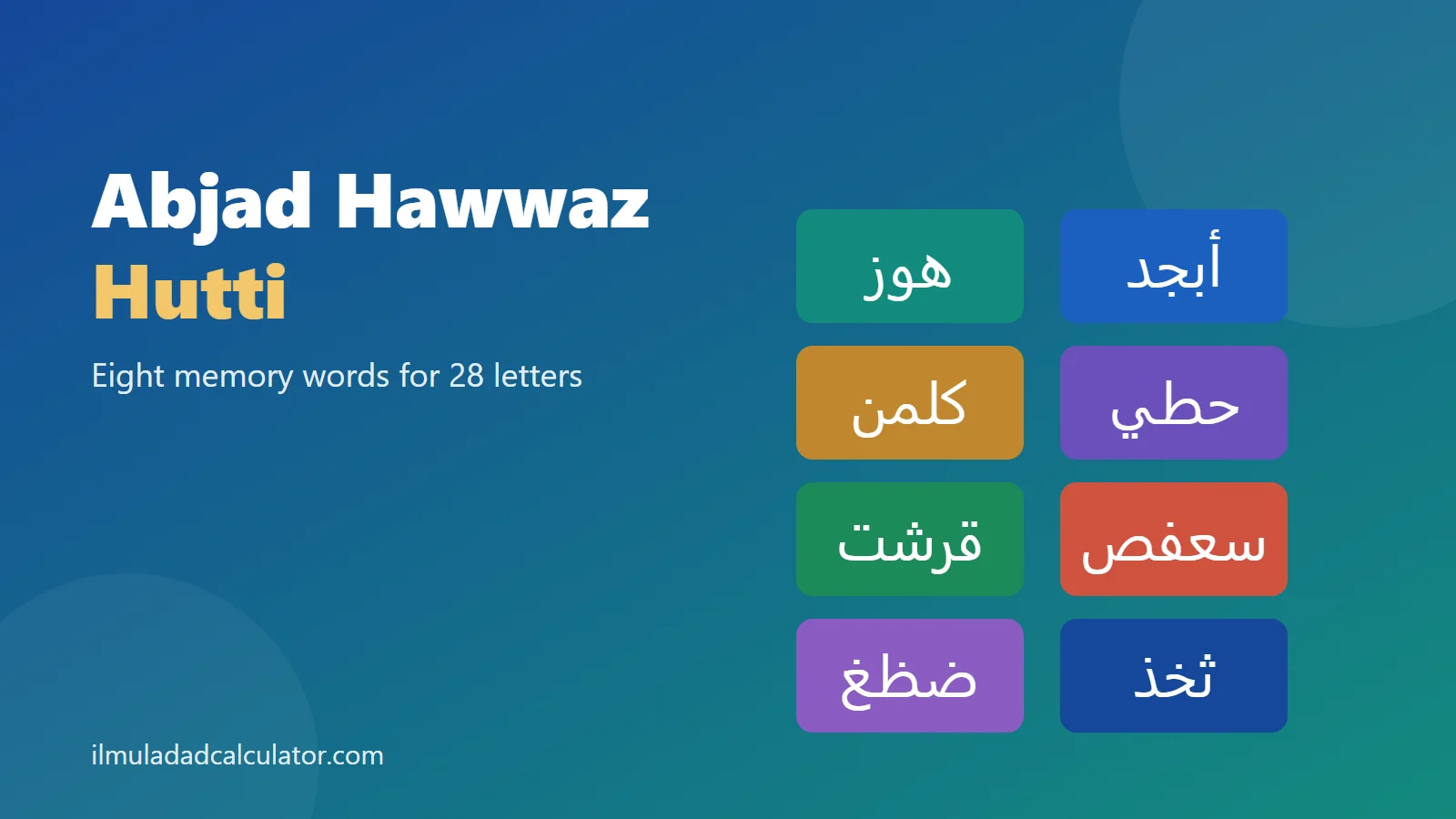
Abjad, hawwaz, hutti, kalaman, sa’fas, qarashat, thakhadh and dazagh are eight memory words. Together they hold all 28 Arabic letters in counting order, from alif (1) to ghayn (1000). Know the words, and you know every letter’s value.
What Are the Eight Memory Words?
Each word strings a few letters together so they can be said aloud. Read as words, they have no everyday meaning. Their job is to fix the order.
| Word | Said as | Letters | Values |
|---|---|---|---|
| أبجد | abjad | ا ب ج د | 1, 2, 3, 4 |
| هوز | hawwaz | ه و ز | 5, 6, 7 |
| حطي | hutti | ح ط ي | 8, 9, 10 |
| كلمن | kalaman | ك ل م ن | 20, 30, 40, 50 |
| سعفص | sa’fas | س ع ف ص | 60, 70, 80, 90 |
| قرشت | qarashat | ق ر ش ت | 100, 200, 300, 400 |
| ثخذ | thakhadh | ث خ ذ | 500, 600, 700 |
| ضظغ | dazagh | ض ظ غ | 800, 900, 1000 |
How Do the Words Encode the Values?
The values come from each letter’s place in the chain of 28. The first nine places count ones, the next nine count tens, and the next nine count hundreds.
The word boundaries do not match these bands. Hutti ends with ي, the first of the tens, while qarashat starts the hundreds with ق.
The last two words, thakhadh and dazagh, hold the six letters worth 500 to 1000. Ghayn, the final letter, stands alone for 1000.
Where Does the Order Come From?
The first six words follow the letter order of older Semitic alphabets, such as Phoenician and Aramaic. Those alphabets had 22 letters and stopped at taw, the ت that ends qarashat at 400.
Arabic letters that the old alphabets lacked were placed after them, and they form thakhadh and dazagh. One slot is a puzzle: the Semitic order had samekh where sin now stands.
No Arabic letter comes from samekh. In the common Mashriqi order, sin fills its place. The letter values page shows all 28 letters in both systems.
How Are the Words Pronounced?
The common reading is abjad, hawwaz, hutti, kalaman, sa’fas, qarashat, thakhadh and dazagh. It is the version most learners meet first.
A fuller reading also appears: abujadin, hawazin, hutiya, kalman, sa’fas, qurishat, thakhudh and dazugh. Both readings carry exactly the same letters.
What Is the Maghribi Version?
The Maghribi order, used in North Africa and al-Andalus, keeps the first four words. Three later words change to sa’fad, qurisat and zaghush.
Six letters move to new places, so their values change as well. The Mashriqi and Maghribi comparison tool shows the effect on any word.
How Can You Use the Words to Find a Value?
Once the words are memorized, any value takes a few seconds to find. Follow these steps:
- Find the memory word that holds the letter.
- Note the letter’s place inside that word.
- Recall the value the word starts from.
- Count up by ones, tens or hundreds to the letter.
What Memory Hook Fits Each Word?
A short hook makes each word easier to recall. Learn the word, its letter count and its value range together.
| Word | Letters | Values | Hook |
|---|---|---|---|
| abjad | 4 | 1 to 4 | The word that names the whole system |
| hawwaz | 3 | 5 to 7 | Carries the ones on to zay |
| hutti | 3 | 8 to 10 | Crosses from the ones into the tens |
| kalaman | 4 | 20 to 50 | Climbs by tens, one letter at a time |
| sa’fas | 4 | 60 to 90 | Closes the tens |
| qarashat | 4 | 100 to 400 | Ends the old 22-letter alphabet |
| thakhadh | 3 | 500 to 700 | Starts the letters Arabic added |
| dazagh | 3 | 800 to 1000 | Ends the chain at the top value |
Say the words in order with their hooks once a day. After a week, test yourself by covering the Values column.
How Do the Words Help You Read Abjad Numerals?
The words let you read numbers written in letters. Each letter gives its value, and you add them all up.
Take غتمو, the Hijri year 1446 written in letters. Each letter sits in a different memory word.
- غ ends dazagh, so it is 1000.
- ت ends qarashat, so it is 400.
- م is the third letter of kalaman, so it is 40.
- و is the second letter of hawwaz, so it is 6.
By custom, the largest value is written first and the smallest last. The system has no zero, so a missing place is simply skipped.
Order matters for thousands. A smaller letter written before ghayn multiplies it, so بغ means 2000. Written the usual way, غب means 1002.
Arabic still uses this order to number lists, as أ, ب, ج. To turn any year into letters, try the number to Abjad tool.
Can You Answer These Practice Questions?
Try each question with the memory words alone. Then open the answer to check your work.
Which memory word holds ر, and what is its value?
It is in qarashat, so its value is 200.
What is the value of ظ?
It is the middle letter of dazagh, so it is worth 900.
What is the total of the Urdu name عمران?
ع 70 + م 40 + ر 200 + ا 1 + ن 50 = 361.
How would you write 365 in abjad letters?
Use ش from qarashat, س from sa’fas and ه from hawwaz: شسه.
What number does ذفو stand for?
ذ 700 + ف 80 + و 6 = 786.
How Can You Practice With Urdu Words?
Urdu words make good practice, because they use the same eight memory words. Letters that Arabic lacks borrow the value of the letter they are built on.
So پ counts like ب, چ like ج and گ like ک. Here is how two Pakistani city names add up:
ک 20 + ر 200 + ا 1 + چ 3 + ی 10 = 234
پ 2 + ش 300 + ا 1 + و 6 + ر 200 = 509
Try your own city or family names next. Check each answer with the Abjad value calculator, and see how many Urdu letters there are.
What Mistakes Do Learners Often Make?
Most mistakes come from letters that look alike. A single dot can change a value by hundreds.
- ح in hutti is 8, but dotted خ in thakhadh is 600.
- ز in hawwaz is 7, but dotted ذ in thakhadh is 700.
- ص in sa’fas is 90, but dotted ض in dazagh is 800.
- ت in qarashat is 400, but ث in thakhadh is 500.
Another mistake is using the Urdu alphabet order, alif, be, pe, te. That order is for dictionaries, not for values.
Last, watch the system. A North African source may use Maghribi values, which change six letters.
To build speed, practice with the Abjad quiz. It includes a seven-day plan for learning the eight words.
New to the subject? Start with what Ilm-ul-Adad is, then come back to the words.
خلاصہ
ابجد، ہوز، حطی، کلمن، سعفص، قرشت، ثخذ اور ضظغ آٹھ یادداشتی الفاظ ہیں جن میں عربی کے اٹھائیس حروف گنتی کی ترتیب میں آتے ہیں۔ یہ الفاظ یاد ہو جائیں تو ہر حرف کی قیمت معلوم ہو جاتی ہے۔ مغربی نظام میں آخری الفاظ میں سے تین بدل جاتے ہیں۔
Sources and Further Reading
- Abjad numerals, Wikipedia. Both readings of the words, the Maghribi version and the samekh question.
- Letter values on this page come from this site’s tested engine. See the methodology.
Frequently Asked Questions
What does the word abjad itself mean?
It is formed from its own four letters: alif, ba, jim and dal. In modern Arabic, abjadiyya means alphabet.
Is this the same order as an Arabic dictionary?
No. Dictionaries use the hija’i order, which groups letters by shape. Only the abjad order gives the values.
Are the same words taught in Urdu and Persian?
Yes. Urdu and Persian learners use the same eight words for the same 28 letters and values.
Do Urdu letters such as پ appear in the words?
No. The extra Urdu and Persian letters are not part of the eight words. Each takes the value of its Arabic base letter.
What is the best way to memorize the eight words?
Short daily practice works better than one long session. Say the words aloud, then test yourself with the quiz.
Are the words written with spaces between letters?
No. Each word is written joined, like a normal Arabic word. The table at the top shows each one in full.
Why does hutti cross from 9 to 10?
The words were made to be easy to say, not to match the value bands. Hutti simply holds the letters in the places 8, 9 and 10.