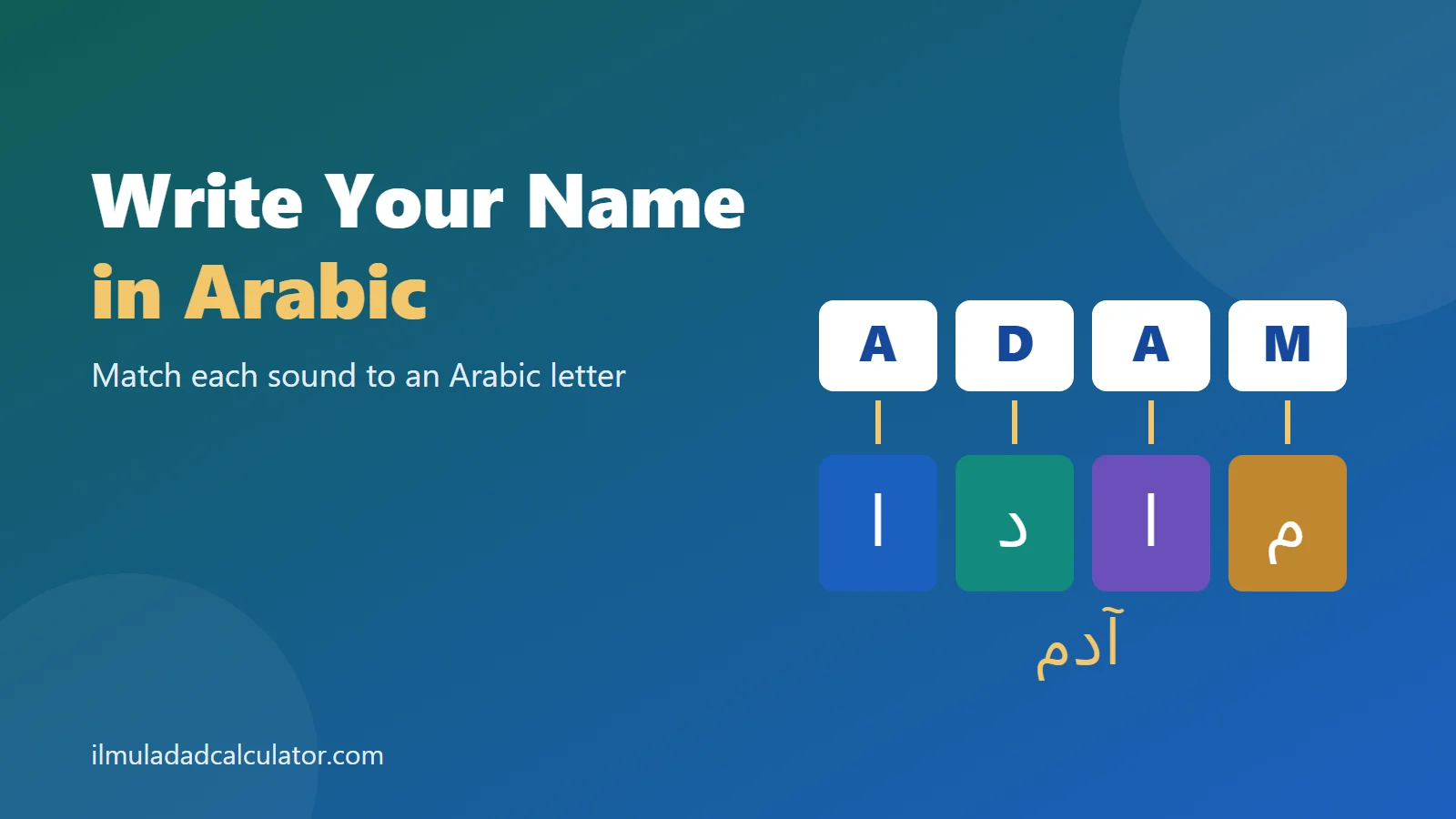
To write your name in Arabic, say it slowly and match each sound to an Arabic letter. Write long vowels with letters and leave most short vowels out. Sounds Arabic lacks, such as p and v, take the closest Arabic letter.
How Do You Write a Name in Arabic, Step by Step?
- Say the name slowly and split it into sounds, not English letters.
- Match each consonant sound to its Arabic letter, using the table below.
- Write long vowels with letters: alif for a, ya for i or e, and waw for u or o.
- End names that finish in -a with ta marbuta (ة) or alif (ا), as the name’s tradition prefers.
- Compare your spelling with a known one, then keep it the same everywhere.
Arabic is written from right to left, and most letters join to the next one. Type the letters in order, and the computer joins them for you.
Which Arabic Letters Match English Sounds?
Most English consonants have a clear partner in Arabic. Two-letter sounds such as sh, th and kh each have a single Arabic letter.
What About Sounds Arabic Does Not Have?
Standard Arabic has no p, v or g. Writers use the closest letter: ب for p, ف for v, and one of several letters for g.
Some writers add extra letters instead, such as پ for p or ڤ for v. These are optional, and the choice depends on the writer’s country.
The g sound shows the most variety. The word golf can be written with jim, ghayn, qaf or kaf, and each choice changes the total.
How Are Vowels Written?
Arabic marks short vowels with small signs that are usually left out. When writing foreign names, Arabic speakers tend to write most vowels as long ones, with letters.
So the a in Adam becomes an alif, and the second vowel of Daniel becomes another alif. This makes the name easier to read without vowel signs.
Gliding vowel sounds take two letters. The sound in Kai takes alif and ya (اي). The sound in now takes alif and waw (او).
How Are Common English Name Endings Written?
English name endings often hide how the Arabic name ends. Follow the sound and a reviewed spelling, not the English letters.
- -ah: The final h in Sarah or Hamzah is silent in English. Both names end in ta marbuta: سارة and حمزة.
- Other -a endings: Some names end in alif maqsura or a plain alif instead. Layla is ليلى, and Sofia is صوفيا.
- -y and -i: A final ee sound takes ya. Ali and Aly are both علي.
- -er: The e in Omer, Bader and Shaker is a short vowel. Arabic writes only the r: عمر, بدر and شاكر.
The last letter can change the total a lot. Ta marbuta counts 5, alif maqsura 10 and alif 1. The guide to the ta marbuta value explains the first one.
How Do You Write a Name That Starts With a Vowel?
In Arabic, a name that starts with a vowel sound begins with alif or with the throat letter ain (ع). The alif often carries a small hamza (أ).
English spelling does not show which letter to use. Usama starts with alif, أسامة, but Umar and Imran start with ain: عمر and عمران.
The choice matters for the total. The English name Amir covers two Arabic names, أمير (251) and عامر (311). Ask which one your family uses.
How Do You Handle Double Letters?
Write a doubled English letter only once in Arabic. The double may show a real doubled sound, or it may be only an English spelling habit.
- A real double: In Ammar, the m sound is held longer. Arabic writes one mim, عمار, and may add a shadda (ّ) above it.
- A spelling habit: Hassan and Farrah have no doubled sound in Arabic. They are written حسن and فرح.
- Pakistani names: Khurram has a real double r. It is still written with one ra, خرم.
The shadda never adds value. عمّار with the mark and عمار without it both give 311.
Should Pakistani Names Use Arabic or Urdu Letters?
Either works, and the total stays the same. Urdu builds on the Arabic letters, and its alphabet has up to 39 or 40 letters.
Urdu adds letters for sounds Arabic lacks, such as پ, ٹ, چ, ڈ and گ. On this site, each one counts as its Arabic base letter.
Urdu also writes a few common letters in its own way. Final ta marbuta often becomes gol he (ہ), and a final ya becomes choti ye (ی).
| Name | Arabic letters | Urdu letters | Total |
|---|---|---|---|
| Fatima | فاطمة | فاطمہ | 135 |
| Ayesha | عائشة | عائشہ | 386 |
| Ali | علي | علی | 110 |
| Karim | كريم | کریم | 270 |
Urdu is usually written in the Nastaliq style, which is more flowing than standard Arabic print. The letters look different, but the characters and the totals match. For the full Urdu letter list, see how many letters Urdu has.
What Do Some Common Names Look Like?
These spellings come from our reviewed list of names. The totals use the Mashriqi system.
| Name | Arabic | Total |
|---|---|---|
| Adam | آدم | 45 |
| Sarah | سارة | 266 |
| Daniel | دانيال | 96 |
| Noah | نوح | 64 |
| Jasmine | ياسمين | 171 |
| Elias | إلياس | 102 |
| Sofia | صوفيا | 187 |
| Layla | ليلى | 80 |
Some names have more than one accepted Arabic spelling. Check yours against the letter values table before you settle on one.
Can You Spell These Names? A Practice Set
Try to write each name in Arabic letters before you open the answer. Each answer gives the reviewed spelling and its Mashriqi total.
How do you write Yousaf?
يوسف, with a total of 156. The ou is a long u, written with waw. The short a is not written.
How do you write Zubair?
زبير, with a total of 219. The ai sound is written with ya.
How do you write Haleema?
حليمة, with a total of 93. The ee is written with ya, and the -a ending takes ta marbuta.
How do you write Taimoor?
تيمور, with a total of 656. The ai takes ya, and the oo takes waw.
How do you write Bushra?
بشرى, with a total of 512. This name ends in alif maqsura, not ta marbuta.
If your spelling differs, compare the two in the value comparison tool. You will see which letter makes the gap.
How Do You Find the Value of Your Arabic Name?
Once you have a spelling, type it into the Ilm-ul-Adad calculator. It shows the total and the value of every letter.
Shortcut: the English Name to Abjad Value calculator does both steps for you. Type your name in English letters, and it suggests the Arabic spelling and adds it up.
Extra letters count as their Arabic base, so پ counts as ب. Two spellings that differ only in such a letter give the same total.
Spelling choices for one name are compared on the page about why Muhammad has many spellings. If two tools disagree on your total, see why calculators give different values.
Sources and Further Reading
- Arabic alphabet, Wikipedia. Long vowels in foreign names, optional letters, and the golf example.
- Urdu alphabet, Wikipedia. The number of Urdu letters, the added letters, the two forms of ye, and the Nastaliq style.
- Name spellings come from our reviewed name list. See the sources and bibliography.
Frequently Asked Questions
Is there one correct Arabic spelling of my name?
Often there is more than one. Pick the spelling your family or community uses, and keep it the same.
What is the difference between ی and ے in Urdu?
Choti ye (ی) writes the long i sound and the consonant y. Bari ye (ے) writes the vowels e and ai. Both count as 10.
Can I mix Arabic and Urdu letters in one name?
You can, but one style looks neater. Pick Arabic or Urdu letters and use them for every part of the name. The total stays the same either way.
Do I need the vowel marks?
No. Names are usually written without them. The marks also have no value in Ilm-ul-Adad.
Why does my name look different when typed?
Arabic letters change shape when they join. The letters are the same, only their forms change.
Can I write a name with a silent letter?
Write the name as it sounds. Silent English letters, such as the h in Sarah, are usually not written.