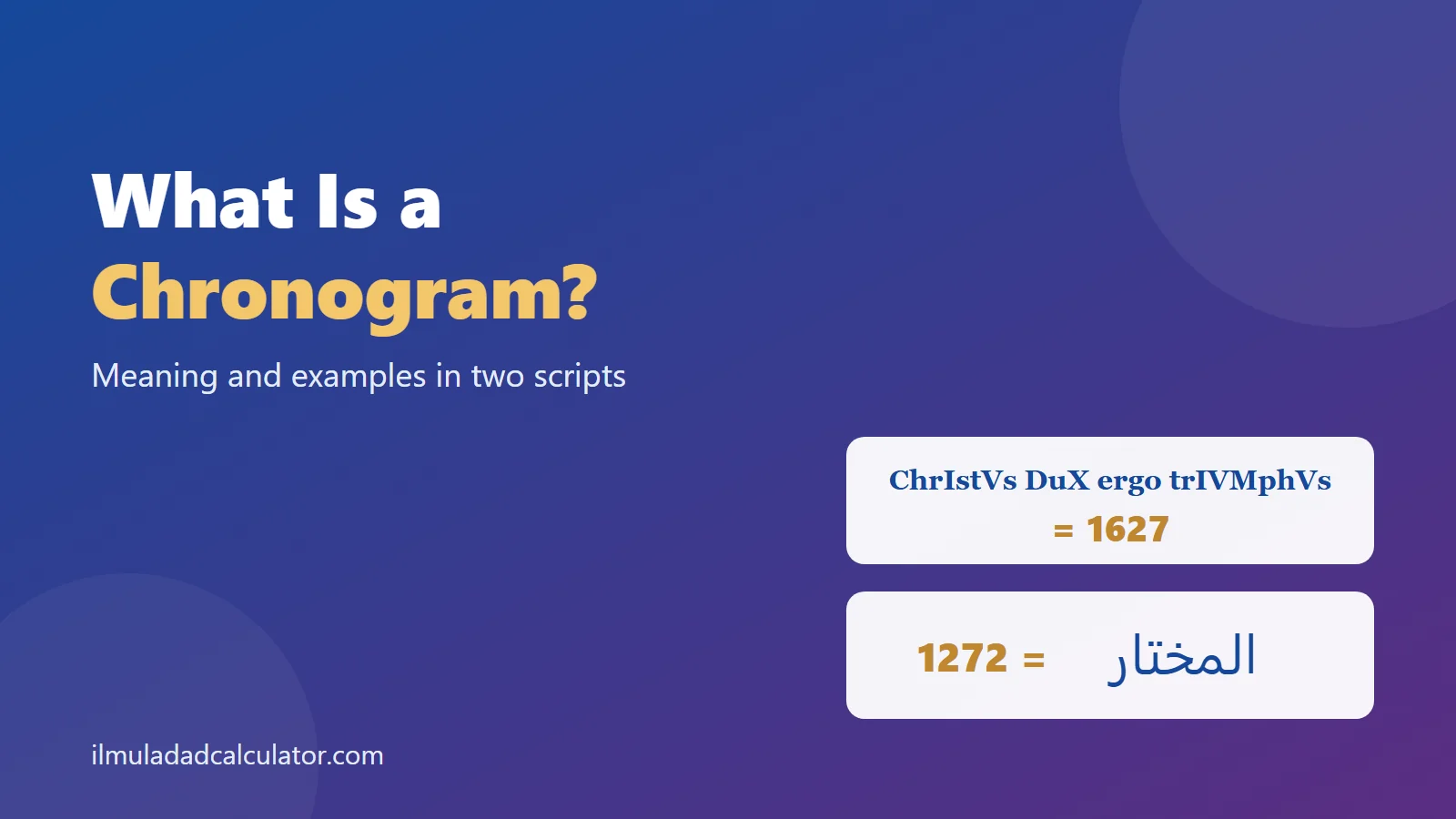
A chronogram is a phrase or inscription that hides a year in its letters. Some or all of the letters stand for numbers, and adding them gives the date. Latin writers used Roman numeral letters, while Arabic, Persian and Urdu writers used abjad letter values.
What Is a Chronogram?
A chronogram is a piece of writing that works twice. You can read it as normal words, and you can also add up its letters to get a year.
The year usually belongs to the event the words describe. A coin carries the year it was struck, and a tomb carries the year of a death.
So the meaning of chronogram is simple: a date written in letters instead of digits. The puzzle is that the date sits inside words that also make sense.
Where Does the Word Chronogram Come From?
The word comes from two Greek roots. Chronos means time, and gramma means letter or something written.
Put together, chronogram means “time writing.” The same chronos appears in English words like chronology and chronicle.
Urdu and Persian have their own name for the art. Writers call it tarikh goi, which means “saying the date.”
How Do You Read a Chronogram Step by Step?
Reading a chronogram is just careful adding. The steps are nearly the same in both traditions.
- Find out which script and number system the writer used.
- Pick out the letters that count. In Latin these are the marked numeral letters, and in Arabic script every letter counts.
- Write the number for each letter you picked.
- Add all the numbers together. The order of the letters does not matter.
- Check the total against the event, and note which calendar it uses.
The last step matters most. A total only proves a chronogram when it matches a real date tied to the words.
Almost any phrase adds up to some number, so a lucky total proves little. Look for proof from outside the words, such as a dated record of the coin, building or birth.
Which Letters Count in a Latin Chronogram?
Only seven Latin letters are Roman numerals. Every other letter in the line is just part of the words.
- M = 1000 and D = 500
- C = 100 and L = 50
- X = 10, V = 5 and I = 1
Writers had to show which of these letters to count. Most printed them as capitals, while others used larger type, dots or lines.
Old Latin had no separate U, so writers used V in its place. That is why many chronograms spell words with V, as in trIVMphVs.
What Is an Example of a Latin Chronogram?
In 1627, King Gustavus Adolphus of Sweden struck a coin with this Latin line: ChrIstVs DuX ergo trIVMphVs. It means “Christ the Leader, so a triumph.”
Gustavus Adolphus was a warrior king, so the line suits a coin from a time of war. That fit between words and date is what makes a good chronogram.
Look closely at the capital letters. Each one is a Roman numeral, and the small letters are ignored.
The nine capitals are C, I, V, D, X, I, V, M and V. Their values add up to 1627, the year on the coin.
More Latin Examples
Latin chronograms appear on coins, monuments and title pages. Here are three more, each checked by adding the capitals.
| Text | Numeral letters | Where it appears | Total |
|---|---|---|---|
| FranCIs GoLDsMIth | CILDMI | Author’s name on the 1652 book Hugo Grotius his Sophompaneas | 1652 |
| SICVLICIDIVM | ICVLICIDIVM | Monument to the 1764 massacre at Madéfalva, in Transylvania | 1764 |
| AMORE MATVRITAS | MMVI | A modern “natural” chronogram, with its numerals already in order | 2006 |
In SICVLICIDIVM, every letter counts except the first S. The word means “murder of the Székelys,” and it names the massacre itself.
What Is an Example of an Arabic-Script Chronogram?
In Arabic script, every letter has a fixed number in the abjad system. Alif is 1, and ghayn is 1000.
The South Asian scholar Ahmad Raza Khan was born in 1856. He took the historical name المختار (al-Mukhtar), because its letters give his birth year.
ا 1 + ل 30 + م 40 + خ 600 + ت 400 + ا 1 + ر 200 = 1272
Each letter is counted as it is written. The two alifs count twice, and the lam of the article al- counts too.
The total, 1272, is a Hijri year. His birth date, 10 Shawwal 1272, falls on 14 June 1856.
A name chosen this way is called a historical name, or tarikhi naam in Urdu. It works like a chronogram for a birth.
Good to know: al-Mukhtar gives 1272 in the Maghribi system too. None of its letters change value between the two systems. Most Urdu and Persian chronograms use Mashriqi values.
How Do the Latin and Arabic Traditions Differ?
Both traditions add letters to reach a year. They differ in which letters count and how readers spot them.
| Feature | Latin (Roman numerals) | Arabic script (abjad) |
|---|---|---|
| Letters that count | Only M, D, C, L, X, V and I | Every letter |
| How they are marked | Capitals, larger type or dots | Not marked; the whole phrase counts |
| Usual calendar | Common Era (AD) | Hijri, sometimes other calendars |
| Letter order | Does not matter; just add | Does not matter; just add |
| Where you find them | Coins, medals, buildings, title pages | Tombs, book titles, names, poems |
Because every Arabic letter counts, Arabic-script chronograms need no special marks. The reader must know which words to count, which the poem usually signals.
Latin chronograms are the opposite. Every word is printed, but only the marked letters are added.
Is a Chronogram the Same as an Acrostic or a Date?
People often mix up chronograms with two other things. Both look similar at first glance but work in different ways.
Chronogram vs Acrostic
An acrostic is a poem whose first letters, read downward, spell a word or name. Nothing is added, so no number comes out.
A chronogram can hide its numbers anywhere in a line. The goal is always a year, not a word.
Chronogram vs Date Stamp
A building may show ANNO MDCXXVII, which is 1627 written openly in Roman numerals. That is a plain date, not a chronogram.
A plain Roman date is read with its usual rules, so IV means 4. A chronogram ignores those rules and simply adds the letters.
Chronogram vs Chronograph
The two words share the Greek root chronos, so they are easy to confuse. A chronograph is a watch or instrument that measures time.
A chronogram is writing, not a device. If you searched for a stopwatch feature, you want the other word.
What Kinds of Chronograms Are There?
Writers sorted Latin chronograms by how tightly the numbers fit the words. Three kinds come up most often.
Marked Chronograms
In a long sentence, only some numeral letters are meant to count. The writer marks them with capitals, larger type, dots or lines.
Pure Chronograms
In a pure chronogram, every word contains at least one numeral letter. No word is just filler.
Natural Chronograms
A natural chronogram goes one step further. Its numerals already appear in the right order, so they read as a correct Roman number.
AMORE MATVRITAS is a modern example. Its numerals give MMVI, which is 2006 in ordinary Roman numerals too.
What Mistakes Do Beginners Make?
Most wrong totals come from a few simple slips. Watch for these when you check a chronogram.
- Counting small letters. In a Latin chronogram, a lowercase i or v does not count.
- Using subtraction. Roman rules say IX is 9, but a chronogram adds I and X to get 11.
- Changing the spelling. In Arabic script, adding or dropping one alif changes the total.
- Mixing calendars. A Hijri total must be converted before you compare it with a Common Era year.
Are Chronograms Found in Other Languages?
Yes. Any script whose letters carry number values can hide a year. Hebrew is the best-known case beyond Latin and Arabic.
Hebrew chronograms appear on gravestones, in poems and in printed books, which were often dated only this way. Like Arabic, Hebrew gives a value to every letter.
The oldest known Hebrew chronogram is in a poem by Al-Harizi from 1205. The oldest known Latin one is dated only five years later.
English chronograms also exist, since English uses the same Latin letters. They follow the Latin rules and count only the marked numerals.
Why Did People Write Chronograms?
A chronogram joins a date to a message. The words praise, mourn or bless, and the numbers record when it happened.
- Coins and medals: many 17th and 18th century coins carry chronograms instead of a plain date.
- Buildings: foundation stones and house fronts recorded the year of building.
- Tombs: gravestones in both traditions gave the year of death.
- Books and names: authors hid the year in a title, and families chose names that gave a birth year.
The art also showed skill. Finding words that fit both the meaning and the number took patience, so a good chronogram earned praise.
Chronograms were especially popular during the Renaissance in Europe. In Urdu and Persian, poets wrote them for centuries, as the chronogram poetry guide shows.
How Can You Check a Chronogram Yourself?
For Latin, write down each capital numeral letter and add it up. A pencil and the seven values are all you need.
Group the letters by size to make the adding easy. Count the M’s first, then the D’s and C’s, and finish with the small letters.
For Arabic, Persian or Urdu, paste the phrase into the chronogram decoder. It adds each letter and converts the Hijri year to the Common Era.
The Arabic letter values page lists all 28 values if you want to add by hand. The guide to Ilm-ul-Adad explains where those values come from.
Copy the spelling exactly when you check. One extra or missing letter changes the total, so the year will not match.
خلاصہ
کرونوگرام ایسا جملہ یا کتبہ ہے جس کے حروف جمع کرنے سے کوئی سال نکلتا ہے۔ لاطینی میں صرف رومی ہندسوں والے بڑے حروف گنے جاتے ہیں، جبکہ عربی، فارسی اور اردو میں ہر حرف کی ابجد قیمت شمار ہوتی ہے۔ اردو میں اس فن کو تاریخ گوئی کہتے ہیں، اور «المختار» جیسا تاریخی نام اس کی سادہ مثال ہے، جس سے ۱۲۷۲ ہجری نکلتا ہے۔
Sources and Further Reading
- Chronogram, Wikipedia. Definition, Greek roots, Hebrew uses, the 1627 coin, the 1652 and 1764 examples, and al-Mukhtar.
- Chronogram, New World Encyclopedia. Marked letters, natural chronograms and Renaissance use.
- Chronogram year notation, Coins Japan. How capital letters date 17th and 18th century coins.
- Ahmed Raza Khan Barelvi, Wikipedia. Birth date and the historical name al-Mukhtar.
- Abjad values come from this site’s tested engine. See the methodology.
Frequently Asked Questions
What is a chronogram in simple words?
It is a phrase whose letters, read as numbers and added together, give a year.
Is a chronogram the same as tarikh goi?
Tarikh goi is the Urdu and Persian name for the chronogram. It uses abjad letter values.
Why are some letters capitalized in Latin chronograms?
The capitals mark the letters that count as Roman numerals. Small letters are ignored.
Does a chronogram follow Roman numeral rules like IV for 4?
No. In a chronogram, every marked letter is simply added, so I and V give 6.
Can I make my own chronogram?
Yes. Choose a year, then search for words whose letters add up to it.