For about two centuries, Urdu poets marked births, deaths and new books with a chronogram. A chosen phrase adds up, letter by letter, to the year of the event.
This page traces the tradition from its Persian roots to Delhi and Lucknow. It ends with six examples checked letter by letter.
Where Did the Urdu Chronogram Come From?
The Urdu chronogram grew out of Persian poetry. Persian poets were writing dates in verse long before Urdu became a literary language. The chronogram hub shows a famous Persian case from the 14th century.
Early Urdu poets were trained in Persian first. They brought the habit with them. For a long time, they wrote many chronograms in Persian, even for Urdu poets.
Slowly the Urdu line took its place beside the Persian one. By the late 18th century, a full Urdu hemistich could carry a date, as Dard’s example below shows.
What Is Ab-e Hayat and Why Does It Matter Here?
Our main witness is Ab-e Hayat, a history of Urdu poetry by Muhammad Husain Azad. It was first published in Lahore in 1880.
Azad recorded dozens of chronograms while telling the lives of the poets. He also noted who was good at them and who did not care for them.
Historians treat some of his stories with caution. So this page keeps only the dates that the letters themselves confirm.
Which Urdu Poets Were Known for Chronograms?
Nearly every classical poet wrote a few chronograms. A handful became famous for them, in both of the great centers of Urdu poetry.
Poets of Delhi
- Sauda (died 1781) wrote chronograms that Azad called precisely calculated and well placed.
- Momin (died 1852) used adding and subtracting so cleverly that Azad counted it a beauty, not a fault.
- Zauq (died 1854) wrote many chronograms, most of them at the request of the king, Bahadur Shah Zafar.
- Ghalib (died 1869) wrote few chronograms in Urdu, but his own death date became a famous story.
Poets of Lucknow
- Nasikh (died 1838) filled the end of his collection with chronograms. Azad says he worked on them day and night.
- Rashk, a pupil of Nasikh, was said to hold a near monopoly on composing them.
- Karamat Ali Azhar wrote the chronograms printed in many Lucknow books of his day.
Not everyone joined in. Azad notes that Mir Taqi Mir, the great ghazal poet, seems to have had no interest in composing chronograms.
What Occasions Did Urdu Chronograms Mark?
The occasions were the moments a family, a patron or a town wished to remember. Ab-e Hayat records all of the following.
- Deaths. This was the most common use. When Zauq died, Delhi’s Urdu newspaper printed new chronograms for him every week for a year.
- Births. Shah Hatim said his own name held his birth year.
- Books. A writer finishing an anthology might ask a friend for a chronogram on the spot.
- Buildings. Patrons asked poets for chronograms when a new house or hall was built.
- Personal events. Zauq wrote one for the day he gave up bad habits, at age 36.
How Is the Year Signaled in an Urdu Verse?
Readers need to know which words to count. Urdu poets gave clear signals, usually in the line just before the date.
- The word تاریخ (tarikh). It means date, and it often appears as “he said the tarikh.”
- The phrase مصرع تاریخ (misra-e-tarikh). It names the hemistich that carries the date.
- The word سال (sal). A line may ask “in which year?”, and the next line answers.
- A command to speak. Words like “say” point to the phrase that follows.
Sometimes the whole hemistich is the date, with no cue inside it. Then the heading or the story around the poem tells the reader to count.
The tarikh goi guide explains the full anatomy of a chronogram poem. Here we look at the examples themselves.
Which Famous Urdu Chronograms Can We Check?
The table lists six chronograms from Urdu literary history. Each total comes from our engine, using Mashriqi values and the site’s Urdu letter rules.
| Phrase | By | Occasion | Total | Common Era |
|---|---|---|---|---|
| ظہور | Shah Hatim | Own birth | 1111 AH | 1699 to 1700 |
| حیف دنیا سے سدھارا وہ خدا کا محبوب | A disciple of Dard | Death of Khwaja Mir Dard | 1199 AH | 1784 to 1785 |
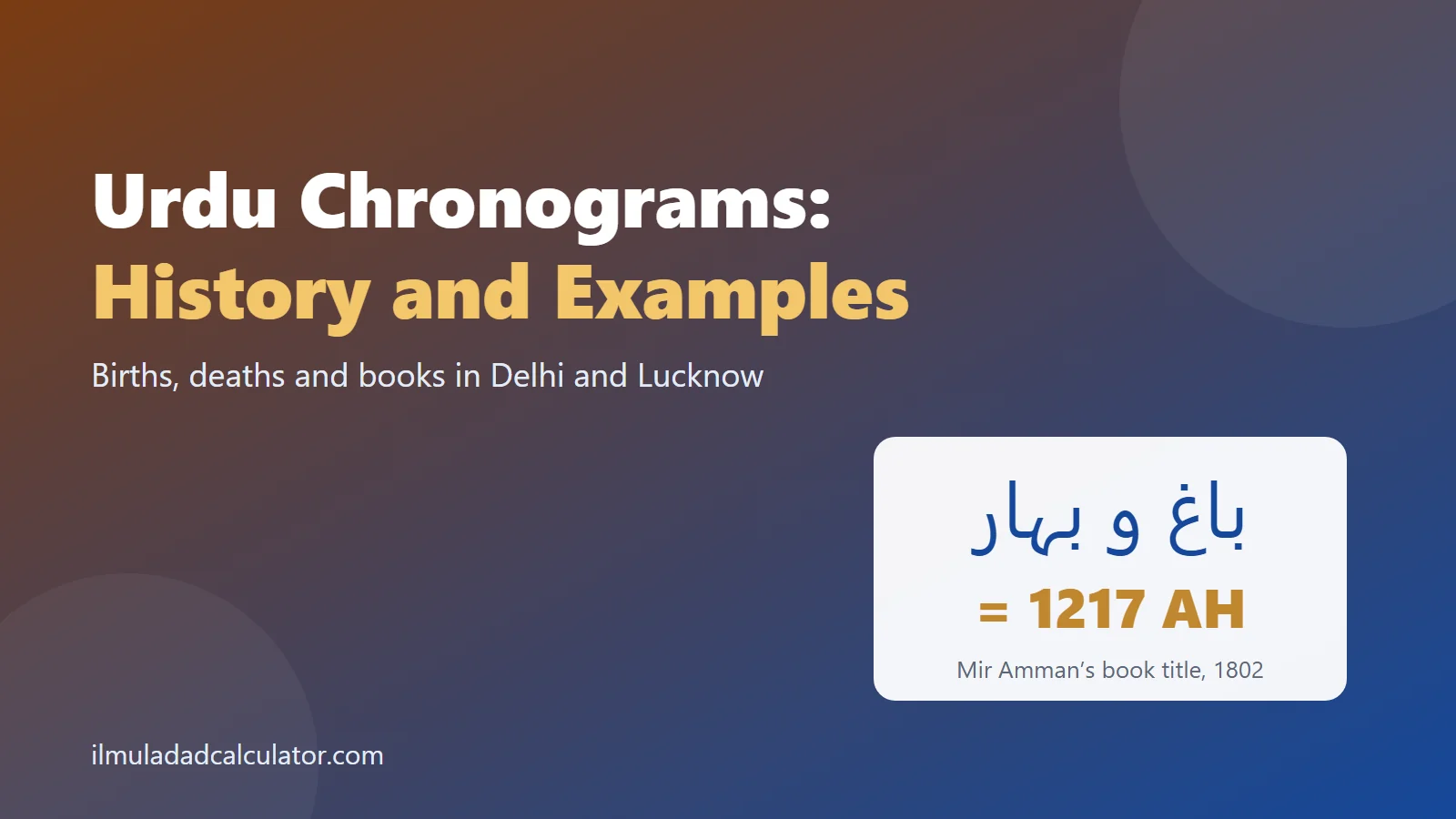
| باغ و بہار | Mir Amman | Completion of a book | 1217 AH | 1802 to 1803 |
| چراغ گل | A pupil of Shah Naseer | Death of Shah Naseer | 1254 AH | 1838 to 1839 |
| دست و بازو بشکست | Momin | His own fall from a roof | 1268 AH | 1851 to 1852 |
| آہ غالب بمرد | Muhammad Husain Azad | Death of Ghalib | 1285 AH | 1868 to 1869 |
Every total equals the Hijri year that the source gives. None of the six needs an added or subtracted word.
Shah Hatim’s Birth
Shah Hatim was an early Delhi poet whose full name was Zahur ud-Din. He liked to say that ظہور (zahur, appearance) was the chronogram of his birth.
The four letters give 1111, which is 1699 to 1700 CE. His own name carried his birth year.
Khwaja Mir Dard’s Death
The Sufi poet Mir Dard died in Delhi in 1199 AH. A devoted disciple wrote a whole Urdu hemistich as the date.
The line says that the beloved of God has left the world, alas. It mourns him and records the year at once.
Spelling matters: the word سدھارا has a do-chashmi he. Counted as 5, the line gives 1199, and without it 1194. Our Urdu letters guide explains this rule.
The Title Bagh o Bahar
Mir Amman finished his famous prose tale at Fort William College, Calcutta. He named it باغ و بہار, “Garden and Spring.”
An editor’s note in the classic English edition explains the choice. The letters were chosen to total 1217, the year the book was finished.
Shah Naseer’s Death
Shah Naseer was a Delhi master who died far from home in Hyderabad. A pupil found the date in two short words, چراغ گل, “the lamp is out.”
The image of a lamp going out is a classic picture of death. Its letters give 1254, counting گ as ک.
Momin’s Fall
Momin fell from the roof of his house and hurt himself badly. He wrote the chronogram of his own fall: دست و بازو بشکست, “arm and hand are broken.”
The phrase gives 1268. Momin died about five months later, on 24 Rajab 1268 AH, in the same Hijri year.
What Happened With Ghalib’s Own Chronogram?
About twenty years before his death, Ghalib found a phrase for his own death date. He liked it so much that he put it into a Persian verse.
The date phrase is غالب مرد, “Ghalib died.” It gives 1277, a year when a terrible epidemic struck Delhi.
Ghalib survived that year and lived until 1285 AH. Azad then wrote his own Persian chronogram for the real date.
Azad’s phrase adds a sigh and one letter. These eight extra points carry the date from 1277 to 1285.
What Made an Urdu Chronogram Admired?
Any patient person can find letters that add up to a year. Critics in Delhi and Lucknow asked for much more than that.
- Fit with the event. A death line had to sound like grief, as Dard’s line does.
- Brevity. Two words, like Shah Naseer’s lamp, were prized above a long and clumsy phrase.
- No adjustment. A phrase that hit the year exactly ranked above one that needed a trick.
- Meter. The best date phrases also fit the rhythm of the verse.
- Speed. Poets won praise for finding a chronogram on the spot, in the middle of a conversation.
Azad gives an example of the last two qualities together. When the poet Mazhar Jan-e Janan was killed in 1781, many people wrote chronograms.
Azad ranked one by Minnat above the rest. Its Arabic words came from a well-known saying, and by chance they were also metrical.
What Do These Examples Teach a Modern Reader?
The six examples are small, but together they show how the tradition worked in practice. Three lessons stand out.
First, the language could be Urdu, Persian or Arabic, even inside one Urdu poet’s life story. Second, the letter rules matter, since one do-chashmi he or one gaf can change the total.
Third, the year is almost always Hijri. A reader who compares a total with a Common Era date will think the chronogram is wrong.
Did Poets Allow Adding or Subtracting?
Strict critics did not like it. Azad writes that adding or subtracting a value was always counted as a fault in a chronogram.
He also gives a rule of the art: an addition or subtraction should be no more than nine. Larger tricks, he says, turn the chronogram into a puzzle.
This is why the best-loved Urdu chronograms, like the six above, need no adjustment at all.
How Can You Check an Urdu Chronogram Yourself?
Copy the date phrase exactly as printed, with every letter in place. Then paste it into the chronogram decoder.
Compare the total with the Hijri year in your source. When a single word changes, use the phrase value calculator to see which letter made the difference.
Our methodology page explains how the engine counts Urdu letters. These checks are arithmetic only and make no predictions.
خلاصہ
اردو میں تاریخ گوئی فارسی روایت سے آئی اور دہلی و لکھنؤ کے شعراء نے اسے خوب نبھایا۔ پیدائش، وفات، کتاب کی تکمیل اور عمارت کی تعمیر جیسے مواقع پر تاریخ کہی جاتی تھی۔ خواجہ میر درد کی وفات کا مصرع «حیف دنیا سے سدھارا وہ خدا کا محبوب» ۱۱۹۹ ہجری دیتا ہے، اور میر امن کی کتاب «باغ و بہار» کا نام ۱۲۱۷ ہجری۔ اس صفحے کی تمام مثالیں آبِ حیات اور دیگر معتبر حوالوں سے لی گئی ہیں اور ہر ایک کا حساب جانچا گیا ہے۔
Sources and Further Reading
- Ab-e Hayat, Muhammad Husain Azad (1880), Urdu text on Wikisource. Urdu wording of the Dard, Hatim, Shah Naseer, Momin and Ghalib chronograms.
- Ab-e Hayat: Shaping the Canon of Urdu Poetry, translated by Frances W. Pritchett with Shamsur Rahman Faruqi.
- Earlier chapters used: Hatim, Mazhar, Dard, Sauda, and Mir.
- Later chapters used: Nasikh and Rashk, Shah Naseer, Momin, Zauq, Zauq’s chronograms, Ghalib and Ghalib’s own date.
- Bagh o Bahar, Mir Amman’s introduction, with the editor’s note on the title and the year 1217.
- Momin Khan Momin, Wikipedia. Date of death, 24 Rajab 1268 AH.
- Tarikh Nigari: Numbers Speaking Through Words, Rekhta blog.
- Chronogram, Wikipedia.
Frequently Asked Questions
Who were the best-known Urdu chronogram poets?
Nasikh and Rashk in Lucknow, and Sauda, Momin and Zauq in Delhi, were especially known for them.
Were Urdu poets’ chronograms always in Urdu?
No. Many were in Persian, even for Urdu poets, such as Azad’s chronogram for Ghalib.
Is Bagh o Bahar really a chronogram?
Yes. The letters of the title add up to 1217, the Hijri year the book was finished.
Which calendar do these examples use?
All six use the Hijri calendar. The table gives the matching Common Era years.
Where can I read more Urdu chronograms?
Ab-e Hayat records many of them. Rekhta also holds whole books of chronogram poems.