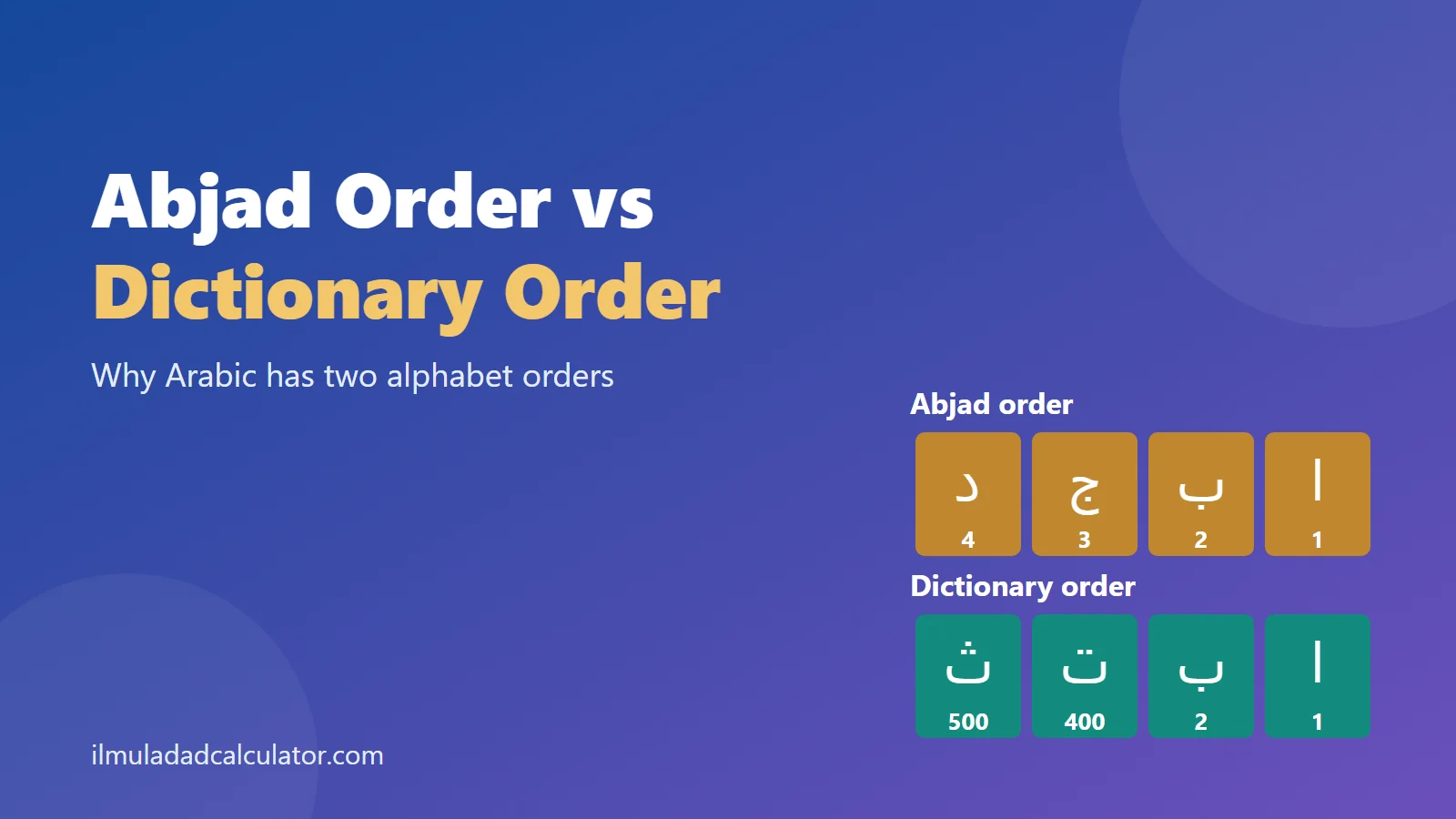
Arabic has two alphabet orders. The abjad order (ا ب ج د) is the old counting order, and it carries the letter values. The hija’i order (ا ب ت ث) is the everyday alphabetical order, grouped by letter shape.
Why Does Arabic Have Two Alphabet Orders?
The abjad order came first. Arabic took it from older Semitic alphabets, where each letter also stood for a number.
The hija’i order came later, as a teaching tool. It puts letters with the same base shape side by side, so learners can tell them apart by their dots.
Both orders use the same 28 letters. Only the sequence changes, and only one sequence gives the values.
How Do the Two Orders Compare at a Glance?
The quick table below sets the two orders side by side. The details follow in the sections after it.
| Feature | Abjad order | Hija’i order |
|---|---|---|
| Starts with | ا ب ج د | ا ب ت ث |
| Ends with | ض ظ غ | ه و ي |
| Based on | The old Semitic sequence | Shared letter shapes |
| Letter values | Yes, 1 to 1000 | None |
| Main use today | List numbering and Ilm-ul-Adad | Dictionaries, schools and indexes |
| Memory aid | Eight memory words | Shape families |
What Is the Abjad Order?
The abjad order runs ا ب ج د ه و ز ح ط ي and on to غ. It follows the old Semitic sequence, which is why it looks like Hebrew and Greek alphabet orders.
Each place in this order has a fixed value. The first nine letters count 1 to 9. The next nine count 10 to 90, and the nine after that count 100 to 900.
The last letter, غ, stands for 1000. Learners recall the whole sequence with eight memory words, explained on the abjad hawwaz hutti page.
What Is the Hija’i Order?
The hija’i order is the one taught in schools today. It starts ا ب ت ث ج ح خ and ends with ه و ي.
The name comes from hija’, the spelling out of letters. The same order is also called alifba’i, after its first two letters.
How Do the Shape Families Work?
Early Arabic writing used one base shape for several letters. For example, ب, ت and ث share one shape and differ only in their dots.
The hija’i order keeps each family together. That makes the alphabet easier to learn and words easier to find in a list.
- Three-letter families: ب ت ث and ج ح خ.
- Two-letter families: د ذ, ر ز, س ش, ص ض, ط ظ and ع غ.
- A looser pair: ف ق, which share a rounded head.
- Letters with a shape of their own: ا, ك, ل, م, ن, ه, و and ي.
Who Created the Hija’i Order?
Tradition credits the shape order to Nasr ibn Asim al-Laythi, a grammarian of Basra who died around 708 or 709. Some accounts also name Yahya ibn Ya’mar, a fellow Basran grammarian who worked with him.
Both men are known for the system of dots that tells look-alike letters apart. Grouping those letters by shape follows naturally from that work.
This places the change in the Umayyad period, around the late 7th century. The exact details are not certain, so treat the names as a strong tradition rather than a settled fact.
For the longer story of the old order and its numbers, see the history of letter values.
How Do the Two Orders Line Up Letter by Letter?
The figure joins each letter to its place in both orders. Only ا and ب keep the same place; every other letter moves.
The table lists the letters in dictionary order. It gives each letter’s place in both orders and its abjad value.
| Hija’i place | Letter | Name | Abjad place | Abjad value |
|---|---|---|---|---|
| 1 | ا | Alif | 1 | 1 |
| 2 | ب | Ba | 2 | 2 |
| 3 | ت | Ta | 22 | 400 |
| 4 | ث | Tha | 23 | 500 |
| 5 | ج | Jim | 3 | 3 |
| 6 | ح | Ha (Hooti) | 8 | 8 |
| 7 | خ | Kha | 24 | 600 |
| 8 | د | Dal | 4 | 4 |
| 9 | ذ | Dhal | 25 | 700 |
| 10 | ر | Ra | 20 | 200 |
| 11 | ز | Zay | 7 | 7 |
| 12 | س | Sin | 15 | 60 |
| 13 | ش | Shin | 21 | 300 |
| 14 | ص | Sad | 18 | 90 |
| 15 | ض | Dad | 26 | 800 |
| 16 | ط | Ṭa | 9 | 9 |
| 17 | ظ | Za | 27 | 900 |
| 18 | ع | Ayn | 16 | 70 |
| 19 | غ | Ghayn | 28 | 1000 |
| 20 | ف | Fa | 17 | 80 |
| 21 | ق | Qaf | 19 | 100 |
| 22 | ك | Kaf | 11 | 20 |
| 23 | ل | Lam | 12 | 30 |
| 24 | م | Mim | 13 | 40 |
| 25 | ن | Nun | 14 | 50 |
| 26 | ه | Ha | 5 | 5 |
| 27 | و | Waw | 6 | 6 |
| 28 | ي | Ya | 10 | 10 |
How Far Do the Letters Move?
Some letters travel a long way between the two orders. Letter ي is 10th in the abjad order but last in the dictionary.
Others barely move. Letter ج drops from third to fifth, and د drops from fourth to eighth.
Notice how the value tracks the abjad place, not the hija’i place. Letter ت is third in the dictionary but 22nd in the abjad order, so it is worth 400.
What Is the Maghribi Version of Each Order?
North Africa and al-Andalus used their own versions of both orders. They are known as Maghribi, or Western.
The Maghribi Abjad Order
The Maghribi abjad order keeps the first part of the Eastern one. It changes the place of six letters, so their values change too.
ا ب ج د ه و ز ح ط ي ك ل م ن ص ع ف ض ق ر س ت ث خ ذ ظ غ ش
In this order ش comes last and is worth 1000. The letter values page shows both value sets side by side.
The Maghribi Hija’i Order
The Maghribi dictionary order also keeps shape families together, but in a different sequence. It is now seldom used.
ا ب ت ث ج ح خ د ذ ر ز ط ظ ك ل م ن ص ض ع غ ف ق س ش ه و ي
Here ط ظ come straight after ر ز. The pairs ص ض and س ش move toward the end, after ن and ق.
These Western orders appear mainly in older North African books. Modern schools across the Arab world teach the Eastern hija’i order.
Why Did the Old Abjad Order Survive?
The hija’i order won for teaching and sorting. Yet the abjad order never disappeared, because it was tied to numbers.
For centuries, writers used letters to mark numbers, dates and page counts. Changing the sequence would have changed every value, so the old order stayed in use for counting.
Poets also used it to hide dates inside verses. You can read how that works on the chronograms page.
What Do the Two Orders Have in Common?
The two orders are not two alphabets. They are two ways of listing one set of 28 letters.
Each letter keeps its name, its sound and its shape in both orders. A word is spelled the same way whichever order you learned first.
Both orders also begin with ا and ب. That shared start is why many people do not notice that the orders differ until the third letter.
How Does the Hija’i Order Help You Find Words?
Shape grouping pays off when you search a long list. If you know the base shape, you already know roughly where the letter sits.
Many Arabic dictionaries list words under their root letters, such as ك ت ب for words about writing. The roots are then sorted in hija’i order, letter by letter.
Urdu dictionaries work in a similar way, but with the full Urdu alphabet. Letters such as پ and ٹ sit next to the Arabic letters they resemble.
Where Is Each Order Used Today?
Both orders are still alive, but they do different jobs. Here is where you will meet each one.
- Dictionaries and lists of names use the hija’i order. So do phone books, class lists and indexes.
- School primers teach the hija’i order first. Urdu primers use an expanded form of it, starting ا ب پ ت.
- Numbered points in Arabic use the abjad order. Lists run أ, ب, ج, د, like A, B, C, D in English.
- Ilm-ul-Adad uses the abjad order, because the values come from it. Every name or word total depends on it.
The Urdu alphabet adds its own letters to the dictionary order. See how many letters the Urdu alphabet has for the full list.
Which Order Carries the Abjad Values?
Only the abjad order carries values. Letters in the hija’i order are never used as numbers.
The reason is simple. The values were tied to the old places long before the shape order existed. The new order did not move them.
Key point: a letter’s place in the dictionary is not its value. Always read values from the abjad order or a value chart.
Take the word قلم, meaning pen. Counting its dictionary places gives 21 + 23 + 24 = 68, which is wrong.
Using the abjad values gives the right total:
ق 100 + ل 30 + م 40 = 170
What Mistakes Do People Make With the Two Orders?
Most mistakes come from mixing the two orders. These are the ones that come up most often.
- Using the school order for values. Someone who learned ا ب ت ث may think ت is 3. Its value is 400.
- Assuming the last letter is the biggest. In the dictionary, ي comes last. In the abjad order it is worth only 10.
- Numbering lists with dictionary letters. An Arabic list goes أ, ب, ج, not أ, ب, ت.
- Mixing Eastern and Maghribi charts. A North African chart may place six letters differently. Check the system before you add.
How Should Teachers Introduce the Two Orders?
Children in Pakistan learn the Urdu alphabet first, in its dictionary order. That is the right start, since it is the order they need for reading.
The abjad order can come later, as a separate lesson. Present it as a second list with a different purpose, not as a replacement.
A short side-by-side chart works well for this lesson. Point out that the first two letters match, then show where the orders split.
How Can You Check a Letter’s Value Quickly?
You do not need to memorize both orders at once. Follow these steps whenever you are unsure:
- Find the letter in the abjad sequence, not the school alphabet.
- Note its place in that sequence.
- Turn the place into a value. Places 1 to 9 are ones, 10 to 18 are tens, and 19 to 27 are hundreds. Place 28 is 1000.
- Confirm the result with a chart or the Abjad value calculator.
How Can You Practice Both Orders?
A printed chart helps you see both sequences at a glance. The printable Abjad chart has an “Abjad order or dictionary order” option, so you can print one of each.
Another good drill is to write both orders in two columns from memory. Then draw a line from each letter to its partner, as in the figure above.
To test your recall of the values, try the Abjad quiz. New to the subject? Start with what Ilm-ul-Adad is.
خلاصہ
عربی حروف کی دو ترتیبیں ہیں۔ ابجدی ترتیب (ا ب ج د) پرانی گنتی والی ترتیب ہے اور حروف کی عددی قیمتیں اسی سے نکلتی ہیں۔ ہجائی ترتیب (ا ب ت ث) لغت اور اسکول کی ترتیب ہے، جس میں ملتی جلتی شکل والے حروف ساتھ رکھے گئے ہیں۔ روایت کے مطابق یہ ترتیب اموی دور میں نصر بن عاصم سے منسوب ہے۔ علم الاعداد میں ہمیشہ ابجدی ترتیب ہی استعمال ہوتی ہے۔
Sources and Further Reading
- Arabic alphabet, Wikipedia. Both orders, shape grouping, and the Maghribi abjadi and hija’i sequences.
- Alphabetical order, Wikipedia. Credits the hija’i order to Nasr ibn Asim al-Laythi and describes ordering by base shape.
- Nasr ibn ’Asim al-Laythi, Wikipedia. His dates, Basra, and the dot system with Yahya ibn Ya’mar.
- History of the Arabic alphabet, Wikipedia. Grammarians regrouping letters by shape for teaching.
- Abjad numerals, Wikipedia. Hija’i letters not used as numerals, and list numbering with أ ب ج.
- Letter values on this page come from this site’s tested engine. See the methodology.
Frequently Asked Questions
Is the abjad order still used today?
Yes. It numbers points in Arabic lists, and Ilm-ul-Adad uses it for all letter values.
Do hija’i letters have number values?
No. The hija’i order is only for sorting and teaching. Values always follow the abjad order.
Is the Urdu alphabet order the same as the hija’i order?
It is based on it. Urdu adds letters such as پ, ٹ and ڈ next to the Arabic letters they resemble.
Why do alif and ba keep the same place?
Both orders happen to start with them. From the third letter on, the two orders part.
Which order should I learn first?
Learn the hija’i order for reading. Learn the abjad order when you want to work out letter values.