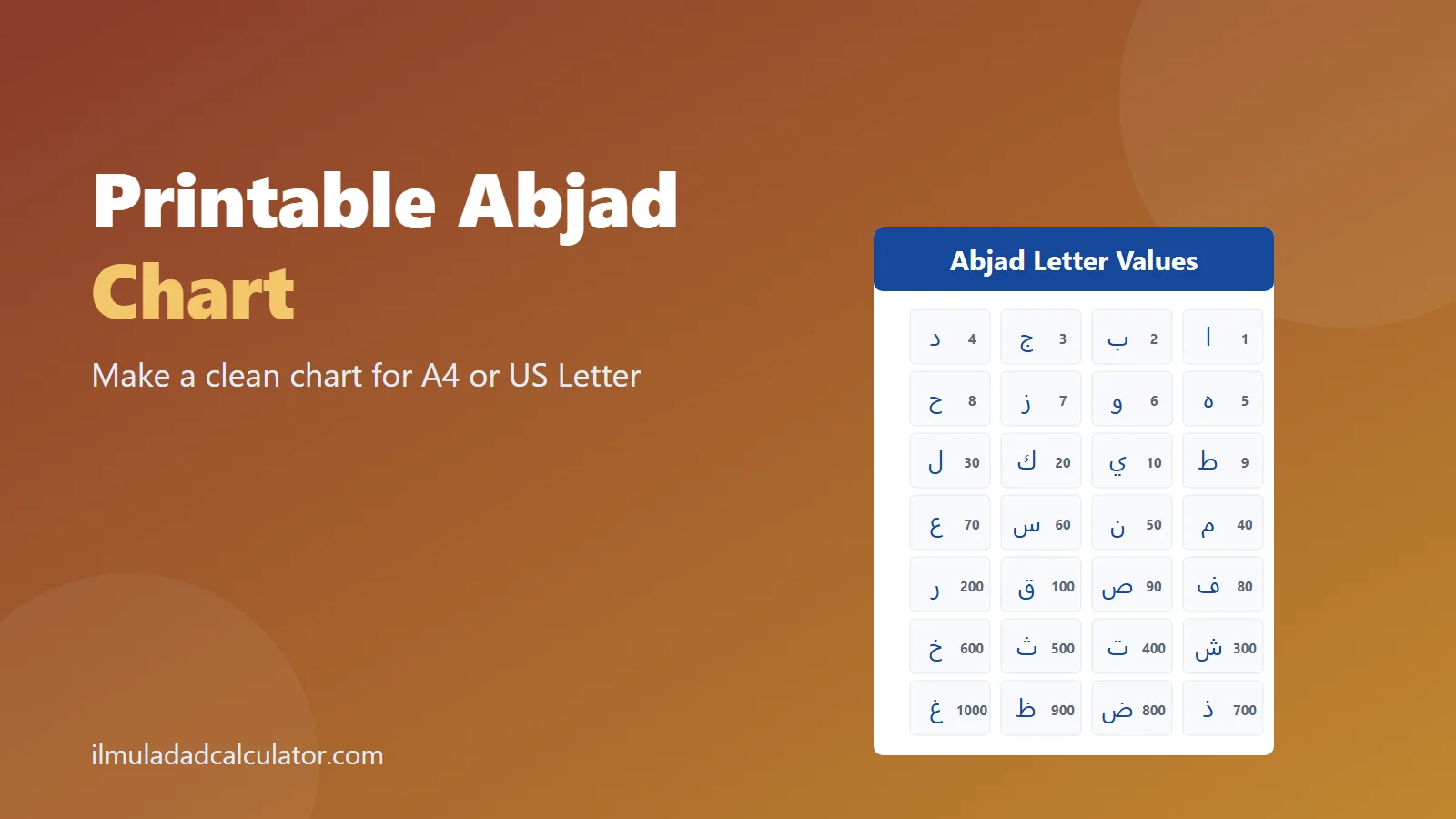
Make a clean, printable chart of the Abjad letter values. Choose the system, the letter order, the paper size and whether to add Urdu letters. Then print it or save it as a PDF.
How to Make Your Chart
- Choose the values: Mashriqi, Maghribi or both.
- Choose the letter order.
- Pick A4 or US Letter paper.
- Type your own title if you like.
- Press Print chart, then print or choose Save as PDF.
Which Options to Choose
Abjad Order or Dictionary Order?
Abjad order lists the letters by value, so the pattern of units, tens and hundreds is easy to see. It is best for learning.
Dictionary order follows the alphabet students already know. It is best for looking up a letter quickly.
One System or Both?
Choose Mashriqi for general use, because it is the common standard. Choose both systems for research, and the six letters that differ are marked.
Urdu and Persian Letters
Turn these on for Urdu or Persian learners. Each extra letter is shown with the Arabic letter it counts as.
Using the Chart
Pin the chart where you study or teach. Learners can check each letter while they add up a name.
Teachers can print one chart per pupil for tests and keep a large copy on the wall.
Printing Tips
- Allow pop-ups for this site, because the chart opens in a new window.
- In the print window, set the margins to Default and the scale to 100 percent.
- Turn on background graphics to keep the marked Maghribi letters.
To practice the values, take the Abjad Quiz. For written exercises, use the Worksheet Generator.
How to Read the Chart
The chart follows a simple pattern. The first nine letters count 1 to 9. The next nine count 10 to 90, and the next nine count 100 to 900.
The last letter, غ, stands alone at 1000. Once you see the four bands, you can find any value quickly.
Adding a Word With the Chart
- Write the word in large letters on paper.
- Find each letter on the chart and write its value under it.
- Add the values. The order of the letters does not change the total.
For example, نور is ن 50, و 6 and ر 200, which makes 256.
Ideas for Teachers and Learners
- Color the four bands with highlighters, so the pattern stands out.
- Cover the values with a strip of paper and test yourself one row at a time.
- For a wall poster, choose A3 paper in the print window and pick Fit to page.
- For a pocket card, set the print scale to 50 percent and cut it out.
Frequently Asked Questions
Can I hide the letter names?
Yes. Untick Show letter names, and only the letters and values are printed.
Can I make a chart with only the Maghribi values?
Yes. Choose Maghribi under Values, and every cell shows the Maghribi number.
Can teachers copy the chart for class?
Yes. The values are standard and the chart is free to print for teaching. Please keep the site name at the bottom.
Why does the print window not open?
Your browser may block pop-ups. Allow pop-ups for this site and press Print chart again.
Are the values on the chart verified?
Yes. The chart uses the same letter table as every calculator on this site.
Can I print the chart in black and white?
Yes. The letters and values stay clear in grayscale. Only the color marking of the Maghribi letters is lost.
Author: Shakeel Muzaffar
Reviewer: Moulana Haji Abdul Basit (Islamic Scholar and Mentor)