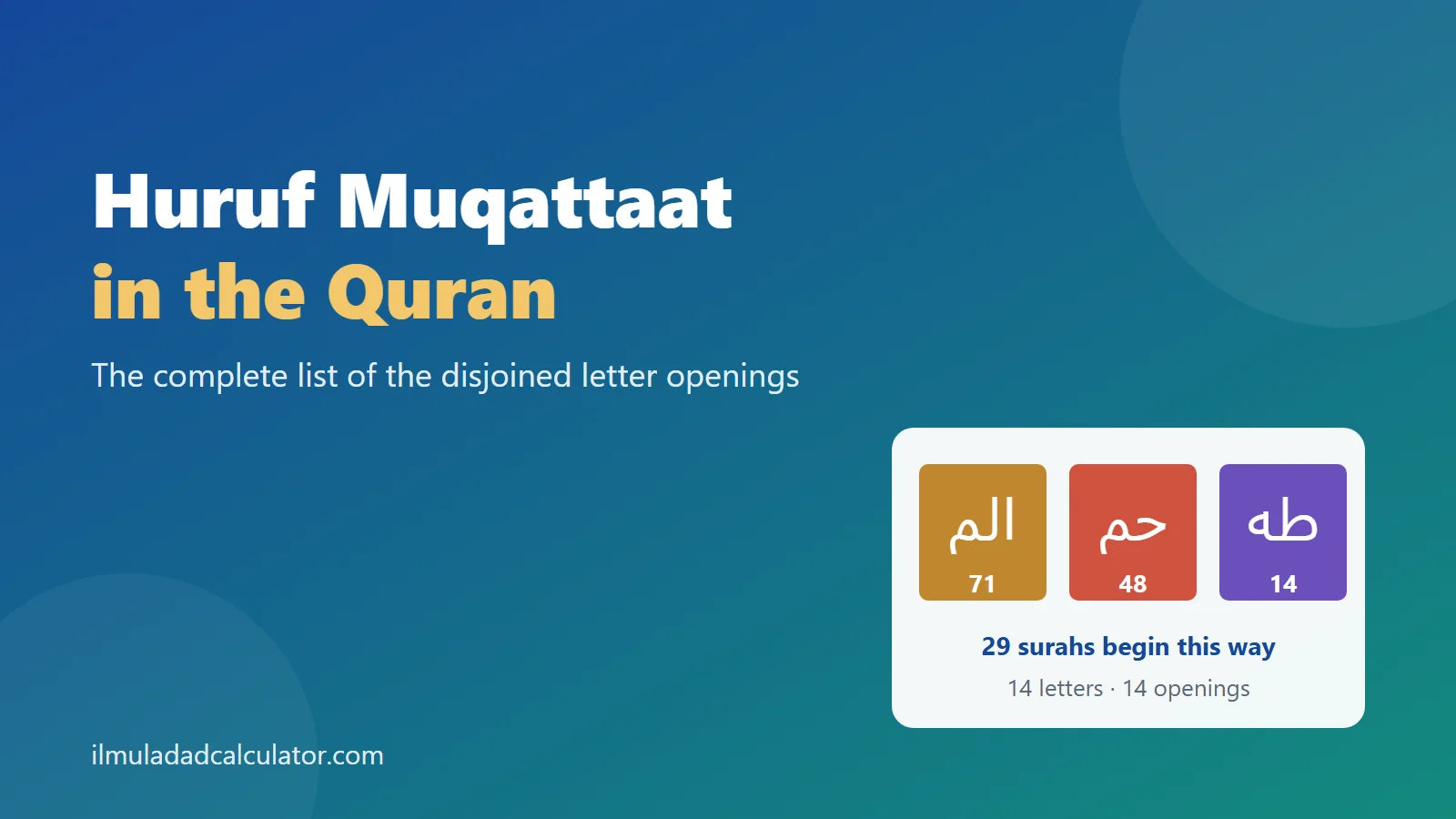
The huruf muqattaat are the single letters that open some surahs of the Quran, such as الم and حم. In total, 29 surahs begin this way. They use 14 distinct letters arranged in 14 distinct combinations.
How Many Huruf Muqattaat Are in the Quran?
The muqattaat open 29 of the 114 surahs. The name حروف مقطعات means the “disjoined letters,” because each letter is read on its own.
These 29 openings are built from just 14 letters. Those 14 letters appear in 14 set combinations, which is the number this page counts.
So three numbers describe the muqattaat. There are 29 surahs, 14 letters and 14 combinations. Each number is checked against the standard text.
Quick answer: 29 surahs open with the muqattaat. They use 14 distinct letters in 14 distinct combinations. This page is a factual reference, not an interpretation.
Where Do the Muqattaat Appear in a Surah?
The muqattaat always sit at the very start of a surah. They come right after the opening Bismillah, before the rest of the text.
No surah places these letters in the middle or at the end. When they appear, they open the surah and nothing comes before them. Their place is always fixed at the head of the surah.
Which Surahs Begin With the Muqattaat?
The table lists all 29 surahs in the order they appear in the Quran. For each one it gives the number, name, opening letters, and how those letters are read.
The last column is the plain sum of the letter values in the Mashriqi system. It is arithmetic only, shown here for reference.
| Surah # | Name | Opening | Transliteration | Letter sum |
|---|---|---|---|---|
| 2 | Al-Baqarah | الم | Alif Lam Mim | 71 |
| 3 | Al-Imran | الم | Alif Lam Mim | 71 |
| 7 | Al-Araf | المص | Alif Lam Mim Sad | 161 |
| 10 | Yunus | الر | Alif Lam Ra | 231 |
| 11 | Hud | الر | Alif Lam Ra | 231 |
| 12 | Yusuf | الر | Alif Lam Ra | 231 |
| 13 | Ar-Rad | المر | Alif Lam Mim Ra | 271 |
| 14 | Ibrahim | الر | Alif Lam Ra | 231 |
| 15 | Al-Hijr | الر | Alif Lam Ra | 231 |
| 19 | Maryam | كهيعص | Kaf Ha Ya Ain Sad | 195 |
| 20 | Ta-Ha | طه | Ta Ha | 14 |
| 26 | Ash-Shuara | طسم | Ta Sin Mim | 109 |
| 27 | An-Naml | طس | Ta Sin | 69 |
| 28 | Al-Qasas | طسم | Ta Sin Mim | 109 |
| 29 | Al-Ankabut | الم | Alif Lam Mim | 71 |
| 30 | Ar-Rum | الم | Alif Lam Mim | 71 |
| 31 | Luqman | الم | Alif Lam Mim | 71 |
| 32 | As-Sajdah | الم | Alif Lam Mim | 71 |
| 36 | Ya-Sin | يس | Ya Sin | 70 |
| 38 | Sad | ص | Sad | 90 |
| 40 | Ghafir | حم | Ha Mim | 48 |
| 41 | Fussilat | حم | Ha Mim | 48 |
| 42 | Ash-Shura | حم عسق | Ha Mim, Ain Sin Qaf | 278 |
| 43 | Az-Zukhruf | حم | Ha Mim | 48 |
| 44 | Ad-Dukhan | حم | Ha Mim | 48 |
| 45 | Al-Jathiyah | حم | Ha Mim | 48 |
| 46 | Al-Ahqaf | حم | Ha Mim | 48 |
| 50 | Qaf | ق | Qaf | 100 |
| 68 | Al-Qalam | ن | Nun | 50 |
The surahs are spread across the Quran, not bunched in one place. The first is Surah 2 and the last is Surah 68. In between, they appear in surahs of many different lengths.
Surah 42, Ash-Shura, is the one surah whose opening runs over two lines: حم then عسق. Every other surah opens with a single line of letters.
What Are the 14 Muqattaat Letters?
Exactly half of the 28 Arabic letters appear in the muqattaat. The other half never open a surah this way.
Here are the 14 letters in reading order:
ا ل م ص ر ك ه ي ع ط س ح ق ن
Their names are alif, lam, mim, sad, ra, kaf, ha, ya, ain, ta, sin, ha, qaf and nun. Two of them read as “ha” in English.
The letters ه and ح share that sound in a loose spelling. This page writes the second as ḥa to keep them apart.
The tiles below show each letter with its plain Abjad value. The value is arithmetic and holds no hidden meaning.
Which Letters Never Appear in the Muqattaat?
Fourteen Arabic letters never open a surah as a disjoined letter. They make up the other half of the alphabet.
ب ت ث ج خ د ذ ز ش ض ظ غ ف و
One neat pattern stands out here. The six letters at the tail of the Abjad order, ثخذ ضظغ, are all absent. The rest are scattered through the alphabet.
What Are the 14 Letter Combinations?
The 14 letters form 14 fixed openings. Some openings are a single letter, while others run to five letters.
| Opening | Transliteration | Letter sum | Surahs |
|---|---|---|---|
| الم | Alif Lam Mim | 71 | 6 |
| المص | Alif Lam Mim Sad | 161 | 1 |
| الر | Alif Lam Ra | 231 | 5 |
| المر | Alif Lam Mim Ra | 271 | 1 |
| كهيعص | Kaf Ha Ya Ain Sad | 195 | 1 |
| طه | Ta Ha | 14 | 1 |
| طسم | Ta Sin Mim | 109 | 2 |
| طس | Ta Sin | 69 | 1 |
| يس | Ya Sin | 70 | 1 |
| ص | Sad | 90 | 1 |
| حم | Ha Mim | 48 | 6 |
| حم عسق | Ha Mim Ain Sin Qaf | 278 | 1 |
| ق | Qaf | 100 | 1 |
| ن | Nun | 50 | 1 |
The shortest openings are the single letters ص (Sad), ق (Qaf) and ن (Nun). The longest is كهيعص (Kaf Ha Ya Ain Sad), which opens Surah Maryam.
Which Openings Are Shared Across Surahs?
Most openings appear only once. A few are shared by several surahs, which is why 29 surahs use only 14 combinations.
- الم (Alif Lam Mim) opens 6 surahs: Al-Baqarah, Al-Imran, Al-Ankabut, Ar-Rum, Luqman and As-Sajdah.
- حم (Ha Mim) opens 6 surahs: Ghafir, Fussilat, Az-Zukhruf, Ad-Dukhan, Al-Jathiyah and Al-Ahqaf.
- الر (Alif Lam Ra) opens 5 surahs: Yunus, Hud, Yusuf, Ibrahim and Al-Hijr.
- طسم (Ta Sin Mim) opens 2 surahs: Ash-Shuara and Al-Qasas.
The remaining 10 combinations each open a single surah. That accounts for every one of the 29 surahs.
What Is the Hawamim Group?
The Hawamim are the surahs that open with حم (Ha Mim). They sit together as a block, from Surah 40 to Surah 46.
Six of these seven surahs open with حم on its own. The exception is Surah 42, Ash-Shura, which adds a second line, عسق.
Because the seven surahs run back to back, scholars often study them as one family. The name simply means the Ha Mim surahs. Together they form the largest run of related openings.
Are These Surahs Meccan or Medinan?
Most of the 29 surahs are Meccan, meaning they date to the earlier period. A few are Medinan, such as Al-Baqarah and Al-Imran.
The muqattaat are therefore not tied to one period alone. They appear in both the earlier and the later surahs of the Quran. The count of 29 holds across both the Meccan and the Medinan surahs.
What Comes Right After the Muqattaat?
In many of these surahs, the letters are followed by a reference to the Book or the revelation. This is a plain observation about the text.
Not every surah follows that pattern, so this page does not treat it as a rule. It is simply a feature that readers have long noticed.
Are the Muqattaat the Same in Every Quran?
Yes. The openings, the surahs and the letter order are the same in the standard printed text worldwide. A copy in Pakistan matches a copy in Egypt.
That is why a fixed list like this one can be given at all. The 29 surahs and their letters do not change from one edition to the next.
Why Are They Called Huruf Muqattaat?
The name is Arabic. حروف (huruf) means “letters,” and مقطعات (muqattaat) means “cut off” or “disjoined.”
So the full name means the disjoined letters. It points to the way the letters are read apart, not joined into a word.
The word muqattaat comes from the same root as cutting. The sense is that the letters are set off on their own.
How Are the Muqattaat Letters Named and Read?
The letters are read one by one, by their letter names. They are not blended into a single word.
So الم is read as alif, then lam, then mim. It is not read as the word alam.
A reader pauses on each letter and gives it its full name. The letters stand apart, even when they are written joined.
A short guide to reading each opening aloud is planned for the huruf muqattaat overview on this site.
How Long Are the Muqattaat Openings?
The openings range from one letter to five letters. The 14 combinations break down by length as follows:
- One letter: ص, ق and ن, so 3 openings.
- Two letters: طه, طس, يس and حم, so 4 openings.
- Three letters: الم, الر and طسم, so 3 openings.
- Four letters: المص and المر, so 2 openings.
- Five letters: كهيعص and حم عسق, so 2 openings.
No opening uses more than five letters. The two longest both include a cluster of five. Most openings are short, with two or three letters.
Do Any Other Surahs Open With Letters?
No. Only these 29 surahs begin with disjoined letters. The other 85 surahs all open with ordinary words.
That makes the muqattaat a small and fixed set. The list on this page is complete, with nothing left out. You can rely on the table above as the full set.
What Do the Muqattaat Mean?
The honest answer is that no one knows for certain. Commentators across history have proposed several explanations, and this page does not take a side.
Explanations Scholars Have Offered
Some scholars suggested the letters are names or markers of their surahs. Others held that they draw the reader’s attention to the text that follows.
Many commentators also linked the letters to the sounds of the Arabic language. A few saw them as a way to open each surah. These are general views, reported here without any ranking.
The Most Widely Held View
The most widely held position is that their exact meaning is known with certainty only to God. This is a factual note about the majority view, not a ruling.
Please note: this site does not offer any secret-code, predictive or fortune-telling reading of these letters. It reports the letters, the counts and the plain arithmetic only.
How Are the Letter Values Summed?
In the Abjad system, every Arabic letter has a number. People through history have added up the letters of these openings.
This works the same way any Arabic text can be added. For example, الم is alif (1) plus lam (30) plus mim (40), which gives 71.
That total is simple arithmetic and carries no meaning on its own. The counts on this page stay at that factual level. Readers can treat the sums purely as numbers.
- Find each letter’s value in the letter values table.
- Add the values together.
- Check the total with the phrase value calculator.
You can read more about these number systems on the numbers in Arabic script page. The method this site uses is explained in the methodology.
How Can You Explore This List?
This page works as a quick reference you can return to. Use the table to find a surah, its opening and its letter sum.
To go deeper, the huruf muqattaat overview gives more background. The calculator lets you check every sum for yourself. Each figure and sum here comes from the same tested source.
خلاصہ
قرآن کی انتیس سورتیں حروفِ مقطعات سے شروع ہوتی ہیں، جیسے الم اور حم۔ ان میں کل چودہ الگ حرف استعمال ہوئے ہیں، جو چودہ مختلف ترکیبوں میں آتے ہیں۔ الم اور حم چھ چھ سورتوں کی ابتدا کرتے ہیں، اور الر پانچ سورتوں کی۔ یہ صفحہ صرف حقائق اور گنتی بیان کرتا ہے، کوئی تفسیر یا پیش گوئی نہیں۔
Sources and Further Reading
- Muqattaʿat, Wikipedia. The full table of 29 surahs, the 14 letters and the 14 combinations.
- List of chapters in the Quran, Wikipedia. Surah numbers and names cross-checked.
- Letter sums come from this site’s tested engine. See the methodology.
Frequently Asked Questions
How many huruf muqattaat are in the Quran?
They open 29 of the 114 surahs, using 14 distinct letters in 14 distinct combinations.
How many surahs start with Alif Lam Mim?
Six surahs open with الم: Al-Baqarah, Al-Imran, Al-Ankabut, Ar-Rum, Luqman and As-Sajdah.
What are the 14 muqattaat letters?
They are alif, lam, mim, sad, ra, kaf, ha, ya, ain, ta, sin, ha (ḥa), qaf and nun.
Which surah has the longest muqattaat opening?
Surah Maryam, which opens with five letters, كهيعص (Kaf Ha Ya Ain Sad).
What does muqattaat mean?
It means the “disjoined letters,” because each letter is read on its own by its name.
Do the muqattaat have a known meaning?
The most widely held view is that their exact meaning is known with certainty only to God.