A chronogram does not announce itself with a number. It uses signal words such as tarikh, sal and hatif to say that a date is hidden close by.
This page names the common cues and shows how they work in one sourced line. It also explains why they are never added.
What Are Signal Words in a Chronogram?
A signal word is a short word or phrase placed just before the counted words. It does one job. It tells the reader that the next words hide a year.
Encyclopaedia Iranica describes the usual layout. The counted phrase normally closes the poem. It is preceded by a clue to the presence of a hidden date.
The clue is a signal, and the phrase is the date line.
Our page on the madda-e-tarikh covers the counted phrase itself. This page covers what comes before it.
Which Words Point to the Date?
Sources name a small group of cues again and again. They fall into four kinds, and many lines use two or three at once.
| Romanized | Script | Meaning | Kind | Seen in |
|---|---|---|---|---|
| tarikh | تاریخ | date | Time | Hafez (787); Nizamuddin Auliya (725); Momin |
| sal | سال | year | Time | Hafez (787) |
| talab | طلب | seek | Seeking | Hafez (787) |
| hatif | ہاتف | unseen voice | Voice | Nizamuddin Auliya (725); Momin |
| nida dad | ندا داد | called out | Voice | Nizamuddin Auliya (725) |
| barkhast | برخاست | arose | Action | Najib of Kashan (1105) |
The Rekhta Dictionary gives taariikh several senses, including date, era and history. In the abjad sense it is the chronogram itself. That is why a poet can write the word tarikh to say that a chronogram follows.
Time Cues: Tarikh and Sal
Tarikh means date, and sal means year. Hafez uses both in his poem on the death of a vizier. Iranica quotes the line sal-e tarikh-e wafat-ash talab az meyl-e behesht.
It asks the reader to seek the year of his death. Only the last two words, worth 80 and 707, are counted. They give 787, which Iranica reads as 787 AH.
Seeking Cues: Talab and Bar Jastam
The poet often speaks as a person who has gone looking for the date. In the Hafez line the verb talab means seek. In the example below the poet says that he sought the date from the unseen.
Voice Cues: Hatif and Nida Dad
The hatif is an unseen voice. Rekhta Dictionary defines it as a hidden voice. It adds that in Sufism and poetry the word stands for ideas that arrive without effort.
A poet who writes that the hatif spoke the date is saying that the answer came as if from outside.
Momin’s verse on his daughter’s birth uses the same device. Our page on tarikh goi shows how common the voice is in Urdu verse.
How Does a Cue Work in a Real Line?
The Urdu Wikipedia article on Nizamuddin Auliya records a Persian chronogram for his death. It is inscribed, the page says, on the wall of the mosque beside the shrine. It has two verses.
چو تاریخ فوتش بر جستم ز غیب
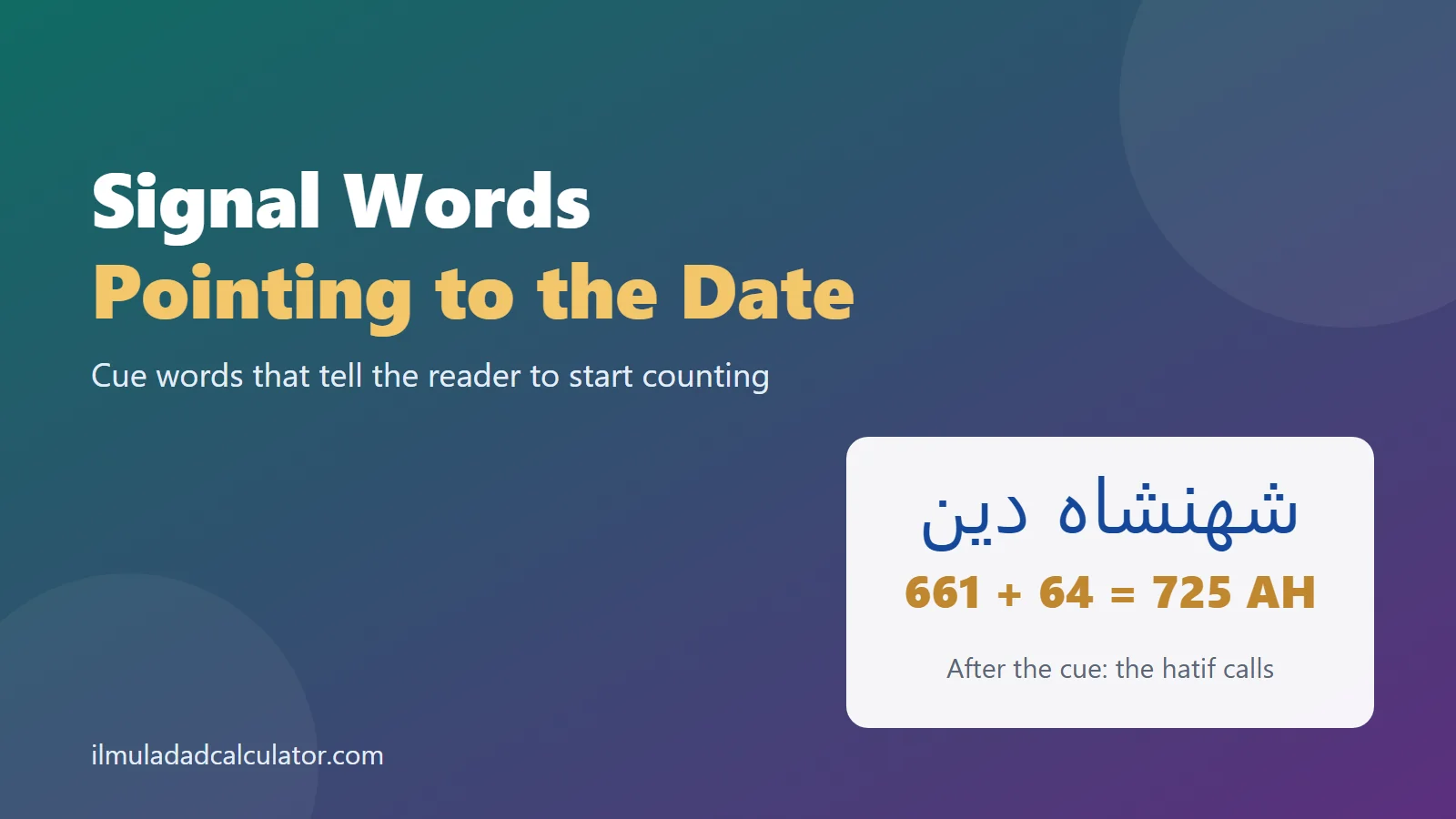
ندا داد هاتف شهنشاه دین
The first verse says that the poet sought the date of his death from the unseen. The second says that the hatif called out the answer. Then comes the counted phrase, shahanshah-e din, “king of the faith.”
Here is the sum, using the engine’s Mashriqi values.
ش 300 + ه 5 + ن 50 + ش 300 + ا 1 + ه 5 + د 4 + ی 10 + ن 50 = 725
The total is 661 + 64 = 725. The page gives the year as 725 AH.
English Wikipedia gives the death as 18 Rabi al-Thani 725 AH, or 3 April 1325. In the tabular civil calendar on the Julian calendar, 18 Rabi II 725 falls on 3 April 1325. The two dates agree, so the reading holds.
Count check: adding the whole second verse, hatif included, gives 1275. That is far from 725, which is why the cue words must stay out.
Where Does the Cue Sit in the Poem?
Iranica notes that the chronogram usually fills the final half-verse. The cue therefore tends to sit in the line or two just before it.
In the Hafez poem it opens the last verse. In the Nizamuddin lines it fills the closing couplet except the phrase.
This gives you a practical rule.
Start at the end of the poem and work backward. Stop at a word that says date, year, seek or voice. The counted words begin right after it.
The same article says Safavid and Mughal poems ran from five to fifteen verses. In a poem that long, the cue is a landmark. Without it, a reader would have to test every phrase against the year.
How Is a Cue Different From an Explicit Date?
Iranica separates two ways of dating a poem. An explicit date, called tarikh-e suri, writes the year out in words. A meaningful date, tarikh-e ma’nawi, hides it in the letters of a phrase.
The poet Kesai of Marv gave his own birth year in the first way. His line says that the turn of the year came to three hundred and forty-one. That is 300 + 40 + 1 = 341 AH, and no letter is counted.
An explicit date needs no cue, since the number is plain. A hidden date needs one, because otherwise the reader would take the phrase for ordinary words.
Why Do Poets Use the Hatif and Not Just the Word Tarikh?
The plain word tarikh is clear and short. The hatif adds a story. The date becomes a message that arrived from the unseen, and that suits an elegy or a tribute.
A voice cue also gives the poet a reason to stop and name the phrase. In the Nizamuddin lines, the hatif “called out” the words that follow. The reader is told where the call begins, and the counting begins with it.
Do Signal Words Ever Change the Sum?
Mostly they do not. A cue about the date, the voice or the search stays outside the arithmetic. Some verbs are different, because they tell the reader what to do with the numbers.
Iranica gives Najib of Kashan’s motto for the death of Shah Solayman. It says faryad ba yak martaba az takht cho barkhast. The verb barkhast, “arose,” signals that the value of faryad is lifted out of takht.
ت 400 + خ 600 + ت 400 = 1400
That is 1400 − 295 = 1105, the year Iranica reports. This kind of cue is an operation word. Our guide to add and subtract devices lists more of them.
What Is the Difference Between a Cue and the Counted Phrase?
| Part | Job | In the sum? |
|---|---|---|
| Cue word | Says a date is hidden | No |
| Operation word | Says to subtract or adjust | It changes the sum |
| Counted phrase | Carries the year | Yes |
The counted phrase has its own page, and it should not be confused with the cue. A cue such as hatif is scenery, and the phrase after it is the date.
How Can You Spot the Date Line in a Poem?
You can use the cue words as a map. They help you find the line before you do any arithmetic. The figure below shows the steps.
- Read to the last verse, since the date line usually closes the poem.
- Look for a time, seeking or voice cue such as tarikh, talab or hatif.
- Mark where the cue ends and the phrase begins.
- Add the phrase with a single table of values.
- Compare the total with the year of the event.
For the adding itself, see how to read a chronogram. The chronogram decoder will total a phrase for you.
Do All Chronograms Have a Signal Word?
No. Some chronograms give no cue at all, and the reader must notice that the phrase suits the event. Iranica describes a single word, lawd, that dates the death of the last Il-khanid ruler.
That is why a known year helps so much. When you know the date of the event, you can test each candidate phrase quickly.
What If the Cue Word Is Also a Name?
Context settles it. Hatif is a common pen name, and tarikh also means history. A word is a cue only when it sits just before a phrase that fits the event.
Rekhta Dictionary lists the poet Haatif Aarifi Fatehpuri among its examples of the word. In his couplet, hatif is a name, not a signal. No date hides there.
So ask two questions. Does the word point forward to a phrase, and does that phrase suit the event? If both answers are yes, you have found a cue.
Which Mistakes Should You Avoid?
- Counting the cue. Words such as tarikh, sal and hatif are signals, not numbers.
- Missing an operation word. A verb like barkhast may tell you to subtract.
- Starting the phrase too early. The cue may run over two verses, as in the Nizamuddin lines.
- Reading a name as a cue. Hatif can also be a poet’s pen name, so check the context.
- Trusting one spelling. Test the plausible spellings and keep the one that fits the year.
For the wider world of the form, visit Persian chronograms and Urdu chronograms. The main chronograms hub lists every guide.
خلاصہ
تاریخ گوئی میں «تاریخ»، «سال»، «طلب» اور «ہاتف» جیسے الفاظ صرف اشارہ ہوتے ہیں کہ آگے سال چھپا ہے۔ ان الفاظ کے عدد جمع نہیں کیے جاتے۔ حضرت نظام الدین اولیاء کے قطعے میں «شہنشاہ دین» کے عدد مل کر ۷۲۵ ہجری بنتے ہیں۔ کچھ فعل، جیسے «برخاست»، جمع کے بجائے تفریق کا اشارہ دیتے ہیں۔
Sources and Further Reading
- Mādda tāriḵ, Encyclopaedia Iranica, by Paul E. Losensky (2006). The clue before the chronogram, the Hafez line (787), and Najib of Kashan’s barkhast motto (1105).
- Chronograms, Encyclopaedia Iranica, by J. T. P. de Bruijn (1991). Meaningful dates, the hidden date and the one-word example lawd.
- نظام الدین اولیاء, Urdu Wikipedia. The two-verse chronogram on his death, dated 725 AH.
- Nizamuddin Auliya, English Wikipedia. The date of death, 18 Rabi al-Thani 725 AH, 3 April 1325.
- haatif, Rekhta Dictionary. The hidden voice and its use in poetry.
- taariikh, Rekhta Dictionary. The senses of date, era and chronogram.
- Tarikh Nigari: Numbers Speaking Through Words, Rekhta blog (2020). Momin’s verse with the signal words Tarikh and Hatif.
Frequently Asked Questions
What is a signal word in a chronogram?
It is a word such as tarikh, sal or hatif. It tells the reader that a date is hidden in the words that follow.
Do signal words count in the sum?
No. They only point to the date. Only the counted phrase is added, unless a verb tells you to subtract.
What does hatif mean in a chronogram?
It means an unseen voice. The poet says that the voice spoke the date, and the words it speaks are counted.
Does every chronogram have a cue word?
No. Some give none, and the reader finds the phrase by meaning and by checking the year.
How is a signal word different from the madda?
The signal word points to the date. The madda is the phrase whose letters give the year.