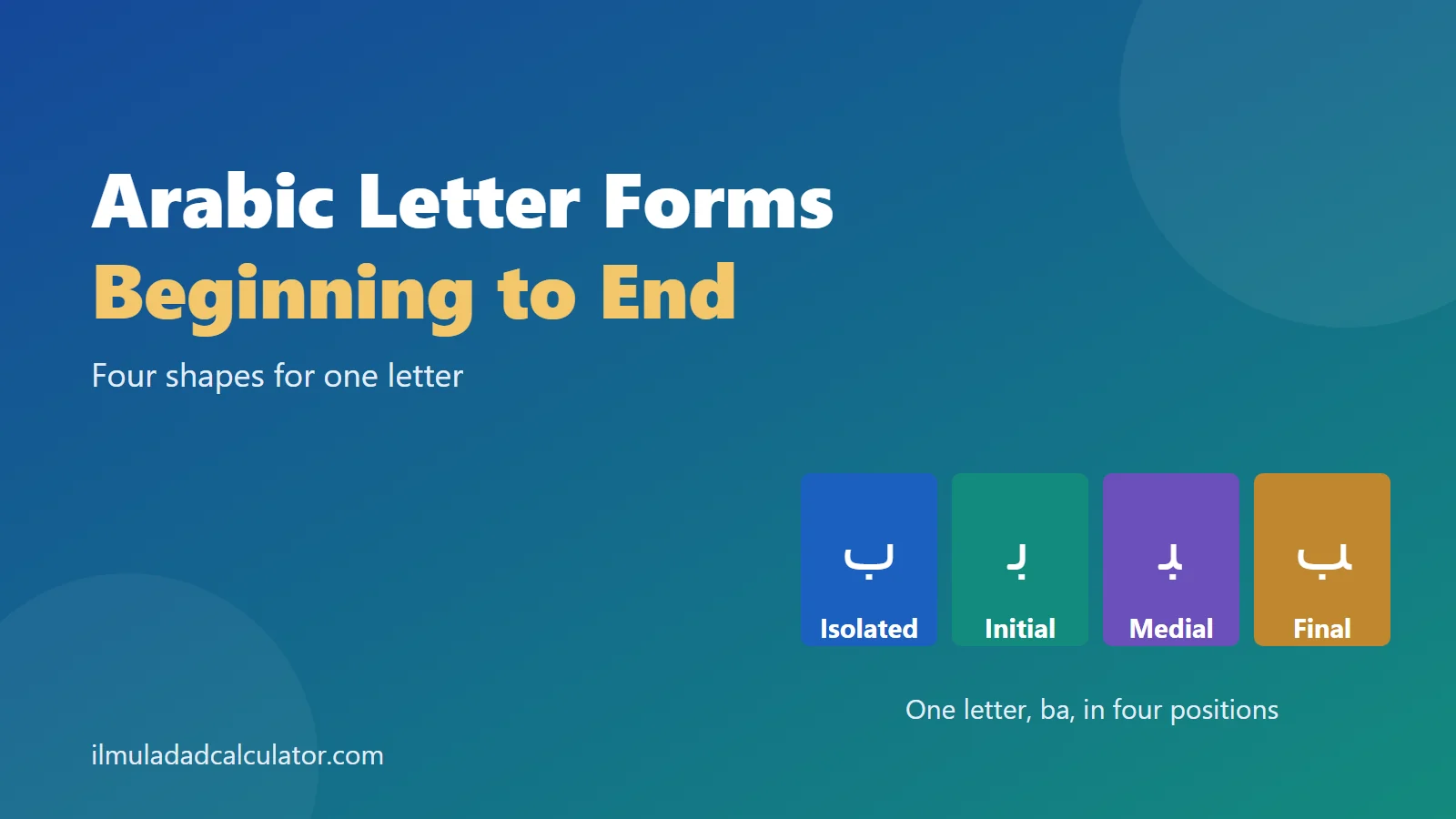
Most Arabic letters have four shapes: isolated, initial, medial and final. The shape depends on where the letter sits in a word. This page shows all 28 letters in every form, and explains how to know which one to use.
Why Do Arabic Letters Change Shape?
Arabic is always written in a joined style, a little like cursive English. Letters link to their neighbors, so each one bends to fit what sits beside it.
The body of the letter stays the same. The strokes that connect it to the letter before or after it are what change.
There are no capital letters in Arabic. Position inside the word is the only thing that changes a letter’s look. If you are new to the script, start with the guide to the Arabic script.
What Are the Four Forms of an Arabic Letter?
Each form has a simple job. Here they are, using the letter ba (ب) as the example.
Isolated Form
This is the standalone shape, used when nothing joins the letter on either side. It is the form you see in alphabet charts.
Initial Form
This shape starts a word. It keeps the letter’s body and adds a small tail that reaches toward the next letter on the left.
Medial Form
This shape sits in the middle of a word. It has a link on both sides, one to the letter before and one to the letter after.
Final Form
This shape ends a word. It links to the letter before it, and it often has a longer tail on the left side.
In books, a short dash often marks the link. For example, ه is initial, ه is medial and ه is final.
How Do You Choose the Right Form?
You only need to look at the neighbors. Follow these steps for any letter in a word.
- Look at the letter just before it, on the right. Does that letter join forward?
- Look at the letter just after it, on the left. Is there one, and can this letter join it?
- If the letter joins on both sides, use the medial form.
- If it joins only the letter before it, use the final form.
- If it joins only the letter after it, use the initial form.
- If it joins neither, use the isolated form.
Take the word كتاب (kitab, book). Kaf starts the word, ta sits in the middle, and alif ends the joined part. Ba comes after alif, and alif does not join forward, so ba stands alone.
What Do All 28 Letters Look Like in Four Forms?
The table shows every letter. Names use plain English spellings with no special marks. The mark n/a means that the form does not exist for that letter.
| # | Name | Isolated | Initial | Medial | Final | Joins the next letter? | Abjad value |
|---|---|---|---|---|---|---|---|
| 1 | Alif | ا | n/a | n/a | ا | No | 1 |
| 2 | Ba | ب | ب | ب | ب | Yes | 2 |
| 3 | Ta | ت | ت | ت | ت | Yes | 400 |
| 4 | Tha | ث | ث | ث | ث | Yes | 500 |
| 5 | Jim | ج | ج | ج | ج | Yes | 3 |
| 6 | Ha (deep) | ح | ح | ح | ح | Yes | 8 |
| 7 | Kha | خ | خ | خ | خ | Yes | 600 |
| 8 | Dal | د | n/a | n/a | د | No | 4 |
| 9 | Dhal | ذ | n/a | n/a | ذ | No | 700 |
| 10 | Ra | ر | n/a | n/a | ر | No | 200 |
| 11 | Zay | ز | n/a | n/a | ز | No | 7 |
| 12 | Sin | س | س | س | س | Yes | 60 |
| 13 | Shin | ش | ش | ش | ش | Yes | 300 |
| 14 | Sad | ص | ص | ص | ص | Yes | 90 |
| 15 | Dad | ض | ض | ض | ض | Yes | 800 |
| 16 | Tah | ط | ط | ط | ط | Yes | 9 |
| 17 | Zah | ظ | ظ | ظ | ظ | Yes | 900 |
| 18 | Ain | ع | ع | ع | ع | Yes | 70 |
| 19 | Ghain | غ | غ | غ | غ | Yes | 1000 |
| 20 | Fa | ف | ف | ف | ف | Yes | 80 |
| 21 | Qaf | ق | ق | ق | ق | Yes | 100 |
| 22 | Kaf | ك | ك | ك | ك | Yes | 20 |
| 23 | Lam | ل | ل | ل | ل | Yes | 30 |
| 24 | Mim | م | م | م | م | Yes | 40 |
| 25 | Nun | ن | ن | ن | ن | Yes | 50 |
| 26 | Ha (light) | ه | ه | ه | ه | Yes | 5 |
| 27 | Waw | و | n/a | n/a | و | No | 6 |
| 28 | Ya | ي | ي | ي | ي | Yes | 10 |
Font caution: the table stores each letter once and adds an invisible joiner, so your device picks the shape. A font that handles Arabic will show the right form. A weak font may show the same shape in every cell, or gaps between letters.
Which Letters Have Only Two Forms?
Six letters never join the letter after them. They are alif (ا), dal (د), dhal (ذ), ra (ر), zay (ز) and waw (و).
Unicode calls them right-joining letters.
These six have an isolated form and a final form, but no initial or medial form. The other 22 letters have all four. That gives 22 × 4 + 6 × 2 = 100 shapes for the 28 letters.
The effect on words is bigger than it sounds, because it opens gaps inside words. The page on letters that do not connect explains this in detail.
Which Letters Share the Same Base Shape?
Many letters are one shape with different dots. Ba, ta and tha look alike and differ only in their dots. Learn the shape once, then add the dots.
Unicode sorts the 28 letters into 18 joining groups. Letters in one group, such as jim, ha and kha, share a body.
Some teachers also group ba, ta, tha, nun and ya together, since their middle forms look alike. That is a teaching choice, not the Unicode grouping.
What Is the Lam-Alif Ligature?
When lam is followed by alif, the two letters usually merge into one shape: لا. It is the only mandatory ligature in Arabic.
Unicode has a code point for this shape, U+FEFB. It is not counted as a separate letter, which is why lists still say 28. The page on how many Arabic letters there are covers the count.
What About Hamza and Ta Marbuta?
Hamza (ء) is not one of the 28 letters. Unicode treats it as a non-joining sign, so it has one shape.
Ta marbuta (ة) appears only at the end of a word. It has two forms, like the six right-joining letters. Our pages on hamza in Ilm-ul-Adad show how both are counted.
How Do Computers Store the Four Forms?
In normal text, computers store only the base letter, such as ba (U+0628). The font and the software then choose the form, using the neighbors.
Unicode also holds separate code points for each shape, in a block called Arabic Presentation Forms-B. They exist for old systems, and Unicode says text should not use them in general.
| Form | Shape | Code point |
|---|---|---|
| Isolated | ﺏ | U+FE8F |
| Initial | ﺑ | U+FE91 |
| Medial | ﺒ | U+FE92 |
| Final | ﺐ | U+FE90 |
Two invisible characters can steer the shape. The zero width joiner (U+200D) asks a letter to join its neighbor. The zero width non-joiner (U+200C) blocks a join.
Do the Four Forms Change a Letter’s Abjad Value?
No. A letter keeps one value, whatever shape it takes. Ba counts 2 as an initial, a medial, a final or alone.
ب 2 + ي 10 + ت 400 = 412
ك 20 + ت 400 + ب 2 = 422
In بيت, ba is initial. In كتب, ba is final. Both times it adds 2.
You can try any word in the Abjad value calculator. The full value list is on the Arabic letters page.
Remember: forms change how a letter looks, not what it is worth. The values follow the letter order, which you can read about in Abjad order versus hija’i order.
How Do the Forms Appear in Real Words?
The table below applies the steps to four short words. The forms come from each letter’s joining type, read from right to left.
| Word | Sense | Forms, first letter first | Abjad total |
|---|---|---|---|
| بيت | bayt, house | initial, medial, final | 412 |
| كتب | kataba, he wrote | initial, medial, final | 422 |
| كتاب | kitab, book | initial, medial, final, isolated | 423 |
| دار | dar, home | isolated, isolated, isolated | 205 |
Notice دار. Dal and alif both refuse to join forward, so all three letters stand apart. The word still reads as one unit.
Why Do Some Letters Look Almost the Same in Every Form?
Not every letter changes a lot. Wikipedia notes that some letters vary a great deal between positions, while others look almost the same.
Wikibooks calls one teaching group “constant”. It holds sin, sad, tah, dad, zah, fa, qaf and shin. The same page admits that this grouping is the authors’ own view.
What Is the Stretching Stroke Called Tatweel?
Tatweel is a long horizontal line (U+0640) that can be placed between joined letters. It stretches a word without changing which letters are in it.
Unicode calls tatweel a join-causing character. It makes its neighbors take their joined forms, while it adds no letter of its own. In Ilm-ul-Adad it adds nothing: بـيـت still totals 412.
How Do You Type a Letter in One Specific Form?
On an Arabic keyboard, you press one key per letter. The software then shapes each letter from its neighbors, so you never choose a form by hand.
To show a single form on its own, add a zero width joiner next to the letter. A joiner after the letter gives the initial form. A joiner on both sides gives the medial form, and a joiner before it gives the final form.
This is how the table on this page was built. Each cell holds the base letter and an invisible joiner, and your font draws the shape.
What Mistakes Do Beginners Make With Letter Forms?
- Joining a letter forward after alif, dal, dhal, ra, zay or waw.
- Using the isolated form in the middle of a joined group.
- Reading the dots as part of the form. The dots belong to the letter in every form.
- Mixing up ha (deep) and ha (light), since their forms look very different.
A good rule is to check the letter before it first. That one look settles most cases.
How Can You Practice Reading the Forms?
Start small, and build up from one letter to a short word. These habits help most learners.
- Learn the six right-joining letters first, since they break words into pieces.
- Pick a letter group, such as ba, ta and tha, and read its four forms side by side.
- Copy short words by hand, moving from right to left.
- Look for the dots last, after you know the base shape.
To see the letters in their standard order first, read the Arabic alphabet in order page.
خلاصہ
عربی حروف لفظ میں اپنی جگہ کے مطابق شکل بدلتے ہیں۔ زیادہ تر حروف کی چار شکلیں ہوتی ہیں: الگ، شروع، درمیان اور آخر۔ چھ حروف یعنی ا، د، ذ، ر، ز اور و آگے کے حرف سے نہیں ملتے، اس لیے ان کی صرف دو شکلیں ہیں۔ شکل بدلنے سے ابجد کی قیمت نہیں بدلتی۔
Sources and Further Reading
- Arabic alphabet, Wikipedia. The 28 letters, the four forms, the six non-joining letters and the lam-alif ligature.
- ArabicShaping.txt, Unicode Consortium. Joining type and joining group of each letter.
- Unicode Standard, Chapter 9: Middle East-I. Joining types, contextual forms, joiners and the lam-alef ligature.
- Arabic script in Unicode, Wikipedia. Presentation Forms-B and why text uses base letters.
- Arabic alphabet (by group), Wikibooks. A teaching grouping of letters by shape.
- Write in Arabic, arabic.fi. The four forms of one letter, shown with heh.
- Abjad values come from this site’s tested engine. See the methodology.
Frequently Asked Questions
How many forms does an Arabic letter have?
Most letters have four: isolated, initial, medial and final. Six letters have only two, isolated and final.
Do capital letters exist in Arabic?
No. Arabic has no capital letters. Only the position of a letter in a word changes its shape.
Why does a letter look different in the middle of a word?
It must link to a letter on each side. The connecting strokes change, while the body of the letter stays the same.
Which Arabic letters do not connect to the next letter?
Alif, dal, dhal, ra, zay and waw. They join the letter before them but not the one after.
Does the form of a letter change its Abjad value?
No. A letter has one Abjad value in every form. Ba is 2 whether it starts, joins or ends a word.