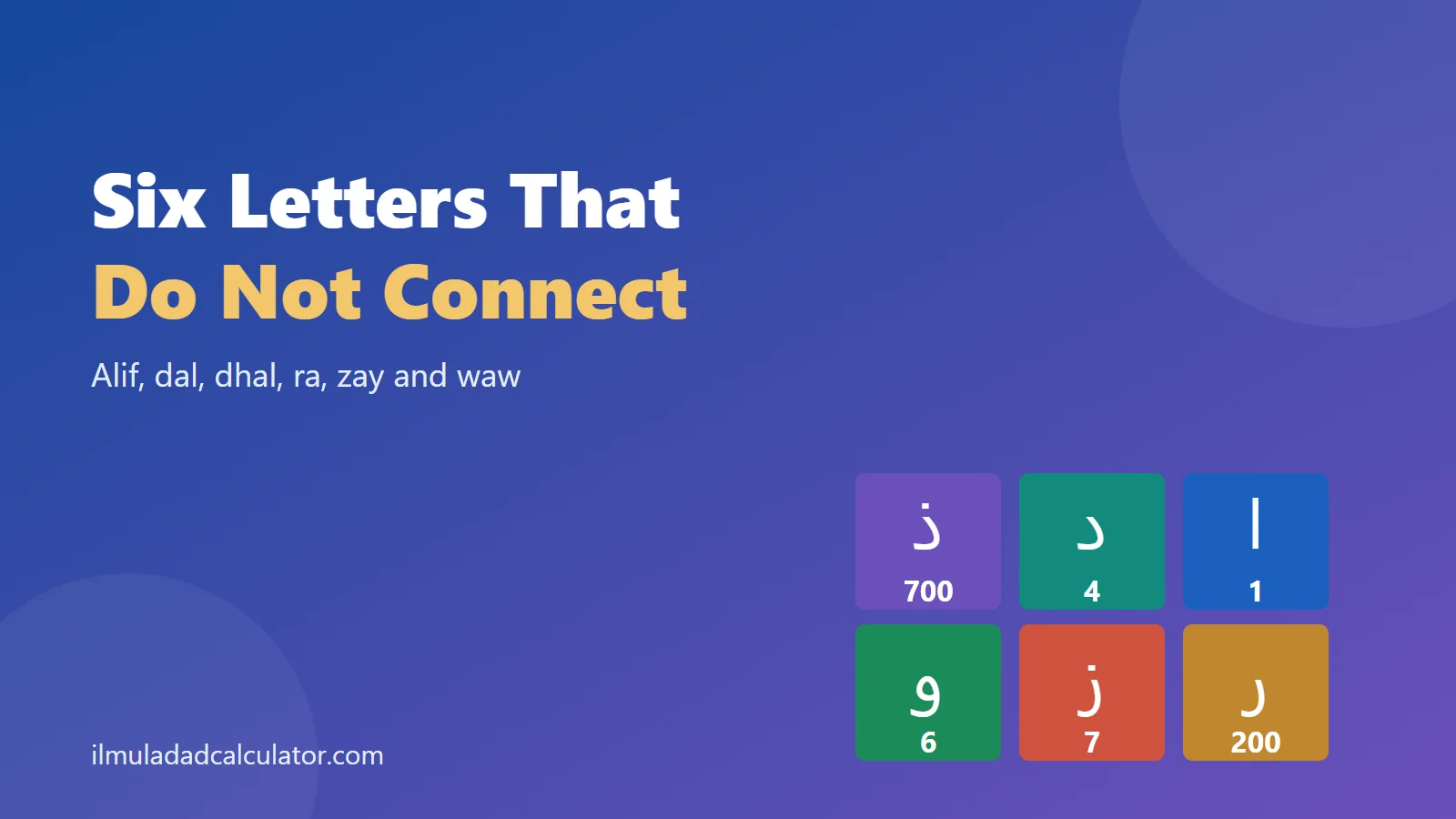
Six Arabic letters never connect to the letter that follows them: ا, د, ذ, ر, ز and و. Each one links only to the letter before it, so it leaves a small gap inside the word. This guide shows how those gaps work, and why they do not change an Abjad value.
Which Arabic Letters Do Not Connect to the Next Letter?
The six are alif, dal, dhal, ra, zay and waw. Wikipedia’s Arabic alphabet article says these letters can only be linked to the letter before them. The Unicode data file ArabicShaping marks all six as “right joining”, which is the technical name for the same behavior.
Arabic is written from right to left. The letters on the right come first, so “before” means to the right and “after” means to the left.
| Letter | Name | Romanization | Abjad value | Look-alike pair |
|---|---|---|---|---|
| ا | alif | a or aa | 1 | stands alone |
| د | dal | d | 4 | dal and dhal |
| ذ | dhal | dh | 700 | dal and dhal |
| ر | ra | r | 200 | ra and zay |
| ز | zay | z | 7 | ra and zay |
| و | waw | w or oo | 6 | stands alone |
This page uses a plain scheme. It writes dh for ذ and uses the common English spellings for the names.
What Does “Not Connecting” Actually Mean?
Arabic handwriting is cursive, so most letters are joined to their neighbors by a small stroke. A letter such as ب can join on its right side and on its left side.
The six letters join on the right side only. When one of them appears, the pen stops. The next letter starts a fresh connected group, even though it is still in the same word.
The rule belongs to the shape of the letters, not to their sounds. A vowel letter like alif and a consonant like dal follow exactly the same pattern. Once you know the six, you can apply the rule to any Arabic word you meet.
Remember: a gap inside a word is not a space. It only means that the letter before the gap is one of the six.
Why Do These Letters Have Only Two Shapes?
Most Arabic letters change shape in four ways: alone, at the start, in the middle and at the end. The six need fewer shapes, since nothing ever attaches to their left.
Their start shape matches their alone shape. Their middle shape matches their end shape.
The Unicode chart agrees. It lists isolated and final forms for them, but no initial or medial form.
You can read more about all four shapes on the Arabic letter forms page.
How Do These Letters Change the Look of a Word?
Take the word كتاب, which means book. The letters ك, ت and ا are joined. The alif stops the chain, so the final ب stands apart.
The word زيارة, meaning visit, shows the effect more strongly. It splits into four small groups, because ز, ا and ر each end a group.
Here are six sample words. The groups were found with a short program that ends a group after each of the six letters.
| Word | Meaning | Groups (read right to left) | Groups | Abjad value |
|---|---|---|---|---|
| كتاب | book (kitab) | كتا | ب | 2 | 423 |
| مدرسة | school (madrasa) | مد | ر | سة | 3 | 309 |
| هذا | this (hadha) | هذ | ا | 2 | 706 |
| نور | light (nur) | نو | ر | 2 | 256 |
| زيارة | visit (ziyara) | ز | يا | ر | ة | 4 | 223 |
| دراسة | study (dirasa) | د | ر | ا | سة | 4 | 270 |
Several of these words appear in a lesson on non-connecting letters at arabic123.com. The splits in the table were all computed, so they follow the rule exactly.
How Can You Find the Groups in a Word?
- Write the word and read it from right to left.
- Look for any of the six letters: alif, dal, dhal, ra, zay or waw.
- Draw a break just after each one, on its left side.
- Whatever sits between two breaks is one connected group.
A word that ends with one of the six letters has no break after it. The last group simply ends there.
Do the Gaps Change a Word’s Abjad Value?
No. Ilm-ul-Adad adds up letters, and the shape of a letter makes no difference. The font does the shaping, and the value belongs to the letter itself.
For example, كتاب gives the same total whether you see it joined or written letter by letter:
ك 20 + ت 400 + ا 1 + ب 2 = 423
The six letters carry very different weights. Together they add up to 918, and ذ alone accounts for 700 of that. You can test any word on the Abjad value calculator.
Typing tip: never type a space or a joiner mark to “fix” a gap. Type only the letters, and let the font draw the breaks.
How Can You Remember the Six Letters?
Two pairs help a lot. Dhal is dal with one dot above it, and zay is ra with one dot above it. The Unicode names say exactly that: “dal with dot above” and “reh with dot above”.
- Dal and dhal share one shape and differ by a dot.
- Ra and zay share one shape and differ by a dot.
- Alif and waw are the two that stand on their own.
The old Abjad memory words give another way to recall the letters. The abjad hawwaz hutti guide explains that order. For the everyday alphabet order, see the Arabic alphabet in order.
Which Urdu and Persian Letters Behave the Same Way?
Urdu keeps all six Arabic letters and adds more that also refuse to join forward. Wikipedia’s Urdu alphabet article lists ڈ (ddal), ڑ (rre) and ژ (zhe) with only isolated and final forms. The Unicode data confirms all three as right joining.
- Ddal (ڈ) and rre (ڑ) are Urdu additions for sounds Arabic lacks. They are a dal and a ra with a small sign above.
- Zhe (ژ) is a ra with three dots above. The article says it is used mainly for Persian loanwords.
- Bari ye (ے) is Urdu only, and the article lists it with isolated and final forms.
Urdu words show the same breaks. اردو (Urdu) splits into four separate letters, and بڑی (big) splits into two groups, بڑ and ی. The Urdu article also gives ڈھول (drum), where the ddal is followed by a separate he.
For the full Urdu list, see the Urdu alphabet letter count. Note that ط (tah) is not on any of these lists, since it connects normally.
How Do Fonts and Keyboards Handle These Letters?
When you type Arabic, the computer stores only the plain letters. It does not store a start shape or an end shape. The font and the text engine choose the right shape as the text is drawn.
Unicode helps with this by giving every Arabic letter a joining type.
The ArabicShaping file uses R for the right-joining letters and D for letters that join on both sides. Alif, dal, dhal, ra, zay and waw are R letters.
The engine reads each letter and its neighbors, then picks a shape. After an R letter, the next letter is drawn in its start or alone shape. That is why the gaps appear without any extra typing.
Why Does the Same Word Look Different in Different Fonts?
Fonts differ in style, so the breaks look different too. A calligraphic font may draw the alif tall and thin. A simple font may draw it as a plain vertical bar.
The gap is always there, but its size varies. Some fonts also tuck a following letter close to a non-joiner, which makes the gap look tiny.
How Does This Help You Read Handwriting?
Beginners often try to read a word letter by letter. It is easier to look for the groups first. Each group is a short chain of joined letters, and the chains are easy to spot.
The six letters also help you count. A word with three breaks has at least four groups, which tells you roughly how many letters to expect.
Which Mistakes Should You Avoid?
- Do not join a letter to the left of any of the six when you write by hand.
- Do not treat a gap as the end of a word. Read on to the next group.
- Do not mix up dal with dhal, or ra with zay. The dot is the only difference.
- Do not assume every tall stroke is an alif. Lam is tall too, and it does join forward.
One famous case is lam followed by alif. The two letters are written as a single ligature, لا, because alif joins the letter before it. This fits the rule, since the lam is the letter on the right.
What About Hamza and Ta Marbuta?
Two related signs are easy to confuse with the six. Ta marbuta (ة) is also right joining. It appears only at the end of a word, so nothing could follow it anyway.
Hamza (ء) is different. Unicode gives it no joining behavior at all, so it never connects to either side.
Alif and waw carrying a hamza (أ, ؤ) are right joining too. So is alif with madda (آ).
Whether these count as separate letters is a counting question. The Arabic letter count page covers it.
For a wider overview, start at the Arabic script guide. For letter values, see the Arabic letter values page.
خلاصہ
عربی کے چھ حروف یعنی ا، د، ذ، ر، ز اور و اپنے بعد والے حرف سے نہیں جڑتے۔ یہ صرف پچھلے حرف سے جڑتے ہیں، اس لیے لفظ کے بیچ میں چھوٹا سا وقفہ آ جاتا ہے۔ اردو میں ڈ، ڑ، ژ اور بڑی یے بھی آگے نہیں جڑتے۔ اس وقفے سے ابجد کی قیمت پر کوئی فرق نہیں پڑتا۔
Sources and Further Reading
- Arabic alphabet, Wikipedia. The six letters that link only to the previous letter.
- ArabicShaping.txt, Unicode Consortium. Joining type R for these letters, ddal, rre, zhe and ta marbuta, and joining type U for hamza.
- Urdu alphabet, Wikipedia. Non-joining Urdu letters and the example words.
- Arabic Script and Vowels, Quranic Grammar. The six letters, and the fact that each has two forms.
- Arabic Non-Connecting Letters, Arabic123. Two forms per letter and sample words.
- Abjad values and character names come from this site’s tested engine and Python’s Unicode database. See the methodology.
Frequently Asked Questions
Which Arabic letters do not connect to the next letter?
Alif, dal, dhal, ra, zay and waw. They join only to the letter before them.
Why do these six letters leave gaps in words?
Nothing attaches to their left side, so the next letter starts a new connected group.
Do the gaps change the Abjad value of a word?
No. The value comes from the letters, not from how they are joined or spaced.
Are there extra non-connecting letters in Urdu?
Yes. Ddal, rre, zhe and bari ye also do not join forward in Urdu writing.
Is hamza one of the six?
No. Hamza never joins on either side, which is a different behavior from the six letters.