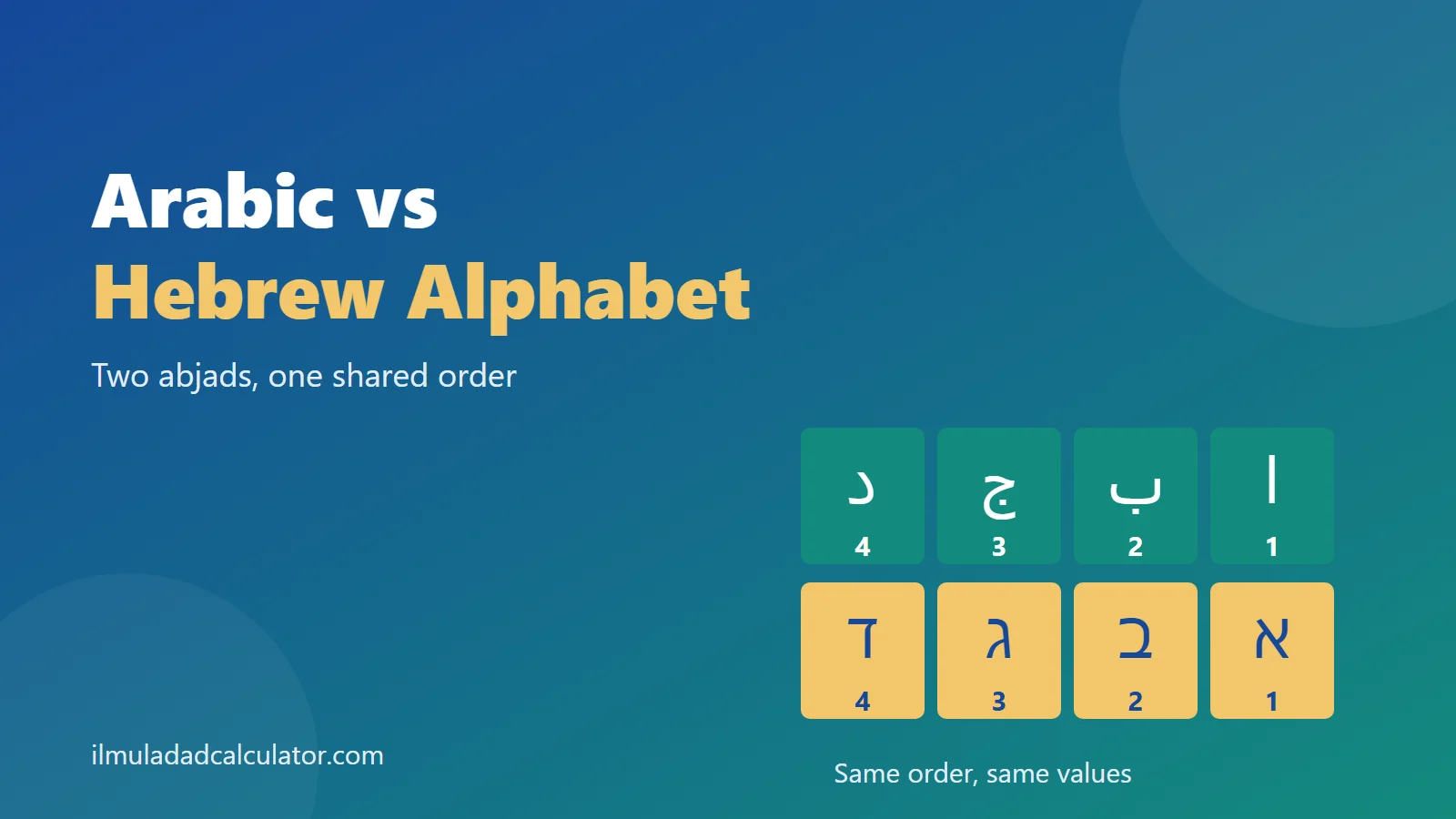
The Arabic and Hebrew alphabets are close relatives. Both are abjads that run right to left, and both turn letters into numbers. Arabic has 28 letters and Hebrew has 22, and the first 22 slots line up value for value.
How Are the Arabic and Hebrew Alphabets Related?
Arabic and Hebrew are both Semitic languages, so their scripts have common roots. Omniglot says the Arabic script evolved from the Nabataean Aramaic script. Wikipedia describes the modern Hebrew square script as descended from the Aramaic alphabet.
Both are abjads, which means the main letters stand for consonants. The word abjad itself comes from the first four letters of the Semitic alphabet: alif, ba, jim and dal.
Today both scripts are called impure abjads. They show some vowels with letters and others with optional marks.
Why Do Both Scripts Focus on Consonants?
Wikipedia explains that an abjad works for Semitic languages because consonants carry the main meaning. Word roots are usually sets of three consonants, and the vowels are filled in between them.
Wiktionary gives the Hebrew root מ־ל־ך (m-l-k) for king. The Arabic word ملك (malik) uses the same three consonants in the same order.
A script that writes the root letters first, and treats vowels as extra, fits this pattern well. That is one reason both scripts kept the old abjad design.
How Do the Two Alphabets Compare at a Glance?
The table puts the main facts side by side. Each row is explained further down the page.
| Feature | Hebrew | Arabic |
|---|---|---|
| Letters | 22 consonants | 28 letters |
| Direction | Right to left | Right to left |
| Letter shapes | Five letters have a final form | Most letters change shape by position |
| Joining | Block letters stand apart | Joinable letters always join |
| Long vowels | א, ו, י | ا, و, ي |
| Highest single-letter value | 400 (ת) | 1000 (غ) |
Do the Two Alphabets Share the Same Order?
Yes, for the first 22 slots. Hebrew runs aleph, bet, gimel, dalet. Arabic in abjad order runs alif, ba, jim, dal.
This is the abjad order, not the everyday dictionary order of Arabic. Our page on abjad and hijai order explains the difference, and the Arabic alphabet in order lists the everyday sequence.
In the figure, every Hebrew letter sits above the Arabic letter in the same slot. Each pair has the same number, from 1 for aleph and alif to 400 for tav and ta.
Do the Letter Names Match?
Many names are close, such as alef and alif, lamed and lam, and mem and mim. The table lists all 22 slots with both names, so you can see which ones differ.
| Value | Hebrew | Hebrew name | Arabic | Arabic name |
|---|---|---|---|---|
| 1 | א | aleph | ا | Alif |
| 2 | ב | bet | ب | Ba |
| 3 | ג | gimel | ج | Jim |
| 4 | ד | dalet | د | Dal |
| 5 | ה | he | ه | Ha |
| 6 | ו | vav | و | Waw |
| 7 | ז | zayin | ز | Zay |
| 8 | ח | het | ح | Ha (Hooti) |
| 9 | ט | tet | ط | Ṭa |
| 10 | י | yod | ي | Ya |
| 20 | כ | kaf | ك | Kaf |
| 30 | ל | lamed | ل | Lam |
| 40 | מ | mem | م | Mim |
| 50 | נ | nun | ن | Nun |
| 60 | ס | samekh | س | Sin |
| 70 | ע | ayin | ع | Ayn |
| 80 | פ | pe | ف | Fa |
| 90 | צ | tsadi | ص | Sad |
| 100 | ק | qof | ق | Qaf |
| 200 | ר | resh | ر | Ra |
| 300 | ש | shin | ش | Shin |
| 400 | ת | tav | ت | Ta |
What Happened to Samekh?
Wikipedia notes that the Arabic abjad order has a slot for samekh, but no Arabic letter comes from samekh. In the common Mashriqi sequence, س takes that slot and counts 60. Shin keeps its own slot at 300.
A note on variants: the Maghribi table fills three slots with other letters.
At 60 it uses ص, at 90 it uses ض, and at 300 it uses س. It then moves ش to 1000. The slot values still match Hebrew, but the letters in them differ.
What Are the Six Extra Arabic Letters?
Hebrew stops at tav, which is 400. Arabic has 28 letters, so six letters come after ta and carry the values from 500 to 1000.
- ث (Tha) = 500
- خ (Kha) = 600
- ذ (Dhal) = 700
- ض (Dad) = 800
- ظ (Za) = 900
- غ (Ghayn) = 1000
Arabic has sounds that Hebrew letters do not mark, so it added these letters. Wikipedia says the Arabic abjad system continues past 400 with letters not found in the other Semitic alphabets.
Usually, Hebrew has no single letter for 500 or more. It adds tav to another letter, so תק is 400 + 100 = 500. Nine hundred needs three letters: תתק is 400 + 400 + 100 = 900.
How Do Hebrew Numerals Work?
Hebrew letters have been used as numbers for a long time. Wikipedia places the adapted system between 200 and 78 BCE, based on the earliest evidence. The Yale Library calls the practice gematria and notes that it is used for book dates and page numbers.
The Basic Rules
- The first nine letters are 1 to 9. The next nine are 10 to 90, and the last four are 100 to 400.
- There is no zero, and the values of the letters are added together.
- Final forms usually keep the value of the regular letter, so ם is 40 like מ and ך is 20 like כ.
- By convention, 15 is written טו (9 + 6) and 16 is written טז (9 + 7).
Wikipedia adds that the same letters can be reused as thousands, for numbers from 1,000 up to 999,999. Mathematically, the system needs 27 letters, one for each of 1 to 9, 10 to 90 and 100 to 900.
Arabic reaches the same count another way. Its 28 letters give 27 single-letter values up to 900, plus ghayn at 1000.
A simple example from the Hebrew numerals page is 177. It is written קעז, which is 100 + 70 + 7 = 177.
Writing a Year
The Yale guide gives the Jewish year 5786 as תשפו, ignoring the punctuation marks. The letters add to 400 + 300 + 80 + 6 = 786. The 5000 is usually left out, a custom called the small count.
The Yale guide adds that chronograms are common in early Hebrew printing. A chronogram is a phrase where certain letters are enlarged or bolded to show which ones count toward the year.
Arabic scholars used the same adding idea for dates. See our page on chronograms for how it works with Abjad letters.
Do Related Words Have the Same Value in Both Scripts?
Sometimes they do. Wiktionary lists the Hebrew words for house, king and peace as cognates of Arabic words. Cognates are words that come from a shared older word.
| Meaning | Hebrew | Hebrew sum | Arabic | Arabic sum | Equal? |
|---|---|---|---|---|---|
| house | בית | 2 + 10 + 400 = 412 | بيت | 2 + 10 + 400 = 412 | Yes |
| king | מלך | 40 + 30 + 20 = 90 | ملك | 40 + 30 + 20 = 90 | Yes |
| peace | שלום | 300 + 30 + 6 + 40 = 376 | سلام | 60 + 30 + 1 + 40 = 131 | No |
The Hebrew word for king ends in a final kaf, ך. It counts 20, the same as the regular kaf, so the row adds up cleanly. Letters are listed in reading order, from the right.
House and king match because each word uses the same letters in the same slots. Peace does not match: the Hebrew word starts with shin (300) and the Arabic word starts with sin (60).
The Hebrew word also writes its vowel with vav (6), while the Arabic word uses alif (1). Those two gaps add up to 245, which is the whole difference between 376 and 131.
Keep in mind: a matching value is a result of spelling, not a rule. Two related words can differ whenever a letter, a vowel letter or a sound changes.
How Does the Look of the Two Scripts Differ?
Joining and Letter Shapes
Omniglot says joinable Arabic letters are always joined, in handwriting and in print. Most letters change shape at the start, middle or end of a word.
Hebrew block letters stand apart. Five letters (kaf, mem, nun, pe and tsadi) have a special final form. Read more about Arabic shapes in Arabic letter forms and the six letters that do not connect.
Vowel Marks
Both scripts show long vowels with letters. Hebrew uses א, ו and י for this, and Arabic uses ا, و and ي, according to Omniglot.
These vowel letters count in Abjad and gematria totals like any other letter. That is why spelling a word with or without them changes its value.
Short vowels are left out in most everyday writing.
Omniglot says the Hebrew vowel points, called niqqud, were devised by scholars in Tiberias around 750 AD. Arabic has its own short vowel marks, and they are used less consistently.
What Mistakes Should You Avoid When Comparing Them?
- Assuming equal sounds. Two letters in the same slot share an order and a value. They do not always share a sound.
- Mixing Arabic tables. Mashriqi and Maghribi differ at 6 letters, so name the variant before comparing.
- Counting final forms as hundreds. Wikipedia says final forms are sometimes used for 500 to 900. Usually they keep their regular values.
- Reading numerals as words. The 15 and 16 convention changes how numbers are written. It does not change how words are added.
How Do You Add a Word in Each Script?
The method is the same in both scripts. Only the letter table changes.
- Write the word with its consonants and vowel letters, but without short vowel marks.
- Look up each letter in the table for that script.
- For Hebrew, give a final letter the same value as its regular form.
- For Arabic, check which variant you are using, because Mashriqi and Maghribi differ at a few letters.
- Add the values together. The order of the letters does not change the total.
Always write down the table you used. A total only has meaning when the reader knows which letter values produced it.
Spelling is the main source of differences. A word can be written with or without a vowel letter, and that changes the sum in either script.
Can You Compare Both Scripts With a Calculator?
The Abjad value calculator reads Arabic letters directly. For Hebrew, add the values by hand, as shown above, or use a gematria tool.
The calculate by hand guide shows the same adding steps for Arabic. Only the letter table changes between the two scripts.
خلاصہ
عربی اور عبرانی حروفِ تہجی سامی زبانوں کی قریبی رشتہ دار لکھائیاں ہیں۔ عربی میں اٹھائیس اور عبرانی میں بائیس حروف ہیں، اور دونوں دائیں سے بائیں لکھی جاتی ہیں۔ ابجد ترتیب میں پہلے بائیس مقام دونوں میں ایک جیسی قیمت رکھتے ہیں، جبکہ عربی کے چھ اضافی حروف پانچ سو سے ایک ہزار تک کی قیمت دیتے ہیں۔ بعض ہم معنی الفاظ کی قیمت برابر نکلتی ہے اور بعض کی نہیں، کیونکہ املا میں حروف مختلف ہو سکتے ہیں۔
Sources and Further Reading
- Arabic language and alphabet, Omniglot. The 28 letters, the Nabataean Aramaic origin, joining and letter forms.
- Hebrew language, alphabet and pronunciation, Omniglot. The 22 letters, the five final forms and the vowel points.
- Gematria, Yale Library Metadata. The Hebrew letter values, final forms and the year 5786.
- Abjad numerals, Wikipedia. The Arabic values, the abjad order, samekh and the Maghribi sequence.
- Hebrew numerals, Wikipedia. The additive rules, 500 to 900, the 15 and 16 convention and the 177 example.
- Hebrew alphabet, Wikipedia. The 22 letters, the final forms and the Aramaic ancestry.
- Abjad, Wikipedia. The definition of an abjad and impure abjads.
- Wiktionary: house, king and peace. The cognate pairs.
- Abjad values come from this site’s tested engine. Hebrew values come from the standard table above. See the methodology.
Frequently Asked Questions
How many letters does the Hebrew alphabet have?
Hebrew has 22 letters. Five of them also have a special form used at the end of a word.
Which alphabet has more letters, Arabic or Hebrew?
Arabic has more, with 28 letters against 22. The six extra Arabic letters come last in abjad order.
Do Arabic and Hebrew read in the same direction?
Yes. Both scripts are written from right to left.
Is the Abjad order the same as the Hebrew order?
For the first 22 slots, yes. The values match from 1 to 400 in the Mashriqi table.
Can every Hebrew letter be swapped for an Arabic one?
Not one to one. The 22 slots line up by order and value. The sounds are not identical, and Arabic has six more letters.
Do both languages use letters as numbers?
Yes. Hebrew calls it gematria and Arabic calls it Abjad numerals or Hisab al-Jummal.