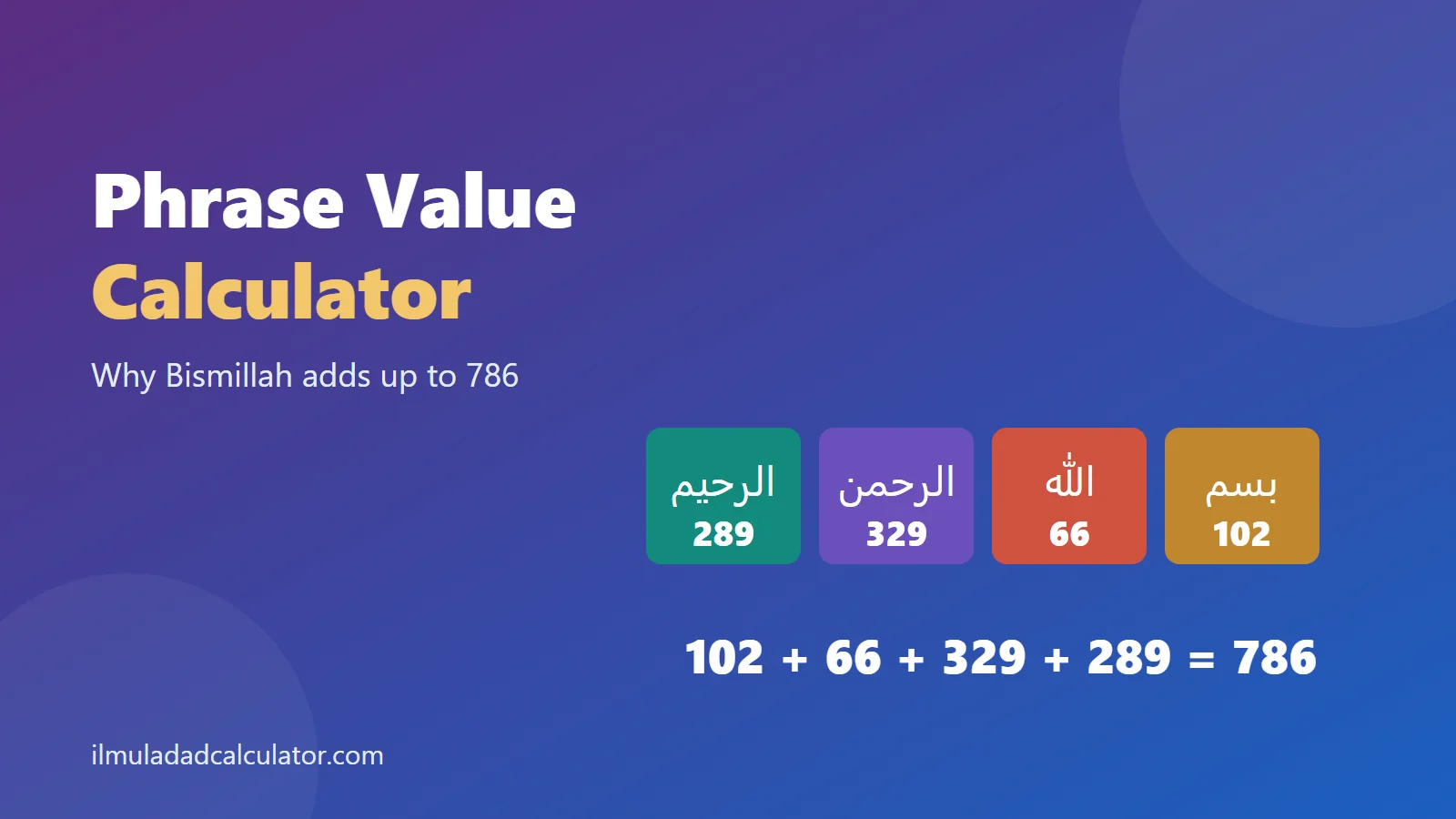
Paste any Arabic or Urdu phrase to see its total Abjad value and the value of each word. For example, بسم الله الرحمن الرحيم adds up to 786 in the Kabir (Mashriqi) system. Each word is counted letter by letter, and then the word totals are added.
Show Arabic letter keypad
Common phrases
| # | Word | Letters | Value | Running total |
|---|
Letter by letter breakdown
| # | Letter | Name | Value | Running total |
|---|
All calculations run in your browser. Nothing you type is sent to a server.
کسی جملے یا عبارت کا ابجد عدد
کوئی بھی عربی یا اردو جملہ لکھیں۔ یہ ٹول ہر لفظ کا عدد الگ دکھاتا ہے اور پھر سب کو جمع کر کے کل عدد بتاتا ہے، مثلاً بسم اللہ الرحمن الرحیم کا عدد 786 ہے۔
Why Bismillah Equals 786
The Basmala, بسم الله الرحمن الرحيم, has four words and 19 letters. In the Kabir (Mashriqi) system, those letters add up to 786.
| Word | Letters | Value |
|---|---|---|
| بسم | 3 | 102 |
| الله | 4 | 66 |
| الرحمن | 6 | 329 |
| الرحيم | 6 | 289 |
| Total | 19 | 786 |
The word الرحمن is counted without an extra alif. The Quran marks that sound with a small dagger alif, which is not a full letter.
How to Check 786 by Hand
- Write the four words on separate lines.
- Find each letter in the Arabic letter values table.
- Add the letters of each word to get four word totals.
- Add the four totals together.
- Compare your answer with the calculator above.
Why Is It 786 and Not 787?
Some writers spell the third word الرحمان, with a full alif. That spelling gives 787, because the extra alif adds 1.
The Quran writes the word with a small dagger alif instead. The dagger alif is a mark, not a letter, so 786 is the standard total.
786 in Other Systems
The 786 total uses the Kabir (Mashriqi) values. In the Maghribi system, the Basmala adds up to 1026.
The difference comes from the letter س in بسم. It is worth 60 in Mashriqi but 300 in Maghribi.
Why Do People Write 786?
In South Asia, many people write 786 at the top of letters and documents. The number stands in for the written Basmala.
The reason usually given is respect. Paper with the written Basmala can end up on the floor or in the trash.
What Scholars Say About Writing 786
Scholars differ on this practice. This page reports their views and gives no ruling of its own.
- The Darul Uloom Deoband fatwa service allows 786 on letterheads when the written Basmala might be treated with disrespect. It adds that the number does not bring the reward of the Basmala.
- Mufti Ebrahim Desai says 786 does not represent the Basmala and is not the Sunnah way. He advises saying the Basmala aloud instead.
- IslamOnline says the number carries no weight in Islamic law. It also says the practice began long after the time of the Prophet.
For a personal decision, ask a scholar you trust. Our Editorial Policy and Disclaimer explain how we report religious questions.
How the Calculator Counts a Phrase
The calculator splits your text at every space. It finds the value of each word and then adds the word totals.
Spaces, punctuation and numbers have no value. Vowel marks and the shadda are not letters, so they are skipped as well.
How to Read the Results
The word table lists every word with its letter count and value. The running total shows the sum after each word, so you can find a mistake quickly.
Open the letter breakdown for even more detail. It lists every letter, its name and its value in order.
Spelling Choices That Change a Total
- الرحمٰن with a dagger alif gives 329. الرحمان with a full alif gives 330.
- ما شاء الله gives 408 by default. It gives 409 when the standalone hamza counts as 1.
- The Quranic alif wasla (ٱ) counts as a normal alif, so ٱلرَّحْمَٰنِ still gives 329.
- Urdu spelling often ends a word with ۃ. It counts as ه (5), so صلوٰۃ gives 131.
Values of Common Phrases
These everyday phrases are shown in both systems. Every value comes from the same letter table as the calculator.
| Phrase | In English | Mashriqi | Maghribi |
|---|---|---|---|
| الحمد لله | Alhamdulillah | 148 | 148 |
| سبحان الله | SubhanAllah | 187 | 427 |
| لا اله الا الله | La ilaha illallah | 165 | 165 |
| الله اكبر | Allahu Akbar | 289 | 289 |
| ما شاء الله | Masha Allah | 408 | 1108 |
| ان شاء الله | In sha Allah | 418 | 1118 |
Phrases that contain س or ش change a lot in the Maghribi system. سبحان الله is 187 in Mashriqi but 427 in Maghribi.
Common Mistakes When Calculating a Phrase
- Leaving out the article ال. Its two letters add 31 to every word that has it.
- Counting the dagger alif as a full alif. That adds 1 for each one.
- Adding a vowel letter that the Arabic spelling does not have, such as a long a in Rahman.
Sources and Further Reading
- Wikipedia: Abjad numerals (Basmala = 786)
- Darul Uloom Deoband: Is it correct to use 786 instead of Bismillah?
- Mufti Ebrahim Desai, Askimam: The significance of 786
- IslamOnline: Can the number 786 substitute for the Basmallah?
Frequently Asked Questions
Can I type a phrase with vowel marks?
Yes. The calculator removes vowel marks before counting, so a fully voweled phrase gives the same total as a plain one.
Does the calculator work for Urdu phrases?
Yes. Urdu letters such as پ and گ take the value of their Arabic base letter.
Is there a length limit?
No. Long passages are added word by word, exactly like short phrases.
Why does the total change when I switch to Maghribi?
Six letters have different values in the Maghribi system. Any phrase with س, ص, ش, ض, ظ or غ gets a different total.
What is the digital root in the results?
It is the total reduced to a single digit by adding its digits. It is shown for convenience and has no special meaning here.
Can I save or share a result?
Yes. The buttons under the result copy, print, save, download or share it.
Author: Shakeel Muzaffar
Reviewer: Moulana Haji Abdul Basit (Islamic Scholar and Mentor)