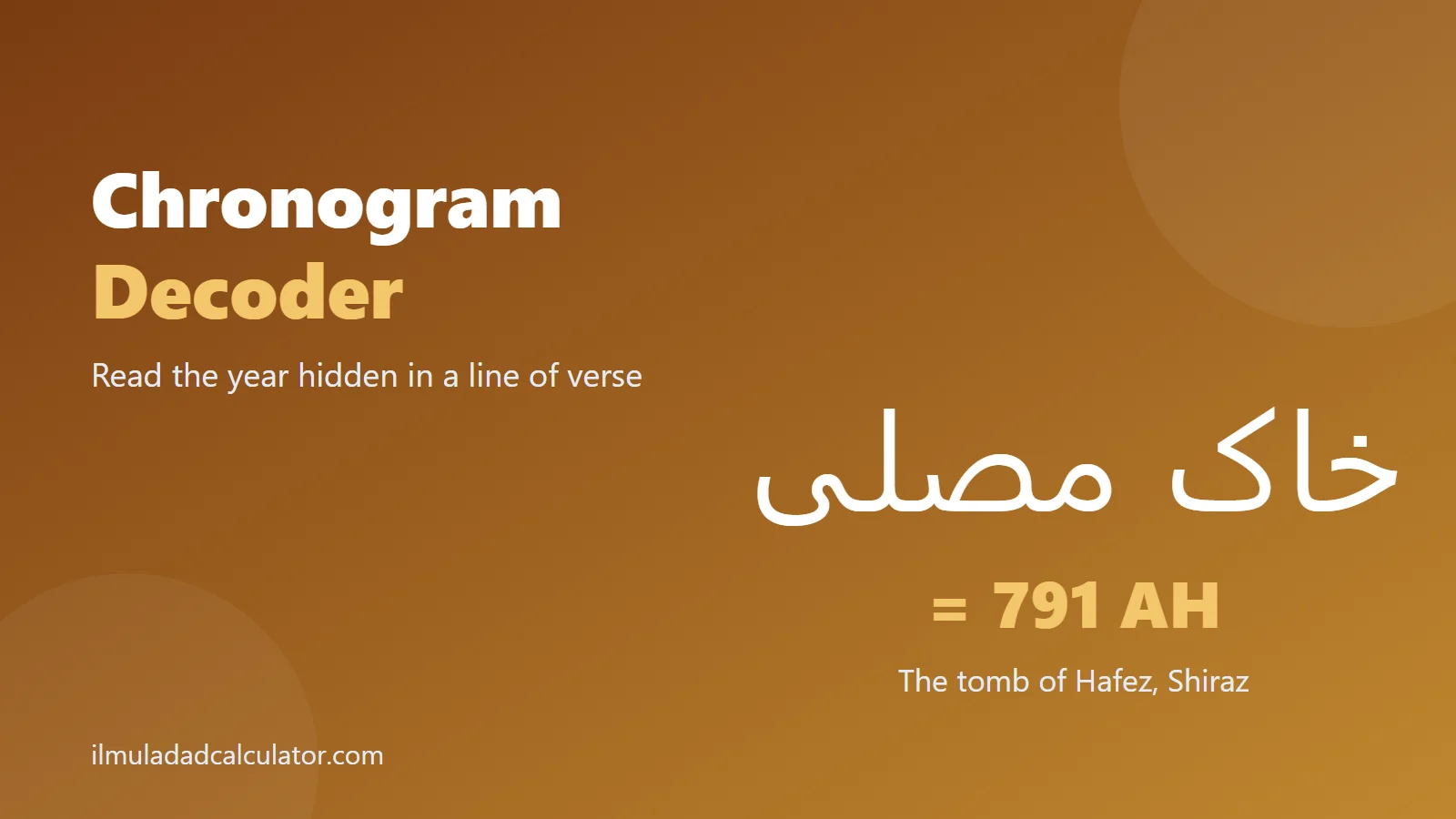
Paste the line of a chronogram (tarikh) to read the year it hides. The tool adds every letter, applies any addition or subtraction, and converts the year. For example, the Persian phrase خاک مصلی on the tomb of Hafez adds up to 791 AH.
Show Arabic letter keypad
| # | Word | Value | Running total |
|---|
All calculations run in your browser. Nothing you type is sent to a server.
تاریخ گوئی: مصرعے سے سال معلوم کریں
تاریخ والا مصرع یہاں لکھیں۔ یہ ٹول ہر حرف کا ابجد عدد جمع کر کے سال بتاتا ہے اور ہجری سال کو عیسوی سال میں بھی بدل دیتا ہے۔ اگر شاعر نے کسی حرف کو جمع یا تفریق کرنے کو کہا ہو تو اسے متعلقہ خانے میں لکھیں۔
What Is a Chronogram?
A chronogram is a phrase whose letters add up to a year. Persian, Urdu, Arabic and Ottoman poets used them to record births, deaths, buildings and books.
The year is usually a Hijri year counted with the Kabir (Mashriqi) letter values. Urdu writers call the art tarikh goi or tarikh nigari.
How to Read a Chronogram
- Find the line that carries the date. A word such as tarikh (date) or sal (year) often comes just before it.
- Copy that line exactly as it is written, letter for letter.
- Paste it into the decoder and read the total.
- Check the poem for an instruction to add or subtract a word.
- Convert the Hijri year to the Common Era.
Four Chronograms Worked Out
The Tomb of Hafez in Shiraz
The tomb of the poet Hafez carries the phrase خاک مصلی, meaning the dust of Musalla. Its letters add up to 791.
The Hijri year 791 began on the last day of 1388 and ran through most of 1389. The Maghribi system would give 761, which shows why Persian chronograms use Mashriqi values.
Momin’s Chronogram for His Daughter
The Urdu poet Momin marked his daughter’s birth with the phrase Dukhtar-e-Momin, written دختر مومن. It adds up to 1340.
The verse also mentions the cutting of the cord, نال, which is worth 81. Subtracting it gives 1259 AH, which is 1843 to 1844 CE.
A Chronogram in Another Calendar
Hamid Hasan Qadiri wrote a chronogram on the death of Gandhi in 1948. He counted the year in the Hindu Bikram Samvat calendar, not the Hijri one.
His phrase بلاد عالم gives 178, and the next line completes the year 2004 Bikram Samvat. The decoder converts Hijri and Common Era years only.
A Book Title That Gives Its Date
The scholar Ahmad Raza Khan gave one of his books a title that is also a chronogram. The title reads النمیقۃ الانقی فی فرق الملاقی والملقی.
Its letters add up to 1327, which is 1327 AH, or 1909 to 1910 CE. The title uses the Urdu letter ۃ, which counts as ه (5).
Adding and Subtracting: Ta’miya and Takhrija
Sometimes a line falls short of the year or goes past it. The poem then tells the reader how to adjust the total.
Urdu writers call the addition device ta’miya and the subtraction device takhrija. Put the extra word in the add box or the subtract box above.
Hijri and Common Era Years
A Hijri year is about 11 days shorter than a solar year. Each Hijri year therefore overlaps two Common Era years.
The decoder uses the standard tabular Islamic calendar. The real start of a month can differ by a day or two from the table.
Dates before October 1582 appear in the Julian calendar. Historians use the same convention for older dates.
Common Mistakes When Reading a Chronogram
- Adding the izafat sound. Dukhtar-e-Momin is written دختر مومن, and the e is not a letter.
- Counting the whole poem. Only the date line counts, plus any word the poet adds or removes.
- Using Maghribi values for a Persian or Urdu chronogram.
- Changing Urdu letters. پ counts as ب and گ counts as ک, so copy them as written.
To write numbers in letters instead, try the Number to Abjad Numerals converter. To count any phrase, use the Phrase Calculator.
Sources and Further Reading
- Rekhta Blog: Tarikh Nigari, Numbers Speaking through Words (Rajat Kumar, 2020)
- Wikipedia: Chronogram
- Wikipedia: Abjad numerals
- Fourmilab: Calendar Converter (tabular Islamic calendar algorithm)
Frequently Asked Questions
Do all chronograms give a Hijri year?
No. Most Persian and Urdu chronograms give a Hijri year. Some use the Common Era or a local calendar.
What if my total is a few years off?
Check the spelling of each word against the original. Then look in the poem for a word the poet asks you to add or subtract.
Can a chronogram contain more than one date?
Yes. Some skilled poets wrote lines that give two dates, or that work in more than one language.
Are European chronograms the same?
They follow the same idea. They use Roman numeral letters, such as M, D and C, instead of Arabic values.
Why does the tool show a start date for the Hijri year?
The start date tells you which Common Era year the event most likely falls in.
Can I read a chronogram on a gravestone?
Yes. Type the date line from the stone exactly as carved, including any Urdu or Persian letters.
Author: Shakeel Muzaffar
Reviewer: Moulana Haji Abdul Basit (Islamic Scholar and Mentor)